

The pursuit of knowledge is a lifelong journey that often presents challenges in understanding complex concepts. Richard Feynman, a Nobel laureate physicist, devised a simple yet powerful technique to overcome this hurdle – the Feynman Technique. This method, named after the brilliant mind who created it, emphasizes the art of simplification and clarity as the key to mastering any subject.
Despite all of his accomplishments, Feynman thought of himself as “an ordinary person who studied hard”. He believed that anyone was capable of learning with enough effort, even complex subjects like quantum mechanics and electromagnetic fields.
There’s no miracle people. It just happens they got interested in this thing and they learned all this stuff. There’s just people.
Richard Feynman
What made Richard Feynman Richard Feynman (according to Richard Feynman, at least) wasn’t innate intelligence, but the systematic way in which he identified the things he didn’t know and then threw himself into understanding them inside and out. Throughout his work and life, Feynman provided insights into his process for considering complex concepts in the world of physics and distilling knowledge and ideas with elegance and simplicity. Many of these observations about his learning process have been collected into what we now call “The Feynman Technique”.
The Feynman Technique is a four-step process for understanding any topic. This technique rejects automated recall in favor of true comprehension gained through selection, research, writing, explaining, and refining. He rejected rote memorization; believed that learning should be an active process of “trial and error, discovery, free inquiry”; and held that if you couldn’t explain something clearly and simply it was because you didn’t understand it well enough.
His philosophies make up the Feynman Technique:
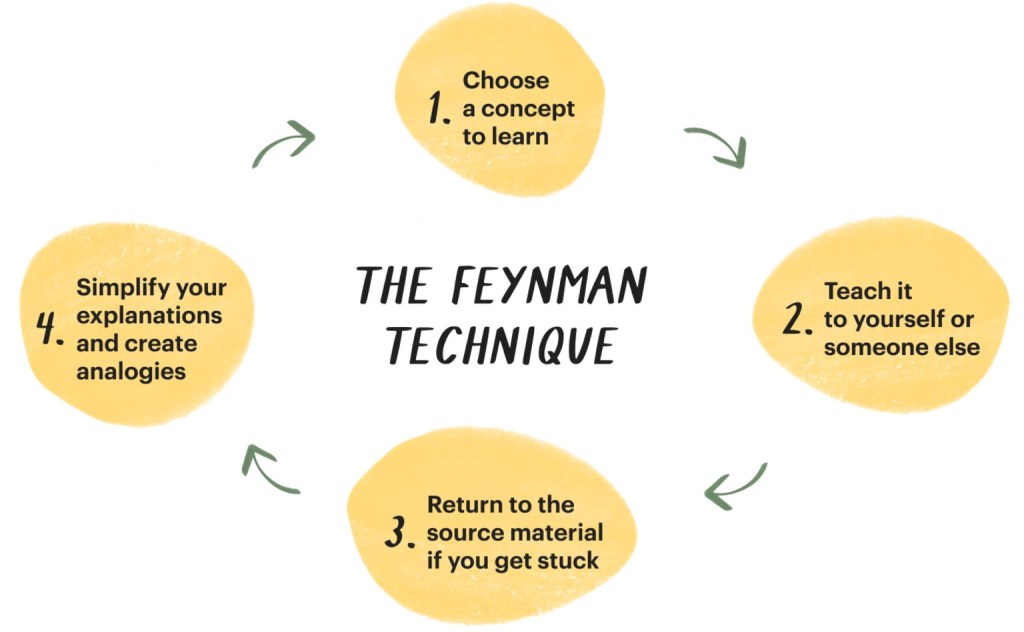
- Choose a concept to learn. Select a topic you’re interested in learning about and write it at the top of a blank page in a notebook.
- Teach it to yourself or someone else. Write everything you know about a topic out as if you were explaining it to yourself. Alternately, actually teach it to someone else.
- Return to the source material if you get stuck. Go back to whatever you’re learning from – a book, lecture notes, podcast – and fill the gaps in your knowledge.
- Simplify your explanations and create analogies. Streamline your notes and explanation, further clarifying the topic until it seems obvious. Additionally, think of analogies that feel intuitive.
I couldn’t reduce it to the freshman level. That means we really don’t understand it.
Richard Feynman
The Feynman Technique doesn’t let us fool ourselves into thinking we’re masters of a subject when we’re really amateurs. Each step of the process forces us to confront what we don’t know, engage directly with the material, and clarify our understanding.
By employing the Feynman Technique, you gain a deeper and more comprehensive understanding of the subject matter. It encourages active learning, critical thinking, and a willingness to confront and address gaps in knowledge. Moreover, the ability to explain complex ideas in simple terms is a valuable skill in various fields, from academia to business and everyday life.
In conclusion, the Feynman Technique provides a practical and effective approach to learning and mastering any subject. By simplifying concepts and explaining them to others, you not only enhance your own understanding but also develop the skills necessary to communicate effectively. With the Feynman Technique as your guide, the journey of learning becomes an exciting adventure of discovery and growth.
 Kenrick Vaz