
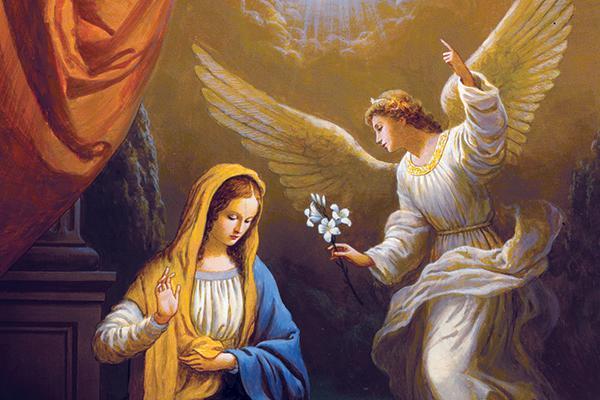
The Feast of the Annunciation of The Lord is normally celebrated on 25 March. This day is exactly nine months before the celebration of Christmas, which occurs on December 25. In the past, most feasts that had the rank of solemnity were considered a holy day of obligation, requiring all Catholics to attend Mass on that day. The Annunciation still remains a solemnity, but is no longer a holy day of obligation.
March 25 will occasionally fall during Holy Week, which means, in the Western Church, that the liturgical celebration is suppressed. Whenever this occurs, the liturgical observance is moved to the next available week day that is not a solemnity.
Since the week following Easter is considered “a week of solemnities,” the Annunciation gets pushed back even further.
This year, 2024, the Annunciation is moved from March 25 all the way to Monday, April 8. This means that all the liturgical readings and prayers for the solemnity of the Annunciation are used on April 8, even though it is not March 25.
Nonetheless, despite this change of dates, it does not diminish the importance of the event that we commemorate, as linking to what we are celebrating this Easter, it was all made possible by the acceptance of Mary of her crucial role in being the Mother of our God and Saviour, Jesus Christ.
Some of you may ask what is the difference between a solemnity, a feast and a memorial.
A solemnity in the liturgical year is a feast day of the highest rank celebrating a mystery of faith such as the Trinity, an event in the life of Jesus, the Blessed Virgin Mary, or important saints. The observance begins with the vigil on the evening before the actual date of the feast. On these days, both the Gloria and the Creed are recited. Along with the Annunciation, other examples of solemnities include the Solemnity of St. Joseph (March 19), the Solemnity of the Sacred Heart of Jesus (Friday after the Feast of Corpus Christi), and the Solemnity of St. Peter and St. Paul (June 29).
Feast days in the liturgical year are second importance and assigned one date out of the year for each and every canonized saint. The saints are remembered on their individual feast days with special mention, prayers, and possibly a scripture reading. On these days, the Gloria is recited but not the Creed.
Next in line are memorials, which are classified as either obligatory or optional. Memorials commemorate a saint or saints. Obligatory memorials must be observed whereas optional memorials do not have to be observed. Only the memorials of those saints who are of “universal significance” are observed by the whole Church and marked in the general liturgical calendar.
Like we’ve seen with the feast of the Annunciation this year, at times we may have more than one celebration and hence we have the order of precedence. The basic rule of thumb is this:
- Sundays, other Solemnities, Holy Week, and the Octave of Easter always take precedence.
- These are followed by Feasts, weekdays of Advent (December 17-24), days within the Octave of Christmas, weekdays of Lent, obligatory memorials, optional memorials, weekdays of Advent (through December 16), other weekdays of the Christmas Season, other weekdays of the Easter Season, and weekdays in Ordinary Time.
This sequence is definitely a bit confusing, and that is why the Bishop’s Committee on the Liturgy of the National Conference of Catholic Bishops publishes an annual Ordo which outlines the proper celebrations and their particulars throughout the liturgical year.
Wishing you all a Happy Feast!
 Kenrick Vaz