
69% of employees want more feedback.
But only 23% of leaders provide it consistently.
Here’s what Harvard discovered:
Your “feedback sandwich” is hurting growth.
Why?
• It dilutes positive recognition.
• It weakens constructive feedback.
• It creates anxiety (everyone knows it’s coming).
The research is clear:
Employees receiving direct feedback are 3x more engaged.
So, how do you give feedback effectively?
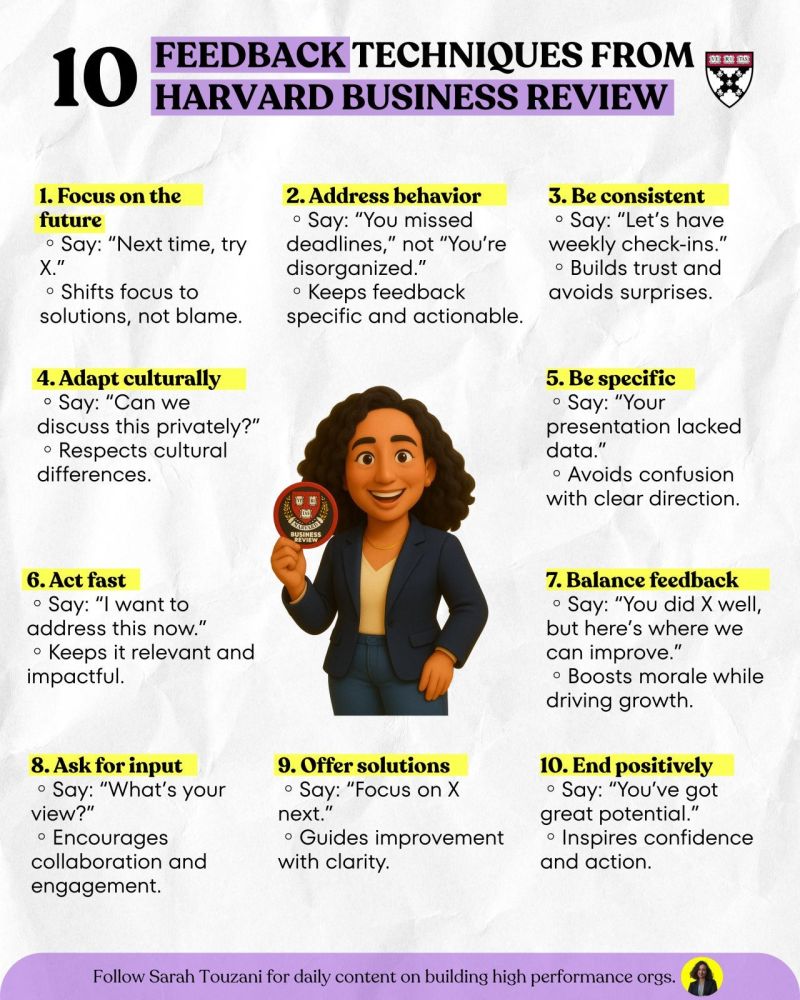
Here are 10 science-backed techniques to drive performance:
1. Focus on the future
◦ Say: “Next time, try X.”
◦ Shifts focus to solutions, not blame.
2. Address behavior
◦ Say: “You missed deadlines,” not “You’re disorganized.”
◦ Keeps feedback specific and actionable.
3. Be consistent
◦ Say: “Let’s have weekly check-ins.”
◦ Builds trust and avoids surprises.
4. Adapt culturally
◦ Say: “Can we discuss this privately?”
◦ Respects cultural differences.
5. Be specific
◦ Say: “Your presentation lacked data.”
◦ Avoids confusion with clear direction.
6. Act fast
◦ Say: “I want to address this now.”
◦ Keeps it relevant and impactful.
7. Balance feedback
◦ Say: “You did X well, but here’s where we can improve.”
◦ Boosts morale while driving growth.
8. Ask for input
◦ Say: “What’s your view?”
◦ Encourages collaboration and engagement.
9. Offer solutions
◦ Say: “Focus on X next.”
◦ Guides improvement with clarity.
10. End positively
◦ Say: “You’ve got great potential.”
◦ Inspires confidence and action.
Microsoft proved it under Satya Nadella.
A feedback-rich culture drives exceptional results.
Under Nadella’s leadership,
Microsoft prioritized continuous feedback, open communication, and a growth mindset, transforming their culture.
This feedback-rich environment helped them:
• Increase employee engagement and retention
• Drive innovation and adaptability
• Achieve superior financial and market results
The simple framework I use:
What? → So What? → Now What?
Which of these techniques will you try first?
10 Feedback Techniques From Harvard
 Kenrick Vaz