
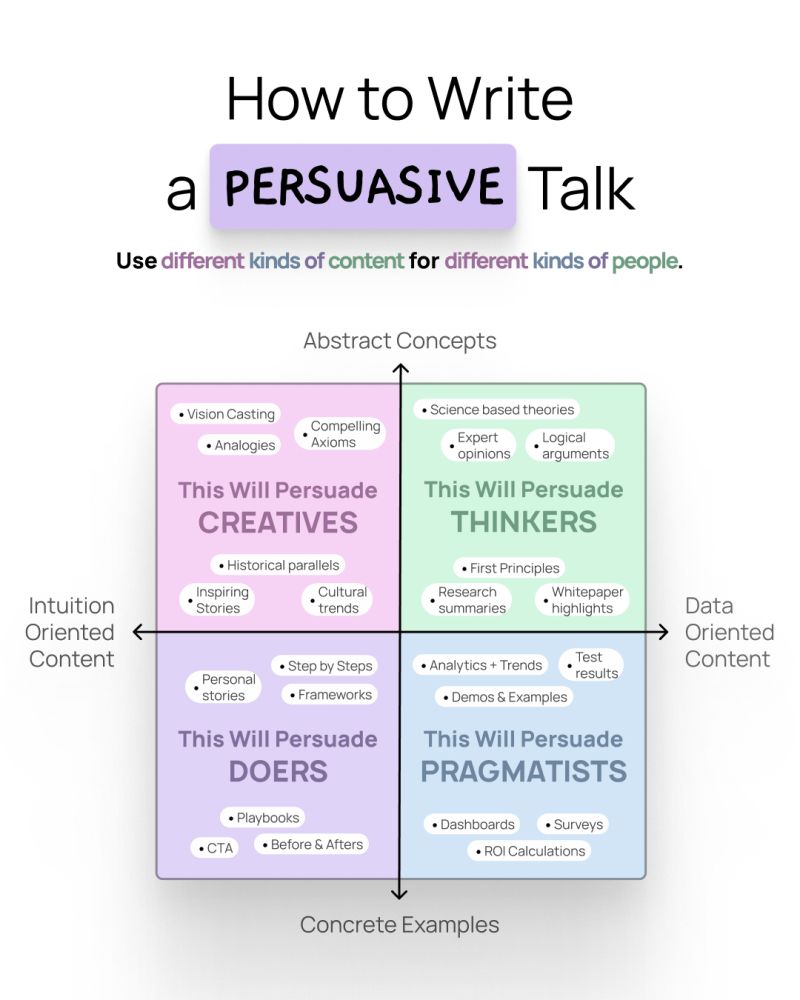
There are 4 kinds of people in every audience.
Most speakers only talk to 1. That’s why they fall flat.
Those 4 types are:
• CREATIVES
• THINKERS
• DOERS
• PRAGMATISTS
[Definitions coming below.]
The problem with most speakers?
They are one of those types themselves.
So they write a talk biased toward their own type.
(We all assume everyone is just like us, don’t we?)
But the most persuasive speakers learn to aim at all 4.
→ They get inside each type’s headspace & bias
→ They consider their values and temperaments
→ They intentionally use different kinds of content
Let me show you how it works:
1. CREATIVES
They’re moved by vision, beauty, and big ideas.
To persuade them, use:
→ Analogies
→ Vision Casting
→ Cultural Trends
→ Inspiring Stories
→ Historical Parallels
→ Compelling Axioms
2. THINKERS
They’re drawn to logic and intellectual clarity.
To persuade them, use:
→ First Principles
→ Expert Insights
→ Logical Arguments
→ Research Summaries
→ Whitepaper Highlights
→ Science-Based Theories
3. DOERS
They buy in through clarity, utility, and step-by-steps.
To persuade them, use:
→ CTAs
→ Playbooks
→ Frameworks
→ Step-by-Steps
→ Before & Afters
→ Example Stories
4. PRAGMATISTS
They care about what works, scales, and proves ROI.
To persuade them, use:
→ Surveys
→ Test Results
→ Dashboards
→ ROI Calculations
→ Analytics & Trends
→ Demos & Examples
If you want to give a persuasive talk, remember this:
→ It’s not how well you understand your idea.
→ It’s how well you understand the people hearing it.
Go get ’em.
How to Write a Persuasive Talk
 Kenrick Vaz