
Want to win your next high-stakes negotiation?
Stop trying to be the smartest person in the room.
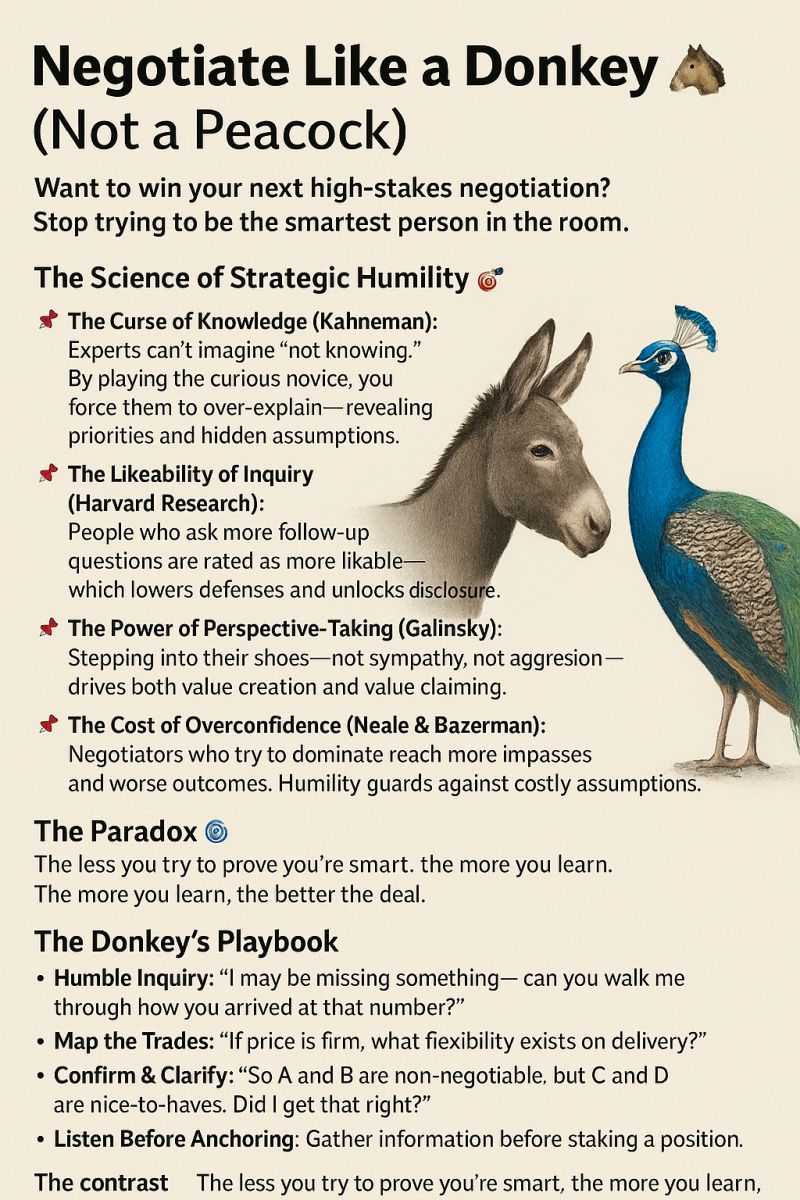
The flashy Peacock negotiator leads with expertise, confidence, and fast anchors.
The humble Donkey negotiator? Patient. Steady. Inquisitive. Deceptively simple.
And paradoxically—the donkey wins more.
The Science of Strategic Humility 🎯
📌 The Curse of Knowledge (Kahneman):
Experts can’t imagine “not knowing.” By playing the curious novice, you force them to over-explain—revealing priorities and hidden assumptions.
📌 The Likeability of Inquiry (Harvard Research):
People who ask more follow-up questions are rated as more likable—which lowers defenses and unlocks disclosure.
📌 The Power of Perspective-Taking (Galinsky):
Stepping into their shoes—not sympathy, not aggression—drives both value creation and value claiming.
📌 The Cost of Overconfidence (Neale & Bazerman):
Negotiators who try to dominate reach more impasses and worse outcomes. Humility guards against costly assumptions.
The Paradox 🌀
The less you try to prove you’re smart, the more you learn.
The more you learn, the better the deal.
The Donkey’s Playbook
· Humble Inquiry: “I may be missing something—can you walk me through how you arrived at that number?”
· Map the Trades: “If price is firm, what flexibility exists on delivery?”
· Confirm & Clarify: “So A and B are non-negotiable, but C and D are nice-to-haves. Did I get that right?”
· Listen Before Anchoring: Gather information before staking a position.
The Contrast
🦚 Peacock: Asserts, performs, anchors fast → Thin trust, fixed-pie deals.
🐴 Donkey: Probes, re-asks, clarifies → Rich disclosure, creative trades, durable agreements.
Sometimes the smartest negotiator is the one who looks like the slowest learner.
The donkey outsmarts the peacock. Every time.
👉 In your next negotiation, what’s the one “dumb” follow-up question you’re willing to ask that might make it the smartest deal of the year?
Negotiate Like a Donkey (Not a Peacock)
 Kenrick Vaz