
The Romans Hacked Productivity 2000 Years Ago
Modern “hacks” make you weaker.
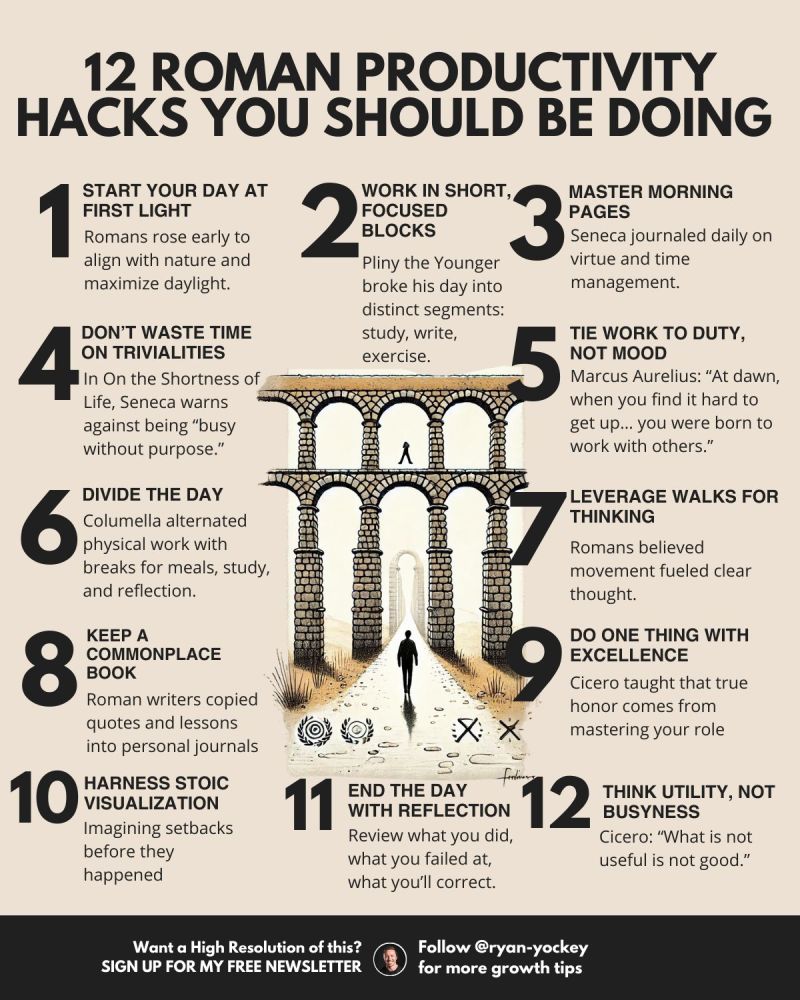
12 Roman Productivity Hacks You Should Be Doing
The Romans built roads, aqueducts, and empires — but their real productivity secret was discipline. These 12 habits still outperform any modern app.
1. Start Your Day at First Light
→ Marcus Aurelius wrote about resisting the urge to stay in bed. Romans rose early to align with nature and maximize daylight.
2. Work in Short, Focused Blocks
→ Pliny the Younger broke his day into distinct segments: study, write, exercise, estate management. They believed in focused sprints, not endless grind.
3. Master Morning Pages
→ Seneca journaled daily on virtue and time management. Writing at dawn clarified his priorities and mindset.
4. Don’t Waste Time on Trivialities
→ In On the Shortness of Life, Seneca warns against being “busy without purpose.” Cut distractions, focus on essentials.
5. Tie Work to Duty, Not Mood
→ Marcus Aurelius: “At dawn, when you find it hard to get up… you were born to work with others.” For Romans, productivity was duty > desire.
6. Divide the Day (Think Pomodoro, 2,000 Years Ago)
→ Columella recommended alternating physical work with breaks for meals, study, and reflection. Structured rhythms boosted output.
7. Leverage Walks for Thinking
→ Cicero composed speeches while walking. Romans believed movement fueled clear thought.
8. Keep a Commonplace Book
→ Roman writers copied quotes, notes, and lessons into personal journals — an ancient version of a second brain.
9. Do One Thing with Excellence
→ Cicero taught that true honor comes from mastering your role — not scattering energy across trivial pursuits.
10. Harness Stoic Visualization
→ Romans practiced premeditatio malorum — imagining setbacks before they happened — to work with calm focus instead of anxiety.
11. End the Day with Reflection
→ Seneca’s nightly routine: review what you did, what you failed at, what you’ll correct tomorrow. A built-in feedback loop.
12. Think Utility, Not Busyness
→ Cicero: “What is not useful is not good.” For Romans, productivity was measured by impact, not hours worked.
These hacks pull directly from Seneca, Marcus Aurelius, Cicero, Pliny, and Columella.
The Romans built aqueducts, armies, and empires without Notion, Slack, or AI.
Their secret wasn’t tools — it was discipline.
Adopt even one of their habits, and you’ll outpace 99% of people still chasing “productivity hacks.”
12 Roman Productivity Hacks You Should Be Doing
 Kenrick Vaz