
“Gen Z doesn’t want to work.”
“Boomers can’t adapt.”
“Millennials overthink everything.”
“Gen X doesn’t care.”
We keep repeating these labels.
But they don’t tell the truth.
What’s true is this:
Each generation learned to survive in a different world.
So they show up differently at work.
If you treat them all the same, you’ll miss what they’re capable of.
Every generation wants to succeed.
Every generation wants to feel valued.
They just express those needs differently.
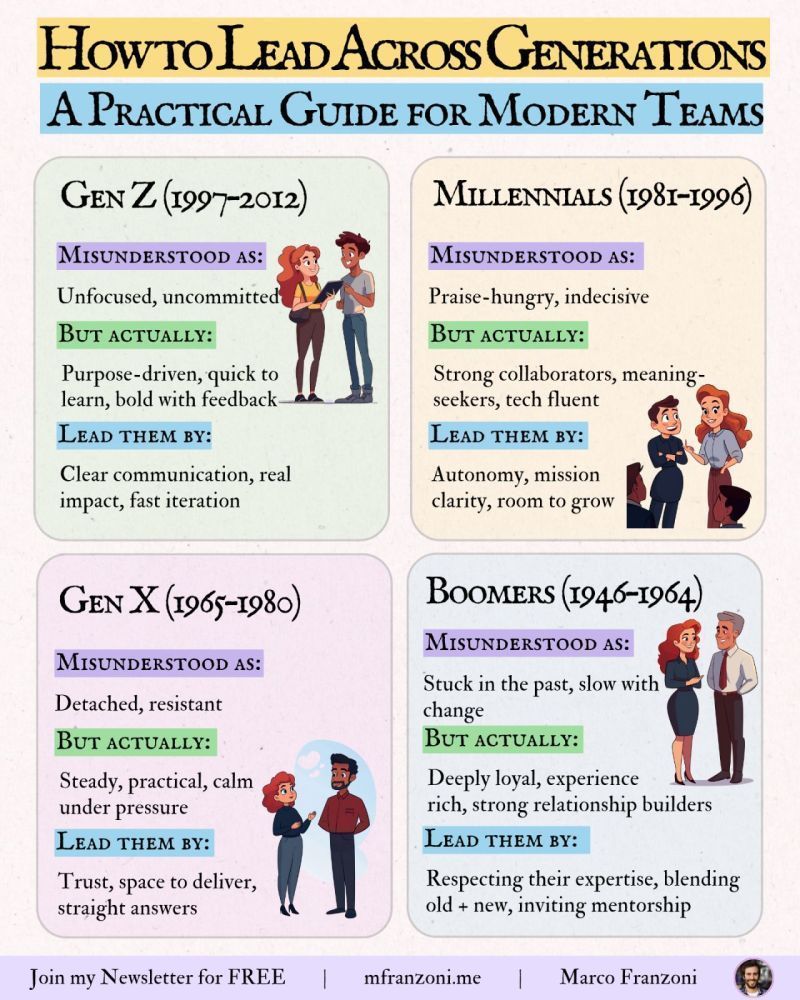
This guide covers:
↳Where friction tends to appear
↳Common myths about each generation
↳What’s actually true beneath them
↳How to lead each group with intention
🟩 Millennials (1981–1996) 🟩
Seen as: Needy, restless, over-caffeinated dreamers
In reality: They’re bridge-builders between analog and AI.
They want meaning and momentum.
Lead them with trust, not micromanagement.
🟦 Gen Z (1997–2012) 🟦
Seen as: Lazy, distracted, uncommitted
In reality: They crave 𝘪𝘮𝘱𝘢𝘤𝘵, not just income.
They speak up faster, experiment sooner, and walk when purpose fades.
Lead them with transparency and speed.
🟫 Boomers (1946–1964) 🟫
Seen as: Outdated or stubborn
In reality: They hold the institutional memory every team needs.
They’ve seen cycles rise and crash—and still show up.
Lead them by honoring their wisdom, not dismissing it.
🟥 Gen X (1965–1980) 🟥
Seen as: Cynical or detached
In reality: They’re the quiet stabilizers.
They balance chaos with calm and loyalty with logic.
Lead them with autonomy and honest feedback.
Here’s the truth:
Generational tension isn’t a problem, it’s potential.
When curiosity replaces judgment,
differences turn into shared strength.
The best leaders?
↳They listen longer.
↳They translate across decades.
↳And they build cultures where everyone feels seen.
How To Lead Across Generations
 Kenrick Vaz