
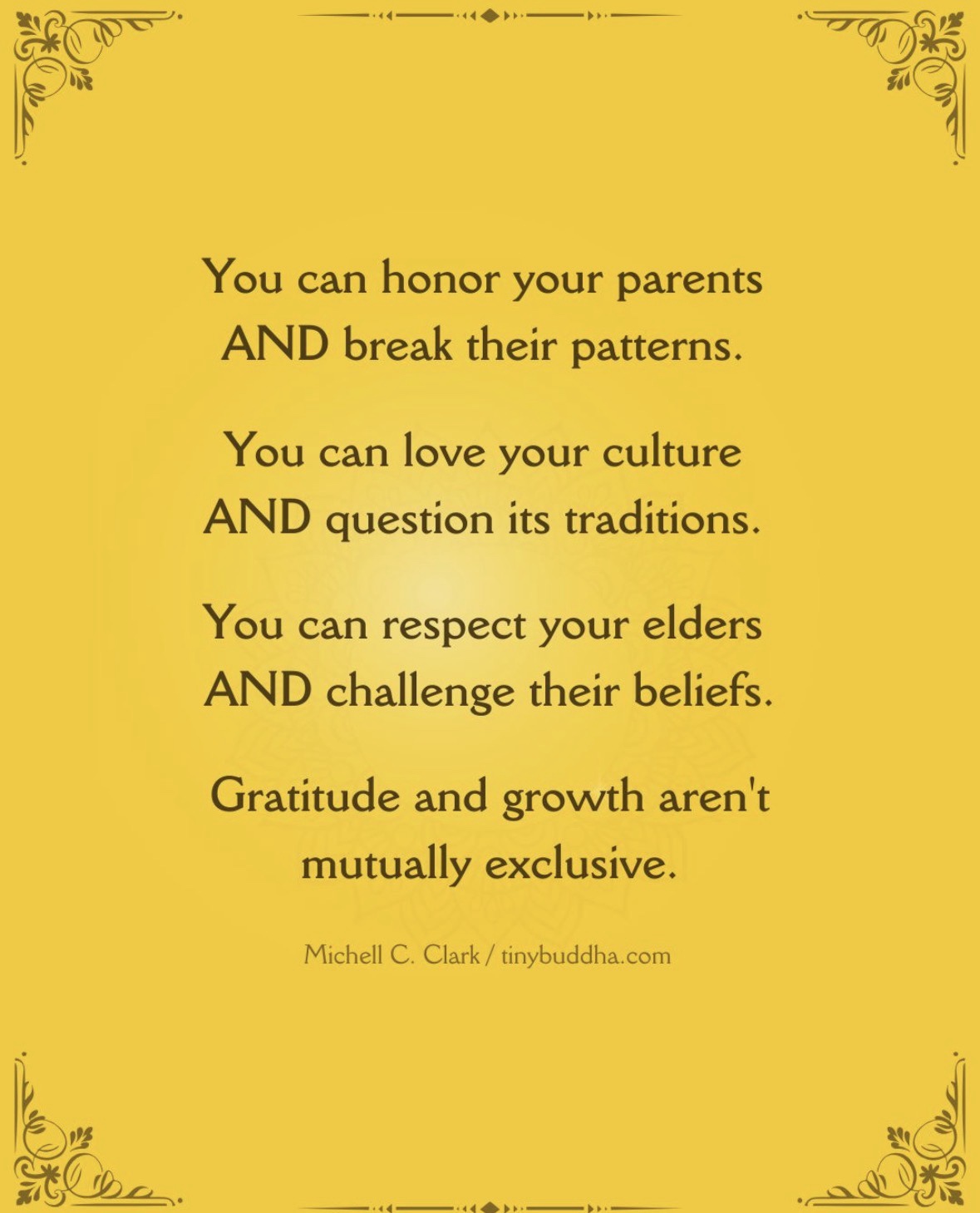
There’s this idea many of us quietly carry: that honoring where we come from somehow means we have to stay exactly the way we were raised. As if gratitude and growth sit on opposite sides of a scale, and choosing one means abandoning the other. But life keeps proving that it isn’t that dramatic. You can hold deep appreciation in one hand and still reach for something new with the other.
Most of us grew up in homes where the rules weren’t just rules—they were culture, identity, family pride, the “right way” to do things. And for the longest time, we took them as unquestionable truths. Respect your elders. Say yes even when your heart says no. Don’t raise your voice. Don’t ask too many questions. Don’t push too hard. Keep your head down and endure. These weren’t just lessons; they were survival mechanisms passed down through generations.
But then adulthood arrives. You build your own life, make your own choices, and suddenly you’re face-to-face with the reality that some of those patterns don’t serve you anymore. Not because they were wrong, but because the world is different now. You’re different now.
That’s where the tension begins. You want to grow, but you don’t want to seem ungrateful. You want to rewrite certain behaviors, but you don’t want to disrespect the people who taught you everything you know. You want to choose mental health over “what will people say,” compassion over ego, boundaries over blind obedience. And deep down, a part of you wonders: Is it okay to question the very things I was raised to honor?
Here’s the truth we often forget: growth isn’t rebellion. Growth is evolution. And evolution is exactly what every generation hopes for—even if they don’t always say it out loud.
You can honor your parents without repeating their fears. You can love your culture without carrying every burden it places on your shoulders. You can respect your elders without inheriting beliefs that limit who you can become. You can appreciate the sacrifices, the struggles, the wisdom—and still walk your own path with clarity and intention.
Breaking patterns doesn’t erase the love behind them. It just means you’re choosing to live with more awareness than the generations before you had the chance to. It means you’re creating space for healthier relationships, kinder conversations, and more emotionally open homes. It means your children will thank you one day for giving them tools you had to teach yourself.
Gratitude and growth aren’t rivals. They’re partners. Gratitude grounds you; growth expands you. One reminds you where you came from; the other guides you to where you’re meant to go. And when you learn to balance both—when you can say “thank you” while still saying “I choose differently”—that’s when you truly honor your roots.
Not by staying the same, but by becoming everything they once hoped was possible.
 Kenrick Vaz