
There’s a quiet truth about people that we don’t always want to admit.
Most of us can tell when we’re being “handled.”
Not in a dramatic, movie-villain way. But in the everyday way—when someone is trying to steer us with pressure, guilt, fear, flattery, or incentives that feel transactional. When the message is less about us and more about what they want from us.
And here’s the thing… manipulation works.
It works in workplaces.
It works in relationships.
It works in parenting.
It works in marketing.
It works in leadership.
At least for a while.
Because when you manipulate people, you can often get the result you’re aiming for. You can get compliance. You can get the task done. You can get the “yes.” You can get the output. You can get the performance.
But it comes with a limit.
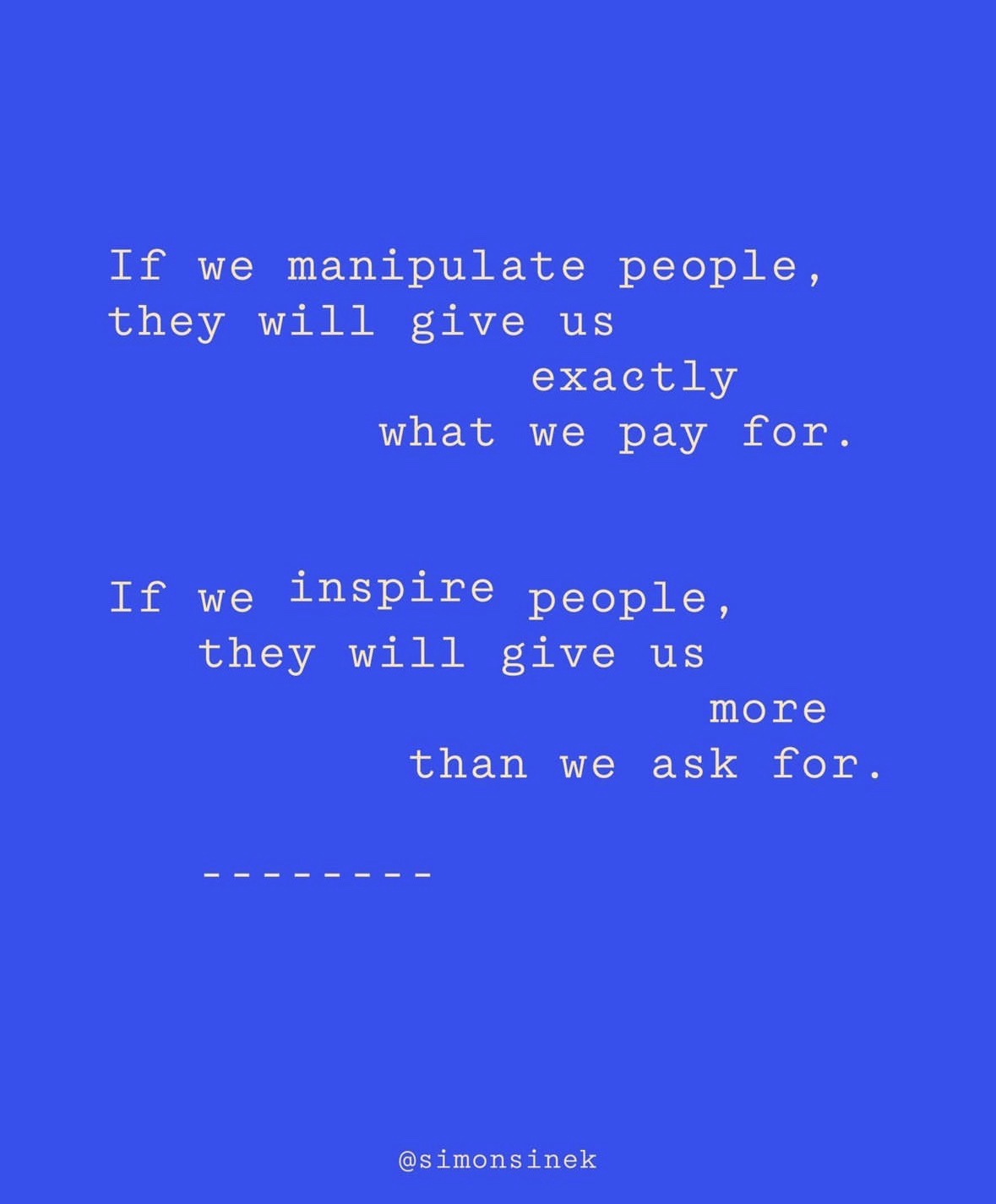
People will give you exactly what you pay for.
They’ll do what’s required. Nothing more.
They’ll follow the instructions. Nothing extra.
They’ll hit the target. Then stop.
They’ll show up physically, but mentally they’ll be elsewhere.
They’ll deliver the bare minimum and quietly protect the rest of their energy for something that actually feels meaningful.
And honestly, you can’t even blame them.
Because manipulation turns human effort into a transaction. It reduces trust into a strategy. It makes people feel like they’re being used, not valued. And once someone feels like a tool, they stop acting like a teammate.
You’ll still get results—but you’ll lose the best part of what people can offer: their heart.
Inspiration is different.
Inspiration doesn’t push.
It pulls.
It doesn’t rely on control.
It relies on connection.
When you inspire people, you’re not trying to extract something from them. You’re trying to awaken something inside them.
You’re saying, “This matters.”
You’re saying, “You matter.”
You’re saying, “What we’re building is worth your best effort.”
And that changes everything.
Because inspired people don’t just do what they’re told.
They think.
They care.
They notice things others ignore.
They bring ideas.
They solve problems before they become escalations.
They protect the quality even when no one is watching.
They take ownership like it’s personal.
Not because they have to.
Because they want to.
That’s the part of the quote that hits the hardest:
If we inspire people, they will give us more than we ask for.
More than the job description.
More than the timeline.
More than the expectation.
More than the minimum.
And you’ve seen it, haven’t you?
You’ve seen the person who stays late—not because they’re afraid, but because they genuinely want the team to win.
You’ve seen someone advocate for a customer when it would’ve been easier to just close the ticket.
You’ve seen someone teach a teammate patiently, even when they’re busy, because they remember what it felt like to be new.
You’ve seen someone raise their hand and say, “This isn’t right,” even though it’s risky to speak up.
That doesn’t come from manipulation.
That comes from meaning.
And meaning is a powerful fuel.
But inspiration isn’t a speech.
It’s not a slogan on a wall.
It’s not a “motivational quote of the day” in a meeting invite.
Inspiration is built in small moments.
It’s built when leaders tell the truth instead of spinning the story.
It’s built when someone gives credit publicly and feedback privately.
It’s built when you keep your word—even on the small stuff.
It’s built when you listen without waiting for your turn to talk.
It’s built when you treat people like adults, not resources.
It’s built when you don’t just ask, “What did you deliver?”
…but also ask, “How are you doing?”
Because people don’t go above and beyond for a system.
They go above and beyond for people who make them feel safe, seen, and significant.
Now, let’s be real—there will always be pressure.
Deadlines will exist.
Metrics will exist.
Targets will exist.
Budgets will exist.
And not every day will feel inspiring. Some days are just grind days. Some days are just “get it done” days.
But even then, manipulation isn’t the answer.
Because manipulation always has a cost.
It costs trust.
It costs creativity.
It costs loyalty.
It costs psychological safety.
It costs the invisible effort that separates a good team from a great one.
And eventually, it costs retention too.
People might stay on payroll, but they mentally check out.
Or worse—they leave, and you’re left wondering why “no one is hungry anymore.”
They were hungry.
They just didn’t want to be used.
Inspiration, on the other hand, compounds.
When you inspire people, they don’t just work harder.
They work freer.
They bring their best selves.
They bring courage.
They bring pride.
They bring energy you didn’t have to beg for.
And yes, they’ll still want to be paid fairly.
Inspiration doesn’t replace compensation.
But it does something compensation can’t do.
It turns work into contribution.
So here’s a simple question worth asking—whether you’re leading a team, building a product, raising kids, or just trying to be a better friend:
Am I trying to control people…
or am I trying to connect with them?
Because control can get you compliance.
But connection gets you commitment.
And commitment is where the real magic lives.
That’s where people give you more than you ask for.
Not because they’re manipulated.
Because they’re inspired.
 Kenrick Vaz