
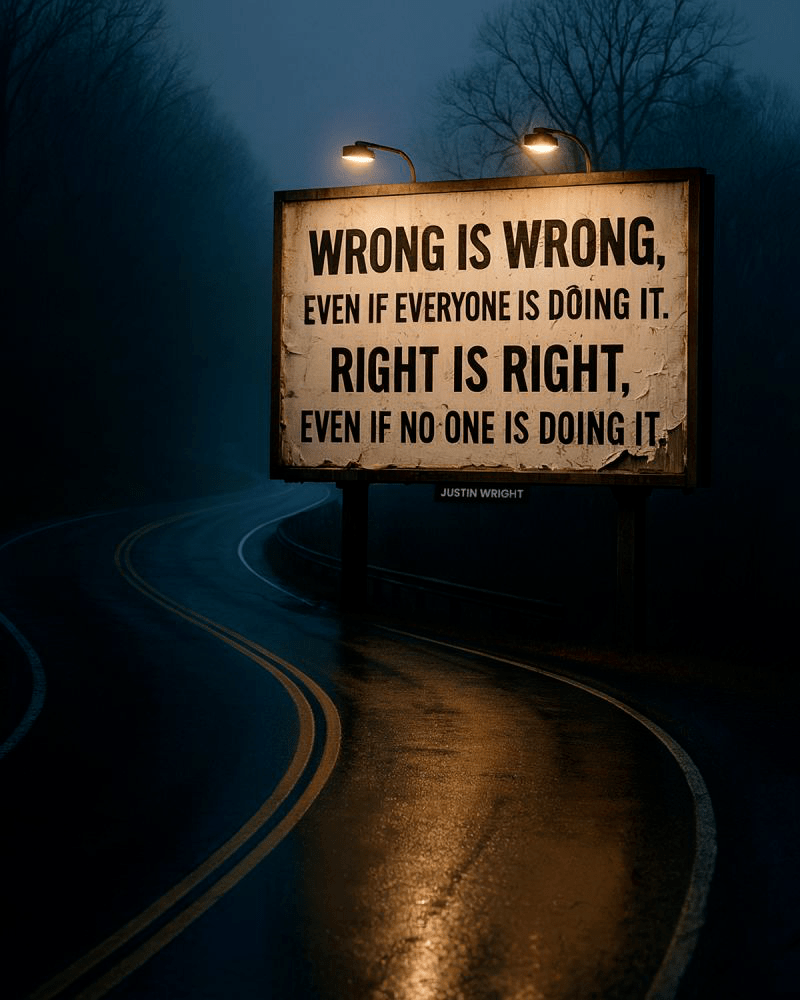
There’s a strange comfort in numbers. When everyone around us is doing the same thing, it starts to feel safe. Normal. Almost justified. We tell ourselves, This is just how things work. We stop questioning it. We stop listening to that quiet voice that nudges us when something feels off.
That’s how “wrong” slowly gets normalized.
It rarely shows up as something dramatic. It’s usually subtle. Cutting a small corner. Staying silent when a line is crossed. Shipping something half-baked because timelines matter more than truth. Laughing along when a joke doesn’t sit right. Signing off on a decision because everyone else already did.
And the dangerous part? It doesn’t feel wrong in the moment. It feels efficient. Practical. Low-risk.
But wrong doesn’t stop being wrong just because it’s popular.
Doing the right thing, on the other hand, often feels lonely. It can make you look difficult. Idealistic. Out of sync with the room. It may cost you speed, approval, or short-term wins. Sometimes it even costs relationships or opportunities.
That’s why it’s hard.
We like to believe that courage shows up in big, cinematic moments. In reality, it shows up in ordinary decisions that no one is applauding. In moments where the only reward is being able to sleep at night. In choosing integrity when cutting corners would be easier and quieter.
What makes this especially tricky is that “everyone” doesn’t have to be a lot of people. Sometimes it’s just your team. Your industry. Your peer group. When the local norm is off, going against it can feel like swimming upstream with no clear destination.
But here’s the thing: right and wrong don’t need consensus. They never did.
History is full of moments where the majority was comfortable—and deeply mistaken. And it’s also full of individuals who stood alone, not because they wanted to, but because they couldn’t unsee what was wrong anymore. They didn’t always win immediately. Sometimes they didn’t win at all. But they shifted the line for everyone who came after.
On a smaller, everyday scale, the same principle applies. Cultures don’t change because everyone wakes up enlightened on the same morning. They change because a few people consistently refuse to compromise on what matters. They ask uncomfortable questions. They slow things down. They choose clarity over convenience.
And yes, that can be exhausting.
But the alternative is more costly than we like to admit. When we repeatedly choose convenience over conviction, we don’t just bend the rules—we bend ourselves. Over time, it becomes harder to tell where the line even was. That’s when cynicism creeps in. That’s when “this is just how it is” replaces “this could be better.”
Doing the right thing won’t always make you popular. It won’t always make you successful in obvious ways. But it does something quieter and more important: it builds self-trust. It reinforces the idea that your values aren’t situational. That they don’t disappear under pressure.
And sometimes, without you realizing it, your choice gives someone else permission to make the same one. What felt like standing alone turns out to be standing first.
Wrong doesn’t become right by repetition.
Right doesn’t stop being right because it’s inconvenient.
The question isn’t whether others are doing it.
The question is whether you can stand by it when no one else is.
 Kenrick Vaz