
Most of us say we like certainty. Plans. Roadmaps. A clean calendar that behaves itself. There’s comfort in knowing what comes next, in believing that if we just think hard enough, prepare long enough, and control enough variables, life will cooperate.
But it rarely does.
Surprises have a way of showing up uninvited. A conversation that shifts your thinking. A door that closes just as you were getting comfortable. A delay, a detour, a moment that doesn’t fit the plan you so carefully made. And when that happens, the reaction depends less on the surprise itself and more on the mindset we’re carrying into it.
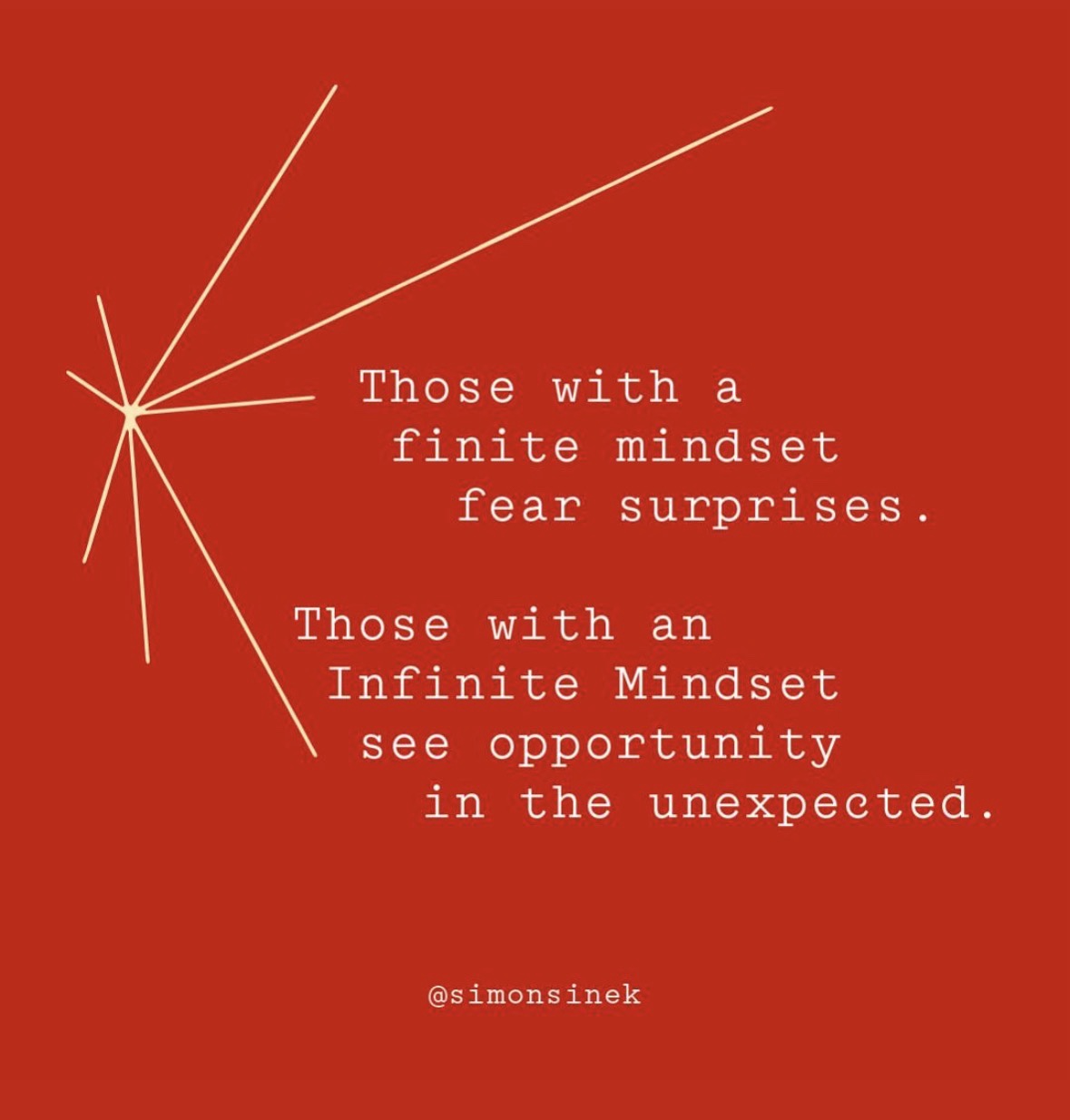
A finite mindset treats surprises like threats. Something went wrong. Someone messed up. This wasn’t supposed to happen. The instinct is to retreat, protect, explain, or rush to restore things back to “normal.” The goal is stability. Predictability. Getting back to the version of the story that feels safe.
An infinite mindset sees the same moment differently. Not as a disruption, but as information. Not as a loss of control, but as a signal. Something new just entered the frame. Pay attention.
This doesn’t mean infinite thinkers enjoy chaos or chase uncertainty for sport. It means they understand something subtle but powerful: growth rarely arrives wrapped in familiarity. The most meaningful changes often come disguised as inconvenience, discomfort, or confusion.
Think about how many pivotal moments in your life began as surprises you didn’t ask for. A job you didn’t plan to take. A move you were unsure about. A setback that forced you to re-evaluate what you were chasing in the first place. In the moment, they may have felt like interruptions. In hindsight, they often read like turning points.
Finite thinking asks, “How do I avoid this next time?”
Infinite thinking asks, “What is this trying to teach me?”
That shift in question changes everything.
When you fear surprises, you shrink your world to what you can predict. You optimize for short-term certainty, even if it costs long-term possibility. You stay close to what you know, not because it’s best, but because it’s familiar. Over time, that safety can quietly turn into stagnation.
When you see opportunity in the unexpected, you widen your horizon. You stay curious longer. You resist the urge to immediately label an outcome as good or bad. You give yourself permission to explore what could emerge instead of clinging to what was planned.
This mindset shows up everywhere. In leadership, it’s the difference between teams that punish deviation and teams that learn from it. In careers, it’s the difference between rigid ladders and evolving paths. In life, it’s the difference between merely managing change and actually being shaped by it.
None of this means surprises are easy. Even with an infinite mindset, uncertainty can be uncomfortable. It can shake confidence. It can force decisions before you feel ready. But there’s a quiet confidence that comes from knowing you don’t need the full map to take the next step. Just awareness. Just openness. Just the willingness to adapt.
The irony is that the more you trust yourself to handle the unexpected, the less threatening it becomes. You stop needing life to behave perfectly in order to move forward. You start believing that whatever shows up, you’ll find a way to work with it.
Finite mindsets look for guarantees before they begin.
Infinite mindsets begin, knowing the guarantees will never come.
And somewhere in that acceptance, surprises stop being enemies. They become collaborators. Nudging you toward paths you couldn’t have designed on your own. Expanding your thinking beyond what you thought was possible. Reminding you that the future isn’t something to defend against, but something to grow into.
The unexpected will keep showing up. That part is unavoidable.
What’s optional is whether you meet it with fear, or with curiosity.
 Kenrick Vaz