
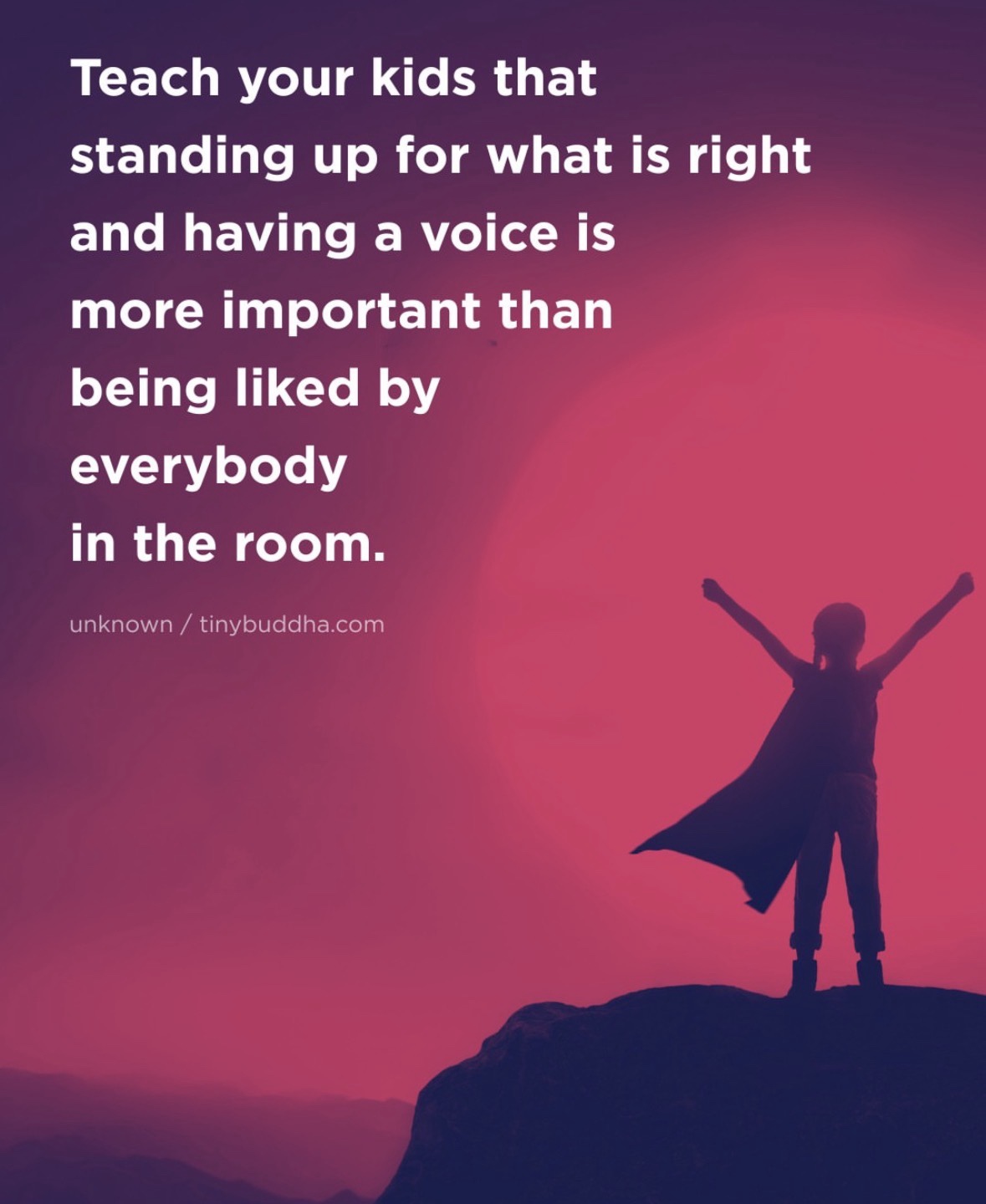
There’s a quiet pressure that starts earlier than we admit.
Be nice.
Be polite.
Don’t make a scene.
Make sure everyone likes you.
And somewhere in all that well-intentioned advice, courage gets edited out.
But here’s something I’ve been thinking about a lot lately: I don’t want to raise a child who is liked by everybody in the room. I want to raise a child who is respected by the right people in the room.
Because those are not the same thing.
Being liked often means blending in. It means softening your opinion so it doesn’t ruffle feathers. It means laughing at jokes that don’t feel right. It means staying quiet when something feels off.
Standing up for what is right is different. It requires a voice. And a backbone. And sometimes the willingness to be the only one raising your hand.
When you’re a parent, these lessons show up in the smallest ways. It’s when your child says, “That’s not fair.” It’s when they tell another kid to stop. It’s when they refuse to join in teasing. It’s when they correct you because something you said doesn’t match what you taught them yesterday.
Those moments are inconvenient. They’re uncomfortable. They’re not always socially smooth.
But they’re powerful.
Because what we’re really teaching in those moments is identity. We’re telling them: Your voice matters. Your values matter. Your instincts matter. Even if it costs you applause.
And let’s be honest—this doesn’t just apply to kids.
As adults, we feel the same pull. In meetings. In group chats. In client conversations. In boardrooms. In family discussions.
There’s always a tension between harmony and honesty.
I’ve been fortunate to work with leaders who make the expectation clear. One of them says it simply: “We must always do right by our clients.”
Not “what keeps everyone happy.”
Not “what protects us from friction.”
Not “what looks good in the short term.”
Do right.
That line carries weight. Because doing right isn’t always the most comfortable path. It can mean hard conversations. It can mean pushing back. It can mean choosing integrity over convenience.
And kids are watching that.
They may not understand quarterly goals or contracts or strategy decks. But they understand tone. They understand courage. They understand whether we mean what we say.
If we tell them to stand up for what is right, but they watch us shrink in the face of pressure, the lesson won’t stick.
If we tell them their voice matters, but we silence ours to avoid being disliked, they will learn that belonging is more important than conviction.
And here’s the truth: not everyone will like you when you choose integrity.
Some people prefer comfort over challenge. Some prefer silence over accountability. Some prefer agreement over growth.
That’s okay.
Your job—and your child’s job—is not to win a popularity contest. It’s to build character.
Because popularity is fragile. It shifts with the room. It depends on trends and moods and who holds influence that day.
Character is steady. It’s who you are when the room goes quiet.
Imagine a generation of kids who aren’t afraid to say, “That’s not right.” Who don’t measure their worth by applause. Who understand that kindness doesn’t mean compliance. Who know that respect is earned by consistency, not charm.
That’s the kind of confidence that doesn’t crumble under pressure.
As parents, we don’t need to raise the loudest kids in the room. We need to raise the clearest. Kids who know what they stand for. Kids who can disagree without being disrespectful. Kids who understand that having a voice is a responsibility, not a weapon.
And it starts small.
It starts at the dinner table when they challenge an idea.
It starts at the playground when they defend someone else.
It starts at home when they say, “I don’t think that’s fair,” and we don’t immediately shut it down.
Teach them that being liked by everybody is impossible.
Teach them that being trusted by a few is powerful.
Teach them that courage sometimes costs approval—but it always builds strength.
And most importantly, show them.
Because one day, they’ll walk into rooms without you. Rooms full of opinions. Pressure. Expectations.
And when that moment comes, I hope they remember this:
It’s better to stand alone for what is right than to sit comfortably in a crowd that knows better.
Raise brave.
The world doesn’t need more agreeable voices.
It needs more honest ones.
 Kenrick Vaz