The quality of your life in 10 years will be determined by the decisions you make today.
But most people make decisions emotionally, then rationalise them logically afterward.
That’s why the same smart people keep making the same bad choices.
Buffett, Munger, Dalio… they all have systematic approaches to decisions.
They don’t trust their gut on big calls.
They trust their process.
Bad decisions compound just like good ones.
The problem is you usually don’t notice until years later.
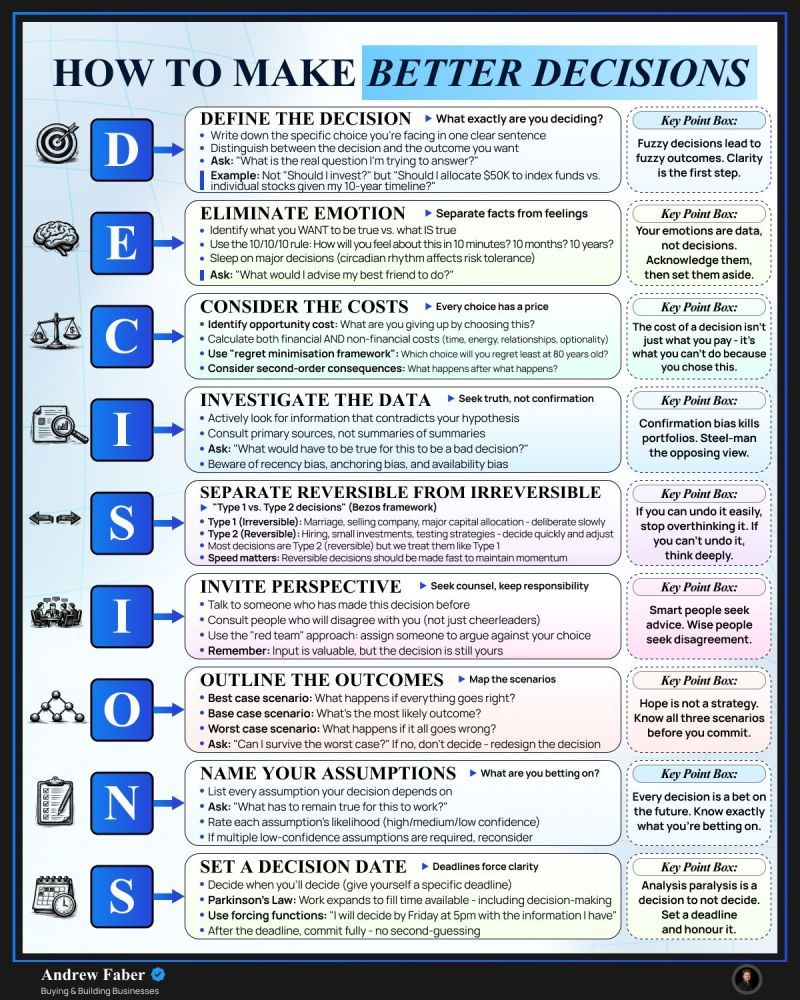
To help, I put together a framework to think through major decisions more clearly.
It works for capital allocation, hiring, partnerships, or anything where the stakes are high enough to warrant slowing down:
D – Define the decision
↳ Write it down in one clear sentence. “Should I invest?” is too vague.
“Should I allocate £50K to this acquisition given my 3-year timeline?” is better.
E – Eliminate emotion
↳ Separate what you WANT to be true from what IS true.
↳ Ask yourself what you’d advise a friend to do in the same situation.
C – Consider the costs
↳ Every choice has a price, and it’s not just financial.
↳ Time, energy, relationships, optionality. What are you giving up by choosing this?
I – Investigate the data
↳ Actively look for information that contradicts your hypothesis.
↳ Ask what would have to be true for this to be a bad decision.
S – Separate reversible from irreversible
↳ Jeff Bezos calls these 1-way and 2-way doors.
↳ Reversible decisions should be made quickly. Irreversible ones deserve more time.
I – Invite perspective
↳ Talk to someone who’s made this decision before.
↳ Better yet, talk to someone who will disagree with you.
O – Outline the outcomes
↳ Best case, base case, worst case.
If you can’t survive the worst case, don’t make the decision. Redesign it.
N – Name your assumptions
↳ Every decision is a bet on the future. List what has to remain true for your decision to work.
↳ If you’re relying on multiple low-confidence assumptions, reconsider.
S – Set a decision date
↳ Decide when you’ll decide.
↳ Analysis paralysis is just a decision to not decide. Set a deadline and honour it.
The goal isn’t to be right 100% of the time.
It’s to have a process that improves your odds and helps you learn from the ones that don’t work out.
Writing down your decisions also creates accountability.
You can look back in a year and see whether your reasoning held up or whether you were fooling yourself.
Having a system won’t guarantee good outcomes…
But it will guarantee better thinking.
How to make Better Decisions