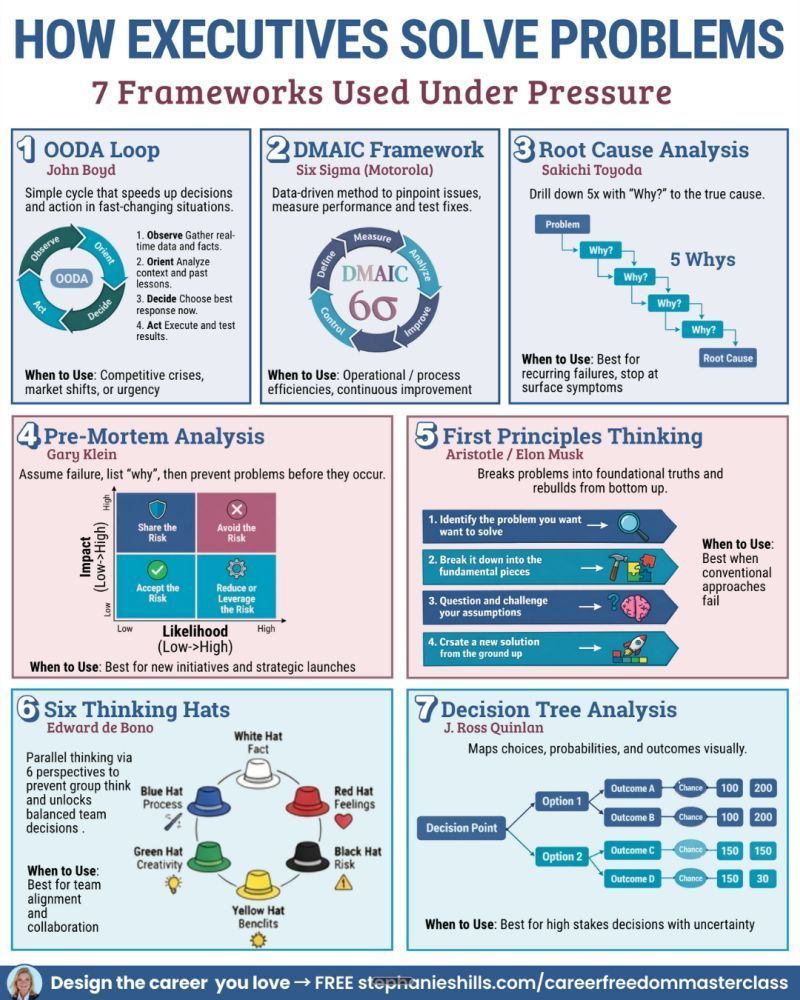
This is how real executives think
when there’s no room for mistakes.
I’ve always been known as a problem solver.
Not because I was the smartest person in the room.
Not because I had all the answers.
Not because I had the best ideas.
But because I knew how to think clearly
when the pressure was high.
I’ll never forget one situation
early in my executive career.
A $50M customer had already decided to fire us.
The relationship was broken.
Quality issues were stacking up.
Delivery was delayed.
Trust was gone.
There was no time to debate.
No room for politics.
No margin for error.
Wednesday, I was pulled in.
Thursday, I met with our executive team
That same day,
I met with the global engineering team
We whiteboarded everything
that wasn’t working.
Friday, I met with engineering leadership.
Saturday and Sunday, I built the plan.
Sunday night, I presented it to our executives.
Monday, I flew to Canada and met with the customer.
We solved the quality issues.
We fixed the delays.
We kept the account.
Not because I was better than anyone else.
But because I relied on proven ways of thinking
when everything was on the line.
Here are the exact frameworks I’ve relied on throughout my career 👇
🧠 7 PROBLEM-SOLVING FRAMEWORKS EXECUTIVES USE
1️⃣ OODA Loop
→ Speeds up decisions and action in fast-changing situations
→ When to use: Competitive crises, market shifts, or urgency
2️⃣ DMAIC Framework
→ Data-driven method to pinpoint issues, measure performance, and test fixes
→ When to use: Operational and process efficiency, continuous improvement
3️⃣ Root Cause Analysis (5 Whys)
→ Drills down past symptoms to uncover the true cause
→ When to use: Recurring failures that keep resurfacing
4️⃣ Pre-Mortem Analysis
→ Assumes failure in advance to identify risks before they happen
→ When to use: New initiatives and strategic launches
5️⃣ First Principles Thinking
→ Breaks problems into fundamental truths and rebuilds from the ground up
→ When to use: When conventional approaches fail
6️⃣ Six Thinking Hats
→ Uses parallel thinking to balance facts, emotion, risk, and creativity
→ When to use: Team alignment and collaboration
7️⃣ Decision Tree Analysis
→ Maps choices, probabilities, and outcomes visually
→ When to use: High-stakes decisions with uncertainty
This is the difference between reacting and leading
🔁 Share with a leader who makes decisions under pressure
How Executives Solve Problems