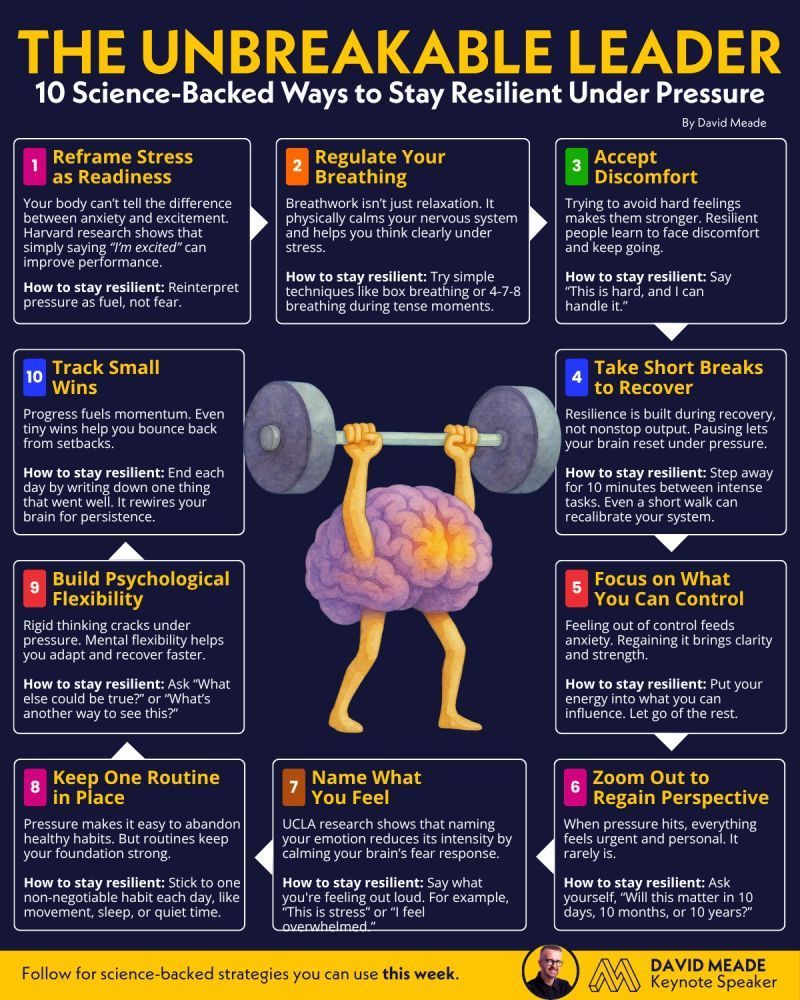
What’s the real difference between breaking and bending under pressure?
(Hint: It’s probably not what you think.)
It’s not:
❌ Willpower
❌ Rubbing dirt on it
❌ Powering through
It’s science-backed self-management.
Resilient leaders don’t just grit their teeth and hope for the best.
They shift how their brain and body respond.
On purpose.
Here are 10 science-backed techniques that actually work:
1. Reframe Stress as Readiness
→ Your racing pulse isn’t a warning. It’s preparation.
→ Anxiety and excitement use the same neurochemicals.
2. Regulate Your Breathing
→ Four counts in, hold for four, out for four.
→ Your vagus nerve responds in seconds.
3. Accept, Don’t Avoid, Discomfort
→ Resilient people keep moving — even when it’s uncomfortable.
→ Avoidance feeds the fear loop. Acceptance breaks it.
4. Take Short Breaks to Recover
→ Your brain resets during rest, not grinding.
→ Elite performers schedule recovery like work.
5. Focus on What You Can Control
→ List what you can influence — and what you can’t.
→ Put your energy in column one only.
6. Zoom Out to Regain Perspective
→ Ask: “Will this matter in 10 years?”
→ Distance creates clarity. Pressure creates tunnel vision.
7. Name What You Feel
→ Saying “I’m anxious” reduces amygdala activation by up to 30%.
→ Your brain stops scanning once it knows the threat.
8. Keep One Routine in Place
→ One steady habit becomes your anchor in chaos.
→ It signals: you’re still in control.
9. Build Psychological Flexibility
→ Rigid thinking cracks. Flexible thinking adapts.
→ Hold your plans lightly, your values tightly.
10. Track Small Wins
→ Your brain defaults to scanning for problems.
→ Logging wins rewires it toward resilience.
The leaders who bend instead of break?
They’re not stronger.
They’re just more strategic when the pressure’s on.
Which of these have you used when the pressure’s on…
And it actually worked?
The Unbreakable Leader