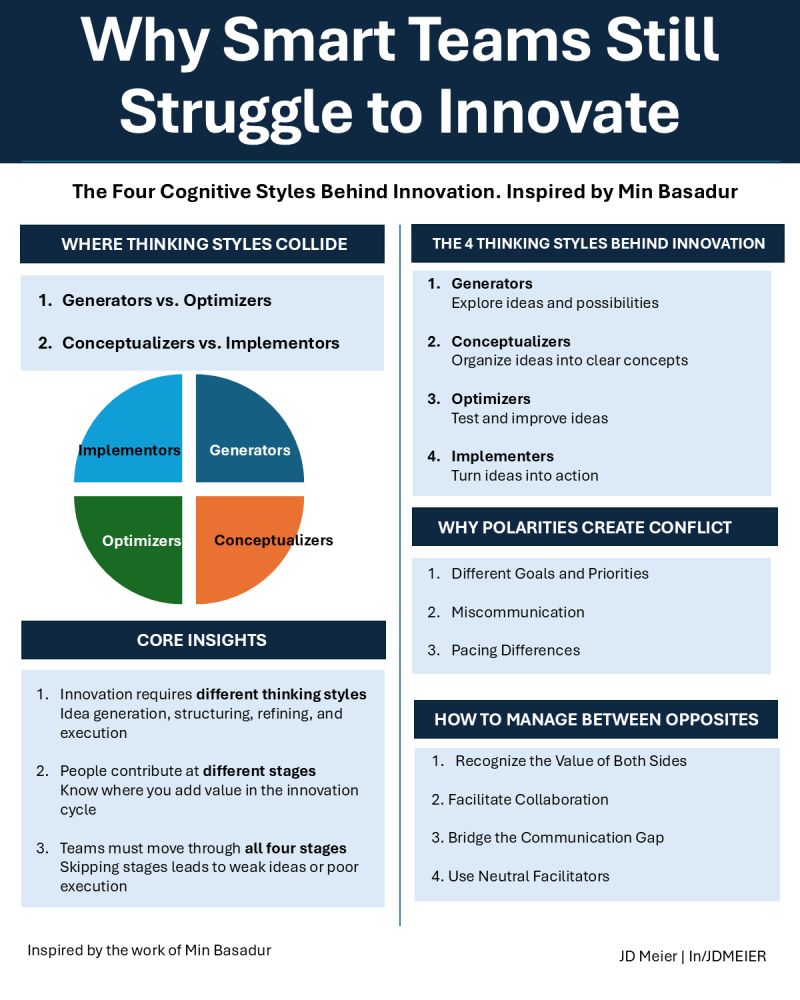
Smart teams still struggle to innovate.
Not because they lack intelligence:
Because their thinking styles collide.
And leaders misread the collision.
I saw this constantly at Microsoft.
I’d watch a team full of talented people grind to a halt. Not because anyone was wrong. Because a Generator was pushing for more possibilities while an Optimizer was challenging feasibility. A Conceptualizer wanted to get the framework right while an Implementer wanted to ship.
From the outside, it looked like personality conflict.
The Generator seemed unrealistic.
The Optimizer seemed negative.
The Conceptualizer seemed slow.
The Implementer seemed impatient.
But it wasn’t personal. It was a cognitive polarity.
Min Basadur mapped this well. Innovation requires four distinct thinking styles: generating ideas, organizing them into concepts, testing and refining, then driving execution. Each one protects a different stage. Skip any stage and you get weak ideas or poor execution.
The problem is that these styles naturally oppose each other. Generators and Optimizers pull in opposite directions. Conceptualizers and Implementers work at different speeds. Without a shared process, the tension turns personal fast.
The teams I saw make real breakthroughs were rarely comfortable. They argued. They challenged each other. They moved at different speeds.
But once they understood 𝘸𝘩𝘺 they were clashing, something shifted.
The friction stopped being a people problem. It became the innovation process working.
Homogeneous teams feel easier. They also stall when the challenge gets hard.
If your team has tension, don’t rush to smooth it over.
Ask whether you’re watching conflict, or cognitive diversity doing its job.
Why Smart Teams Still Struggle To Innovate