
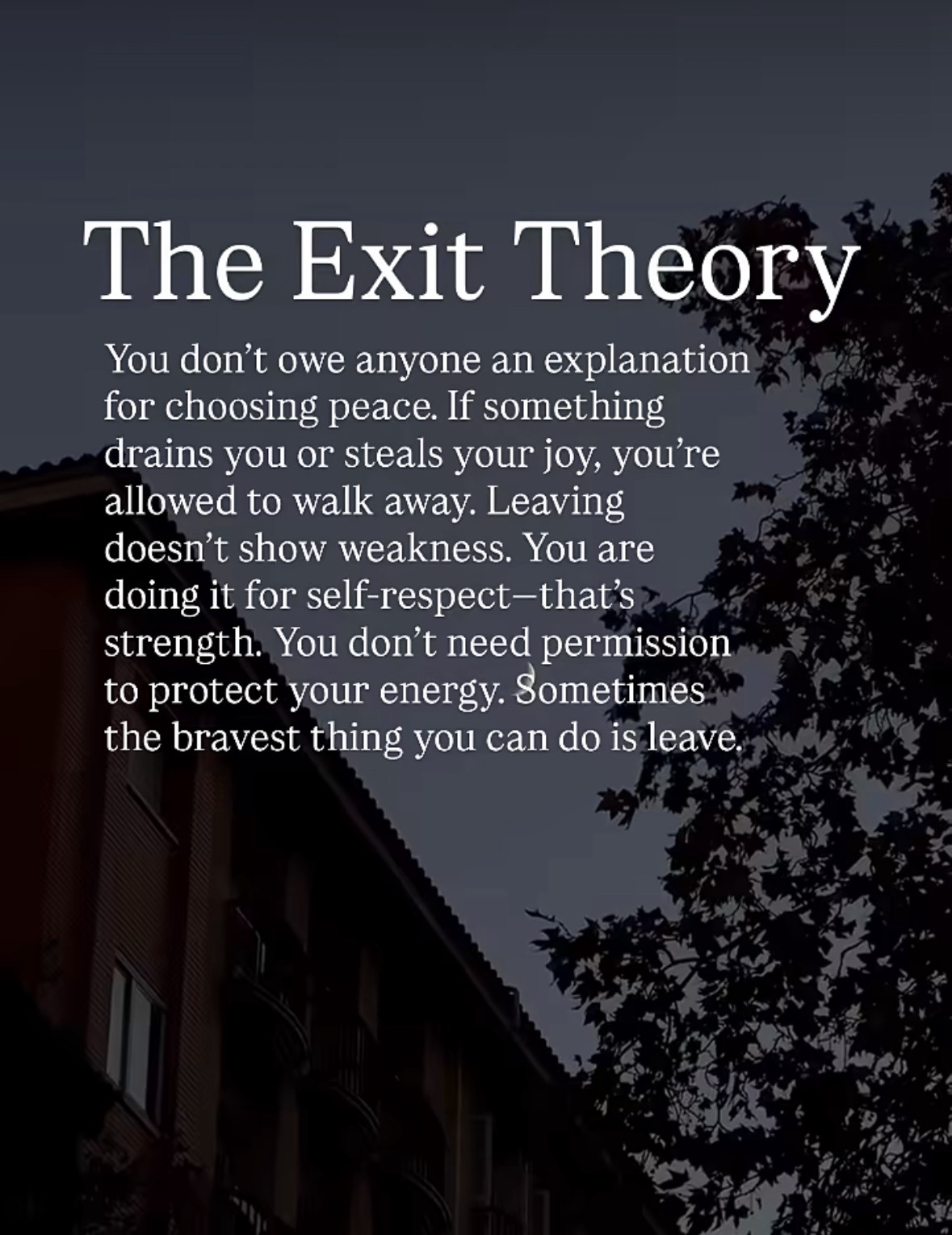
There’s a strange pressure we put on ourselves to stay—stay in conversations that leave us uneasy, stay in situations where we feel small, stay in rhythms that drain us even when we know better. Maybe it’s habit. Maybe it’s guilt. Maybe it’s that quiet fear that someone will ask, “Why are you leaving?” and we won’t have a tidy answer ready.
But here’s the truth most people learn the hard way: you don’t owe anyone an explanation for choosing peace. Not a paragraph, not a speech, not even a sentence. Peace doesn’t need justification. It’s a direction, not a debate.
There comes a point when something that once fit you starts to feel heavy. A friendship that used to lift you now feels like work. A workplace that once excited you now takes more than it gives. A routine you relied on starts to chip away at your joy. And the moment you feel that shift—even if it’s subtle—that’s your internal compass nudging you toward the exit.
Walking away has been painted as quitting, as giving up, as not trying hard enough. But leaving can also be the most powerful act of self-respect. It takes strength to say, “I’m done explaining why this hurts me.” It takes clarity to say, “My peace matters more than keeping this going.” It takes courage to step into the unknown when staying would be so much easier.
Because staying is familiar. But familiar doesn’t mean right.
The Exit Theory is simple: if it drains you, dims you, or makes you betray yourself, you’re allowed to leave. Full stop. You don’t need permission. You don’t need validation. You don’t need to wait until you’re exhausted or broken or resentful. You can choose yourself long before the breaking point.
Sometimes you walk away quietly, without drama. Sometimes you walk away shaking, unsure but determined. Sometimes you walk away after giving too many chances. And sometimes you walk away the very moment you realize your joy has been shrinking to fit a space that was never meant for you.
Leaving isn’t weakness. It’s wisdom. It’s the awareness that your energy is finite and precious. It’s understanding that peace isn’t something you stumble upon—it’s something you protect. And sometimes the bravest thing you’ll ever do is close the door on something that no longer honors who you are becoming.
So if you’re standing at the threshold, hand on the handle, heart uncertain but hopeful, remember this: exits aren’t failures. They’re openings. They’re the first step toward the life that fits you better. And you’re allowed to take that step—without apology, without explanation, without guilt.
Just take it. Your peace will meet you on the other side.
 Kenrick Vaz