
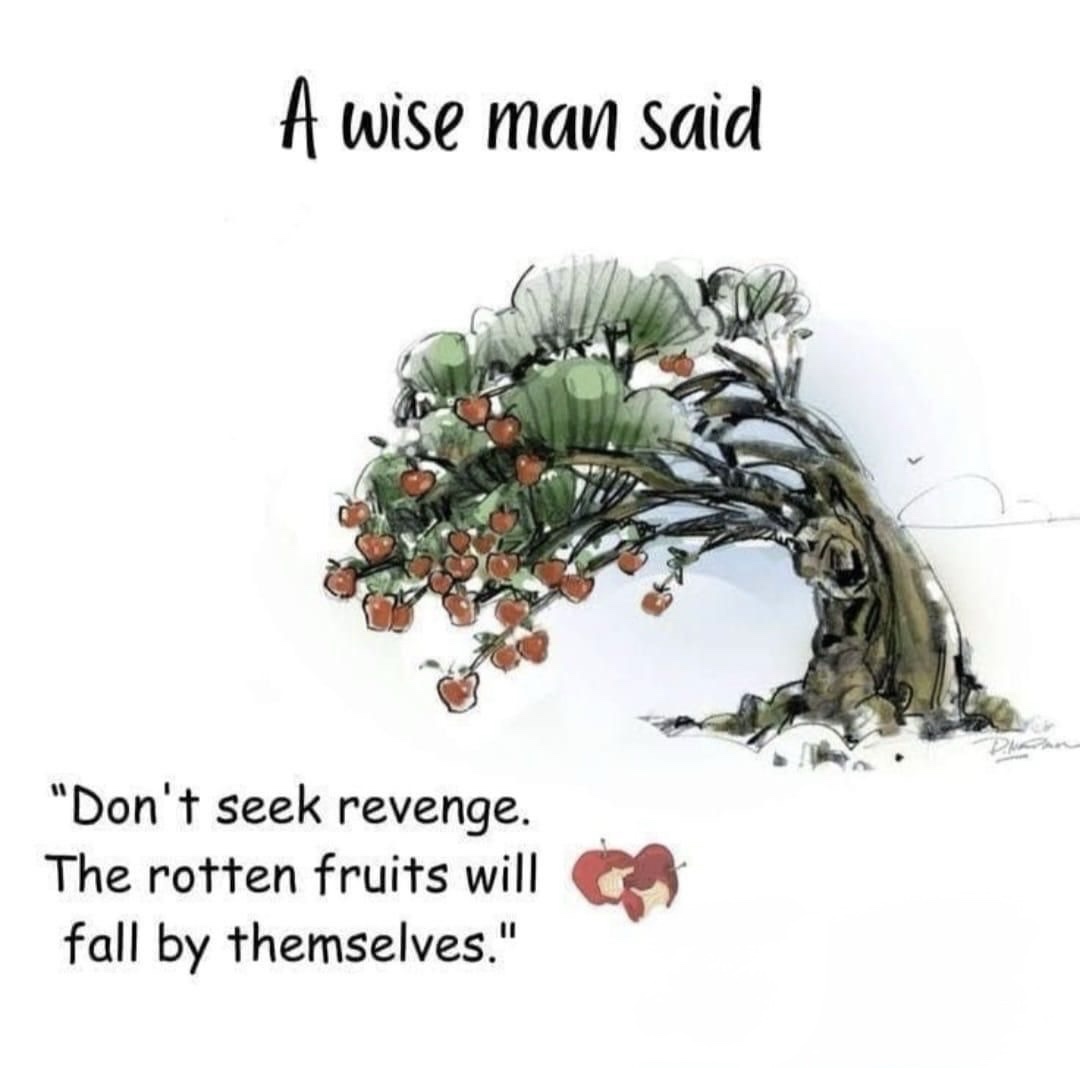
A wise man once said, “Don’t seek revenge. The rotten fruits will fall by themselves.”
It sounds simple, almost too calm for a world that constantly nudges us to react, respond, and retaliate. But the older I get, the more this line feels less like a quote and more like a quiet survival strategy.
We’re taught—subtly, sometimes loudly—that if someone wrongs us, we must do something about it. Say something sharp. Prove a point. Even the score. There’s a strange pressure to show that we weren’t weak, that we noticed, that we won’t let it slide. Revenge, in many ways, is marketed as self-respect.
But real life doesn’t work like movies. Revenge rarely delivers closure. It delivers noise. It keeps the wound open longer than it needs to be.
The idea of “rotten fruits falling on their own” assumes something radical: that time, truth, and gravity are far more effective than our interference. Rotten fruit doesn’t need to be yanked off the branch. It reveals itself. It softens, smells, weighs itself down, and eventually drops—often when no one is even paying attention.
People, situations, behaviors—they work the same way.
When someone acts out of jealousy, ego, insecurity, or deceit, it may look like they’re getting away with it. For a while. From the outside, it can feel deeply unfair. You’re left holding your silence while they seem to collect wins. That’s usually the moment when revenge feels tempting. Not because you’re cruel, but because you want balance restored.
But here’s the uncomfortable truth: most consequences don’t arrive dramatically. They arrive quietly.
The person who lies often has to keep lying. The one who manipulates has to keep track of too many versions of themselves. The one who burns bridges eventually runs out of places to stand. None of that requires your involvement. In fact, your involvement often delays the natural fallout.
Revenge pulls you into the same soil that produced the rot in the first place.
There’s also a hidden cost we don’t talk about enough: attention. When you seek revenge, you keep giving mental space to someone who already took enough from you. You replay conversations. You imagine scenarios. You draft responses in your head that will never be sent. That energy doesn’t punish them—it drains you.
Choosing not to retaliate isn’t weakness. It’s restraint. And restraint is a form of power that doesn’t announce itself.
There’s a deep confidence in saying, “I don’t need to prove anything. I don’t need to explain myself to someone committed to misunderstanding me. I don’t need to fight a battle that time is already winning on my behalf.”
This doesn’t mean pretending nothing hurt. It doesn’t mean suppressing anger or bypassing healing. It means processing your emotions honestly, but not turning them into weapons. It means deciding that your peace is more valuable than temporary satisfaction.
One of the hardest parts of this approach is patience. Rotten fruit doesn’t fall on your schedule. Sometimes it hangs there longer than you think it should. Sometimes people applaud it, unaware of the decay beneath the surface. That’s the real test—not whether you believe the fruit will fall, but whether you can live well while it’s still hanging.
And here’s the part that rarely gets mentioned: sometimes the fruit falls, and you’re no longer even around to notice. You’ve moved on. You’ve grown. You’ve found better things to carry. That’s not avoidance—that’s progress.
Life has a way of evening things out, but not always in ways that satisfy our ego. The outcome may not look like justice in bold letters. It may look like distance. Irrelevance. A quiet realization on their part that something keeps going wrong, over and over again.
Meanwhile, your job isn’t to watch the tree. Your job is to tend your own ground.
Protect your character. Protect your time. Protect your capacity to stay soft in a world that rewards hardness. Not every offense deserves a response. Not every slight deserves your voice. Some things deserve only your absence.
When you stop reaching for revenge, you create space for something better—clarity, freedom, and a lighter heart. And eventually, without your help, gravity does what it always does.
The rotten fruits fall.
You don’t have to be standing underneath them.
 Kenrick Vaz