
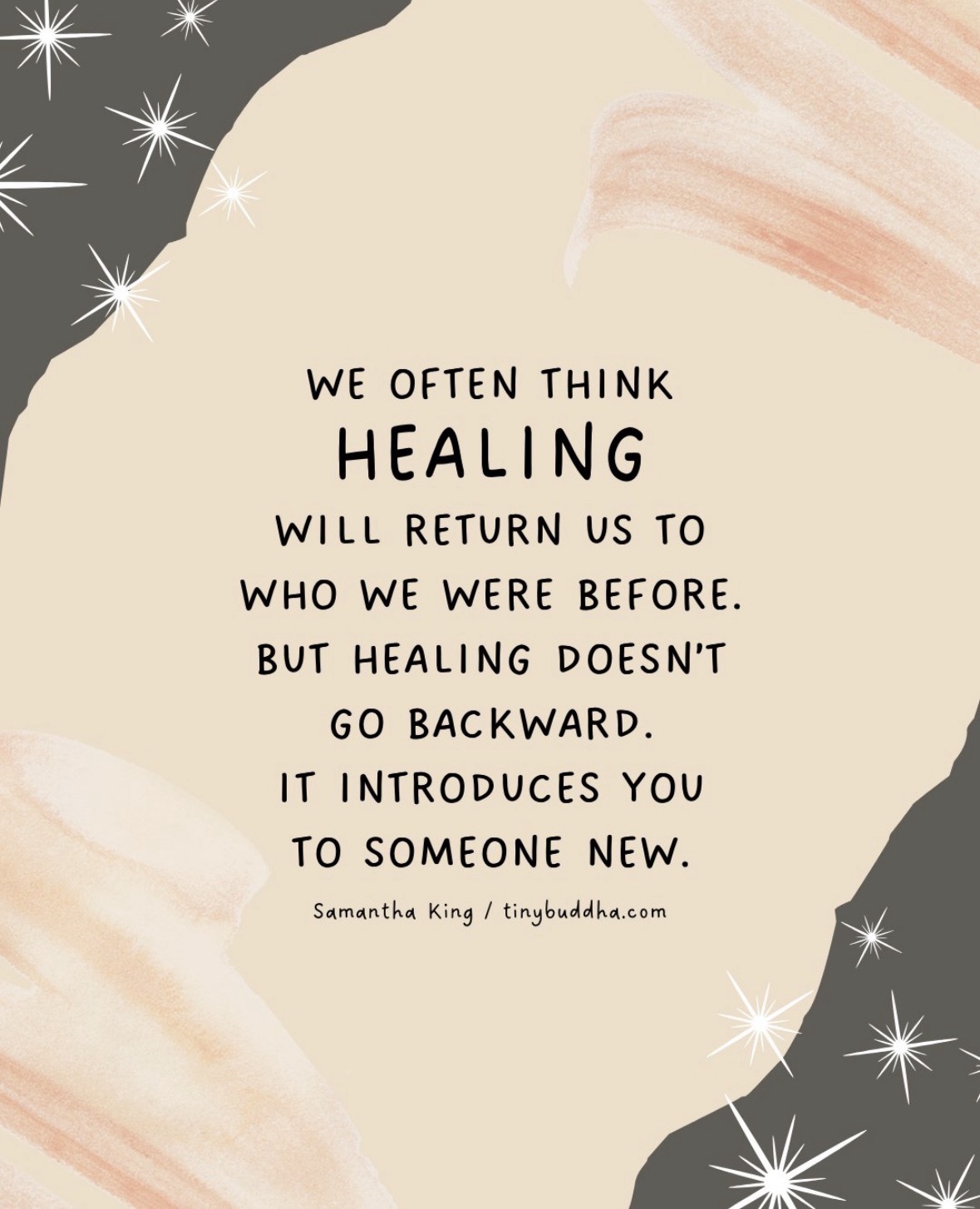
We carry this quiet expectation about healing.
That one day, after enough time has passed, after enough tears or therapy or late-night thinking, we’ll somehow find our way back to who we used to be. The version of us before things got messy. Before the heartbreak. Before the disappointment. Before life proved it could hurt in ways we didn’t see coming.
We imagine healing like a rewind button.
Like we’ll wake up one morning and feel familiar again. Lighter. Simpler. Untouched.
But healing doesn’t work like that.
It doesn’t take you back.
It introduces you to someone new.
And that realization can feel uncomfortable at first. Because there’s grief in it. Real grief. Not just for what happened, but for the version of you that existed before it all. The version that didn’t know. The one that trusted more easily, loved more freely, moved through life without that extra layer of caution.
You don’t get to be that person again.
But here’s the part we don’t talk about enough—you’re not supposed to.
Because that version of you, as beautiful as it was, was also incomplete. Not in a broken way, but in an unfinished way. Life hadn’t shaped you yet. It hadn’t stretched your emotional capacity. It hadn’t forced you to confront your boundaries, your resilience, your depth.
Pain, as much as we resist it, does something profound. It adds layers.
It teaches you where your limits are—and how to protect them.
It shows you what you truly value—and what you’re no longer willing to tolerate.
It sharpens your intuition. It deepens your empathy. It forces you to slow down and pay attention.
The new version of you isn’t a replacement. It’s an evolution.
And yes, that version might be more cautious. Maybe a little quieter. Maybe slower to trust. Maybe more selective with who gets access to your energy.
But that’s not damage.
That’s awareness.
Healing isn’t about erasing what happened. It’s about integrating it. Carrying the lessons without letting them harden you completely. Learning how to stay open without being naive. Learning how to protect yourself without shutting the world out.
There’s a quiet strength in that balance.
The truth is, going “back” would mean losing everything you’ve learned. It would mean unlearning the wisdom that pain gave you. And as much as we romanticize the past, most of us wouldn’t actually choose to be that unaware again.
We just miss how easy it felt.
But easy isn’t always better. Sometimes it just means you haven’t been tested yet.
The person you’re becoming through healing is more grounded. More intentional. More aware of what matters and what doesn’t. You don’t just move through life anymore—you move with a sense of direction, even if it’s still forming.
And there’s something powerful about that.
Because now, when you choose people, you do it with clarity.
When you walk away, you do it with conviction.
When you love, you do it with depth—not just hope.
Healing reshapes your identity in subtle ways. You start noticing what drains you faster. You stop explaining yourself as much. You begin to value peace over validation, alignment over approval.
It’s not flashy. It’s not loud.
But it’s real.
And maybe the most important shift is this—you stop trying to “fix” yourself.
You start understanding yourself.
You realize you weren’t broken. You were just evolving through something that demanded more from you than you thought you could give.
So no, healing won’t return you to who you were before.
It will give you someone wiser. Someone steadier. Someone who has seen what life can do—and still chooses to show up.
And that version of you?
They’re not a consolation prize.
They’re the upgrade.
 Kenrick Vaz