
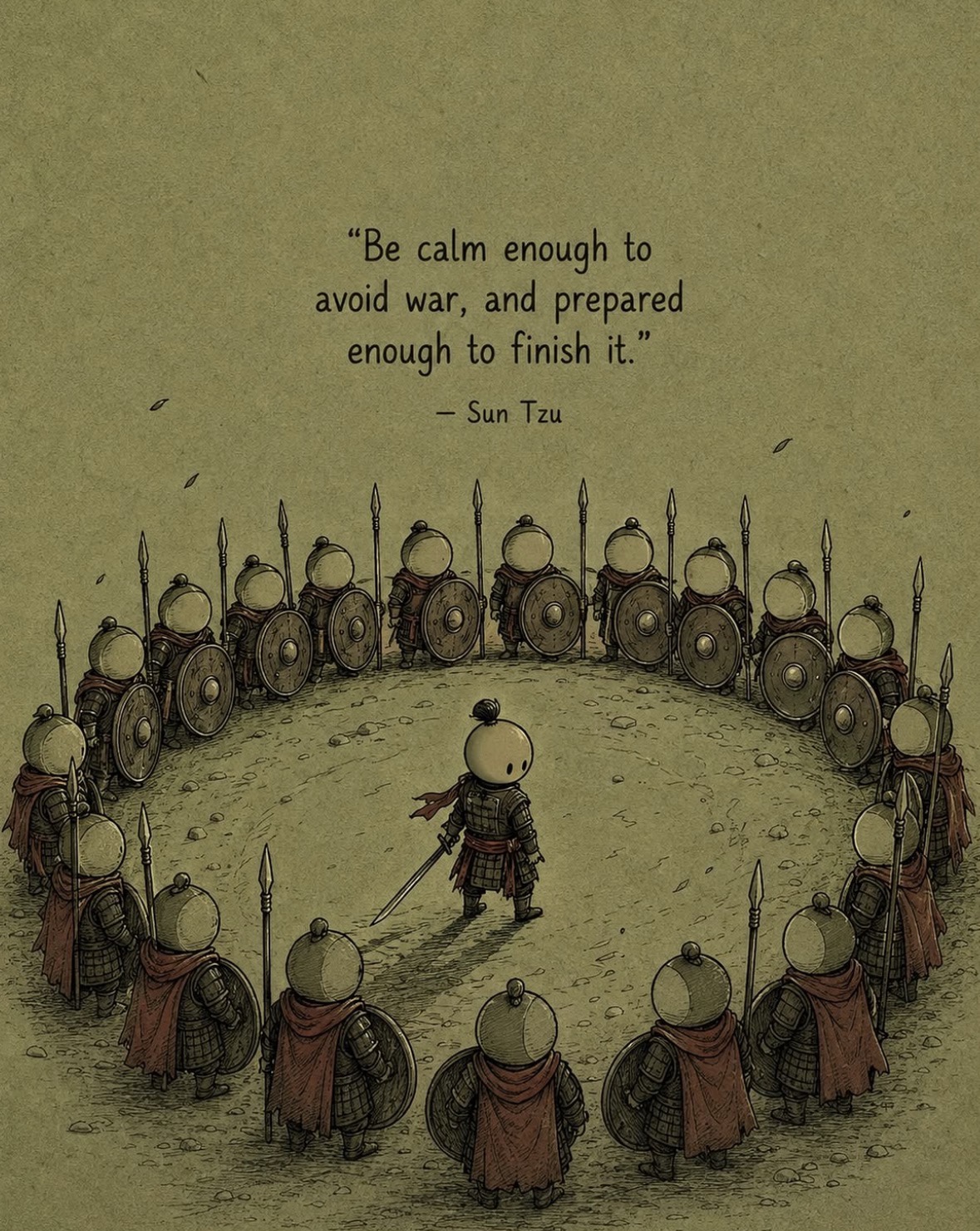
There’s a certain kind of strength that doesn’t need to announce itself.
It doesn’t walk into every disagreement looking for a fight. It doesn’t confuse anger with courage. It doesn’t need the last word just to feel like it won.
It stays calm.
That line often attributed to Sun Tzu captures the idea well:
“Be calm enough to avoid war, and prepared enough to finish it.”
I like that because calmness is sometimes mistaken for weakness.
Someone lets an insult go, so we assume they were afraid to respond. Someone chooses not to argue, so we think they had nothing to say. Someone walks away from a confrontation, and somehow the person shouting the loudest looks stronger.
Yet walking away can take far more control than swinging back.
There are plenty of battles available to us every day.
A rude comment. An unnecessary email. Someone questioning your work. A family argument that starts over something tiny and suddenly drags in grievances from five years ago. A stranger on the road who cuts you off and then somehow gets angry at you.
You could respond to every one of them.
You’d also be exhausted by lunchtime.
Knowing which battles deserve your energy is a skill. So is knowing when silence has stopped being useful.
That’s where the second half of the quote matters.
Be prepared.
Calm works best when it comes from confidence rather than fear.
You can walk away because you know you could stand your ground if you had to. You can ignore the cheap comment because your self-respect doesn’t depend on answering it. You can negotiate patiently because you already know where your boundary is.
Preparation changes the way you carry yourself.
Think about someone who knows their job well. When challenged in a meeting, they rarely need to become defensive. They have the numbers. They know the history. They’ve thought through the obvious questions. Their confidence comes from having done the work before entering the room.
The same principle applies outside work.
Having savings gives you options when a job becomes unbearable. Staying fit gives your body more capacity when life gets demanding. Learning how to communicate helps when relationships hit difficult moments. Knowing your boundaries makes it easier to recognize when someone has crossed one.
You prepare during peaceful days for situations you hope never arrive.
There’s something reassuring about that.
You don’t have to live suspicious of everyone around you. You don’t have to rehearse arguments in your head or treat every disagreement like a threat.
You simply build capability.
Then you get on with your life.
And when conflict does appear, your first instinct doesn’t have to be escalation. You can ask a question. Give someone another chance. Sleep on the angry message before sending it. Leave the room. Decide that this particular argument isn’t worth another minute of your evening.
Sometimes peace costs nothing more than swallowing a little pride.
Other situations require a clear response.
Someone repeatedly crosses a boundary after you’ve explained it. A person takes advantage of your patience. Your reputation, family, livelihood or values are being harmed. At that point, endless tolerance stops being wisdom.
Say what needs to be said.
Make the decision.
Hold the boundary.
Then stop fighting once the issue is settled.
That last part might be the hardest.
People sometimes keep a battle alive long after they’ve made their point because anger has momentum. Winning becomes less important than making the other person hurt. A disagreement that could have ended with one difficult conversation turns into months of resentment.
Strength needs an off switch.
The goal was never to become someone people fear upsetting.
It was to become someone who doesn’t need conflict to feel powerful.
Calm enough to let small things pass.
Prepared enough that your calm is a choice.
And wise enough to know when something is worth standing up for.

