
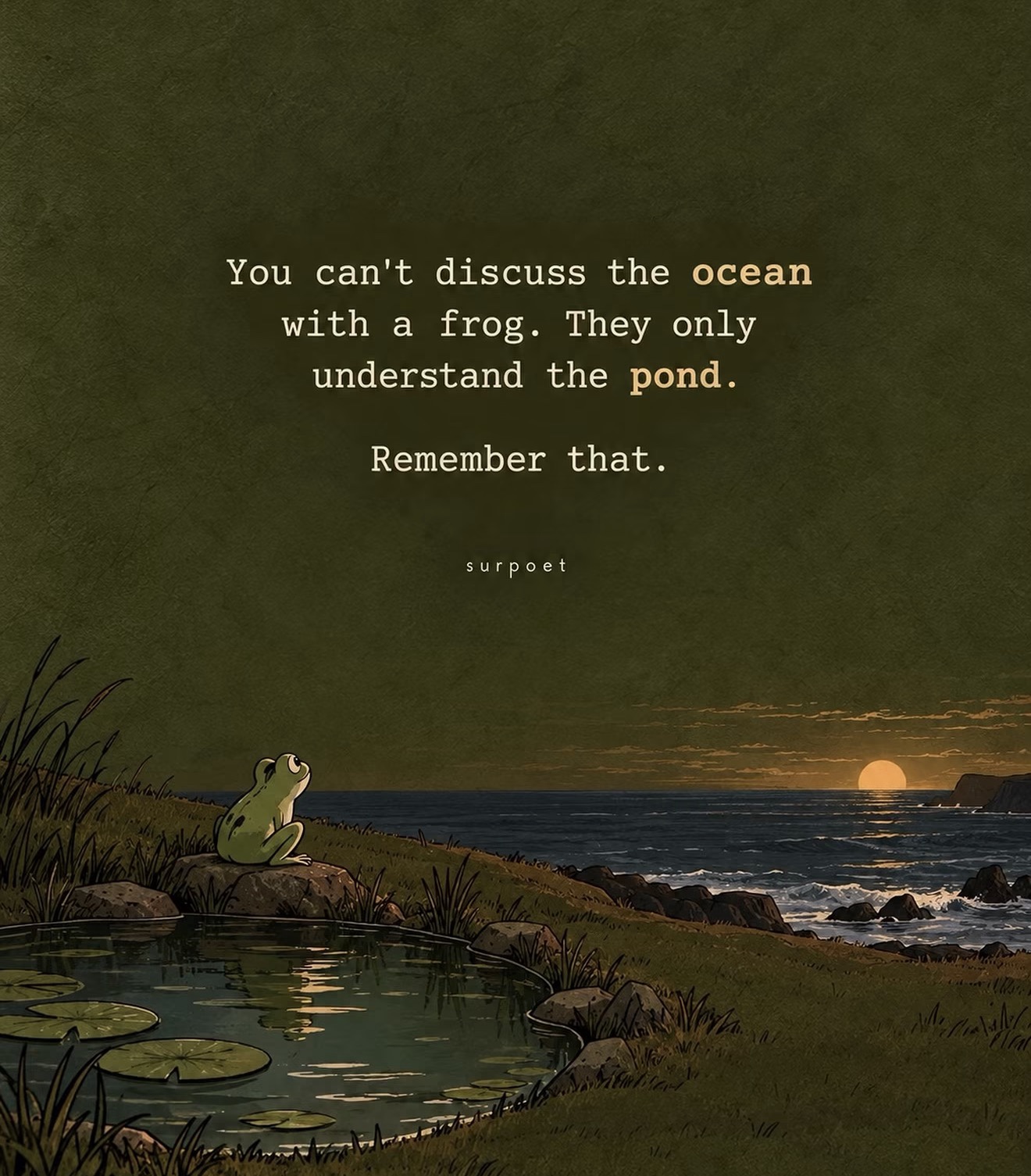
Some conversations are difficult because the other person disagrees with you. Others are difficult because the two of you are looking at the world from completely different distances.
You are talking about the ocean. They have spent their whole life in a pond.
Tell a frog about waves taller than a house, and it has nothing to compare them with. Explain tides pulling water away from the shore and bringing it back hours later. Describe standing on a beach where the horizon seems endless. None of it fits neatly into what the frog knows.
The pond has edges.
That old metaphor says something useful about people too.
We often assume that if we explain ourselves clearly enough, someone will understand. So we add more detail. We try another example. We tell the story from the beginning. When that fails, we wonder whether we used the wrong words.
Sometimes the words are fine.
Understanding depends on experience. Someone who has always had a supportive family may struggle to grasp why another person keeps their distance from theirs. A person who has never worried about money may see a financial decision as unnecessarily cautious. Someone who has spent twenty years in the same kind of job may find it hard to understand why another person would walk away from a comfortable position and start again.
Their response comes from the world they know.
We do this too.
Every one of us has a pond.
There are experiences we understand only from the outside. We can listen. We can learn. We can care deeply. Yet there will still be parts we cannot fully feel because we have never stood in that exact place.
Remembering that changes how you handle conversations.
You stop treating every disagreement as a debate that needs a winner. You become more careful about where you spend your energy. You notice when someone is curious enough to ask another question and when they have already decided that anything beyond their experience cannot be real.
Curiosity matters more than having seen the ocean yourself.
A person can spend their entire life around ponds and still believe you when you describe the sea. They might ask what salt water tastes like. They may wonder how ships survive storms. Perhaps they will pull out a map because they want to see how far the water goes.
That person is worth talking to.
Experience gives us reference points. Curiosity lets us travel beyond them.
Problems begin when the edge of our own experience becomes the edge of what we believe is possible.
You see this at work all the time. Someone proposes a different way of building something and hears, “That will never work.” Dig a little deeper and the sentence often means, “I have never seen that work.”
Those are very different statements.
It happens in relationships too. You tell someone that something hurt you. Instead of trying to understand why, they explain why it would not have hurt them. The conversation gets stuck because they are measuring your experience using their own ruler.
So you explain harder.
That is usually where exhaustion begins.
You do not owe everyone a guided tour of your ocean.
Some people deserve more context because they care and want to understand. Give them the story. Answer their questions. Let them see what shaped your thinking.
With others, a simple sentence is enough.
“This matters to me.”
“I see it differently.”
“This is the decision I am comfortable with.”
There is freedom in knowing when explanation has reached its limit.
It also makes you more humble when you are the frog.
When someone describes an experience that feels strange, excessive, impossible, or difficult to understand, resist the urge to judge it using the dimensions of your pond. Ask another question. Listen for the parts that do not fit your experience.
There may be an ocean just beyond what you can see.
And when you are the one who has seen it, choose carefully who you keep trying to convince.
Some people will ask about the waves.
Some will insist water cannot possibly go that far.
You already know which conversation is worth having.

