
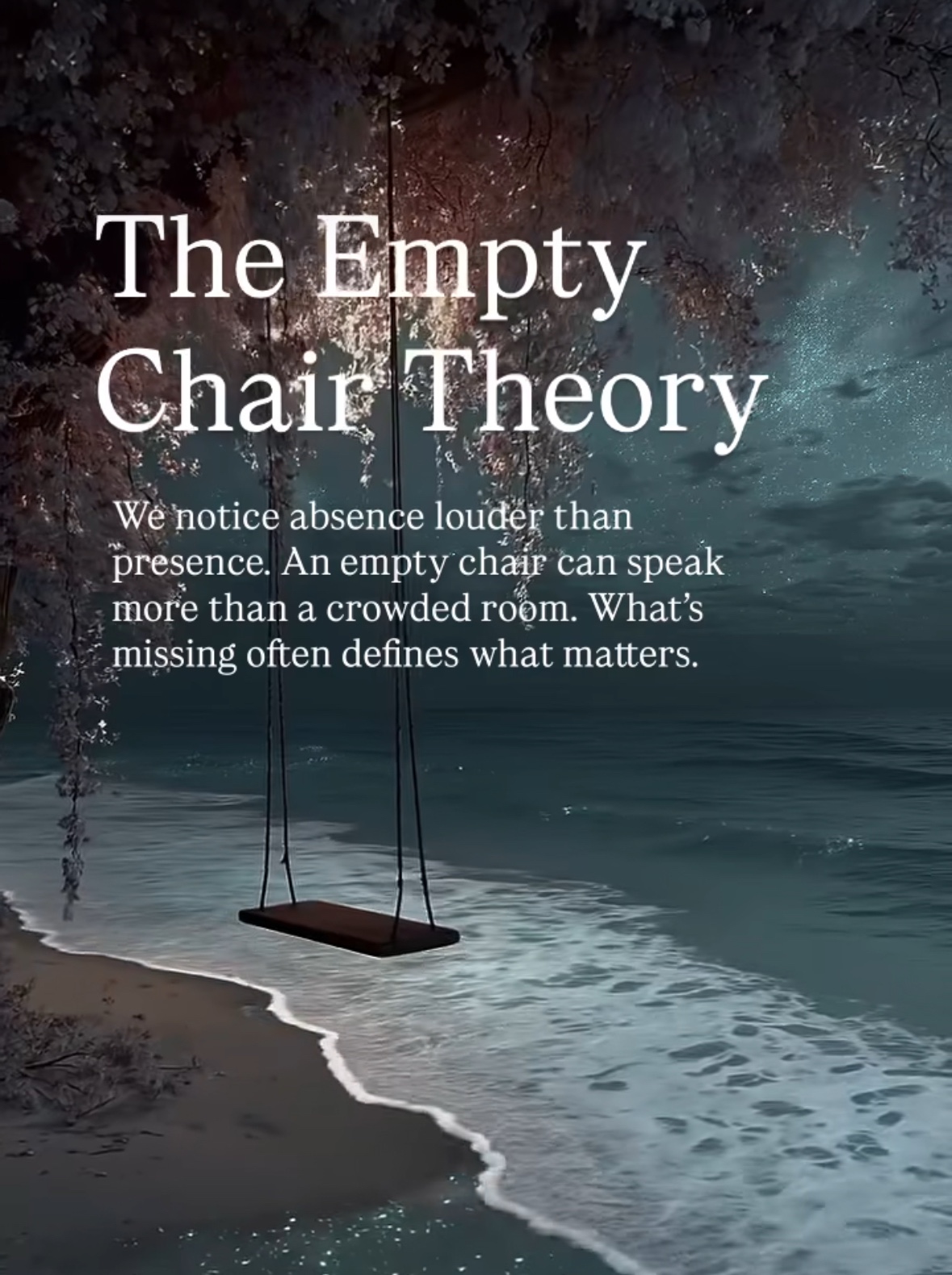
We tend to think presence is what matters most — the words said in a meeting, the people at a party, the full seats in a hall. But often, it’s not what’s present that carries the deepest weight. It’s what’s missing. The empty chair at a dinner table. The unreturned call. The quiet in a once-noisy space.
Absence has a strange way of shouting. An empty chair draws the eye more than the occupied ones. A missing person can dominate a room in a way their presence never did. We are wired to notice gaps because gaps demand meaning. We try to fill them with stories, memories, or projections.
This is The Empty Chair Theory — the idea that what’s missing defines what matters. It isn’t just about loss. It’s about attention. The empty chair forces us to ask: who isn’t here? Why does it matter? What have we overlooked?
Think about meetings at work. A person skipping a key discussion sends a stronger signal than a dozen people showing up. Think about relationships. The friend who doesn’t call back can dominate your thoughts far more than the ones who do. Even in art, a blank space on a canvas or a pause in a song can be more powerful than a crowded composition.
This theory also challenges how we show up in our lives. We often assume our presence is enough — that simply being there ticks the box. But the real impact may come from the moments when our absence is felt. Will people notice the empty chair we leave behind? Will they miss the energy we brought?
And on the flip side, it’s a reminder to appreciate presence before it becomes absence. To notice the filled chairs, the voices in the room, the everyday constants we take for granted. Because one day, the empty chair might be the loudest thing we hear.
In the end, The Empty Chair Theory teaches us two things:
- Pay attention to what’s missing — it’s often more revealing than what’s present.
- Be intentional with your presence — it leaves a trace that lingers even in your absence.
Sometimes silence is louder than speech. Sometimes emptiness speaks the truth fullness hides. And sometimes, a single empty chair can tell the whole story.
 Kenrick Vaz