
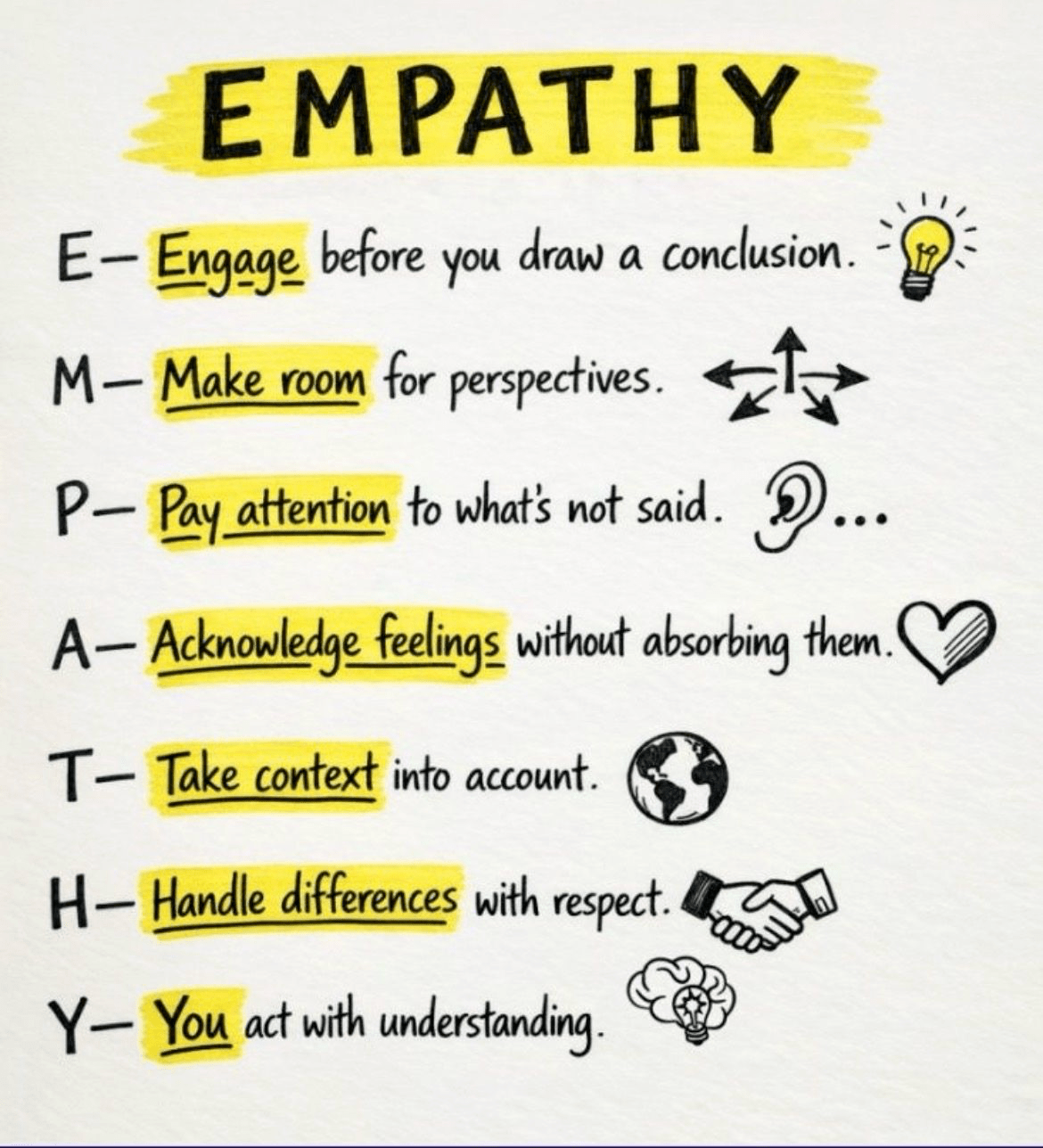
Empathy gets talked about a lot, but honestly, it’s still one of the most misunderstood qualities in life and work.
People often think empathy means being soft. Or agreeing with everyone. Or taking on other people’s emotions until you’re drained. But real empathy is none of that.
Real empathy is awareness. It’s discipline. It’s the ability to pause long enough to understand what might be happening beneath the surface before reacting from your own assumptions.
And in a world where everyone is moving fast, responding fast, and judging even faster, empathy has quietly become one of the rarest strengths you can have.
It starts with something simple: engage before you draw a conclusion.
That sounds obvious, but most of us do the opposite more often than we realize.
Someone responds with a short message, and we assume they’re upset. Someone misses a deadline, and we assume they’re careless. Someone seems distant, and we assume they don’t care.
But assumptions are usually stories we tell ourselves in the absence of context.
Empathy asks for a different approach. It asks us to lean in before we label. To ask before we decide. To understand before we react.
That one shift alone can change relationships, teams, and entire conversations.
Then comes the next part: make room for perspectives.
This is where empathy gets harder.
Because it’s easy to be understanding when someone sees the world the way you do. It’s much harder when their behavior, opinion, or response doesn’t make sense to you.
But empathy isn’t reserved for people who are easy to understand. It matters most when someone’s perspective is different from your own.
Maybe they’re reacting from fear and not logic. Maybe they’re carrying pressure you can’t see. Maybe their life experiences shaped them in ways you haven’t considered.
You don’t have to agree with someone’s perspective to respect that it exists.
That’s maturity.
That’s emotional intelligence.
And that’s often the difference between a conversation that creates distance and one that creates trust.
Another part of empathy that people overlook is this: pay attention to what’s not said.
Not everything important is spoken out loud.
Sometimes the loudest signals are in the pauses, the hesitation, the change in tone, the “I’m fine” that clearly doesn’t mean fine.
Some people won’t tell you they’re overwhelmed.
Some won’t admit they’re hurt.
Some won’t say they feel left out, unsupported, or exhausted.
But if you pay attention, you’ll notice.
Empathy isn’t just about listening to words. It’s about noticing energy. Body language. Patterns. Silence.
And sometimes, what someone can’t say directly tells you more than what they do.
That doesn’t mean you become responsible for fixing everything. Which brings us to one of the healthiest reminders in your illustration: acknowledge feelings without absorbing them.
This one matters.
Because empathy without boundaries turns into emotional burnout.
You can care deeply without carrying everything.
You can be supportive without becoming overwhelmed.
You can hold space for someone without losing yourself in their pain.
That’s not coldness. That’s balance.
A lot of people confuse empathy with emotional overextension. But the most grounded people know how to say, “I see what you’re feeling. I understand this matters. I’m here with you,” without drowning in it.
That kind of empathy is sustainable.
That kind of empathy is strong.
And it gets even better when you remember to take context into account.
Context changes everything.
A harsh response from a stranger is one thing.
A harsh response from someone who’s been under nonstop pressure, navigating family stress, and barely sleeping is another.
A teammate missing one detail may look like carelessness.
But if they’ve been holding together three different priorities and quietly putting out fires all week, the story looks very different.
Context doesn’t excuse bad behavior forever.
But it often explains what judgment alone never can.
And when you understand context, you respond better.
You become less reactive.
Less rigid.
Less likely to turn a temporary moment into a permanent label.
That’s what empathy protects us from: reducing people to one bad day, one awkward moment, one misunderstood decision.
Then there’s a part we need more of everywhere right now: handle differences with respect.
Not everyone will think like you.
Not everyone will communicate like you.
Not everyone will process emotions, conflict, pressure, or change the same way you do.
And that’s okay.
Empathy doesn’t mean erasing differences. It means learning how to navigate them without disrespect.
It means staying human in disagreement.
It means being firm without being cruel.
It means remembering that someone can be different without being wrong in every way.
Some of the strongest people I’ve met aren’t the ones who dominate conversations or win arguments.
They’re the ones who know how to stay respectful even when emotions run high.
That’s not weakness.
That’s control.
That’s character.
And finally, empathy becomes real when you act with understanding.
Because empathy isn’t just something you feel. It’s something you do.
It shows up in the extra question you ask before reacting.
In the pause before sending that sharp reply.
In the grace you give someone who’s clearly not at their best.
In the way you make space for someone to explain themselves.
In the way you choose curiosity over ego.
That’s what makes empathy powerful.
Not the quote.
Not the concept.
The action.
The truth is, empathy doesn’t always solve everything.
It won’t remove conflict.
It won’t make every relationship easy.
It won’t guarantee everyone understands you back.
But it does make you better.
It makes you wiser with people.
Safer to talk to.
Harder to misunderstand.
Easier to trust.
And in a world full of quick opinions and short patience, that’s a rare kind of strength.
So the next time you’re tempted to jump to a conclusion, assume the worst, or react before you understand—pause.
Engage first.
Make room.
Pay attention.
Acknowledge.
Consider context.
Respect differences.
Then act from understanding.
That’s empathy.
And more often than not, it changes everything.
 Kenrick Vaz