
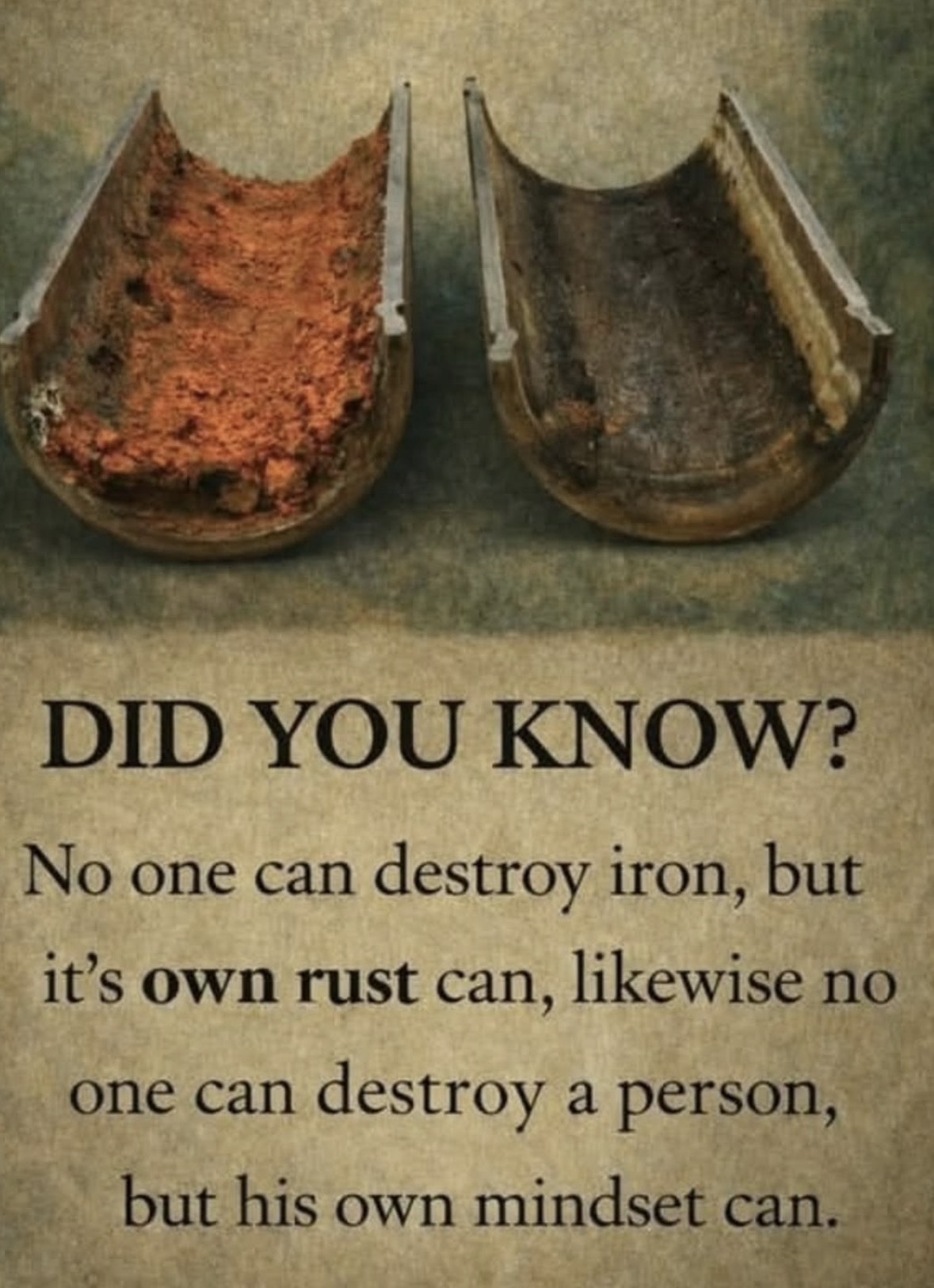
Iron looks invincible.
Strong. Solid. Unshakable.
You can strike it, test it, pressure it, and it still holds its ground. It takes force to bend it. It takes heat to shape it. It takes effort to break it.
And yet, for all its strength, iron has one quiet weakness.
Rust.
Not something from the outside trying to destroy it in one dramatic moment. Not a single blow. Not some massive enemy. Just a slow, silent process from within and around it that, over time, weakens what once seemed unbreakable.
That’s what makes this thought so powerful.
No one can destroy iron, but its own rust can. In the same way, no one can truly destroy a person the way their own mindset can.
That hits hard because it’s true in ways most of us don’t want to admit.
A lot of people spend their lives worrying about external obstacles. The competition. The critics. The failures. The betrayals. The bad luck. The missed opportunities. The people who doubted them. The doors that never opened.
And yes, those things are real. Life can absolutely be unfair. People can hurt you. Circumstances can slow you down. Disappointments can shake you.
But often, the real damage doesn’t come from what happened.
It comes from what you start believing because of what happened.
You fail once, and suddenly your mind whispers, “Maybe I’m not good enough.”
You get rejected, and your thoughts turn it into, “I’m always overlooked.”
You make a mistake, and instead of learning from it, you label yourself as incapable.
You go through heartbreak, loss, or disappointment, and before long, you’re not just carrying pain. You’re carrying a story that says you’re unlucky, unworthy, or destined to keep losing.
That’s the rust.
Not the event itself.
The meaning you let it attach to your identity.
That’s what slowly weakens people.
Not because they aren’t strong, but because even strong people can be worn down by repeated negative thoughts they stop questioning.
Mindset isn’t just about “thinking positive” all the time. It’s not pretending everything is fine when it isn’t. It’s not forcing fake motivation on hard days. And it’s definitely not ignoring real struggles.
Mindset is deeper than that.
It’s the lens you use to interpret your life.
It’s the voice in your head when no one else is around.
It’s the story you tell yourself after a setback.
It’s the difference between “This is hard” and “I can’t do hard things.”
It’s the difference between “I’m learning” and “I’m failing.”
It’s the difference between “This season is painful” and “My life is ruined.”
The world will test you. That part is guaranteed.
But your mindset decides whether the test becomes a lesson or a life sentence.
Think about how many people look successful on the outside but are quietly losing on the inside. They have talent, resources, support, opportunity, maybe even admiration from others. But their thoughts are constantly working against them.
They second-guess every move.
They compare themselves to everyone.
They replay old mistakes.
They expect rejection before they even try.
They talk themselves out of chances they haven’t even taken yet.
They sabotage progress because deep down, they don’t believe they deserve it.
From the outside, they still look like iron.
But inside, the rust has started.
And the scary thing about rust is that it doesn’t always announce itself.
It can sound reasonable.
It can sound like caution.
It can sound like humility.
It can sound like “being realistic.”
But there’s a difference between realism and self-destruction.
Realism says, “This will take work.”
Rust says, “Why bother?”
Realism says, “You’re not there yet.”
Rust says, “You’ll never get there.”
Realism says, “You made a mistake.”
Rust says, “You are the mistake.”
That distinction matters more than most people realize.
Because the way you speak to yourself becomes the way you see yourself.
And the way you see yourself shapes what you attempt, what you tolerate, what you believe you deserve, and how long you keep going when things get hard.
The good news is this: rust can be dealt with.
It can be noticed early.
It can be cleaned off.
It can be prevented.
And the same is true for the mind.
You can catch negative patterns before they become identity.
You can challenge beliefs that were built in pain.
You can replace constant self-criticism with self-awareness.
You can stop assuming every hard season means you’re failing.
You can choose thoughts that strengthen you instead of slowly eating away at you.
That doesn’t happen overnight.
It takes intention.
It takes honesty.
It takes paying attention to the conversations you have with yourself when nobody else can hear them.
Because that inner dialogue is shaping more of your future than you think.
You don’t need a perfect mindset. Nobody has one.
You just need a healthier one.
One that says, “I can grow.”
One that says, “This moment doesn’t define me.”
One that says, “I’ve survived hard things before.”
One that says, “I may not have control over everything, but I do have control over what I feed my mind.”
That last part is huge.
You can’t always control who disappoints you.
You can’t always control what falls apart.
You can’t always control how long a storm lasts.
But you can control whether you let every storm convince you that you were never meant to see sunshine again.
That’s where strength really lives.
Not in pretending you never struggle.
But in refusing to let struggle become your identity.
So protect your mind the way you’d protect anything valuable.
Be careful what you repeat to yourself.
Be careful what voices you let shape you.
Be careful what pain you allow to become permanent truth.
Because most people aren’t destroyed all at once.
They’re slowly worn down by the beliefs they keep feeding.
And just like iron, the greatest threat isn’t always what hits from the outside.
Sometimes it’s what’s quietly forming within!
 Kenrick Vaz