
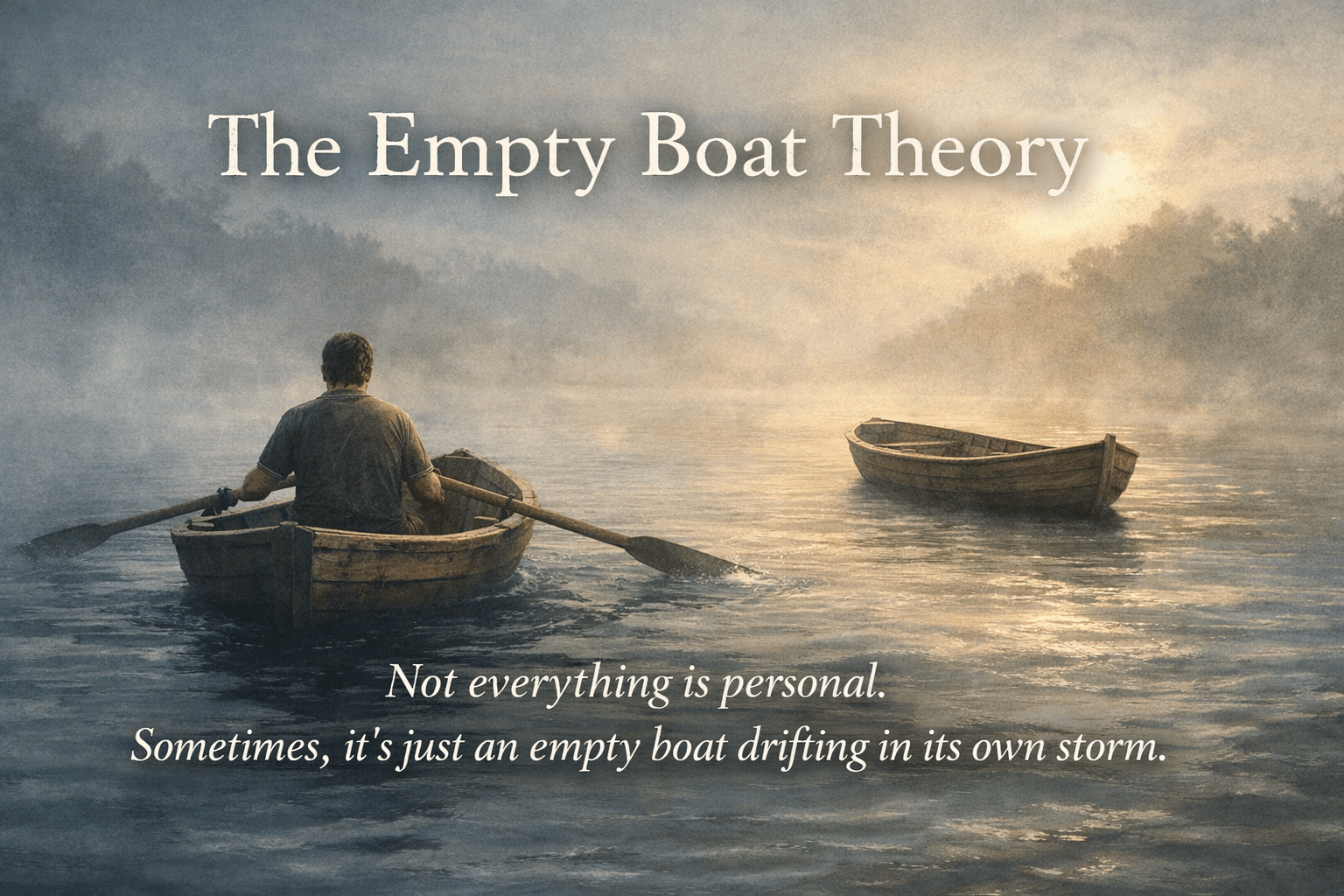
There’s an old story from ancient philosophy that feels strangely modern.
Imagine you’re rowing across a river.
It’s quiet. Calm. You’re focused.
Then suddenly, another boat slams into yours.
Instantly, your body reacts.
You tense up. You get irritated. Maybe angry. Maybe ready to yell.
Who rows like that?
What’s wrong with people?
But then you look up.
And the boat is empty.
No one’s inside.
And just like that… the anger disappears.
Same collision.
Same impact.
Same inconvenience.
But the emotional charge is gone.
Why?
Because there’s no one to blame.
That’s the heart of the Empty Boat Theory.
It’s such a simple image, but once it clicks, it’s hard to unsee.
A lot of what hurts us emotionally isn’t just what happened.
It’s what we think it means.
Someone cuts you off in traffic.
A coworker gives a short reply.
A friend doesn’t text back.
Someone interrupts you.
Someone seems cold, dismissive, distracted, rude.
And before you even realize it, your mind starts filling in the blanks.
They disrespected me.
They ignored me on purpose.
They don’t care.
They’re being difficult.
They’re trying to get under my skin.
Most of us do this automatically.
Psychology has a name for it: attribution.
We’re constantly assigning reasons to people’s behavior. We don’t just observe what they did — we decide why they did it.
And a lot of the time, especially when we’re already stressed, tired, or emotionally loaded, we assume intention where there may be none.
That’s what makes the Empty Boat Theory so powerful.
It reminds us that sometimes we’re not reacting to the actual event.
We’re reacting to the story we attached to it.
That story might be true.
But it also might not be.
Maybe the person who was short with you is overwhelmed.
Maybe the person who forgot to reply is buried in something heavy.
Maybe the person who seemed rude is anxious, distracted, or carrying pain you know nothing about.
Maybe they’re not attacking you.
Maybe they’re just in their own storm.
That doesn’t excuse genuinely harmful behavior. Not every boat is empty.
Some people are careless. Some actions are intentional. Boundaries still matter. Accountability still matters.
But the problem is that we often treat every collision like it came from a full boat.
And that’s exhausting.
Because when you assume intention too quickly, everything starts to feel personal.
Every delay feels like disrespect.
Every silence feels like rejection.
Every bad mood feels like an attack.
Every misunderstanding feels like betrayal.
That’s a heavy way to move through life.
And most of that weight was never yours to carry.
There’s a concept in psychology called cognitive reappraisal — basically, the ability to reinterpret a situation in a less emotionally reactive way.
Instead of asking, Why are they doing this to me?
You ask, What else could be true here?
That shift sounds small.
But it changes everything.
Because the moment you stop assuming malice, your nervous system relaxes.
Your anger softens.
Your defensiveness lowers.
Your clarity returns.
You become less reactive and more grounded.
You stop handing your peace over to every bump in the river.
That doesn’t mean becoming passive.
It means becoming wiser.
It means learning the difference between what actually happened… and what your mind immediately made it mean.
That’s a life skill.
Honestly, one of the most freeing realizations in adulthood is this:
Not everything is personal.
Not every awkward moment is rejection.
Not every delay is disrespect.
Not every mistake is betrayal.
Not every difficult interaction is about you.
People are often just tired.
Distracted.
Wounded.
Human.
They’re navigating their own currents, their own fears, their own invisible battles.
And sometimes, their boat hits yours not because they meant to hurt you…
but because they’re drifting too.
So the next time someone frustrates you, pause for a second before you let the story take over.
Ask yourself:
Is this a full boat… or an empty one?
That one question can save you from a lot of unnecessary anger.
A lot of misread situations.
A lot of emotional weight you were never meant to carry.
Because sometimes the real peace in life doesn’t come from controlling what bumps into you.
It comes from learning not to assume every collision is personal.
And when you stop taking everything personally…
you stop fighting ghosts in empty boats.
 Kenrick Vaz