
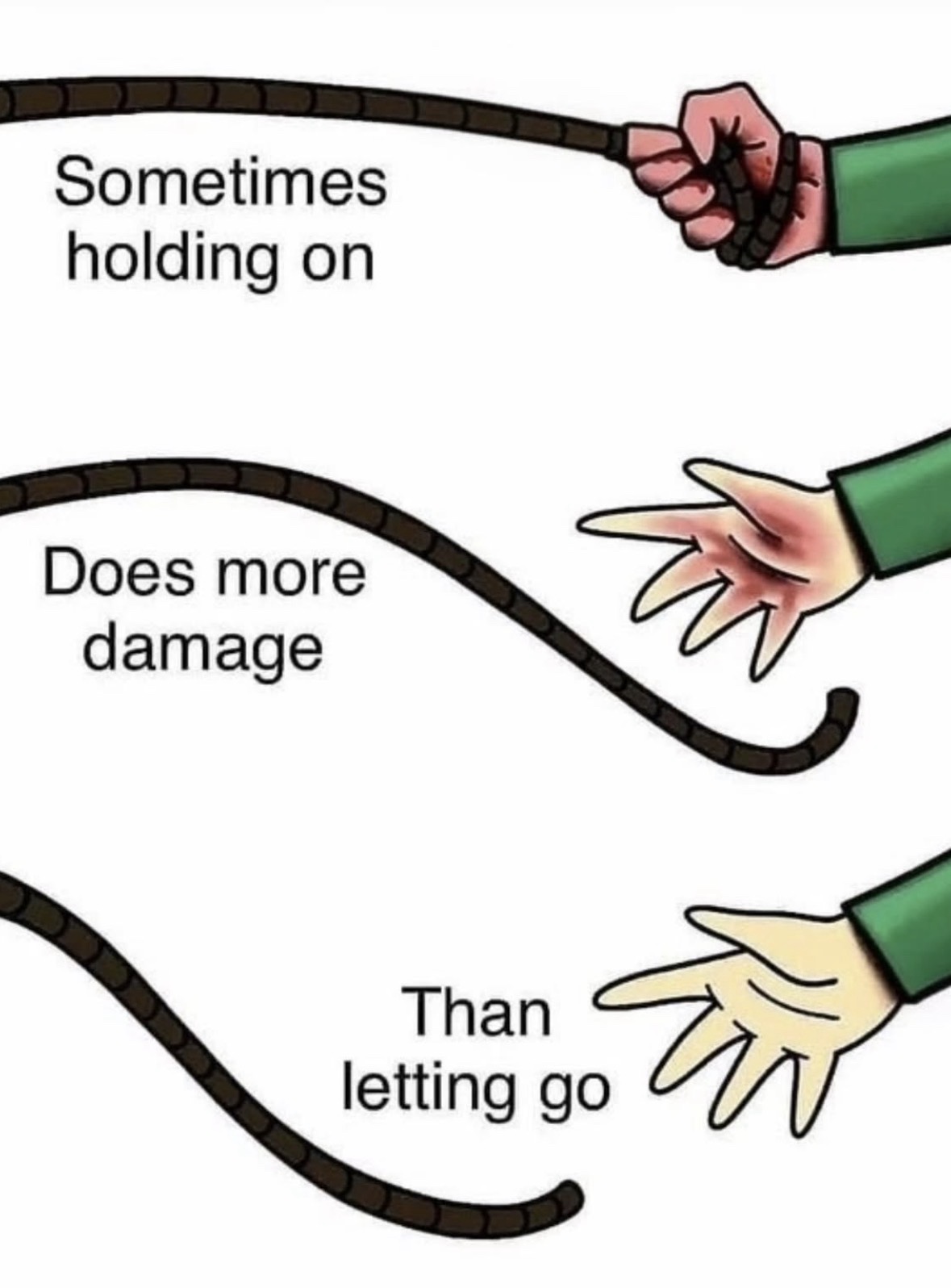
I came across something recently that stuck with me longer than I expected:
Sometimes holding on Does more damage Than letting go.
At first glance, it feels almost too simple. Like one of those lines you read, nod at, and scroll past. But the more I sat with it, the more it started to feel uncomfortably true.
We’re wired to hold on.
To people, to plans, to versions of life we once believed in. We hold on to conversations that didn’t go the way we hoped. To relationships that feel like they’re slipping but we keep gripping tighter anyway. To expectations we quietly built in our heads without realizing how heavy they’d become.
And sometimes, holding on feels like strength.
It feels like loyalty. Commitment. Persistence. Like we’re doing the right thing by not giving up.
But there’s a fine line between strength and strain.
Because not everything we hold on to is meant to stay.
Some things don’t just sit quietly in the background. They weigh on you. They drain your energy in ways you don’t immediately notice. A conversation you replay in your head. A dynamic that leaves you slightly uneasy every time. A situation where you’re constantly justifying why it’s “not that bad.”
That’s the kind of holding on that does damage.
Not dramatic, visible damage. The subtle kind. The kind that builds over time.
You become a little more tired. A little more irritable. A little less like yourself.
And the tricky part? You don’t always connect it to what you’re holding on to.
Because letting go feels like failure.
It feels like admitting something didn’t work. Like you didn’t try hard enough. Like you’re walking away from something that could have been fixed, if only you pushed a little more.
But letting go isn’t always about giving up.
Sometimes it’s about choosing not to carry something that’s quietly breaking you.
There’s a difference between fighting for something and forcing it to stay alive.
The first comes with energy, purpose, and some sense of mutual movement. The second feels like dragging something uphill, alone, hoping gravity will eventually take a day off.
Letting go, in those moments, isn’t weakness. It’s clarity.
It’s recognizing that your time, your peace, and your emotional bandwidth aren’t unlimited resources.
It’s understanding that not every story is meant to be completed the way you imagined.
And more importantly, it’s trusting that releasing something doesn’t erase its value.
Some things were meant to be temporary. Some people were meant to be chapters, not the whole book. Some plans were stepping stones, not destinations.
Holding on to them past their time doesn’t preserve them. It distorts them.
What was once good starts to feel heavy. What was once natural starts to feel forced.
And you end up protecting something that no longer exists in the same way.
Letting go doesn’t mean you didn’t care.
It means you cared enough to be honest about what it’s become.
There’s a quiet kind of strength in that.
Not loud. Not dramatic. No big declarations.
Just a decision.
A moment where you loosen your grip, not because it’s easy, but because you finally see clearly what it’s costing you.
And in that space—right after you let go—there’s something unexpected.
Relief.
Not always immediate. Sometimes it comes in waves. But it shows up.
You start to feel lighter. Your thoughts aren’t as crowded. Your energy shifts.
And slowly, you begin to realize something important:
You didn’t lose as much as you thought.
You just stopped carrying what wasn’t meant for you anymore.
And that changes everything.

