
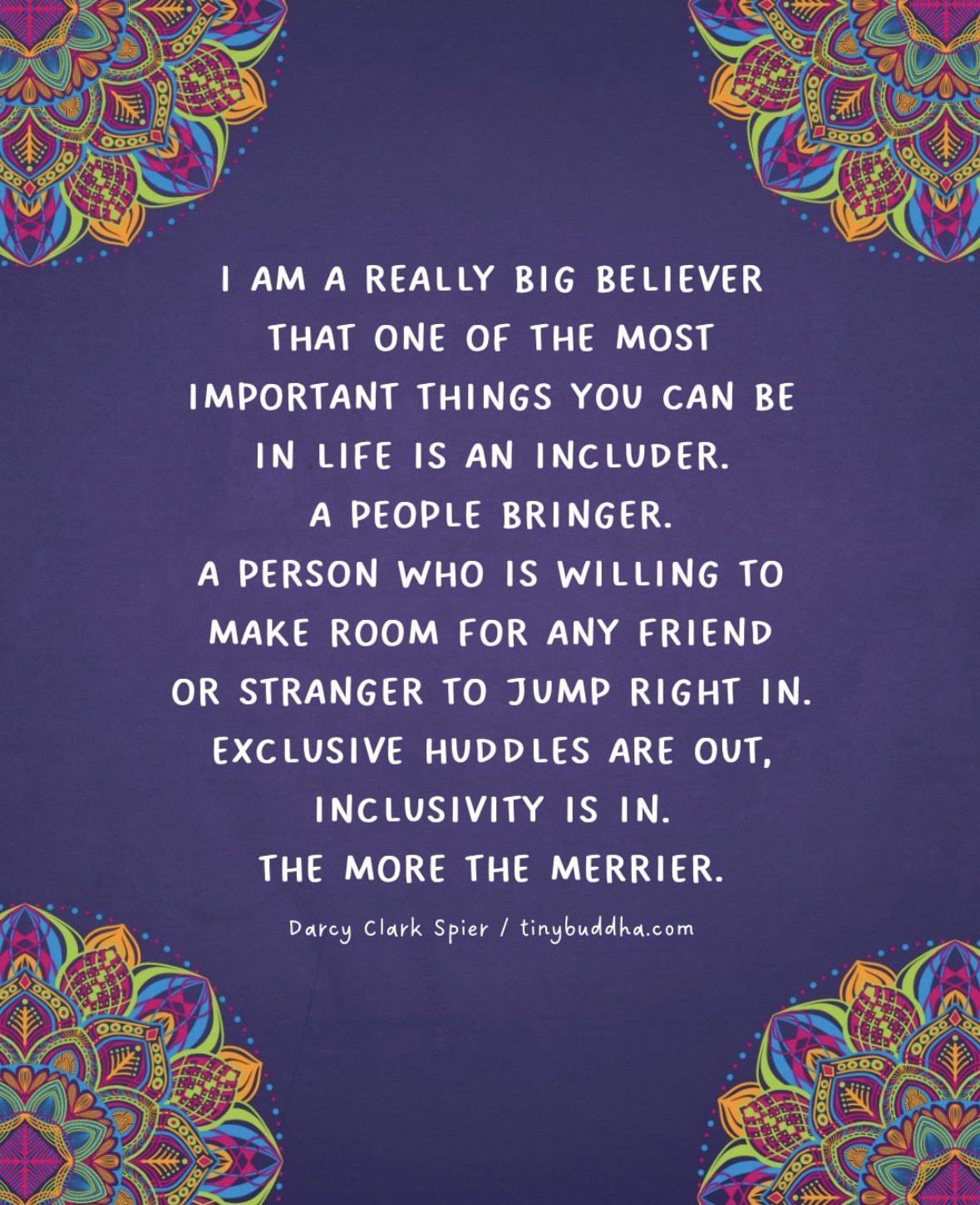
There’s a certain kind of person everyone remembers. Not the loudest in the room. Not the most impressive on paper. But the one who notices when someone is standing alone and does something about it. The one who says, “Hey, come join us,” and actually means it.
That kind of person changes the temperature of a room.
It’s easy to underestimate how powerful that is. We tend to think impact comes from big gestures, big wins, big moments. But more often, it’s built in the small, almost invisible decisions—like choosing to include instead of exclude. Choosing to make space instead of guard it.
Being an includer isn’t complicated, but it does take intention. It means paying attention. It means resisting that quiet instinct to stay within your comfortable circle. It means recognizing that while exclusivity can feel safe, it rarely makes anything better—just smaller.
Think about the last time you walked into a space where you didn’t know anyone. Maybe it was a new job, a social gathering, a meeting, a church, a classroom. There’s always that brief moment of scanning the room, wondering where you fit, if you fit. And then someone makes eye contact, smiles, gestures you over. Instantly, everything shifts. You go from outsider to included in seconds.
That’s not a small thing. That’s everything.
And here’s the part most people miss: inclusion isn’t about grand generosity. It’s about mindset. It’s about deciding that your table isn’t full, even when it looks like it is. It’s about believing there’s always room for one more—one more voice, one more perspective, one more story.
Because when you bring people in, you don’t lose anything. You gain. Conversations get richer. Ideas get sharper. Energy gets lighter. The room becomes more alive. “The more the merrier” isn’t just a saying—it’s a way of experiencing life more fully.
Of course, it’s not always effortless. There are moments when including someone feels inconvenient. When it disrupts the flow. When it asks you to stretch a little socially, emotionally, even culturally. But those are usually the moments that matter most. Anyone can include when it’s easy. It takes something different to include when it’s not.
And let’s be honest—exclusivity can be subtle. It doesn’t always look like shutting people out. Sometimes it’s inside jokes that never get explained. Plans that aren’t extended. Conversations that quietly close themselves off. No one announces it, but people feel it.
Inclusion works the same way, just in the opposite direction. A quick introduction. A simple “you should come.” A pause to bring someone into the conversation. These things seem small, but they send a clear message: you belong here.
That message sticks.
Over time, being an includer becomes less about what you do and more about who you are. You start to notice people differently. You look for the ones on the edge instead of just the ones in front of you. You become someone others trust, because they know you won’t leave them out.
And the ripple effect is real. People who feel included are far more likely to include others. It spreads. What starts as one person making space turns into a culture where space is always being made.
That’s how environments change—teams, communities, even families. Not through policies or slogans, but through consistent, everyday choices by people who decide that no one should feel like an outsider if it can be helped.
You don’t need a title or a platform to do this. You don’t need to be the host, the leader, or the most confident person in the room. You just need to care enough to look around and act on what you see.
So the next time you’re in a group—any group—pay attention. Who’s quiet? Who’s new? Who’s hovering just outside the circle? That’s your moment. Not to make a big deal out of it, but to make a difference in it.
A simple gesture can open a door someone didn’t think was available to them.
Pull up a chair. Scoot over. Make room.
You’ll be surprised how much better everything feels when you do.

