
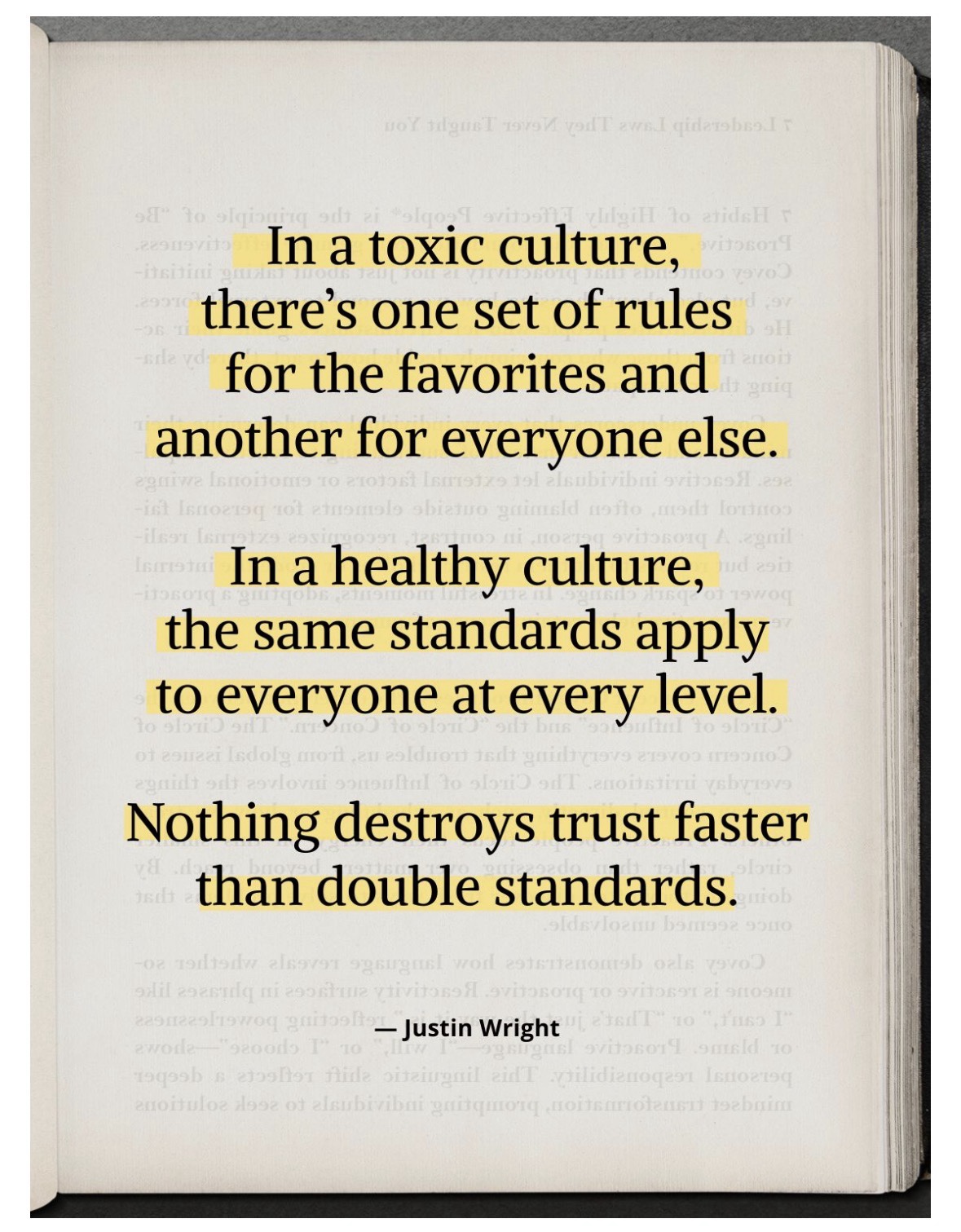
Most people think toxic cultures are created by bad policies, impossible deadlines, or difficult personalities.
Sometimes they are.
But often, the real problem is much simpler.
Different rules for different people.
You can feel it almost immediately when you walk into a workplace, a community, a team, or even a family. One person misses a deadline and gets publicly criticized. Another misses three deadlines and gets a smile and a second chance. One person is expected to follow every process to the letter. Another can ignore the process entirely because they are considered too valuable, too senior, too connected, or simply too well-liked.
Nobody has to announce these rules.
People notice them anyway.
Human beings are remarkably good at spotting unfairness. We may not remember every detail of a conversation, but we remember how consistently people were treated. We remember who got away with things. We remember who was held accountable. And we remember whether the standards seemed to change depending on who was standing in front of them.
The damage starts quietly.
At first, people tell themselves there must be a good reason. Maybe management knows something they don’t. Maybe there are circumstances they aren’t aware of.
But when the pattern continues, trust begins to erode.
People stop believing that effort matters.
They stop believing that performance matters.
Eventually, they stop believing that integrity matters.
Because why would they?
If the outcome depends more on who you are than what you do, then the culture has already communicated its real values.
That’s why double standards are so destructive. They don’t just create frustration. They create cynicism.
And cynicism spreads quickly.
When people see favorites receiving special treatment, they often stop trying to improve the system. Instead, they start figuring out how to survive within it. Politics replaces performance. Visibility replaces contribution. Loyalty to individuals becomes more important than commitment to shared goals.
The saddest part is that leaders often don’t realize it’s happening.
Many double standards aren’t intentional.
A leader may naturally trust certain people more because they’ve worked together for years. A manager may give extra flexibility to someone they personally like. A team may excuse poor behavior from a high performer because they fear losing them.
Each individual decision feels reasonable.
The problem is that culture isn’t built by isolated decisions.
It’s built by patterns.
People don’t judge fairness by what happens once. They judge it by what happens consistently over time.
That’s why healthy cultures look different.
Healthy cultures aren’t perfect. Mistakes still happen. People still receive grace. Circumstances are still considered.
But the standards remain visible and consistent.
The CEO is expected to demonstrate the same values they ask from interns.
Managers are accountable for the same behaviors expected from their teams.
Top performers are celebrated for results without being given permission to disrespect others.
Everyone understands that position may bring responsibility, but it doesn’t bring immunity.
That kind of consistency creates something incredibly valuable.
Psychological safety.
People know where they stand.
They know what is expected.
They know that if they work hard, contribute, and act with integrity, they won’t be competing against invisible rules that change based on popularity.
And when people trust the system, they spend less energy protecting themselves and more energy doing great work.
The strongest cultures are not built on perks, slogans, mission statements, or posters hanging in hallways.
They’re built on fairness.
Not perfect fairness. Human beings will never achieve that completely.
But visible fairness.
Consistent fairness.
The kind of fairness that allows people to believe that standards actually mean something.
Because once people conclude that the rules only apply to some and not others, trust disappears.
And trust is much harder to rebuild than it is to lose.
Nothing destroys a culture faster than double standards.
And very few things strengthen one more than leaders who are willing to hold everyone—including themselves—to the same standard.

