
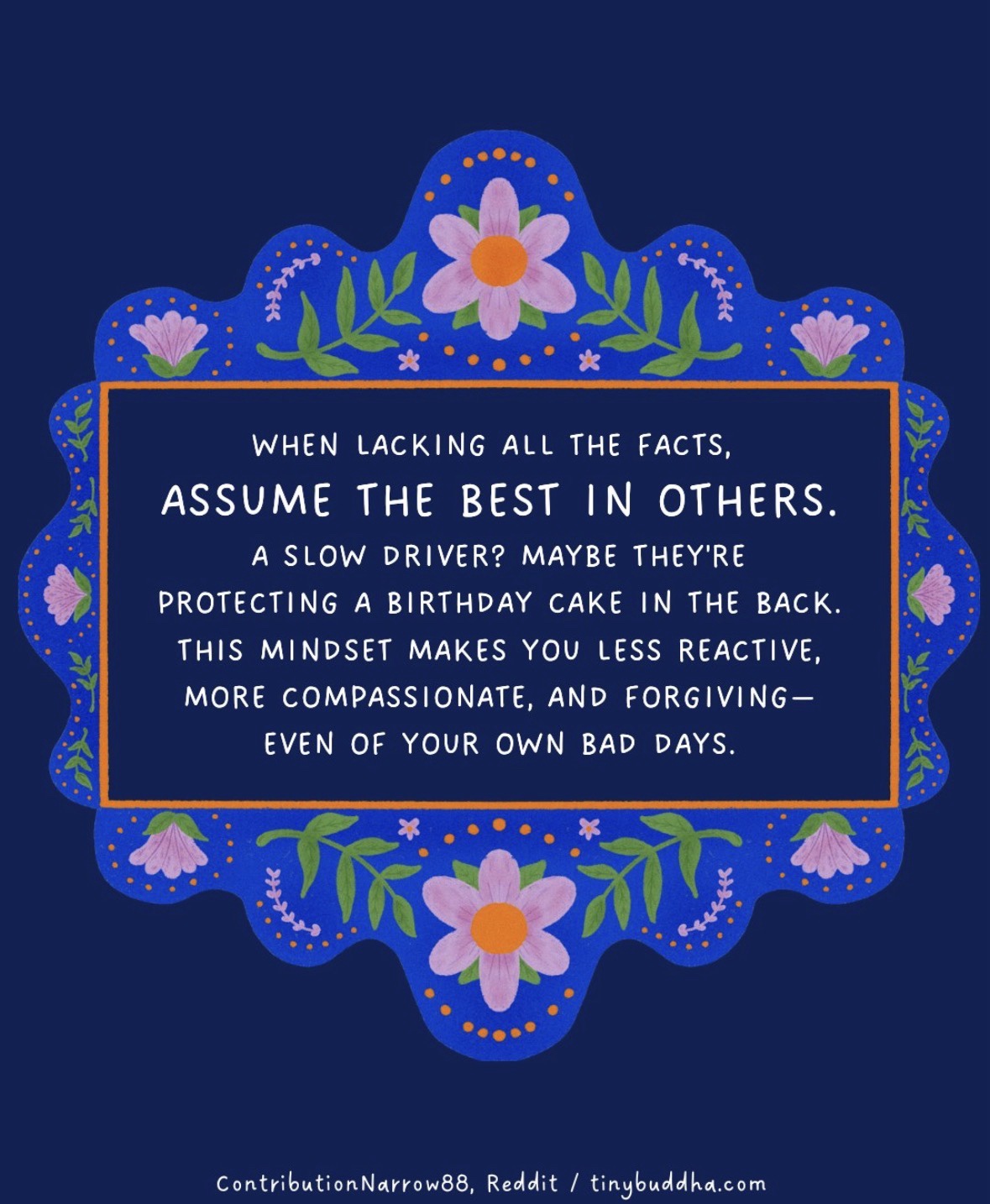
You’re driving home after a long day. Traffic is crawling. The car in front of you refuses to go any faster. You sigh, tap the steering wheel, and start building a story in your head. They’re distracted. They don’t know how to drive. They have no respect for anyone else’s time.
Maybe.
Or maybe they’re carrying a birthday cake in the back seat, trying not to let it slide onto the floor before a little kid blows out the candles.
You’ll probably never know which story is true. That’s the point.
Our brains are wired to fill in missing information. The problem is that we usually fill it with the least generous explanation. Someone doesn’t reply to your message. They must be ignoring you. A coworker gives a short answer. They must be upset with you. A friend cancels dinner. They probably didn’t want to meet in the first place.
Most of the time, we don’t have enough facts to make those calls. We just make them anyway.
What if we chose a different default?
Not blind optimism. Not pretending people never make mistakes. Just giving them the benefit of the doubt until there’s a reason not to.
The slow driver could be nervous because they’re taking their teenager out for their first lesson. The cashier who barely smiled might be finishing a ten hour shift. The parent whose child is having a meltdown in the grocery store has probably tried everything before you walked into that aisle.
None of those explanations might be true. They don’t have to be.
The goal isn’t to guess correctly. The goal is to stop assuming the worst when you have no evidence.
It’s surprising how much energy we waste reacting to stories we’ve invented ourselves. One assumption turns into irritation. Irritation turns into frustration. Before long, we’ve carried someone else’s imagined mistake through the rest of our day.
A kinder assumption breaks that cycle.
It changes how you respond. You stop leaning on the horn. You wait a few extra seconds. You speak with a little more patience. You walk away from conversations that would have become arguments if you had insisted your first impression was the only possible one.
The biggest surprise is that this mindset doesn’t just change how you see other people. It changes how you see yourself.
We all have bad days. Days when we forget things, snap at someone we love, miss a deadline, or simply don’t have much left in the tank. If your default is to believe every mistake reveals a flaw in someone’s character, you’ll treat yourself the same way.
One bad meeting becomes “I’m terrible at my job.”
One missed workout becomes “I have no discipline.”
One mistake as a parent becomes “I’m failing.”
That’s just another story your brain created without all the facts.
Maybe you were exhausted. Maybe you were overwhelmed. Maybe today was simply harder than yesterday.
You can take responsibility without attacking yourself.
The world gives us enough reasons to be impatient. We don’t need to invent more.
The next time someone tests your patience, picture the birthday cake sitting carefully on the back seat. Picture the person hoping they make it home without ruining someone’s special day.
You don’t have to believe that’s what happened.
You just have to remember that it’s every bit as possible as the story that made you angry.
 Kenrick Vaz