
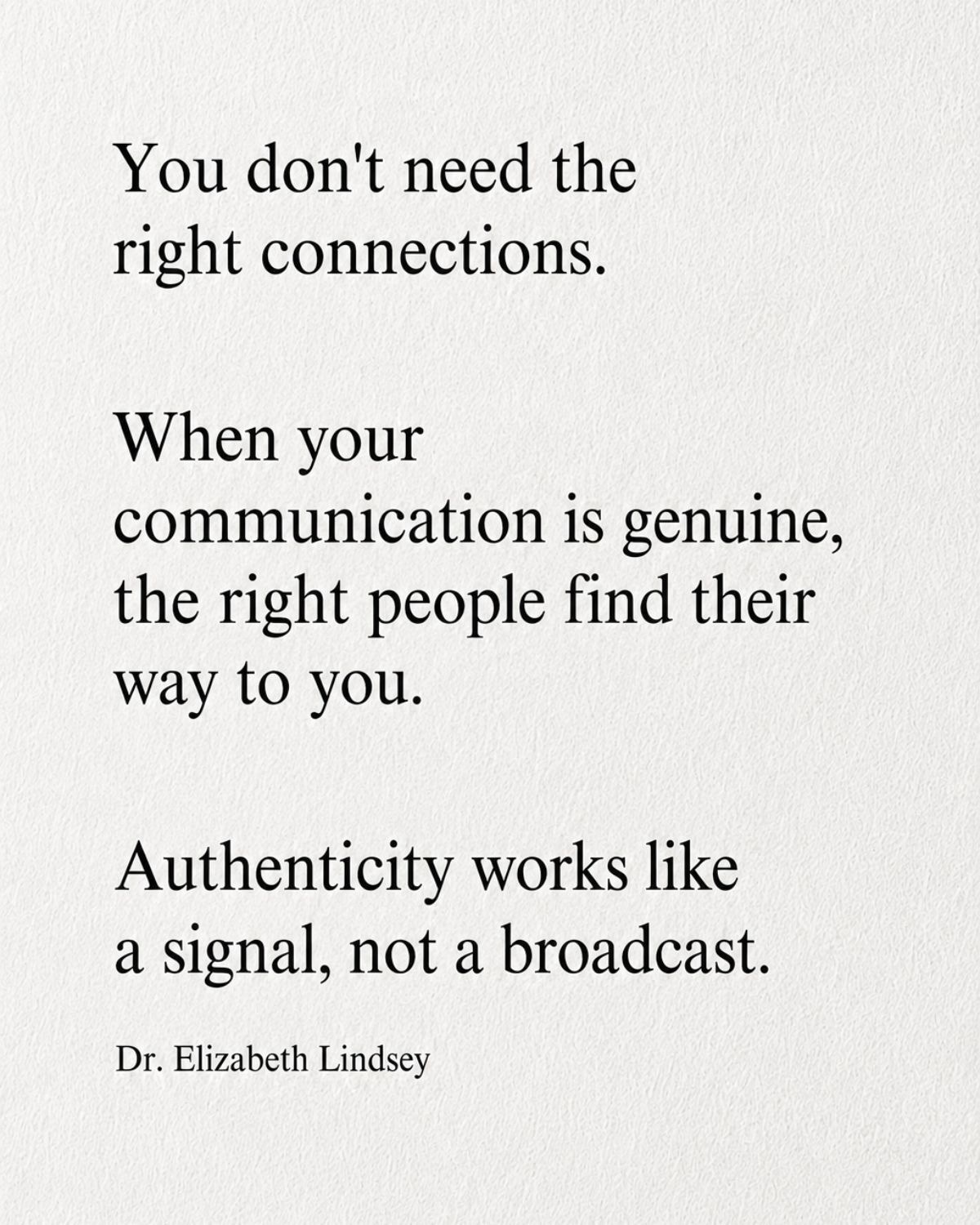
“You need to know the right people.”
It gets repeated so often that it starts sounding like a rule.
People spend hours trying to get introductions, collecting LinkedIn connections, attending networking events, and handing out business cards they’ll never look at again. They think the next conversation will unlock the next opportunity.
Sometimes it does.
Most of the time, it doesn’t.
Real relationships rarely begin because someone forced an introduction. They grow because something about the other person felt genuine enough to remember.
That’s why authenticity works more like a signal than a broadcast.
A broadcast tries to reach everyone. A signal reaches the people who are already tuned to what you stand for.
Think about the people you’ve chosen to follow online. Chances are it wasn’t because they had the biggest audience. It was because they consistently shared ideas that made you stop scrolling. They sounded like themselves. Over time, you felt like you knew how they thought.
That’s a signal.
The same thing happens in everyday life.
One person fills every conversation with buzzwords and rehearsed stories. Another speaks honestly about what they’re learning, what went wrong, and what they’re trying next. Guess which person people remember a week later.
People can sense when they’re being managed instead of being spoken to.
The strongest professional relationships I’ve seen didn’t begin with a carefully planned networking strategy. They started with someone solving a problem, sharing an idea, helping without expecting anything back, or simply showing up consistently.
Those actions create trust.
Trust creates conversations.
Conversations create opportunities.
You can’t fake that sequence for very long.
Social media makes it tempting to optimise every post for attention. Every headline has to sound bigger. Every achievement has to look more impressive. Every photo has to prove you’re doing something important.
Ironically, that often makes people less memorable.
The posts that stick are usually the ones that feel human. Someone admits they got something wrong. They explain how they fixed it. They share a lesson that came from real experience instead of copying the latest trend.
People don’t connect with perfection.
They connect with honesty they recognise.
The same applies inside organisations.
You don’t become the person everyone wants to work with because you know the most people. You become that person because colleagues know what they’ll get when they work with you. Clear communication. Reliability. Curiosity. Respect. Those qualities spread through conversations you never hear.
Someone recommends you in a meeting you weren’t invited to.
Someone forwards your name when an interesting project appears.
Someone remembers a conversation from months ago because you listened instead of waiting for your turn to speak.
None of those moments can be forced.
They happen because your reputation travelled before you did.
That doesn’t mean staying silent and hoping people discover you.
Signals still need to be sent.
Write about what you’re learning.
Share work you’re proud of.
Ask thoughtful questions.
Help someone solve a problem.
Give credit freely.
Keep your promises.
Those small actions tell people far more than a polished personal brand ever could.
The interesting part is that genuine communication also filters people out.
Not everyone will agree with your perspective.
Not everyone will like your style.
That’s not a flaw.
If you’re trying to appeal to everyone, you’ll probably leave nobody with a clear impression of who you are.
When you’re consistently yourself, the people who value the same things naturally move closer. Others move on. Both outcomes save time.
The goal isn’t to collect the largest network.
It’s to build relationships where people trust your words because they’ve seen your actions match them again and again.
The right people rarely appear because you chased them.
More often, they notice the signal you’ve been sending all along.

