
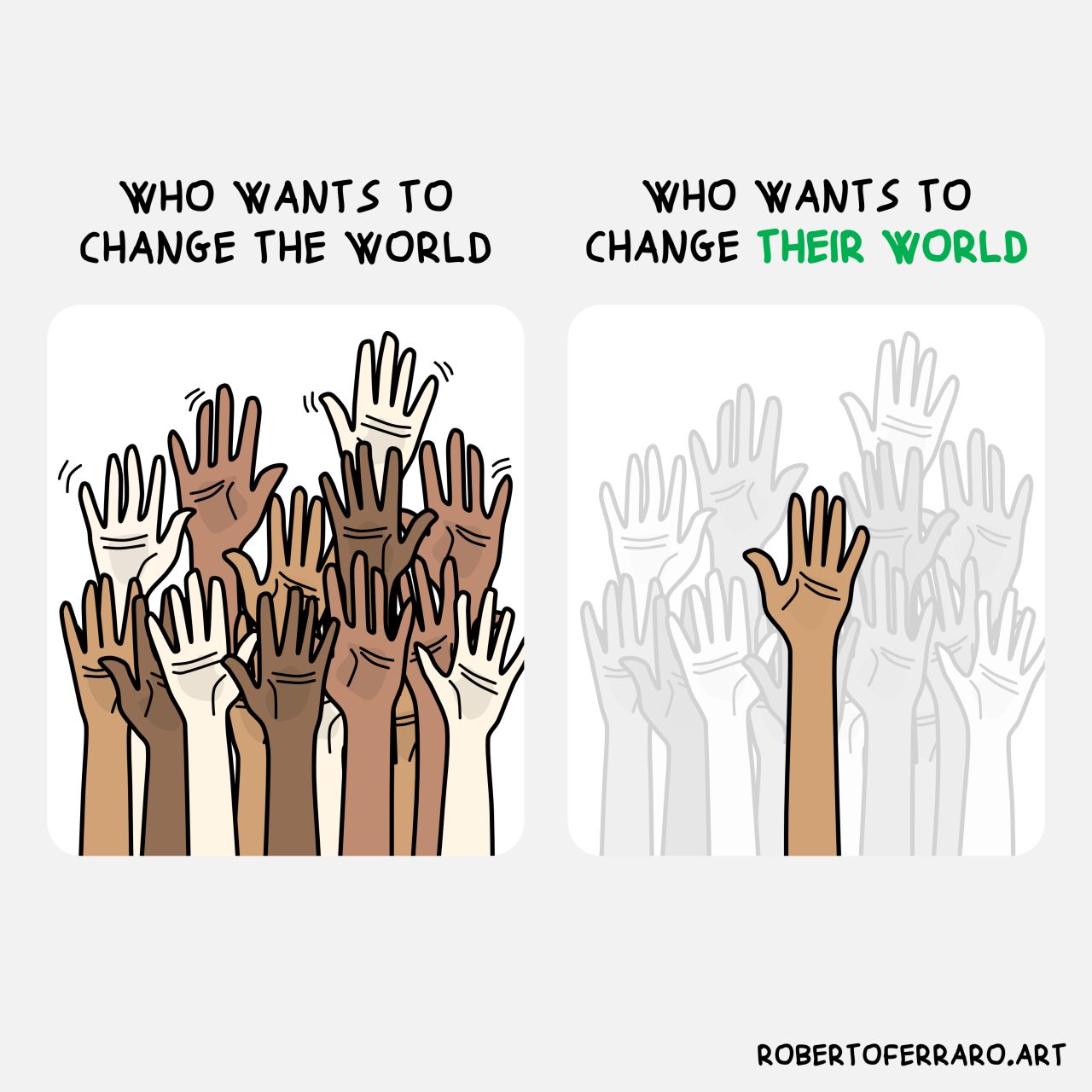
There is something interesting about the two sides of this illustration.
On one side, several hands reach up with a bold question:
WHO WANTS TO CHANGE THE WORLD?
Almost everyone likes the idea.
We talk about changing industries, fixing broken systems, improving education, building better technology, creating opportunities, helping communities, and leaving things better than we found them.
It sounds exciting when the goal is big enough.
Then the illustration asks a quieter question.
WHO WANTS TO CHANGE THEIR WORLD?
Only one hand goes up.
That small difference says a lot.
Changing the world is an inspiring idea. Changing your own world takes work.
Your world might be your team at work. It might be your family, your neighborhood, your health, your skills, or the way you spend your time.
Maybe you want to become a better leader. Maybe you want to stop putting off the thing you keep saying you will start. Maybe you want to learn AI instead of watching the industry change around you. Maybe you want to be more present when your phone is sitting right next to you.
Those changes rarely come with applause.
Nobody is going to give you a standing ovation for waking up early to learn something new. Your LinkedIn network probably won’t notice that you handled a difficult conversation better than you would have six months ago. Your child won’t remember every small sacrifice you made to be more present.
You will notice.
That is where change starts.
We often make personal change sound much bigger than it needs to be. We imagine a dramatic decision, a perfect plan, and a completely different version of ourselves waiting on the other side.
Most of the time, it starts with something ordinary.
You read ten pages.
You make the call.
You apply for the job.
You apologize.
You go for the walk.
You spend an hour learning a skill that felt intimidating last month.
You finally start the project you have been talking about for a year.
Small choices change the shape of a day. Enough days can change the shape of a life.
There is another reason people prefer the idea of changing the world.
It gives us distance.
The world is a huge problem. Your own habits are much harder to hide from.
It is easy to have an opinion about how companies should innovate. It is harder to ask whether you are still learning.
It is easy to talk about better leadership. It is harder to look at how you behave when your team makes a mistake.
It is easy to say people should embrace change. It is harder when the change affects your role, your routine, or your paycheck.
Your world is where your choices have consequences.
That makes it worth paying attention to.
You don’t have to solve everything around you. Pick the part of your world where you have some control.
If you lead a team, make the next meeting better.
If you are building something, make the next version better.
If you are learning, spend another hour with the thing you still don’t understand.
If you are raising a child, put the phone down and listen to the story you have heard three times already.
If you are unhappy with your direction, take one step toward a different one.
The hand that goes up in the second question matters.
It represents someone willing to take responsibility for their own corner of the world.
That is where big change often begins.
Someone decides to change what they can reach.
Then someone else sees it.
Then they change something too.
You don’t need to change the whole world today.
Start with yours.

