
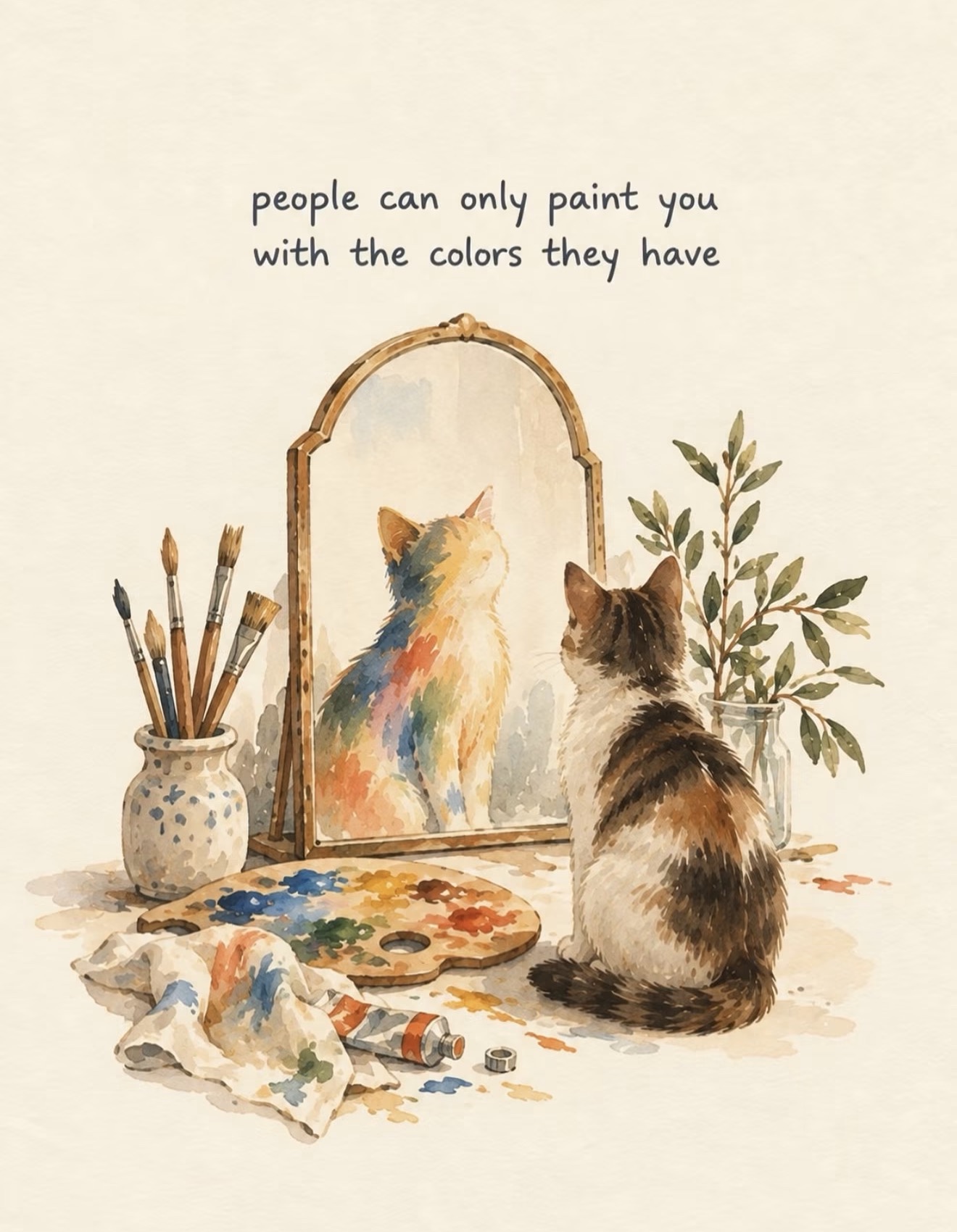
People can only paint you with the colors they have.
Someone sees you as difficult. Someone else thinks you’re brave. One person calls you quiet. Another feels safe around you because you listen. You can walk into the same room, say the same words, behave exactly the same way, and leave behind completely different versions of yourself in everyone’s mind.
That can mess with you if you let it.
We spend a lot of time wondering what people think about us. A strange reply makes us replay the conversation. A cold reaction makes us wonder what we did wrong. Someone misunderstands our intentions, and suddenly we are preparing a ten-minute explanation for something that felt perfectly clear when we did it.
Sometimes the explanation changes nothing.
People don’t meet you with an empty canvas. They arrive carrying years of their own experiences.
Someone who has been lied to may struggle to trust you even when you’re telling the truth. A person who grew up around criticism might hear judgment in an innocent question. Someone who has repeatedly been abandoned may interpret your need for space as rejection. A person who has always had to compete might see your success as a threat.
They are painting with the colors they have.
You do it too.
You meet someone and form an opinion within minutes. Their confidence reminds you of somebody you once knew. Their silence feels unfriendly because silence has meant that before. Their kindness makes you suspicious because you’ve met people who used kindness to get something.
Then you spend more time with them and discover that you had half the picture wrong.
It happens every day.
This becomes especially important when someone forms an opinion of you that feels completely disconnected from who you are.
Maybe you’ve spent years trying to be thoughtful, yet somebody calls you selfish because you finally said no.
Maybe you worked hard for an opportunity and someone decides you were simply lucky.
You leave a job, a friendship, a relationship, or a community because staying was costing you too much. Someone watching from the outside calls you ungrateful.
Their picture can feel convincing because they’re holding the brush.
You still don’t have to hang it on your wall.
There is a difference between listening to feedback and allowing every opinion to become part of your identity. Feedback can teach you something. A person might notice a habit you’ve missed. They may point out that your words landed differently from how you intended. Those moments are worth paying attention to.
An opinion also comes through the person giving it.
Think about who is speaking. Look at how well they know you. Pay attention to whether they are describing something you did or making a sweeping statement about who you are.
“You interrupted me twice during that meeting” gives you something useful to examine.
“You’re an arrogant person” is a much bigger claim.
One describes behavior. The other tries to paint the entire canvas with one color.
We often give too much power to people who have seen only a tiny piece of our lives. A colleague knows the version of you they see during work calls. A relative might still think of you as the person you were ten years ago. Someone on social media knows a few photographs, captions, and opinions you’ve chosen to share.
Even people who love you deeply see you through their own experiences.
You know the conversations you had with yourself before making that difficult decision. You know what it took to get out of bed during a rough week and still show up for people. You remember the apology nobody else heard, the second chance you gave, the temptation you walked away from, the nights you questioned yourself.
Other people see pieces.
That doesn’t make their perspective worthless. It gives it a boundary.
There is freedom in realizing that you cannot manage every version of yourself that exists in other people’s minds. Trying to do that turns life into an endless public relations exercise. You explain more. You soften every sentence. You avoid choices that might upset someone. You start performing a version of yourself designed to be impossible to misunderstand.
And people will still misunderstand you.
So listen when there is something worth hearing. Apologize when you’ve hurt someone. Change when you recognize something in yourself that needs work.
Then allow people to have their paintings.
Some will use warm colors. Some will make you darker than you recognize. A few will capture parts of you beautifully. Others will paint from memory, fear, jealousy, affection, disappointment, admiration, or an experience that had almost nothing to do with you.
You don’t need to grab the brush from their hands.
Keep living long enough for your own colors to become clear.

