
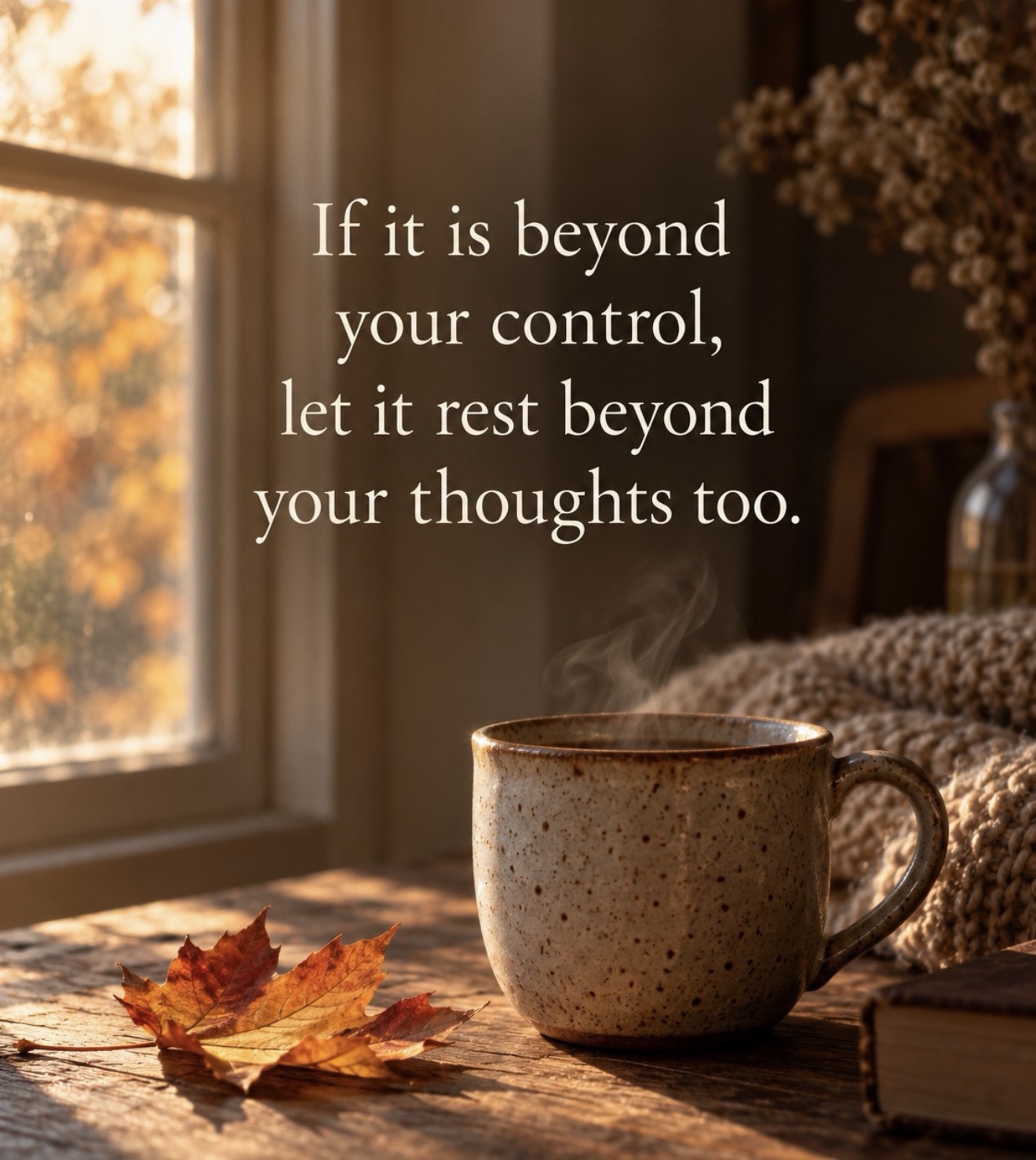
Some things take up far more space in our heads than they deserve.
A conversation that ended badly. A decision someone else made. A message that went unanswered. Something that happened months ago that still manages to find its way into our thoughts when we’re trying to fall asleep.
We replay it. We imagine what we could have said differently. We think about what might happen next, then spend another twenty minutes preparing for a conversation that may never take place.
And somehow, we convince ourselves that all this thinking is helping.
There’s a quote I keep coming back to.
“If it is beyond your control, let it rest beyond your thoughts too.”
It sounds simple enough. Until you try living by it.
Because our minds have a strange habit of treating every uncertainty like a problem that needs solving. We want answers. We want to know why someone behaved a certain way, whether a decision will work out, or what people think about us.
When those answers aren’t available, we start making up possibilities.
Maybe they’re upset with us. Maybe we’ve made a mistake. Maybe something terrible is about to happen.
Before long, we’ve spent an entire evening worrying about something that hasn’t happened, based on information we don’t have.
I’ve caught myself doing this more times than I’d like to admit.
There have been situations where I’ve done everything I reasonably could. I’ve had the conversation, made the effort, sent the email, or taken the decision. The next step belongs to someone else.
Yet my mind keeps going back to it.
What if they misunderstood me? What if things don’t work out? Should I have done something differently?
At some point, thinking becomes a way of trying to control an outcome we’ve already handed over.
And that’s exhausting.
I think one of the hardest things to accept is that we can do everything right and still end up disappointed.
You can prepare thoroughly for an opportunity and still lose it. You can be kind to someone who chooses to walk away. You can explain yourself carefully and still be misunderstood.
You can spend years building something, only for circumstances to change overnight.
None of those experiences becomes easier because you spend another three hours going over them in your head.
Of course, there are things worth thinking about. If you’ve hurt someone, you can apologise. If you’ve made a mistake, you can learn from it. If there’s a difficult conversation you’ve been avoiding, you can pick up the phone.
Those thoughts have somewhere useful to go.
The trouble starts when there’s nothing left for you to do, but you keep asking your mind to find one more solution.
It’s like repeatedly checking the tracking status of a package that’s already on its way. You can refresh the page fifty times. The delivery van will still arrive when it arrives.
Life has plenty of moments like that.
Waiting to hear back after an interview. Wondering whether a friendship will recover. Hoping someone appreciates what you’ve done. Waiting for a medical result. Watching someone you love make a choice you wouldn’t have made.
The waiting can be uncomfortable. Sometimes frightening.
And I don’t think we should expect ourselves to become completely unaffected by things that matter to us.
We’re human. We care. We get attached to people and outcomes. We worry because something feels important.
But caring about something doesn’t mean it deserves unlimited access to our attention.
That’s a distinction I’ve been trying to make more often.
When a thought keeps returning, I ask myself a fairly practical question.
Is there anything I can do about this today?
Sometimes the answer is yes. I can make a call, clarify something, prepare better, or take a small step towards fixing the situation.
Other times, the answer is simply that I have to wait.
And waiting is much harder when we keep mentally rehearsing every possible outcome.
I’ve also noticed how easily worry steals time from the things right in front of us.
You can be sitting at dinner with your family, listening to someone tell you about their day, while half your attention is stuck on an email you received that morning.
You can be out for a walk on a beautiful evening and barely notice the sky because you’re still thinking about something someone said last Tuesday.
You can spend a perfectly good Sunday worrying about Monday.
Those are hours we never get back.
And the frustrating part is that whatever we’re worrying about will usually demand our attention when the time comes anyway. We’ll deal with the conversation when it happens. We’ll make the decision when we have the information. We’ll respond to the news when it arrives.
We don’t need to experience every possible version of the future before we get there.
I’ve started to think that peace has a lot to do with knowing when to stop participating in a problem.
Sometimes that means putting your phone down after sending an important message. Sometimes it means resisting the urge to explain yourself for the fifth time. Sometimes it means accepting that another person’s opinion of you belongs to them.
There will always be people who misunderstand us. Plans that change. Opportunities that disappear. Decisions we wish had gone differently.
We can learn from those experiences without carrying them into every quiet moment of the day.
And some days, we’ll struggle with that. A thought will come back ten minutes after we’ve decided to leave it alone.
That’s fine. We can notice it, recognise that there’s nothing useful to do with it right now, and return to whatever we were doing.
Maybe that’s how we get better at letting things rest. Through ordinary moments when we choose to give our attention back to the life happening around us.
The dinner getting cold on the table. The child asking us to come and play. The friend who’s been trying to tell us a story for the last five minutes.
The evening light coming through the window while our phone sits unanswered on the other side of the room.

