
A quick way to destroy trust?
Have a bonus plan no one understands:
If people don’t know how the prize is earned—
You’re not rewarding performance.
You’re just guessing.
And guessing destroys motivation.
Most bonus plans fail because
they’re vague, hidden, and unfair.
Here’s how to fix that:
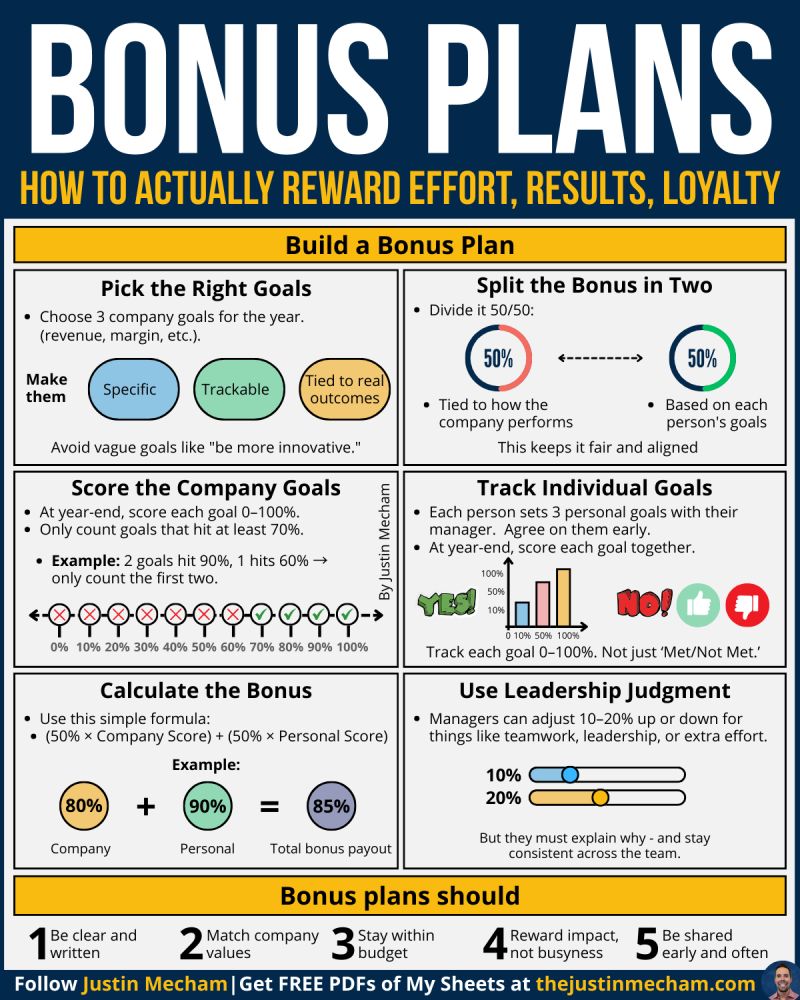
✅ Pick clear company goals
— No fluff. No buzzwords.
— Just 3 measurable priorities.
✅ Split the bonus 50/50
— Half based on company results.
— Half based on personal goals.
— Fair. Simple. Balanced.
✅ Score company goals
— Only count goals that hit 70% or more.
— If one misses, don’t let it sink the rest.
✅ Track individual goals with numbers
— 3 goals per person.
— Set them early. Score each 0–100%.
— Not just “met” or “not met.”
✅ Use this formula:
— (50% × Company Score) +
(50% × Personal Score) = Final Bonus %
— No guesswork. No surprises.
✅ Apply judgment — and explain it
— Managers can adjust by 10–20% for
things like leadership or extra effort.
— But only with clear reasons.
— And it must be consistent.
This isn’t about money.
It’s about meaning.
It’s how you turn effort into impact—
And loyalty into culture.
The Snowball System
Business development isn’t about big wins on day one.
It’s about building unstoppable momentum…
With the actions you take every day.
✅ One article
✅ One insight
✅ One introduction
These small steps might seem minor at first.
But each one moves you forward.
And over time, they start to work together, building
momentum that leads to real growth.
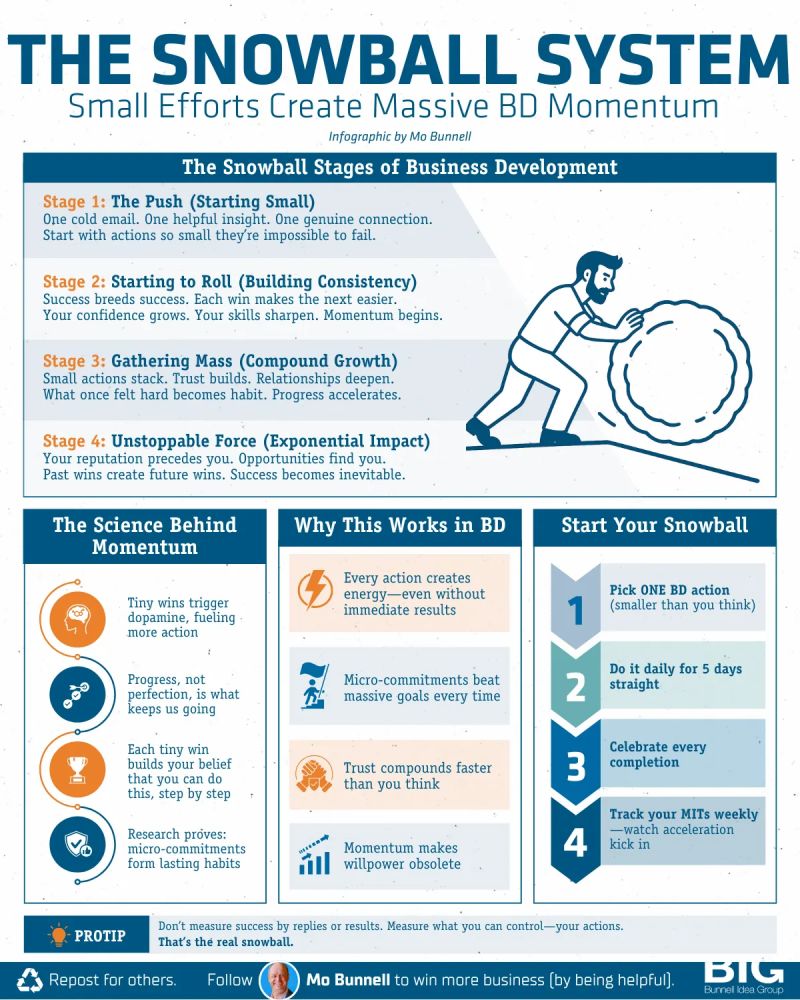
Here’s how it builds—step by step, like a snowball:
1. The Push (Starting Small)
→ Send something useful
→ Share an insight that helps
→ Make a thoughtful introduction
2. The Roll (Building Consistency)
→ Repeat what works
→ Show up weekly with value
→ Let habits lead the way
3. The Mass (Earning Trust)
→ Add value before being asked
→ Follow through every time
→ Make generosity your default
4. The Force (Accelerating Growth)
→ Your name shows up before you do
→ New opportunities start finding you
→ Growth becomes the natural next step
You don’t need a breakthrough moment to succeed.
You just need to keep moving, one helpful step at a time.
In business development, motion creates opportunity.
And momentum does the rest.
And remember:
Don’t measure replies or results.
Measure what you control: your actions.
That’s the real snowball system.
What’s one small step you can take today to build
your snowball?
Drop it in the comments. 👇
I’d love to hear it.
♻️ Valuable? Repost to help someone in your network.
📌 Follow Mo Bunnell for client-growth strategies that
don’t feel like selling.
P.S. Are you a lawyer looking to grow your legal practice?
I’m cohosting a live webinar on October 1:
Beyond the Billable Hour: Mastering Relationship Development to Build a Thriving Legal Practice
It’s normally a paid event, but I have a code that makes it free for you: BBHCLE25.
💡 Shift from transactions to trust
💡 Focus on the right relationships
💡 Use simple systems to grow consistently
Most lawyers spend years perfecting their craft. But the truth is,
your relationships drive your practice.
Future of Jobs with AI
Future of Jobs with AI
Most career advice for kids is outdated. Especially in the age of AI.
Here’s how I’m preparing my own kid—and what I’d tell any parent asking the same question.
I have thought about this a lot over the last weeks.
The result is this: I have identified 3 future-proof path for our kids (and probably ourselves too!)
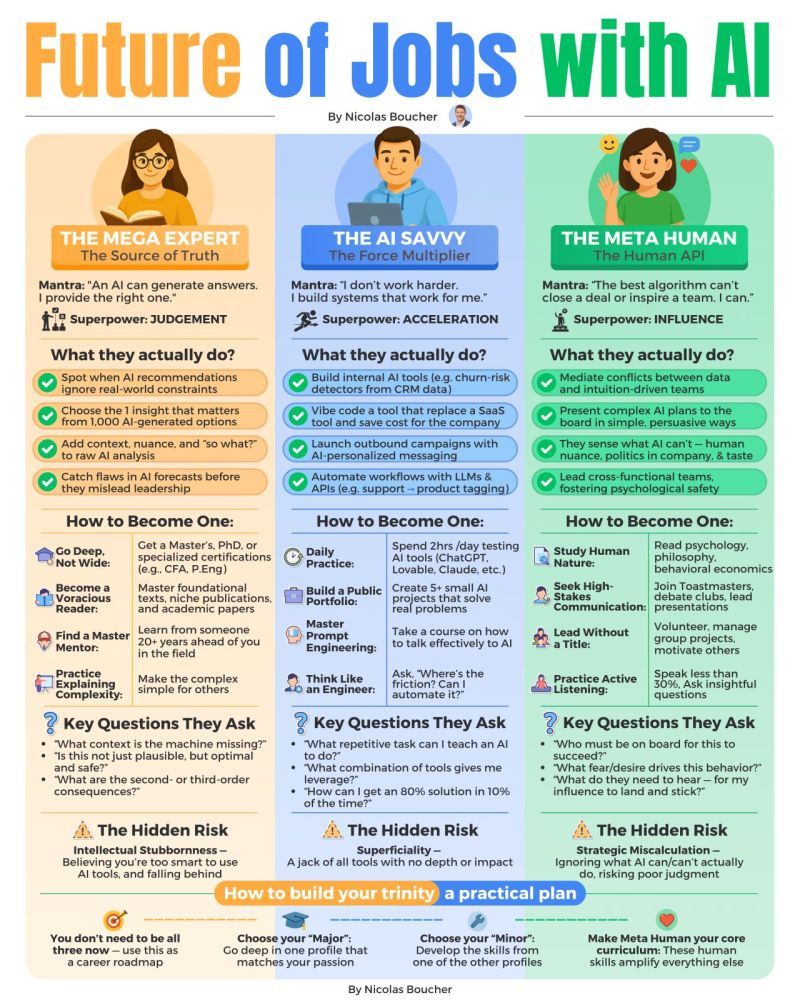
1. THE MEGA EXPERT
Their superpower: judgement
Mantra: “An AI can generate answers. I provide the right one.”
What they actually do:
– Spot when AI recommendations ignore real-world signals
– Choose the 1 insight that matters from 1,000 AI-generated options
– Add context, nuance, and “so what?” to raw AI analysis
– Catch flaws in AI forecasts before they mislead leadership
How to become one:
– Get a Master’s degree or specialized certifications
– Become a voracious reader of foundational texts and research
– Find a master mentor with 20+ years in the field
– Practice explaining complexity simply
Hidden risk: Intellectual stubbornness
2. THE AI SAVVY
Their superpower: acceleration
Mantra: “I don’t work harder. I build systems that work for me.”
What they actually do:
– Build internal AI tools (e.g. churn-risk detectors from CRM data)
– Vibe code tools/apps with no-code + LLM APIs
– Launch outbound campaigns with AI-personalized messaging
– Automate workflows using LLMs and APIs
How to become one:
– 2h Daily practice with AI tools (ChatGPT, Claude, Lovable)
– Build small AI projects to solve real problems
– Mastering prompt engineering (I have FREE infographics + courses about this, go to my page & follow)
– Think like an engineer: “Where’s the friction AI can remove?”
Hidden risk: Superficiality where you become a jack of all tools with no depth or impact
3. THE META HUMAN
Their superpower: influence
Mantra: “The best algorithm can’t close a deal or inspire a team. I can.”
What they actually do:
– Mediate conflicts between data and intuition-driven teams
– Present complex AI plans persuasively to the board
– Sense what AI can’t like human nuance, company politics, taste
– Lead cross-functional teams with psychological safety
How to become one:
– Study human nature
– Seek high-stakes communication roles
– Learn to lead without a title
– Practice active listening
Hidden risk: Strategic miscalculation—ignoring what AI can/can’t do and risking poor judgment
You don’t need to master all 3 right now.
Here is what you can do:
– Choose one of these 3 as your major
– But also one of them to develop as your minor
Which of the 3 personas do you see yourself becoming?
Still Early. Still Becoming. Still Yours.
There’s a quiet kind of power in realizing that the voice in your head is not always telling the truth. Especially the one that whispers limits. The one that says you’re late, behind, not ready, not capable enough. That voice sounds convincing because it’s familiar, not because it’s right.
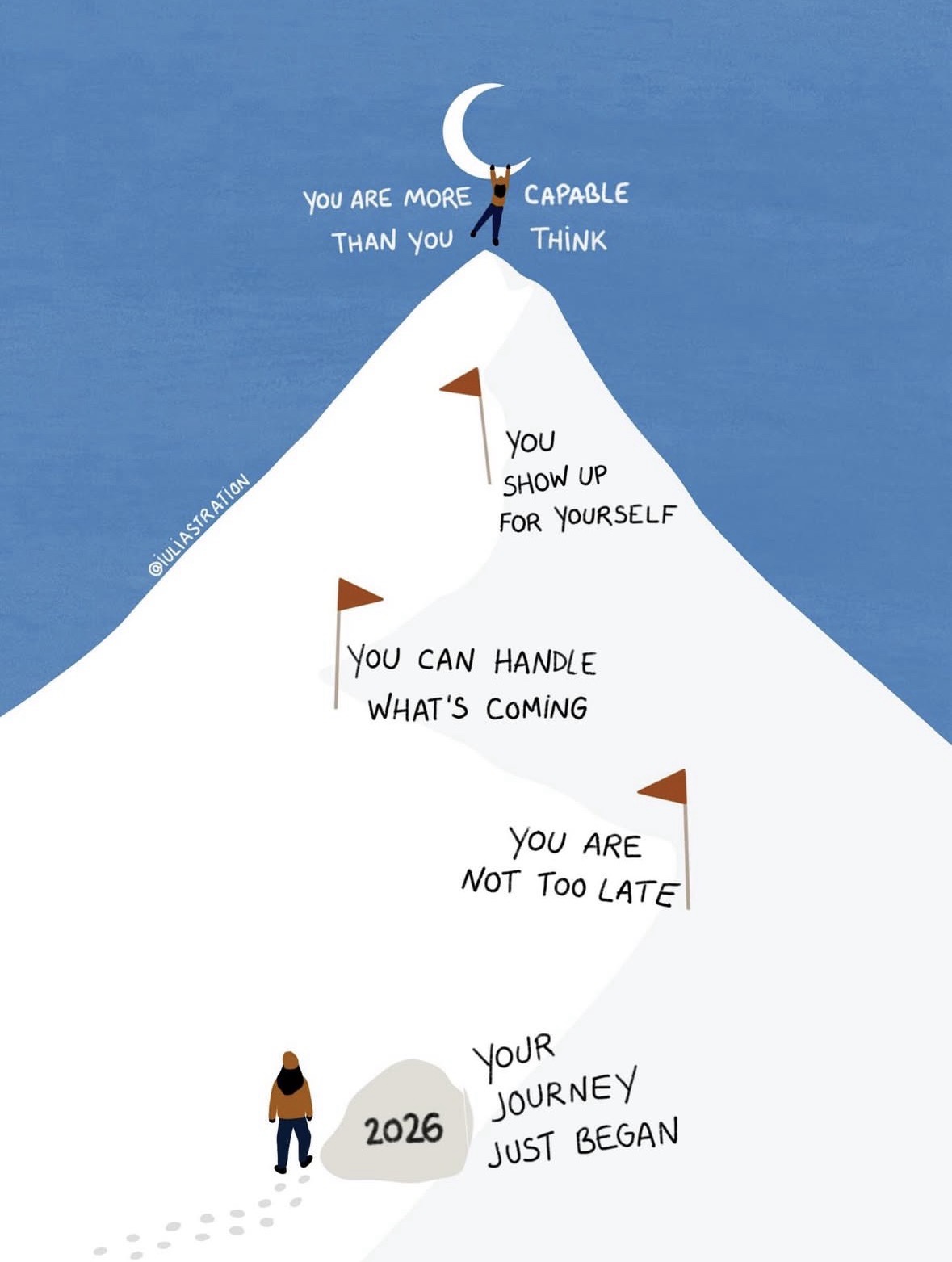
You are more than you think you’re capable of. Not in a loud, chest-thumping way. In a steady, grounded, lived-in way. The kind that doesn’t announce itself, but shows up anyway.
Think about how many things you’ve already survived that once felt overwhelming. Moments you didn’t feel prepared for. Seasons you didn’t choose. Conversations you didn’t want to have. And yet, here you are. Not untouched, maybe a little wiser, maybe a little tired, but still standing. Still learning. Still moving.
That didn’t happen by accident.
You showed up for yourself when it would’ve been easier to disappear into distraction or doubt. You got out of bed on days when motivation was nowhere to be found. You kept going even when progress felt invisible. That counts. More than you give yourself credit for.
We often underestimate ourselves because we’re measuring against imaginary timelines. Someone else’s highlight reel. Someone else’s chapter five while we’re still rereading chapter two. We forget that growth isn’t linear and life isn’t a race with a shared finish line. It’s a collection of moments where you choose to try again, even when you’re unsure.
You can handle what’s coming. Not because everything will be easy, but because you are adaptable. Because you’ve learned how to bend without breaking. Because you’ve built resilience quietly, over time, through experience rather than intention.
Strength doesn’t always feel like strength when you’re in it. Sometimes it feels like showing up tired. Like asking for help. Like taking one small step instead of the giant leap you thought you needed. Sometimes it looks unimpressive from the outside. But it’s real.
And no, you’re not too late.
That idea is one of the most damaging lies we carry. As if life shuts its doors at a certain age. As if opportunity checks a calendar before showing up. As if growth has an expiration date.
It doesn’t.
You’re allowed to begin again. You’re allowed to pivot. You’re allowed to want different things now than you wanted before. You’re allowed to outgrow old versions of yourself without apologizing for it.
2026 doesn’t need you to be perfect. It doesn’t need a fully formed plan or a dramatic reinvention. It just needs your honesty. Your willingness. Your presence.
Your journey didn’t end because a year changed. In many ways, it just began—because now you know yourself better than you did before. You know what drains you. You know what matters. You know where you’ve been pretending you can’t when you actually can.
This is not the year to disappear into comparison or self-doubt. It’s the year to trust the quiet work you’ve been doing. To believe that consistency will take you further than intensity ever could. To remember that becoming yourself is not a destination, it’s a practice.
Some days you’ll feel confident. Other days you won’t. Both are okay. Progress isn’t about feeling unstoppable all the time. It’s about continuing even when you feel unsure.
So take a breath. You don’t need to rush. You don’t need to prove anything to anyone. Just keep showing up. Keep choosing yourself. Keep believing that the story isn’t finished yet.
Because it isn’t.
You’re capable of more than you think.
You’re stronger than you realize.
And you’re right on time—for your life.
Still Standing

God’s faithfulness isn’t proven by what He removes –
but by what He carries you through.
Some things didn’t disappear.
Some prayers weren’t answered the way you hoped.
Some battles lasted longer than expected.
And yet…
you’re still here.
Still breathing.
Still believing.
Still standing – not because it was easy, but because grace was sufficient.
God doesn’t always change the situation.
Sometimes He changes your strength, your endurance, your depth.
And that kind of faith?
It lasts longer than a quick rescue.
If God carried you through something He didn’t remove, put “Still standing.”



Grow Your People
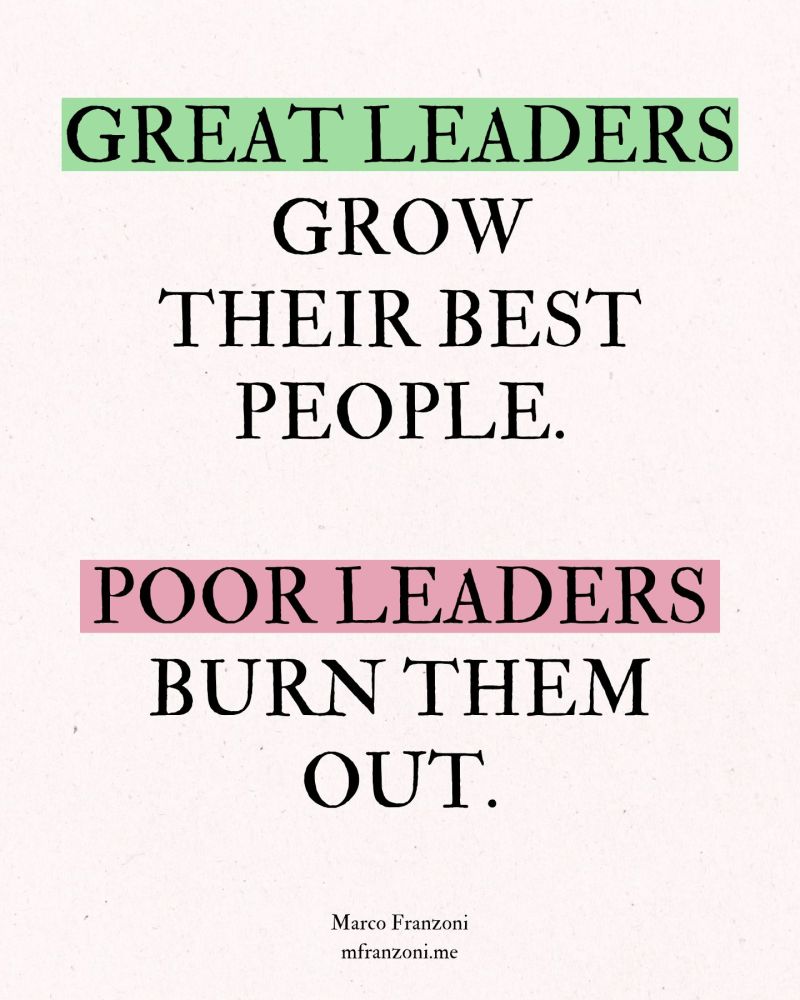
Top performers rarely quit because of hard work.
They leave because of how their effort is handled.
Too often, managers confuse “capability”
with “capacity”, and pile on without balance.
The better someone does,
the more invisible their needs become.
That’s how you burn out your best people.
And I’ve seen it happen far too often.
Here’s what I’ve noticed:
(and what we should do differently)
1) Expecting them to always “figure it out” alone
↳ Instead: Offer coaching, not just challenges
2) Relying on them to absorb every crisis
↳ Instead: Build systems so fires don’t spread
3) Giving them stretch goals with no stretch support
↳ Instead: Pair growth with resources and trust
4) Assuming resilience means endless stamina
↳ Instead: Normalize rest and recovery as strategy
5) Forgetting their achievements after the dust settles
↳ Instead: Make recognition part of the rhythm
6) Treating their calm silence as consent
↳ Instead: Ask deeper questions—and actually listen
7) Using their dedication as a shortcut for weak planning
↳ Instead: Design smarter workflows, not heroic rescues
8) Acting as if loyalty means limitless sacrifice
↳ Instead: Protect their boundaries like they’re your own
Performance burnout is rarely intentional,
but it’s dangerously common.
If you want to retain top talent,
honor the humans behind the results.
The Power of Introverted Leaders
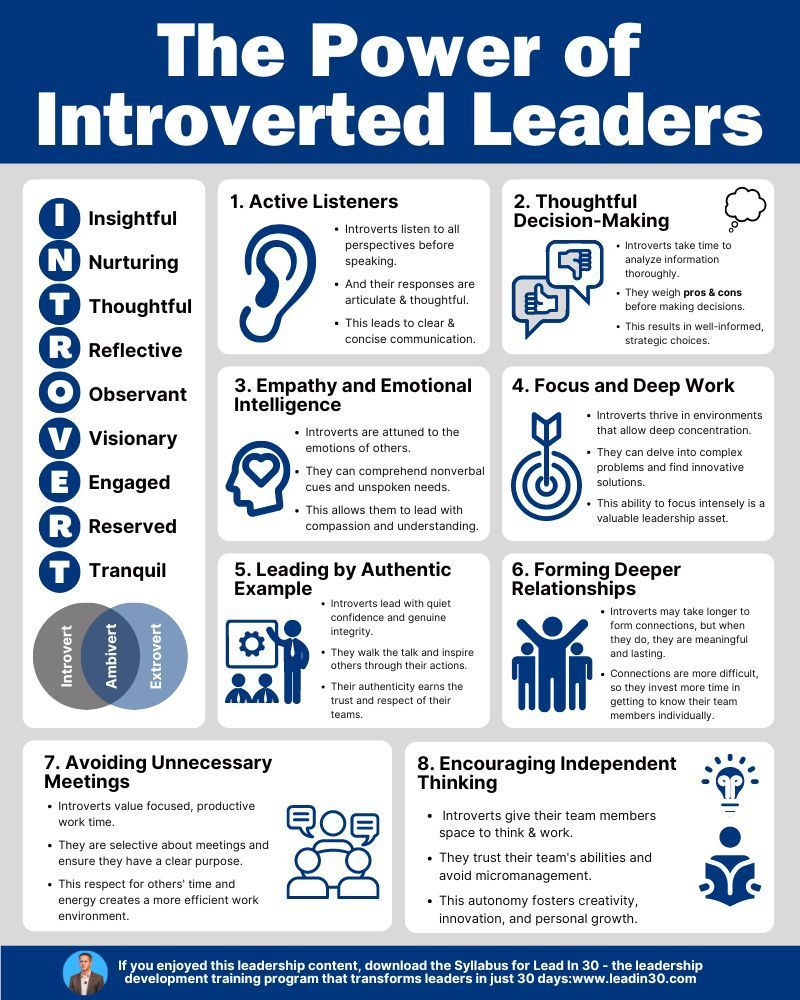
Only 4% of leaders are introverts.
But their rare qualities make them exceptional leaders.
Here’s how to spot an introverted leader:
1. Active Listeners
• Introverts listen to all perspectives before speaking.
• Their responses are articulate & thoughtful.
2. Thoughtful Decision-Making
• Introverts take time to analyze information thoroughly.
• They weigh the pros and cons before making decisions, resulting in well-informed, strategic choices.
3. Empathy and Emotional Intelligence
• Introverts are attuned to the emotions of others.
• They can comprehend nonverbal cues and unspoken needs, allowing them to lead with compassion and understanding.
4. Focus and Deep Work
• Introverts thrive in environments that allow deep concentration.
• They can delve into complex problems and find innovative solutions.
5. Leading by Authentic Example
• Introverts lead with quiet confidence and genuine integrity.
• They walk the talk and inspire others through their actions, earning the trust and respect of their teams.
6. Forming Deeper Relationships
• Introverts may take longer to form connections, but they are meaningful and lasting when they do.
• Since connections are more difficult, they invest more time getting to know their team members individually.
7. Avoiding Unnecessary Meetings
• Introverts value focused, productive work time.
• They are selective about meetings and ensure they have a clear purpose.
• This respect for others’ time and energy creates a more efficient work environment.
8. Encouraging Independent Thinking
• Introverts give their team members space to think & work.
• They trust their team’s abilities and avoid micromanagement.
• This autonomy fosters creativity, innovation, and personal growth.
–
A Wharton professor Adam Grant study found that introverted leaders often deliver better outcomes than extroverts when managing proactive employees.
So, while extroverted leaders tend to be more vocal and energetic, introverted leaders bring a calming presence and deep thoughtfulness to their roles.
Let’s start appreciating the power of quiet.
Good People Don’t Quit
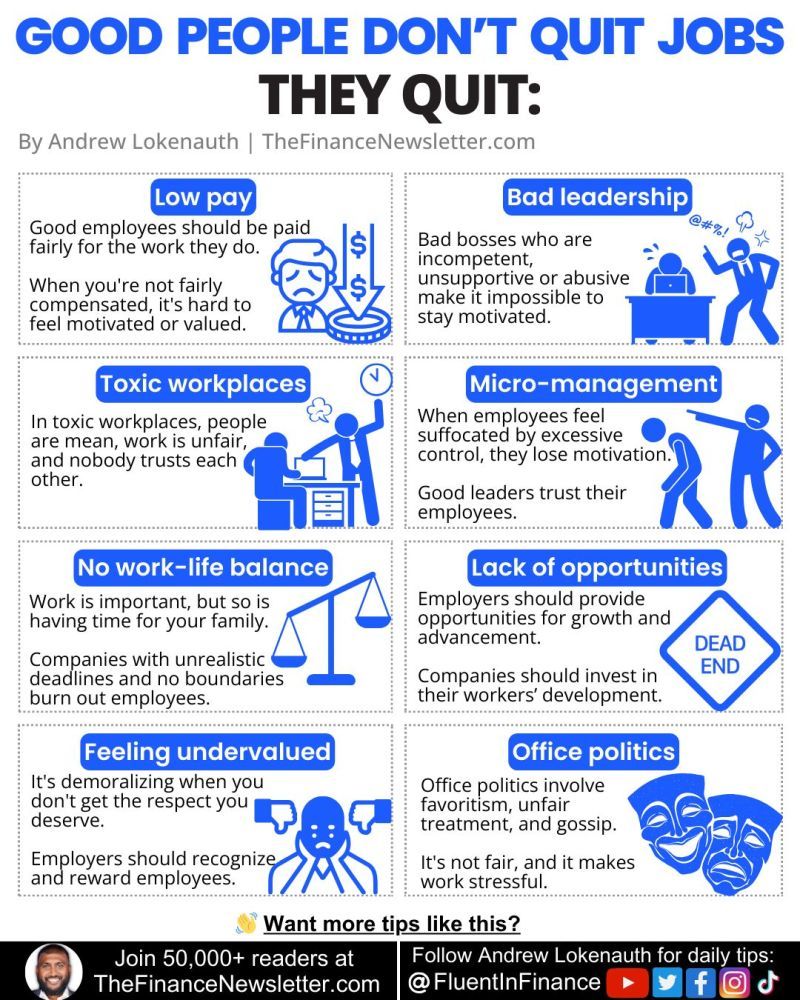
Good people don’t quit jobs. They quit:
1. Low Pay:
People work to make money.
When you’re not fairly compensated for your work, it’s hard to feel motivated or valued.
Top performers know their value in the market.
Good employees should be paid fairly for the work they do.
2. Bad Leadership:
Bad leaders don’t listen, don’t care, and don’t help their team grow.
Bad bosses who are incompetent, unethical, unsupportive or abusive make it impossible to stay motivated and productive.
Good leaders inspire, empower, and develop their team members, creating a positive work environment.
3. Toxic Workplaces:
Nobody wants to work in a place that makes them feel stressed and unhappy.
In toxic workplaces, people are mean, work is unfair, and nobody trusts each other.
This can be due to things like bullying, harassment, or a negative company culture.
4. Micro-Management:
No one likes to feel like they’re being watched over constantly.
This can make workers feel like they have no freedom or trust.
When employees feel suffocated by excessive control, they lose motivation.
If you’re being micromanaged, it can be difficult to do your job effectively.
Good leaders trust their employees to do their job and make decisions.
5. No Work-Life Balance:
Work is important, but so is having time for yourself and your family.
If you’re expected to be available 24/7, it can lead to burnout.
Companies that overwork people with excessive overtime, unrealistic deadlines and no boundaries quickly burn out their best talent.
Good workers will find jobs that let them live, not just grind endlessly.
6. Lack of Opportunities:
Employers should provide opportunities for growth, development, and advancement.
Offering training, promotions, and new challenges keeps employees engaged and motivated.
Companies should invest in their workers’ growth to keep them from leaving.
7. Feeling Undervalued:
Good people quit jobs when they feel undervalued and unappreciated.
People like to know that their hard work is noticed and appreciated.
It’s extremely demoralizing when they don’t get the recognition and respect they deserve.
Employers must recognize and reward employees’ contributions and achievements.
8. Office Politics:
Navigating office politics is exhausting and stressful.
Office politics involve favoritism, unfair treatment, gossip, and hidden agendas.
It’s like a game where some people win by making others lose, creating a negative environment.
It’s not fair, and it makes work stressful.
Employers must create a culture of transparency, fairness, and respect.
Still a Student
Somewhere along the way, many of us quietly stop being students.
Not because we’ve learned everything—but because we start protecting the image of knowing. We avoid questions that might make us look unprepared. We hesitate to try new things in front of others. We trade curiosity for competence, and without realizing it, growth slows to a crawl.
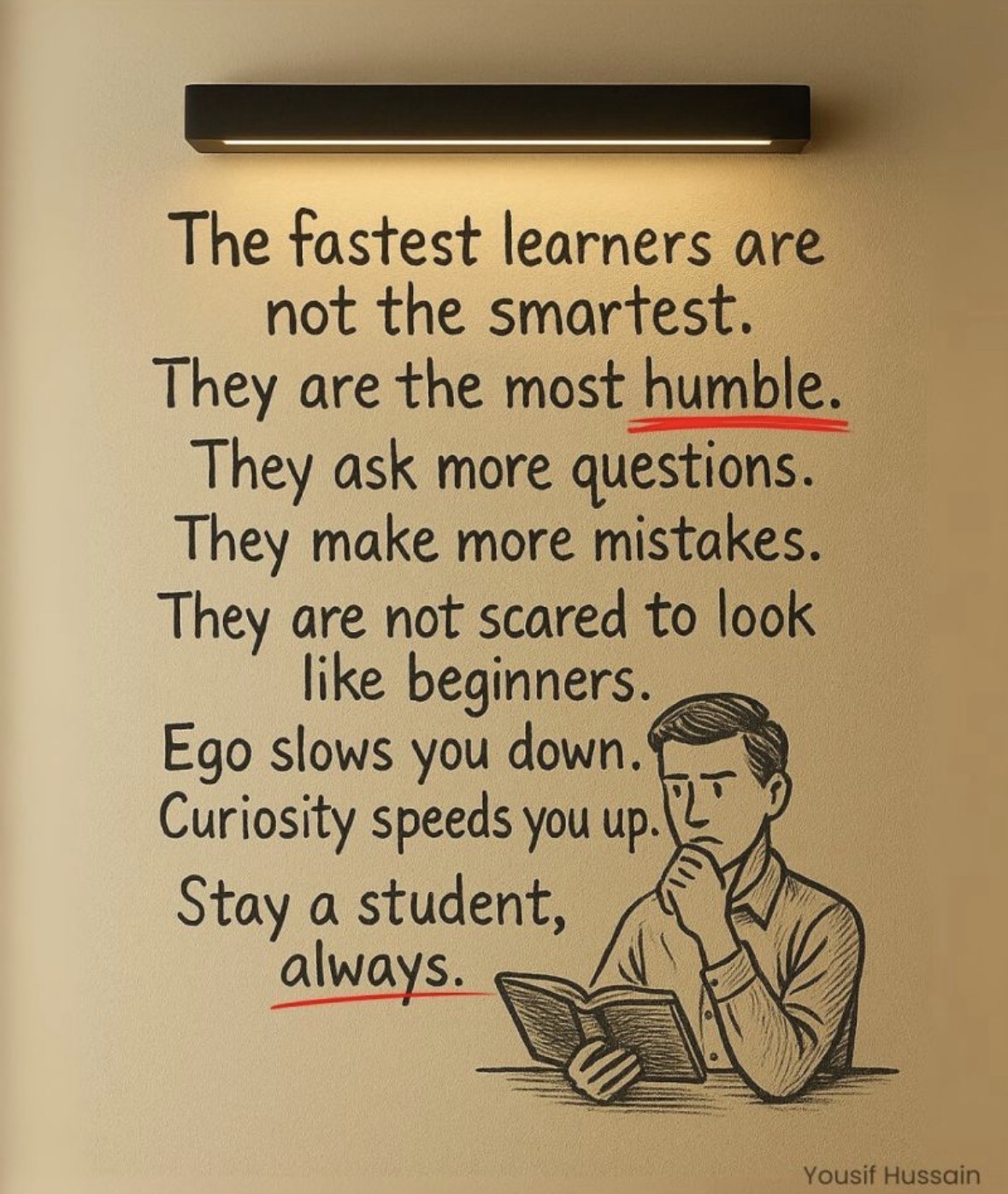
The truth is, the fastest learners aren’t the smartest people in the room. They’re rarely the loudest either. They’re the ones who stay open. They’re comfortable admitting, “I don’t know yet.” They don’t confuse experience with mastery, and they don’t let past success become a cage.
Humility is an underrated advantage. When you’re humble, you listen more closely. You notice patterns others miss because you’re not busy defending your own ideas. You ask better questions—not to impress, but to understand. And understanding compounds.
Mistakes play a big role here too. The people who learn the quickest are usually making the most mistakes in public. Not reckless ones—honest ones. They try, they fail, they adjust. They don’t romanticize failure, but they don’t fear it either. Failure becomes data, not a verdict.
There’s a certain freedom in being willing to look like a beginner. Beginners experiment. They’re curious. They’re playful. They don’t yet have rules about what “should” work, so they discover what does. That beginner energy is powerful—but ego is what usually kills it.
Ego whispers that you should already know this by now. Ego tells you that asking questions will lower your status. Ego turns learning into a performance instead of a process. And once learning becomes about protecting your image, progress slows down dramatically.
Curiosity does the opposite. Curiosity keeps you light. It keeps you moving. It replaces the fear of being wrong with the excitement of finding out. Curious people don’t need to win every conversation; they’re more interested in leaving the conversation knowing something new.
This mindset matters everywhere—work, relationships, creativity, faith, even parenting. The moment you think you’ve figured it all out is usually the moment you stop growing. But when you stay teachable, life keeps expanding.
Staying a student doesn’t mean doubting yourself all the time. It means holding confidence and openness in the same hand. You can be skilled and curious. Experienced and eager to learn. Grounded and flexible.
The world changes too quickly for rigid minds. New tools emerge. New perspectives challenge old assumptions. The people who thrive aren’t the ones clinging to what they already know—they’re the ones willing to update themselves again and again.
So ask the question. Try the thing you might fail at. Let yourself be new at something. Drop the need to look impressive and choose to be interested instead.
Because ego slows you down.
Curiosity speeds you up.
And the most powerful position you can take—at any stage of life—is this:
Still a student.
Knowing Who You Really Are
I recently discovered a children’s book from 1946: “The Bear That Wasn’t.”
A bear hibernates, and a factory gets built over his cave.
When he wakes up, everyone, from the foreman to the CEO tells him, “You’re not a bear. You’re a silly man who needs a shave and wears a fur coat.”
He’s so overwhelmed by their certainty that he starts to believe them.
He gets a job on the factory floor, and feels miserable. He forgets he’s a bear.
Until one day he decides to get back to the cave, and re-discovers that he’s a bear.
This story has a beautiful analogy because I had moments in my life where I felt like that bear.
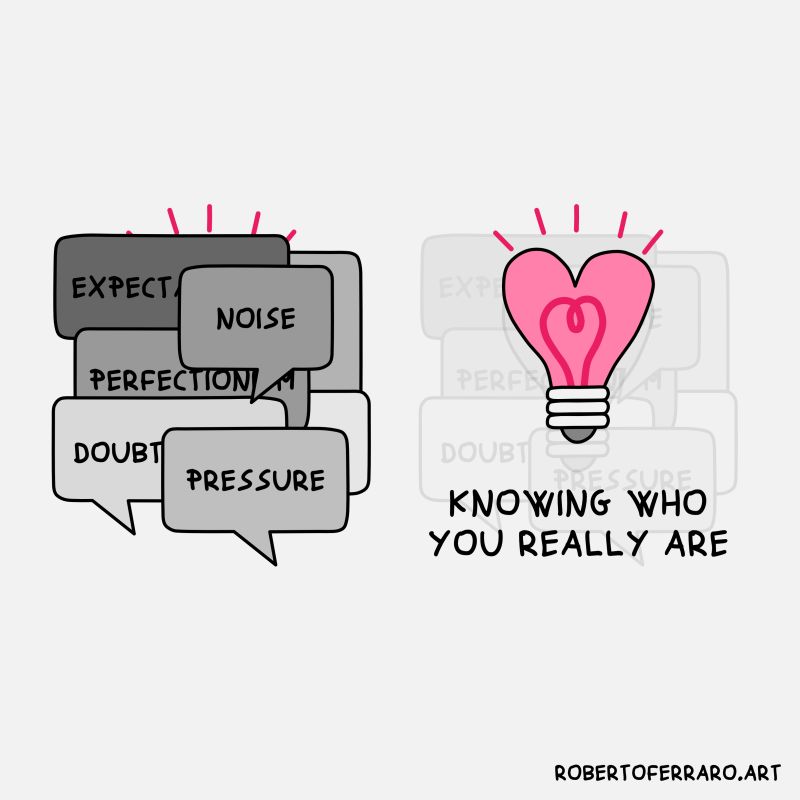
The factory is a metaphor for all the expectations: what a leader should look like, how a manager should act, the unspoken rules.
You start performing the role of the “silly person in a fur coat” because everyone expects it.
But leading from that place is not sustainable, it’s exhausting, and everyone can feel the disconnect.
The challenge isn’t meeting every expectation. It’s knowing who you are, knowing your own values and acting in line with them, even when it’s loud outside.
What is a question that helps you remember who you are?
 Kenrick Vaz