Storytelling for Leaders

Facts tell. Stories sell.

Yet most leaders still lean on slides.


What separates magnetic leaders from forgettable ones?

They’ve learned that stories build connection 3x stronger than facts.

Not theory. Results.

➡️ Numbers make people evaluate
➡️ Stories make people engage

And engagement drives action.

The leaders who get instant buy-in?
They’ve mastered this shift.

Here’s what they do differently:

They make others the hero
↳ Stop being the main character
↳ Position your team as the ones who win the day

They share the struggle first
↳ Victory without conflict feels empty
↳ Show the mountain before the summit

They plant visual anchors
↳ “Picture this…” beats “The data shows…”
↳ Make them see it, not just hear it

They end with transformation
↳ Not just what happened, but what changed
↳ Leave them different than you found them

The hidden cost of data-only leadership:

➡️ People forget 90% within a week
➡️ Emotional disconnect fuels quiet quitting
➡️ Great ideas die in spreadsheet graveyards
➡️ Teams comply but don’t commit

Meanwhile, story-driven leaders spark movements.

Because we’re not wired for charts.
We’re wired for meaning.

Your next presentation doesn’t need more data.
It needs a story they’ll feel.

The question isn’t if you have stories worth telling.
It’s whether you’re ready to tell them.

The T.R.U.S.T Model

2 in 3 employees are ready to quit.

Here’s the leadership secret that’s changing their minds.

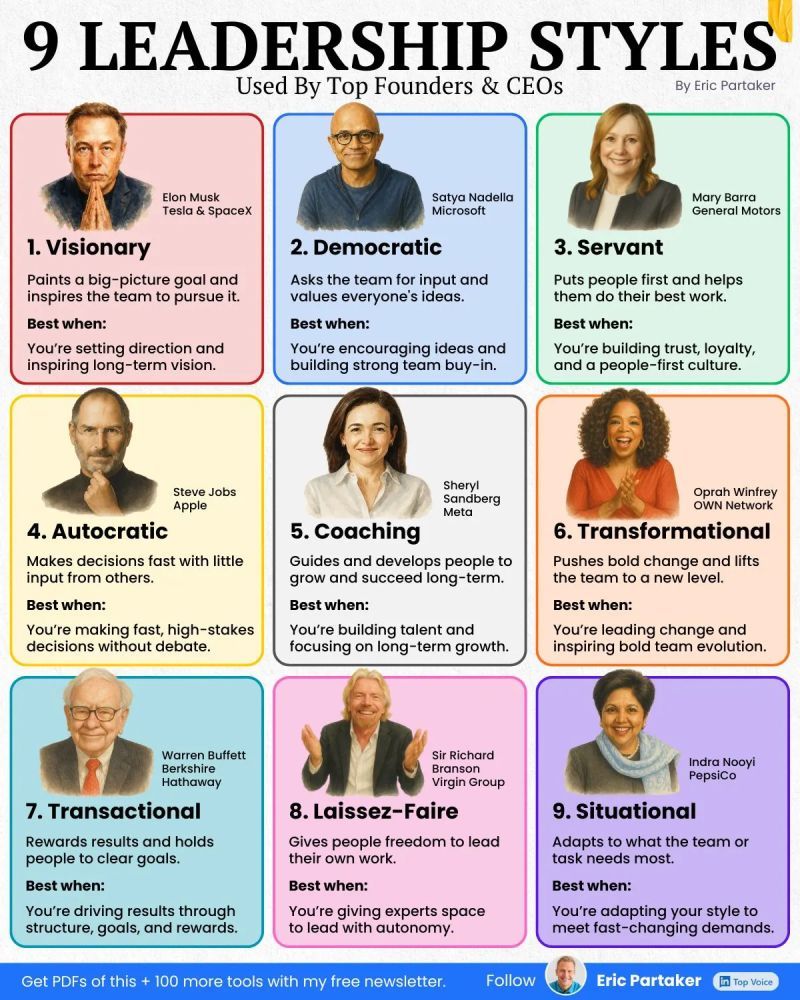
Servant Leadership is an “employee-focused” style that’s been studied for over 30 years.

Companies like Starbucks and Southwest Airlines have recently adopted its principles.

The reason?

Straightforward, ethical guidelines that transform work at all levels.

Here’s a framework based on years of research
(To catch you up in 2 minutes):

The TRUST Model of Servant Leadership:

1. Train
• Develop leaders who prioritize team growth
• Instill a mindset of service and support

2. Reflect
• Encourage self-assessment and personal growth
• Promote transparency and accountability at all levels

3. Uplift
• Identify and nurture each team member’s unique strengths
• Create opportunities for employees to lead

4. Support
• Foster an inclusive environment
• Provide resources and remove obstacles

5. Transform
• Align company culture with servant leadership principles
• Reward servant leader behaviors

5 Practical Tips to Practice Servant Leadership:

• Listen closely
• Lead by example
• Invest in leadership growth
• Foster open, honest feedback
• Celebrate servant leadership acts

Top companies are recognizing the power of this “person-first” approach.

And it’s saving teams and organizations worldwide.

Now’s the time to embrace the “new school” of leadership!

How do you promote TRUST in your teams?

The Gifts That Don’t Need Wrapping

Around Christmas, everything feels wrapped in something. Boxes stack up under trees, paper crinkles, ribbons curl, and we try to guess what’s inside before it’s time. There’s a special kind of joy in giving and receiving gifts this season, in watching faces light up and sharing in that small moment of surprise. But somewhere between the lists, the shopping, and the wrapping, it’s easy to forget that some of the most meaningful gifts of all don’t come in boxes.

Sometimes the best gift doesn’t arrive with shiny paper or a bow that takes five minutes to untangle. It shows up quietly, usually when you’re not looking for it. It’s the moment you pause long enough to realize how much you already have—things that could never fit inside wrapping paper anyway.

We spend so much time chasing the next thing. The upgrade. The milestone. The version of life that feels just a little more complete than the one we’re living right now. And there’s nothing wrong with wanting more. Growth matters. Dreams matter. But somewhere along the way, it’s easy to forget that a lot of what makes life feel full is already here, woven into our ordinary days.

It’s in the people who know your stories without needing the long version. The ones who notice when you’re quieter than usual, or who send a message just to say they were thinking about you. It’s in shared jokes that don’t make sense to anyone else, in comfortable silences, in the simple relief of not having to explain yourself.

It’s in your health on the days you wake up and your body quietly does what it’s supposed to do. In the ability to walk, to breathe deeply, to hold someone’s hand. These are things we rarely celebrate, mostly because we don’t want to imagine life without them. But they are gifts all the same—fragile, precious, and often invisible until they’re gone.

It’s in the small routines that feel boring until they disappear. Morning light through a familiar window. A cup of something warm you didn’t have to rush. The drive you’ve done a hundred times. The sound of laughter from another room. None of these show up on wish lists, yet they’re the threads that hold our days together.

It’s also in the version of you that made it through hard seasons. The resilience you didn’t know you had. The lessons you paid for with time, mistakes, and discomfort. You can’t wrap growth, but it’s there—in how you respond differently now, in what you no longer tolerate, in the boundaries you finally learned to keep.

Sometimes gratitude gets framed as forced positivity, like you’re supposed to ignore what’s hard. That’s not what this is. You can acknowledge what’s missing and still honor what’s present. Both can exist at the same time. In fact, they usually do.

Remembering what you have isn’t about settling. It’s about grounding. It’s about realizing that even while you’re reaching forward, there’s solid ground beneath your feet. It gives you a place to stand, to breathe, to move from intention instead of lack.

Maybe that’s why this kind of remembering feels like a gift, especially at Christmas. It asks nothing from you. No money, no planning, no perfect timing. Just a moment of awareness. A gentle shift in perspective. A quiet thank you—to life, to others, to yourself.

When the paper is recycled, the boxes are put away, and the lights glow a little softer, come back to this. Look around. Notice what’s holding you up. Notice what’s stayed.

Some of the best gifts never needed wrapping at all.

Fear of Asking for Business

Does asking for business make your stomach drop?
You’re not alone.
(And the reason may surprise you.)

Most professionals think the discomfort comes from
bad timing…

Or needing the perfect words.

But here’s the truth:

Asking feels terrifying when it’s about you.

When it’s about them, and how you can help, it becomes
natural, even welcome.

So how do you make that shift?

Here’s the 3-Step Approach we teach for Comfortable Asking:

1. Share Insights First
✔️ Offer a relevant idea or trend.
✔️ Give value without expecting a return.
✔️ Spark curiosity, not obligation.

2. Understand Their Needs
✔️ Ask open, thoughtful questions.
✔️ Let them do most of the talking.
✔️ Listen for where you can help.

3. Make the Connection
✔️ Summarize what you heard.
✔️ Share a quick story that relates.
✔️ Suggest a next step—only if it fits.

At the end of the day, the top BD professionals don’t
“ask” for business.

They spot the moment when help is needed.

And offer it generously.

Try this approach this week and let me know what happens.

Who in your network could benefit from your expertise
right now?

Culture

77% of people say culture affects job performance.
The other 23% don’t know it does. Here’s why:

Imagine spending your day in a place where you feel:

• Isolated
• Invisible
• Unheard
• Stressed
• Powerless
• Controlled
• Intimidated
• Overworked
• Out of place
• Disrespected
• Unappreciated
• Micromanaged

Not fun, right?

Now imagine a workplace where you feel:

• Appreciated
• Empowered
• Connected
• Respected
• Supported
• Motivated
• Confident
• Inspired
• Trusted
• Valued
• Heard
• Safe

That’s the power of culture.

Culture is more than just values or rules.

➟ It’s how people treat one another.
➟ It’s the feeling you get at work every day.
➟ It’s what makes you want to go to work (or not).

But why does it matter so much?

Because a great culture leads to happier employees.
And happy employees are more motivated.

✅ They care more about the work they do.
✅ They’re more creative and innovative.
✅ They take better care of customers.
✅ They stay with the company longer.

Leaders, listen up!
You are the cultivators of culture.

You set the tone with your:

➡️ Words
➡️ Actions
➡️ Example

And, with what you tolerate 👀.

Want to boost performance?
Have happier, more motivated employees?

Start by nurturing a culture where everyone can feel:

• Supported
• Included
• Trusted
• Valued

Here’s how:

1. Listen More
Ask for feedback and act on it.

2. Build Trust
Be transparent. Keep promises. Trust your team.

3. Recognize Efforts
Say “thank you.” Celebrate wins, big and small.

4. Support Growth
Offer training. Help with career paths. Let people grow.

5. Prioritize Well-Being
Offer flexible hours. Make sure they don’t burn out.

6. Encourage Collaboration
Create a sense of community where everyone belongs.

7. Lead by Example
Be kind. Be fair. Be honest.

With these steps, you can transform your workplace.
Or protect the great culture you already have.

It’s not just good for your people.
It’s good for your business, too.

Culture matters. Make yours count.

Have you seen culture affect job performance?

Kindness

No matter your title or salary — be kind.

90% of managers ignore this superpower.
And they lose their best people because of it.

But the other 10%?

Those who lead with genuine kindness.
They know how to grow and keep great talent.

KINDNESS isn’t about being nice.

Here’s what real kindness looks like in action:

K — Kick the ego and lead with humility.

I — Invite voices that aren’t always heard.

N — Nurture your team’s growth beyond KPIs and job titles.

D — Do what you said you’d do, even when it’s inconvenient.

N — Notice small wins as much as big milestones.

E — Empathy is one of the most powerful leadership skills.

S — Support and offer help before it’s asked for.

S — Set boundaries with clarity and respect.

Kindness is a gift everyone can afford to give.

But for the people around you it’s priceless.

Start practicing these elements of kindness,
and your team will follow your lead.

♻️ Kindness is contagious — so let’s spread it through our networks and build better workplaces.

The Hidden Superpowers Behind Career Growth

It’s not hard skills that stall careers.

It’s the soft ones. Here’s how.

I’ve seen this happen dozens of times:

The most talented person on the team…

Who can’t handle feedback.
Who burns out under pressure.
Who alienates everyone around them.

Their career stalls.
No matter how brilliant they are.

So what actually fuels growth?

The soft skills nobody puts on a resume:

1. Gratitude → builds trust
2. Resilience → steadies momentum
3. Openness → invites feedback
4. Willpower → sustains consistency
5. Teamwork → multiplies impact
6. Humility → earns respect

Hard skills get you a seat at the table.
But staying there? Rising higher?
That’s built on trust.

If you want to grow in your career,
don’t just sharpen your skills.

Sharpen your character.

Which soft skill has made the biggest impact on your career?

Let me know in the comments. 👇

When and How to Say No

“No” is a complete sentence—

But here’s when to say it and how:

Most people aren’t drowning because they’re lazy.

They’re drowning because they’re too helpful.

Saying yes feels like the right thing—
until your calendar’s full and
your focus is gone.

Top performers don’t say yes to everything.
They say yes to the right things.

Start with the Impact-Effort Matrix by
Bjørn Andersen, Tom Fagerhaug, and Marti Beltz:

🟢 Quick Wins
Easy + effective? Do them now.

🟡 Big Goals
Harder, but worth it. Prioritize next.

🔵 Small Tasks
Schedule, delegate, or delay.

🔴 Low Reward
High effort + low return = say no.

You can’t do meaningful work if your time is
buried under meaningless tasks.

Saying yes to everything
is saying no to your real priorities.

So here’s your challenge:

Say no once this week. Just once.

Then watch what it protects:
Your energy. Your goals. Your peace of mind.

5 Problem Solving Methods

A great solution to the wrong problem is still a failure.
Because here’s the harsh truth:

If you skip the diagnosis, the treatment won’t work.

When something breaks in your business,
a missed goal, a failed launch, a team breakdown…

The instinct is often to jump straight to a fix.

But without understanding the root cause,
you’re just putting a fresh coat of paint on
a cracked wall.

Here are 5 practical methods to help you fix the right
problem, not just the loudest one:

1. Pre-Mortem Analysis

Spot risks before they derail your plans.

Ask: “If this project failed… what went wrong?”
Then adjust your strategy to prevent those scenarios.

💡 Use this when launching, presenting, or rolling out
a new strategy.

2. The 5 Whys

Get to the root cause—not just the symptom.

Ask “Why?” five times in a row until you find
what’s really broken.

It’s uncomfortable.
But that’s where the insight is.

💡Use this for recurring issues in performance
or operations.

3. Decision Tree Analysis

Visualize outcomes before you commit.
Map each option, the risks, and likely results.

This brings clarity to complex decisions,
and removes gut bias.

💡Use this when making high-stakes calls
on hiring, funding, or growth.

4. Rapid SWOT

Cut through the noise and re-center your strategy fast.

Ask:

✅ What’s working?
❌ What’s holding us back?
📈 Where can we win quickly?
⚠️ What’s threatening us?

💡Use this when momentum stalls,
goals feel unclear, or your team seems off track.

5. Impact vs. Effort Matrix

Prioritize with purpose.

High impact, low effort? Do it now.
High effort, low impact? Cut it.

💡Use this when resources are stretched and
everything feels “important.”

Here’s the key takeaway:

You don’t need to reinvent the wheel every
time something breaks.

You just need a smarter way to break the problem down.

The best leaders don’t wait for clarity to show up,
they create it, by asking better questions, earlier.

Which of these methods will you try first?

Listen

Listening is a superpower –

Here’s how you can get it:

We talk about communication skills…

But forget that listening
is communication.

The best leaders aren’t the loudest.

They’re the ones who listen the most.

True listening is how trust is built.

It’s how teams feel seen, heard, and valued.

Poor listening leads to:

🔻 High turnover
🔻 Lower team morale
🔻 Missed opportunities
🔻 Lack of accountability
🔻 Damaged relationships
🔻 Wasted time and energy
🔻 Decreased motivation
🔻 Unclear expectations
🔻 Repeated mistakes
🔻 Frustrated teams

The solution?

Learn to truly LISTEN:

🔹 L-earn
🔹 I-nterpret
🔹 S-upport
🔹 T-une in
🔹 E-mpathize
🔹 N-urture

And use the HURIER model by Dr. Judi Brownell:

👂 Hearing
🧠 Understanding
📝 Remembering
🔍 Interpreting
📊 Evaluating
💬 Responding

Real listening isn’t about staying quiet.

It’s about being fully present,
with the intent to understand.

Top leaders listen more.

They speak last, not first.

They want to learn, not win.