
If you can’t speak to your value, someone else will. And they’ll get it wrong.
If you’re ready to break through to Executive, you need to be able to answer the question “Why are you ready for the next level?”
You’re answering this question every time you enter a room.
(whether you know it or not)
If this is hard for you, it’s not because you can’t.
You need to practice.
If you’re preparing for a promotion, board seat, or new role, start here:
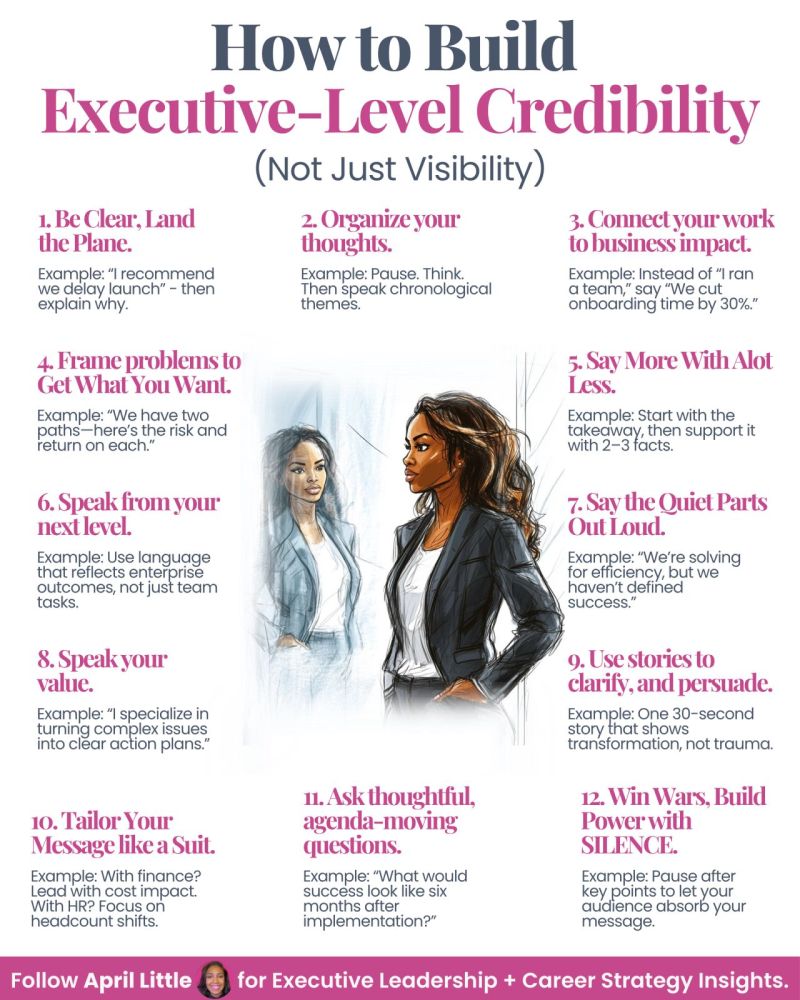
1️⃣ Clarify what you want to drive
Instead of “I’m good at strategy,” try “I build go-to-market plans that doubled revenue in two years.”
2️⃣ Organize your thoughts before you speak
If your value sounds scattered, your impact will too. One clear throughline beats three vague points.
3️⃣ Connect your work to business outcomes
Translate effort into ROI. “I led trainings” becomes “I reduced turnover by 17% in nine months.”
4️⃣ Say more with fewer words that matter
Drop buzzwords. “I solve workflow issues” becomes “I cut onboarding time by 40%.”
5️⃣ Frame challenges to show your leadership
Don’t stop at what went wrong. Explain what you changed and what improved after.
6️⃣ Speak from the level you’re stepping into
Use language that mirrors directors, VPs, or execs. Sound like you already belong there.
7️⃣ Name what others won’t say aloud
Tactfully flag risks or misalignment. That’s how you build influence in tense rooms.
8️⃣ Use one short story to earn trust fast
Keep it under 60-90 seconds. “We missed Q3, but my pivot recovered $1.1M in pipeline.”
9️⃣ Articulate your value without shrinking it
Avoid “I just helped.” Claim your part in the win, clearly and confidently.
🔟 Tailor your message to the listener
With execs: lead with outcomes. With peers: show collaboration. With teams: share your thinking.
🔟+1 Ask questions that move the agenda forward
“Where are we making assumptions?” will earn more respect than repeating the obvious.
🔟+2 Pause with intention to hold attention
When you stop talking, people lean in. Use silence to emphasize your POINT.
Strong communication starts with clarity.
You don’t need to be born with it or come from it.
Practice.
1-1 Meetings
Random chats aren’t leadership—
This is what real 1:1s look like:
1-on-1s shouldn’t be random check-ins—
They should be a system that
builds clarity, trust, and growth.
Here’s how to make them work:
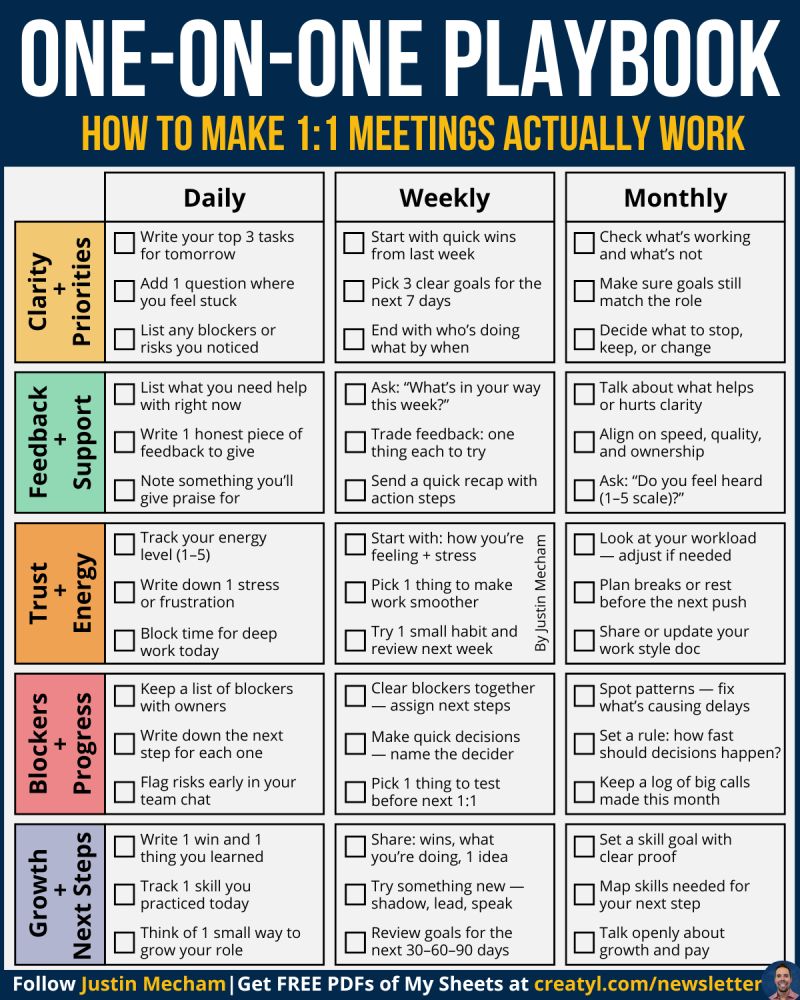
Daily
🟡 Write your top 3 tasks for tomorrow
🟡 Note 1 blocker or question you have
🟡 Track your energy level and one win
Weekly
🟠 Start with last week’s wins + 3 new goals
🟠 Ask: “What’s in your way this week?”
🟠 Each trade one piece of feedback
Monthly
🔴 Talk about clarity, growth, and energy
🔴 Set a small goal with a clear next step
🔴 Review what’s working and what’s not
Try this 3-part 1:1 rhythm:
1️⃣ Daily: Quick notes on wins, blocks, and focus
2️⃣ Weekly: Feedback and fast problem-solving
3️⃣ Monthly: Big-picture clarity and growth
Great 1:1s don’t need more time —
They need a better reason to meet.
Clarity builds momentum.
Trust builds performance.
Great 1:1s build both.
The Distance You’ve Already Walked

There’s a weird thing we do as humans.
We look at where we want to be… and somehow that becomes the only thing we can see.
The goal.
The gap.
The unfinished parts.
The things still missing.
And in the process, we keep forgetting how far we’ve come — just because we still have far to go.
I know this feeling way too well.
You start chasing something bigger. A better version of yourself. A new chapter. A new level. A new season. And at first it’s exciting. You feel motivated. You feel hungry. You feel like you’re finally moving.
But then… that excitement turns into pressure.
Because once you’ve started growing, you don’t want to stop.
Once you’ve improved, you feel like you should be improving faster.
Once you’ve made progress, you suddenly expect perfection.
And what used to be “Wow, I’m doing it” becomes “Why am I not there yet?”
It’s such a sneaky mindset.
You can go from “I’m proud of myself” to “I’m behind” in the span of one bad day.
One slow week.
One mistake.
One moment of comparison.
One glance at someone else’s highlight reel.
And suddenly your brain forgets the nights you stayed consistent.
The habits you built from scratch.
The strength it took just to keep going.
The fact that you’re not even the same person you were a year ago.
You don’t realize how far you’ve come because you’ve made “far to go” your main identity.
But here’s the truth:
Having far to go doesn’t erase how far you’ve come.
It just means you’re still in motion.
And being in motion is a beautiful thing.
Sometimes we treat growth like a finish line instead of a direction.
Like it only counts if we’ve arrived.
But real growth doesn’t always feel like winning.
Sometimes it feels like repetition.
Like showing up again.
Like doing the work quietly.
Like rebuilding confidence after a setback.
Like learning something the hard way.
Like taking two steps forward and one step back and still choosing to move.
Progress is rarely dramatic.
Most of the time it’s subtle.
It’s you reacting differently than you used to.
It’s you staying calm in moments that once shook you.
It’s you not giving up when you normally would’ve.
It’s you doing the hard thing without needing applause.
It’s you learning to say no.
It’s you finally saying yes.
It’s you being kinder to yourself.
It’s you trying again.
That’s growth.
But because it doesn’t always look flashy, we dismiss it.
We treat it like it doesn’t count.
And that’s what breaks people.
Not failure.
Not hard work.
Not the long road.
What breaks people is constantly moving forward while mentally living in the belief that they’re not doing enough.
That’s exhausting.
It makes you feel like you’re always chasing.
Always behind.
Always lacking.
Always “almost.”
And even when you’re doing well, you can’t enjoy it.
Even when you’re improving, you can’t feel it.
Because your mind is stuck in the distance, not the journey.
I’ve realized something important:
If you don’t pause to recognize your progress, you’ll start resenting the process.
You’ll start seeing your life as one long checklist.
One long “not yet.”
One long “maybe someday.”
And you’ll miss the fact that “someday” is being built right now.
The person you used to pray to become?
The version of you that once felt impossible?
The strength you once wished you had?
A lot of that is already here.
It’s just easy to overlook because you’ve gotten used to it.
You’ve normalized your own growth.
You’ve normalized your own resilience.
You’ve normalized your own discipline.
And that’s a compliment, honestly.
It means you’ve become someone you can rely on.
But don’t let that familiarity turn into blindness.
Because you deserve to feel proud.
Not in an arrogant way.
In a grounded way.
In a “I know what it took to get here” way.
In a “I’ve survived things I don’t even talk about anymore” way.
In a “I’ve worked on myself even when nobody noticed” way.
And you also deserve to keep wanting more.
There’s nothing wrong with ambition.
There’s nothing wrong with having far to go.
But don’t let your dreams become a reason to disrespect your current reality.
Don’t let the next chapter make you forget the last one.
Don’t let the mountain ahead make you ignore the miles behind.
Because you’re not starting from zero anymore.
You’re starting from experience.
From lessons.
From scars that became strength.
From effort that became momentum.
From mistakes that became wisdom.
From patience that became maturity.
So if you’re feeling behind right now…
If you’re feeling like you should be further…
If you’re looking at the road ahead and thinking “Man, I’ve got so much to do”…
Take a breath.
And look back — not with regret, but with respect.
Look back and recognize that the old you would be proud of how far you’ve come.
Look back and remember the days when you didn’t even know if you’d make it through.
Look back and realize you did.
And you’re still doing it.
You’re still showing up.
You’re still building.
You’re still becoming.
And that matters.
So yes… you might still have far to go.
But don’t keep forgetting how far you’ve come.
That’s not just progress.
That’s proof.
Passion
People aren’t replaceable parts.
Yet too many companies still
treat them like they are.
They rush to fill roles-and forget what truly drives results:
heart.
ownership.
pride.
You can hire for skills.
You can’t hire for care.
Because what makes people irreplaceable
isn’t in their job description-
it’s in their spirit.
What real appreciation looks like 👇
1. See the human
Not just what they do – but who they are.
Being seen beats being evaluated.
2. Listen deeply
Not to reply – to connect.
Listening is the shortest path between people.
3. Lead with trust
Trust given early becomes ownership fast.
Belief brings out people’s best.
4. Remember the details
Birthdays. Families. Passions.
The small things make people stay big.
5. Show up anyway
Anyone can care when it’s easy.
Respect shows when it costs you comfort.
6. Care quietly
No spotlight. No reason. Just care.
That’s where loyalty begins.
7. Make them feel missed
People don’t want managing.
They want to matter.
When you lose someone great,
you don’t just lose a role.
You lose belief.
You lose creativity.
You lose heart.
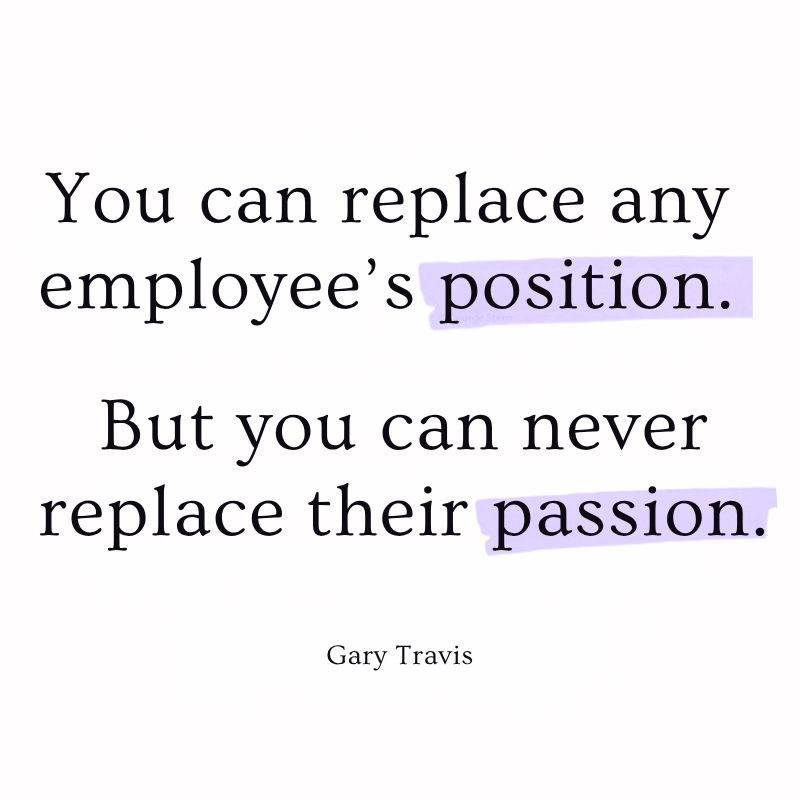
You can replace the title.
But not the trust they built.
Not the spark they brought.
Passion isn’t optional.
It’s oxygen.
Value it-
before it walks out the door.
💬 How do you show people they matter?
Courage
Some time ago, a friend asked me “I don’t see you online as much, is everything ok?”
It was true, I was spending less time on social media and on LinkedIn.
Fortunately everything was ok. Better than ok, I decided to take my kids to the bus in the morning myself, rather than having someone help us with the morning routine.
This meant that something had to go. And it was 30 minutes of daily social media, which I mostly enjoyed, but was not the most important thing at that time.
I thought: “After all the years I invested in social media, what will happen if I just now reduce my engagement? Will my stuff become invisible? Will I lose all that I built?”
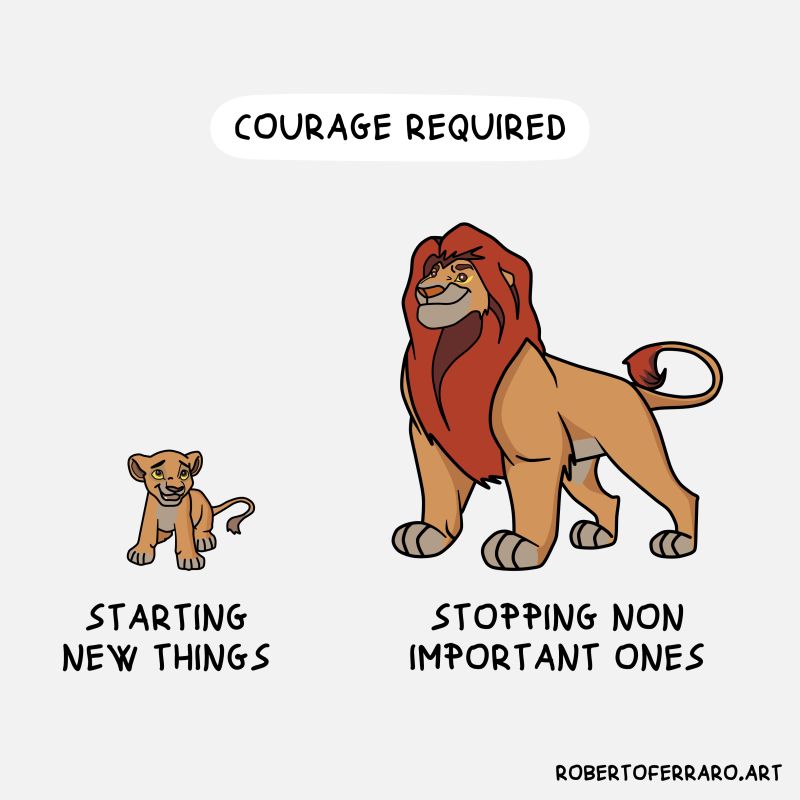
It reminded me of a quote from Jonathan Escobar’s book Lead to Beat: “Courage isn’t about starting new things. It’s about stopping the non-brutally important ones.”
It took some courage to let go of that, and I was a bit anxious, also because I genuinely enjoyed it.
It’s so easy to start new stuff.
So many opportunities, so many interesting things.
The real challenge is to stop doing what’s not essential.
This is true for personal projects and for work teams.
What’s a non-essential activity that’s currently eating into your most valuable time?
The Ultimate Guide To Master Effective Communication
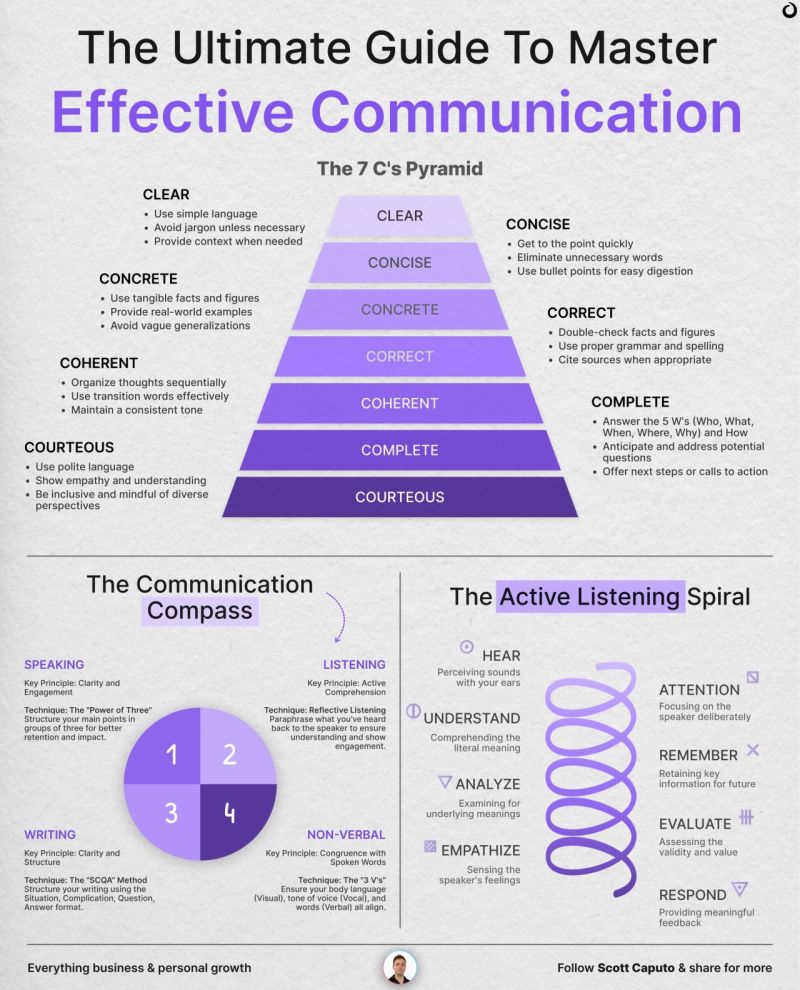
The smartest people don’t get the best job offers..
Those who know how to communicate do:
Here is the Ultimate Guide to Master Effective Communication:
👥 The 7 C’s Pyramid:
1. Clear
↳ Use simple language everyone can understand
2. Concise
↳ Get to the point quickly without beating around the bush
3. Concrete
↳ Back up your points with tangible facts and figures
4. Correct
↳ Double-check all facts and figures before presenting
5. Coherent
↳ Organize your thoughts in a logical, sequential manner
6. Complete
↳ Answer the 5 W’s (Who, What, When, Where, Why) and How
7. Courteous
↳ Show empathy and consider diverse perspectives
🧭 The Communication Compass:
1. Speaking
↳ Key Principle: Clarity and Engagement
2. Writing
↳ Key Principle: Clarity and Structure
3. Listening
↳ Key Principle: Active Comprehension
4. Non-verbal
↳ Key Principle: Congruence with Spoken Words
🌀 The Active Listening Spiral:
1. Hear
↳ Give your full attention to the speaker
2. Understand
↳ Comprehend the literal meaning of what’s being said
3. Analyze
↳ Examine the underlying meanings and implications
4. Empathize
↳ Sense the speaker’s emotions and feelings
5. Respond
↳ Provide meaningful feedback or ask clarifying questions
The Bare Minimum We Owe Each Other
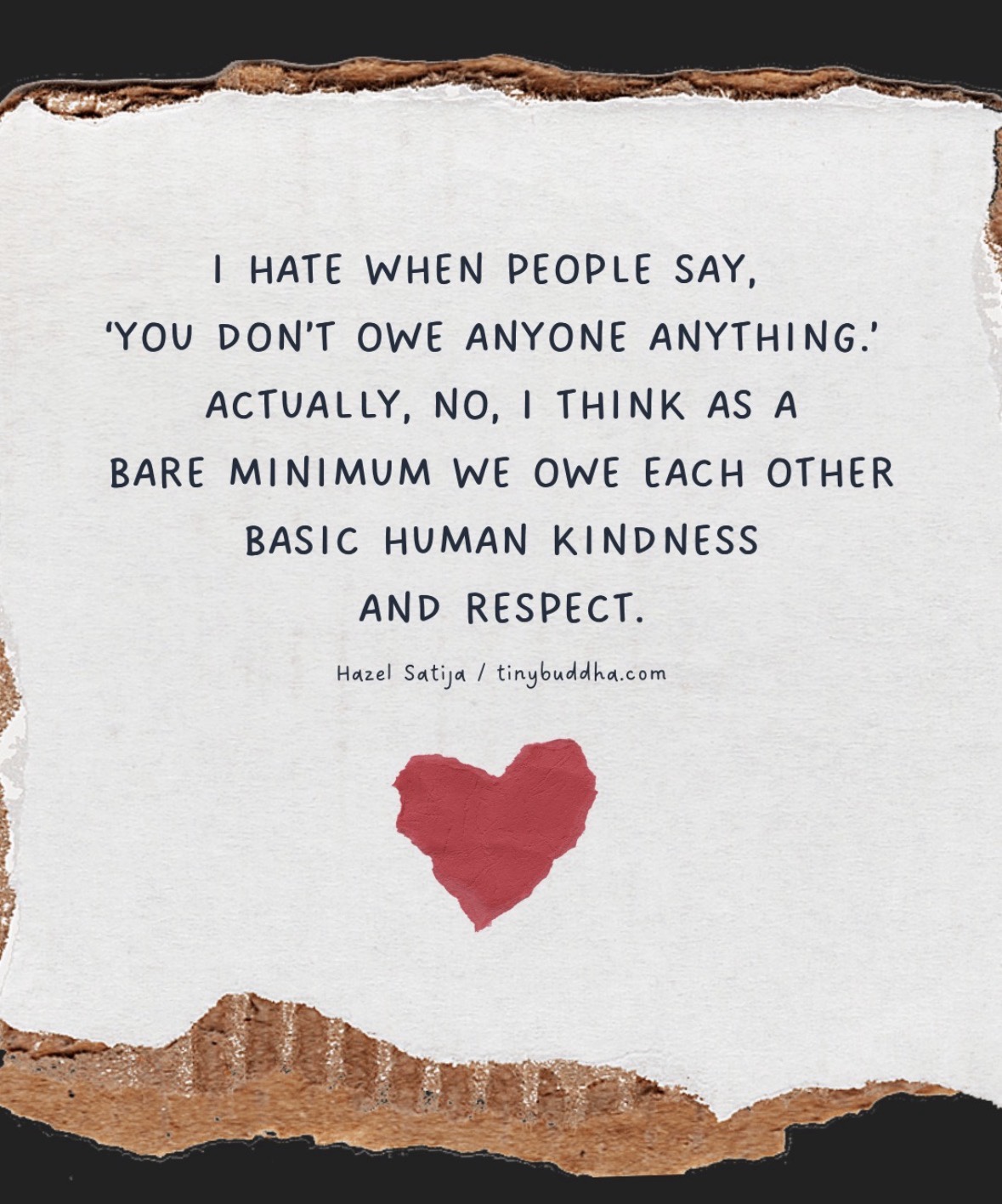
I’ve always flinched a little when someone says, “You don’t owe anyone anything.” I get what they’re trying to say. It usually comes from a place of self-preservation, boundaries, and not letting people walk all over you. And honestly, those are important lessons, especially for people who’ve spent too long giving too much of themselves away.
But taken at face value, that statement feels incomplete. Because while it’s true that you don’t owe anyone your time, your energy, your success, your emotional labor, or access to your life… it’s also true that we do owe each other something. Not everything. Just the bare minimum.
Basic human kindness. And respect.
Somewhere along the way, those two things started feeling optional. Like bonuses you give out only when someone “deserves” them. As if kindness has to be earned and respect is conditional on agreement, status, productivity, or convenience. And that’s where things get messy.
Kindness isn’t the same as self-sacrifice. Respect isn’t the same as obedience. You can say no and still be kind. You can set boundaries and still be respectful. You can disagree strongly and still treat the other person like a human being. These things are not mutually exclusive, even though the internet and modern discourse often make it seem that way.
We live in a time where being blunt is praised, but being cruel is often disguised as “just being honest.” Where dismissiveness is confused with confidence. Where empathy is sometimes framed as weakness. It’s easier to fire off a sharp comment, roll your eyes, or reduce someone to a label than it is to pause and remember there’s a full, complicated person on the other side.
And no, you don’t owe strangers deep emotional investment. You don’t owe explanations to everyone. You don’t owe people access to your inner world. But you do owe them the dignity of not demeaning them. Of not dehumanizing them. Of not treating them as disposable just because they momentarily inconvenience you or don’t align with your worldview.
Basic kindness looks surprisingly simple. It’s listening without planning your comeback. It’s not humiliating someone to feel superior. It’s choosing not to escalate when you could. It’s recognizing that you have no idea what someone else is carrying into the room with them that day.
Respect is just as quiet. It’s letting people exist without trying to control them. It’s disagreeing without contempt. It’s acknowledging someone’s humanity even when you don’t like their choices, opinions, or personality. Respect doesn’t mean endorsement. It means restraint.
What’s interesting is how quickly the “you don’t owe anyone anything” mindset can turn inward too. If I don’t owe you kindness, you don’t owe me kindness. If I don’t owe you respect, you don’t owe me respect. And suddenly we’re all operating at the lowest possible standard, wondering why everything feels so harsh and transactional.
Society doesn’t fracture because people set boundaries. It fractures when people stop caring how their actions land on others. When civility is treated as performative. When decency is seen as optional instead of foundational.
There’s also a quiet confidence in choosing kindness. It says, “I’m secure enough not to make this about winning.” There’s strength in respect. It says, “I don’t need to diminish you to stand tall.” These aren’t soft traits. They’re disciplined ones.
You can protect your peace without becoming indifferent to others. You can prioritize yourself without trampling people on the way. You can be firm, clear, and grounded while still being humane. In fact, those combinations tend to age better than bravado ever does.
At the end of the day, the world doesn’t need more people insisting they owe nothing to anyone. It needs more people willing to meet each other at least at the baseline. Not with perfection. Not with endless patience. Just with the understanding that everyone is more than a moment, a mistake, or a disagreement.
We don’t owe each other everything.
But we do owe each other the bare minimum.
And honestly, if we all held that line just a little more consistently, things would feel a lot less heavy than they do right now.
12 Roman Productivity Hacks You Should Be Doing
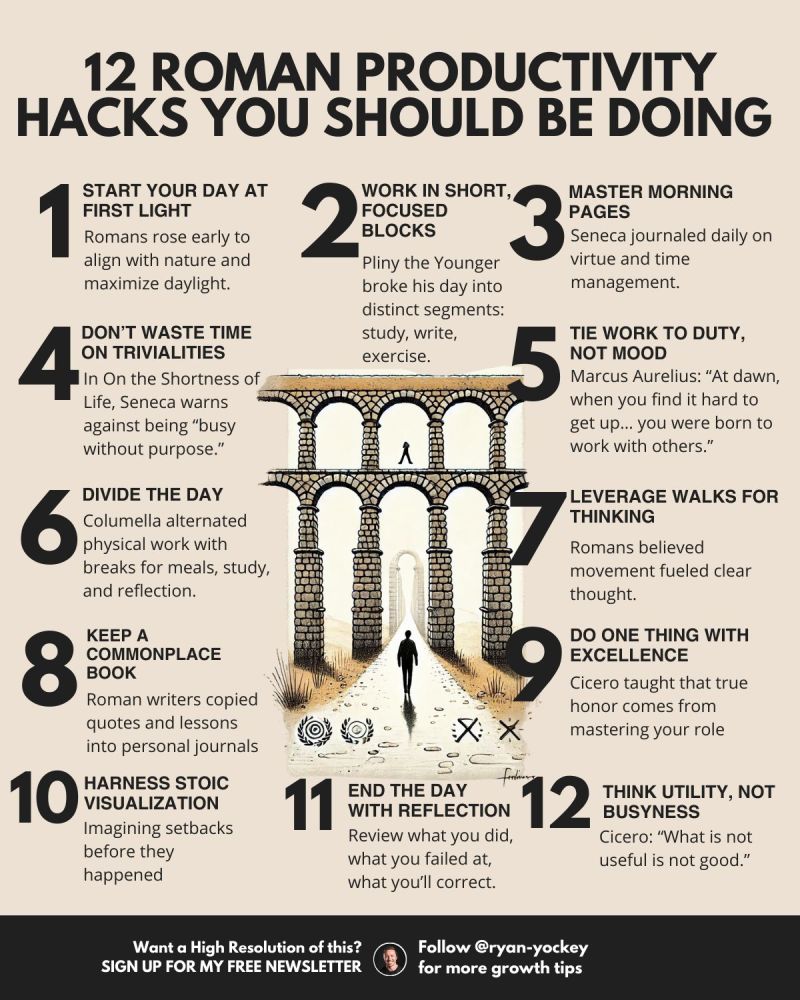
The Romans Hacked Productivity 2000 Years Ago
Modern “hacks” make you weaker.
12 Roman Productivity Hacks You Should Be Doing
The Romans built roads, aqueducts, and empires — but their real productivity secret was discipline. These 12 habits still outperform any modern app.
1. Start Your Day at First Light
→ Marcus Aurelius wrote about resisting the urge to stay in bed. Romans rose early to align with nature and maximize daylight.
2. Work in Short, Focused Blocks
→ Pliny the Younger broke his day into distinct segments: study, write, exercise, estate management. They believed in focused sprints, not endless grind.
3. Master Morning Pages
→ Seneca journaled daily on virtue and time management. Writing at dawn clarified his priorities and mindset.
4. Don’t Waste Time on Trivialities
→ In On the Shortness of Life, Seneca warns against being “busy without purpose.” Cut distractions, focus on essentials.
5. Tie Work to Duty, Not Mood
→ Marcus Aurelius: “At dawn, when you find it hard to get up… you were born to work with others.” For Romans, productivity was duty > desire.
6. Divide the Day (Think Pomodoro, 2,000 Years Ago)
→ Columella recommended alternating physical work with breaks for meals, study, and reflection. Structured rhythms boosted output.
7. Leverage Walks for Thinking
→ Cicero composed speeches while walking. Romans believed movement fueled clear thought.
8. Keep a Commonplace Book
→ Roman writers copied quotes, notes, and lessons into personal journals — an ancient version of a second brain.
9. Do One Thing with Excellence
→ Cicero taught that true honor comes from mastering your role — not scattering energy across trivial pursuits.
10. Harness Stoic Visualization
→ Romans practiced premeditatio malorum — imagining setbacks before they happened — to work with calm focus instead of anxiety.
11. End the Day with Reflection
→ Seneca’s nightly routine: review what you did, what you failed at, what you’ll correct tomorrow. A built-in feedback loop.
12. Think Utility, Not Busyness
→ Cicero: “What is not useful is not good.” For Romans, productivity was measured by impact, not hours worked.
These hacks pull directly from Seneca, Marcus Aurelius, Cicero, Pliny, and Columella.
The Romans built aqueducts, armies, and empires without Notion, Slack, or AI.
Their secret wasn’t tools — it was discipline.
Adopt even one of their habits, and you’ll outpace 99% of people still chasing “productivity hacks.”
6 Thinking Hats
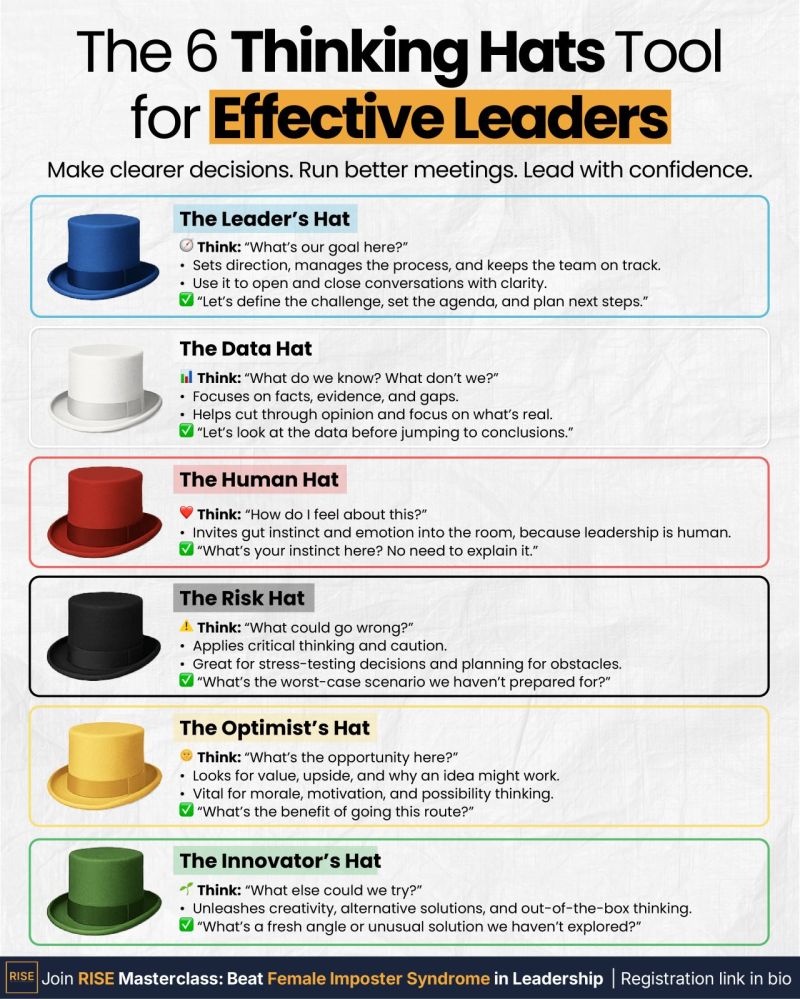
If your meetings feel like chaos disguised as collaboration…
Try this.
One of the simplest leadership tools I know is the 6 Thinking Hats.
It transforms messy discussions into sharp decisions by giving structure to how people think — not just what they say.
Here’s how it works:
🟦 Blue Hat — Lead the process. Set the tone. Define the goal.
⬜ White Hat — Stick to the facts. Data, not opinions.
🟥 Red Hat — Name the gut feeling. Emotions have a seat at the table.
⬛ Black Hat — Spot the risks. Stress-test the decision.
🟨 Yellow Hat — Look for the upside. Fuel optimism and energy.
🟩 Green Hat — Generate ideas. Explore what hasn’t been tried yet.
The best leaders don’t just run meetings; they lead the thinking.
Breathe
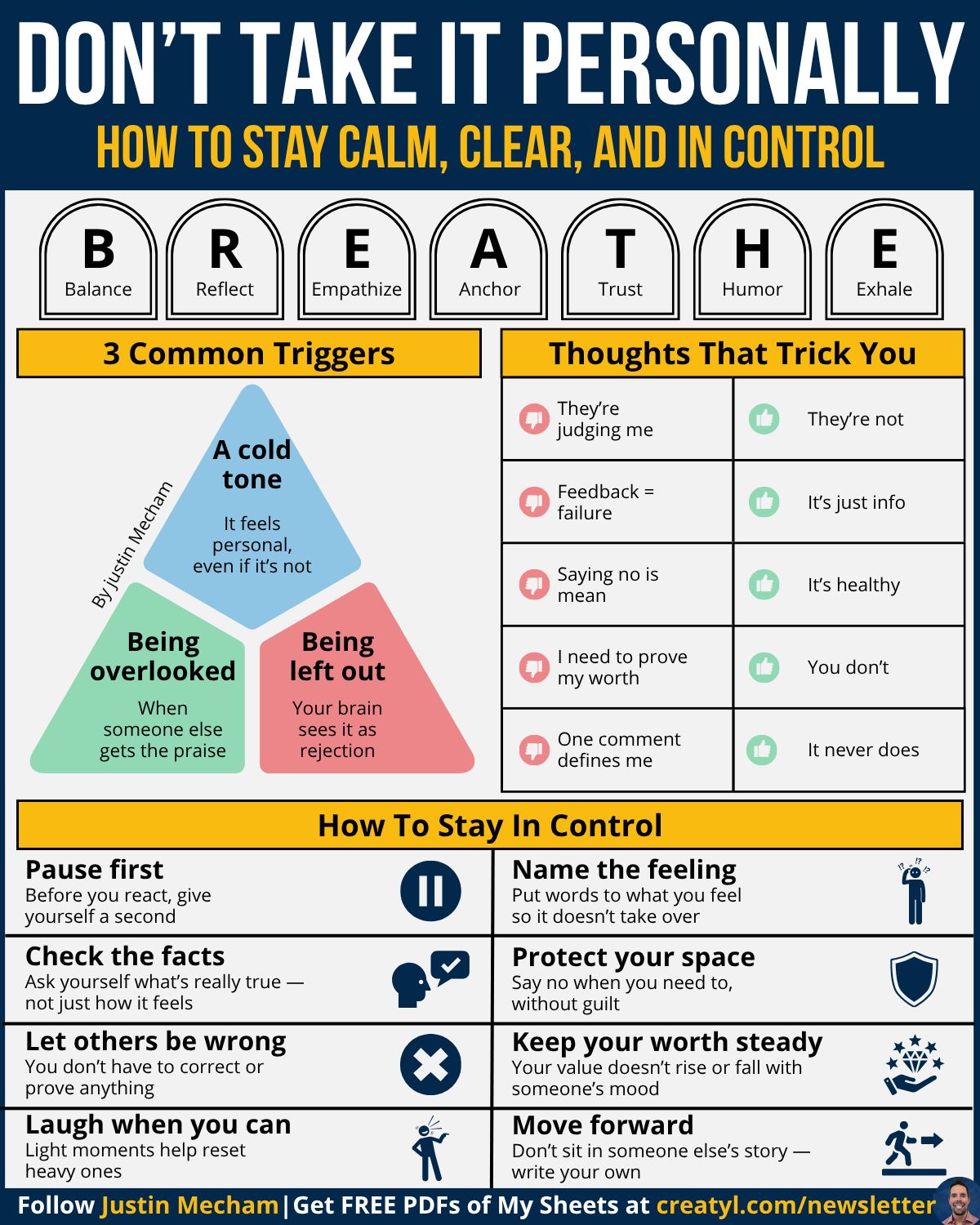
Most of what feels personal— Isn’t personal at all:
Is it how someone’s voice lands?
Maybe praise going to someone else? Or not getting included at all?
Whatever might be, they can all hit hard— But your reaction decides what happens next.
Use the BREATHE model to reset:
🟥 Balance before reacting
🟨 Reflect instead of assuming
⬜ Empathize with their side
🟩 Anchor to what’s true
🟧 Trust your worth
🟪 Humor to lighten the moment
🟦 Exhale and let it go
The truth?
You’re not being judged, feedback isn’t failure. And saying no is healthy (and necessary)
Here are 3 common triggers to watch for:
🔺A cold tone— Feels personal, even if it’s not
🔺Being overlooked— When someone else gets the praise
🔺Being left out— Your brain sees it as rejection
The calmer you stay, the clearer you think.
The clearer you think, the stronger you lead.
Emotional control isn’t coldness, it’s clarity under pressure. And clarity always leads better than impulse.
 Kenrick Vaz