
You can say the hard thing—
Without making it harder:
Most people walk into hard conversations
without a plan—
So they either explode…
or say nothing at all.
Both make things worse.
But it doesn’t have to be that way.
There’s a better way to speak up—
without guilt, confusion, or fear.
Use this simple path to start the
conversation, stay calm, and
actually fix what matters:
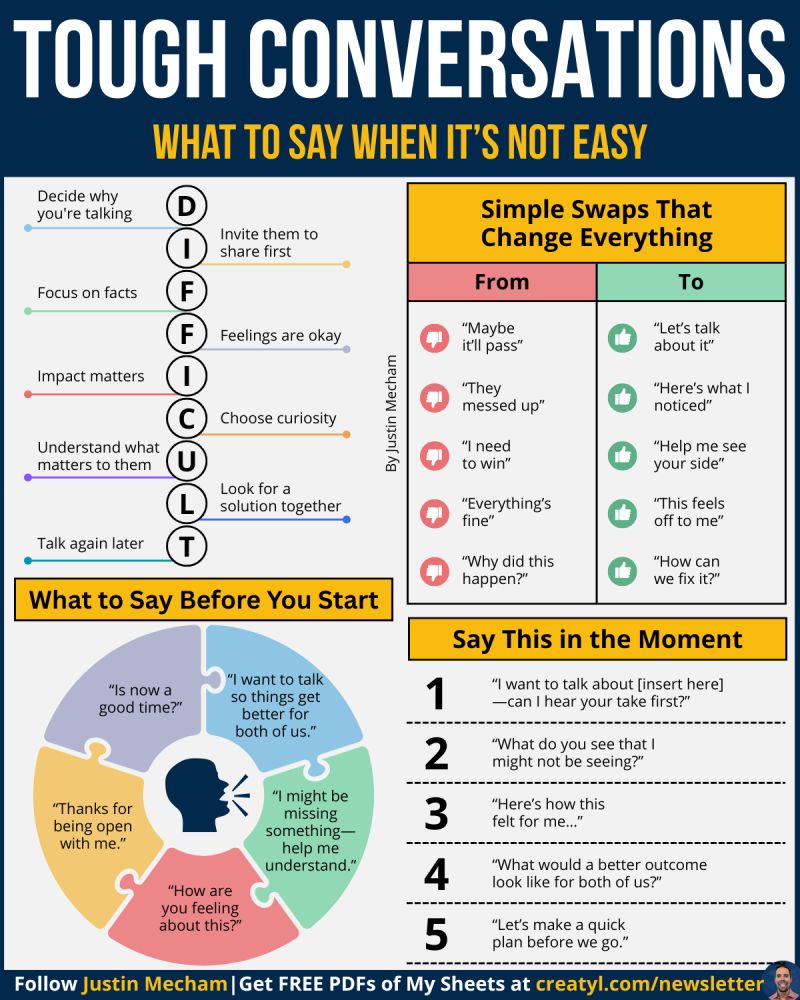
🔹 D — Decide what matters
🔸 I — Invite them to share first
🔹 F — Focus on facts
🔸 F — Feelings are valid
🔹 I — Impact matters
🔸 C — Choose curiosity
🔹 U — Understand their view
🔸 L — Look for a path forward
🔹 T — Talk again if needed
It’s a map for hard moments.
Now you’ll know what to
say when it matters most:
☑️ “Can I hear your take first?”
☑️ “Help me see your side.”
☑️ “Let’s fix this together.”
Because one clear, kind conversation
can save a project, a person, or a team.
And the earlier you say it—
The easier it becomes next time.
How to Say No
Saying yes to everything is a fast track to burnout.
Saying no (the right way) is how high performers stay:
— Respected
— Focused
— In control
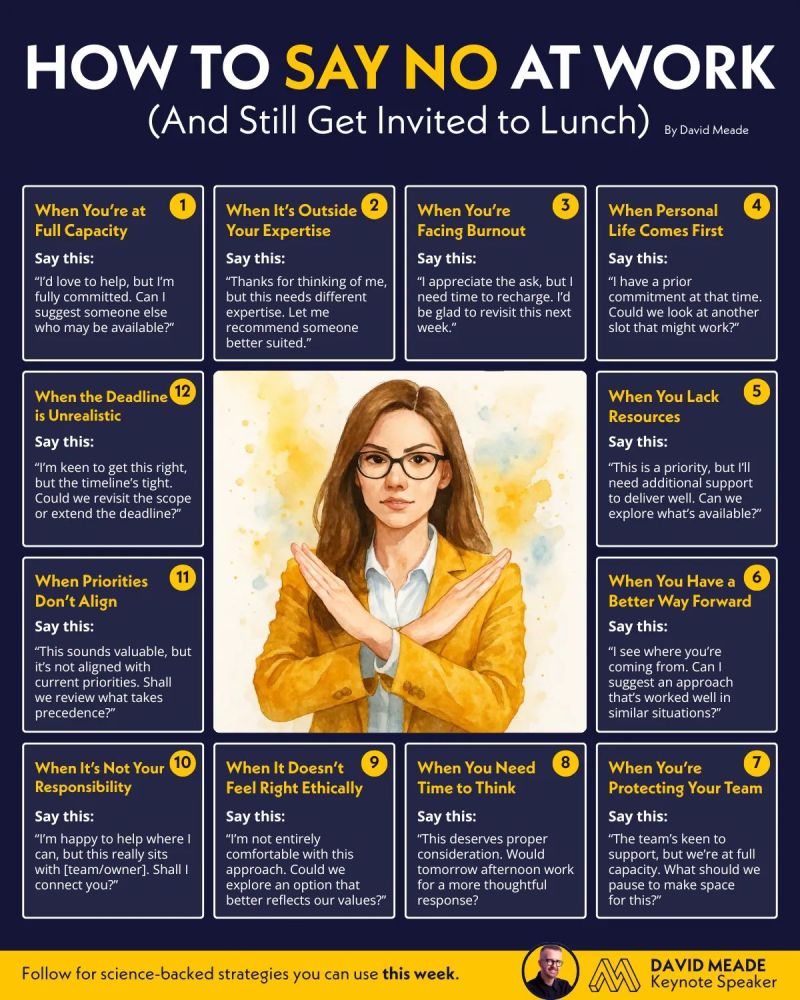
Here are 12 ways to say no
(while still being sort of lovely):
1. When You’re at Full Capacity
“I’d love to help, but I’m fully committed. Can I suggest someone who may be available?”
2. When It’s Outside Your Expertise
“Thanks for thinking of me, but this needs different expertise. Let me recommend someone better suited.”
3. When You’re Facing Burnout
“I appreciate the ask, but I need time to recharge. I’d be glad to revisit this next week.”
4. When Personal Life Comes First
“I have a prior commitment at that time. Could we look at another slot that might work?”
5. When You Lack Resources
“This is a priority, but I’ll need support to deliver it properly. Can we explore what’s available?”
6. When You Have a Better Way Forward
“I see where you’re coming from. Can I suggest an approach that’s worked well in similar situations?”
7. When You’re Protecting Your Team
“The team’s keen to support, but we’re at full capacity. What should we pause to make space for this?”
8. When You Need Time to Think
“This deserves proper consideration. Would tomorrow afternoon work for a more thoughtful response?”
9. When It Doesn’t Feel Right Ethically
“I’m not entirely comfortable with this approach. Could we explore an option that better reflects our values?”
10. When It’s Not Your Responsibility
“I’m happy to help where I can, but this really sits with [team/owner]. Shall I connect you?”
11. When Priorities Don’t Align
“This sounds valuable, but it’s not aligned with current priorities. Shall we review what takes
precedence?”
12. When the Deadline Is Unrealistic
“I’m keen to get this right, but the timeline’s tight. Could we revisit the scope or extend the deadline?”
Being honest though?
No one gets promoted for being the busiest.
They get promoted for being effective.
And effectiveness starts with knowing when – and how – to say no.
The Wheel of Executive Presence
Yes, communication is important.
But you have to listen to lead. Not just give orders.
Equally important?
How you show up (Gravitas)
How you present (Appearance)
How you regulate (Self-Mastery)
Executive presence is how you lead under pressure.
Show up in key moments.
Earn trust without needing to say much at all.
And the best CEOs?
They’re working on it constantly.
Because presence isn’t about being the loudest voice in the room.
It’s about calm, clarity, and credibility.
Especially when the stakes are high.
If you’re:
— Leading a team
— Growing a company
— Navigating tough decisions
— Pitching partners or investors
— Building influence in your industry
Then executive presence is a skill worth mastering.
So what’s it actually made of?
Use my framework:
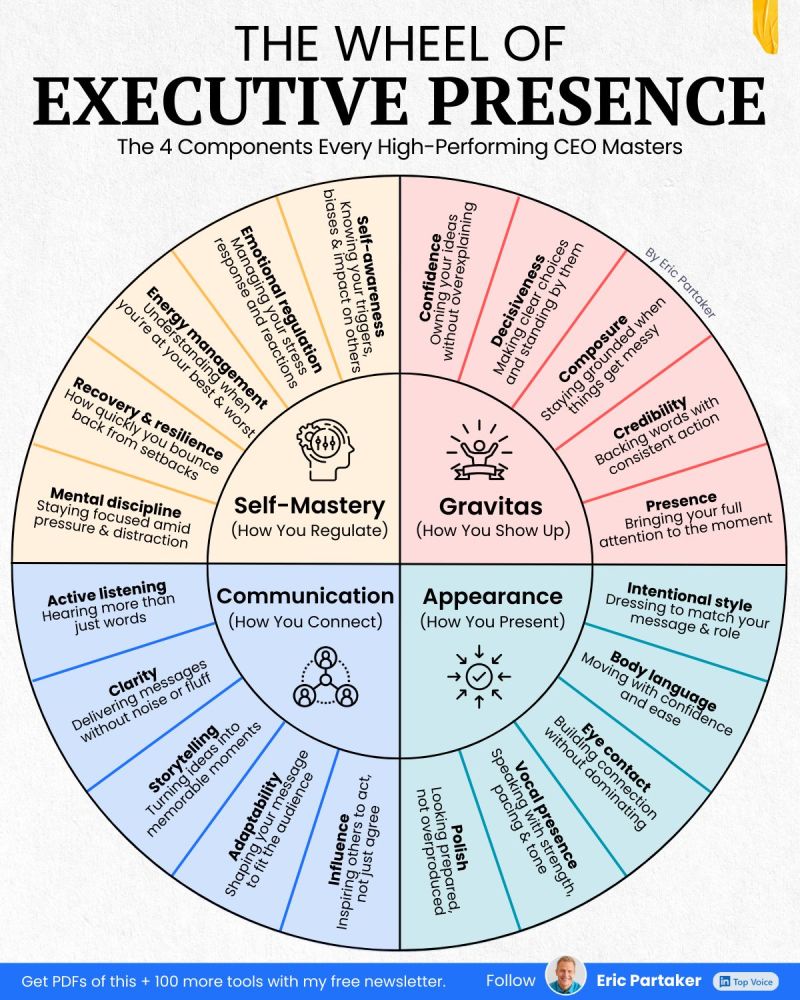
🟠 Self-Mastery (How You Regulate)
The internal game that makes everything else sustainable:
— Self-awareness
— Emotional regulation
— Energy management
— Recovery & resilience
— Mental discipline
🔴 Gravitas (How You Show Up)
The calm, grounded confidence people trust:
— Confidence
— Decisiveness
— Composure
— Credibility
— Presence
🔵 Communication (How You Connect)
The ability to simplify, influence, and land your message:
— Active listening
— Clarity
— Storytelling
— Adaptability
— Influence
🟢 Appearance (How You Present)
The nonverbal cues that shape perception before you speak:
— Intentional style
— Body language
— Eye contact
— Vocal presence
— Polish
This is the kind of presence that earns trust — fast.
Not by performing.
By leading with intention.
And the best part?
It’s not something you’re born with.
It’s something you build.
Start with 1 quadrant.
Work the muscles.
Watch your leadership transform.
The First Morning of the Year

New Year’s Day arrives without noise. The fireworks are over. The countdown has faded. What’s left is a quieter kind of magic—the kind that feels like a deep breath after a long night.
The first morning of the year has a different weight to it. It doesn’t ask you to rush or resolve everything all at once. It simply sits there, wide open, offering possibility without pressure. A clean page. A gentle beginning.
There’s something comforting about that. You don’t have to prove anything today. You don’t need a plan mapped out to December. All you need is a willingness to step into the year with an open heart.
Miracles don’t usually knock loudly on New Year’s Day. They slip in softly. In the calm. In the moments where you notice how peaceful it feels to start again. In the sense that maybe—just maybe—this year could surprise you in good ways.
Being a magnet for those moments doesn’t mean chasing them. It means allowing them. Choosing to move through the year with kindness, curiosity, and trust. Trust that the right people will cross your path. Trust that good energy grows when you protect it. Trust that happiness doesn’t need grand occasions to exist.
New Year’s Day reminds us that kindness is still powerful. That warmth still matters. That the smallest gestures can ripple farther than we expect. When you lead with grace, you attract people who meet you there. People who make ordinary days brighter and heavy days lighter.
And happiness? It often starts right here. In a slow morning. In coffee that tastes better because there’s nowhere you need to be. In the quiet joy of knowing you’re allowed to begin again without explanation.
Today isn’t about becoming a new person. It’s about returning to yourself. About stepping into 2026 gently, carrying hope instead of expectations.
So on this first day of the year, may you be a magnet for miracles—small and unexpected. May kind people find you and stay. May your energy feel lighter, steadier, and more your own. And may countless happy moments weave themselves into your days, starting right now, on this calm and promising New Year’s morning.
How to Write A Conference Talk
Some can initially win a room by sheer personality.
→ Raw confidence
→ Natural humor
→ Good looking
People will often mention these speakers after:
→ “Have you heard of her before?”
→ “She was the funny one!”
→ “He was so cool!”
But though they MAY remember the SPEAKER…
…here’s what they DON’T remember:
👉🏻 The talk itself. 👈🏻
But why??
Because people with magnetic personalities often have strong stage presence, but write sloppy talks.
They get used to phoning it in because they can get away with it.
→ But they rarely make a lasting difference.
At the same time, many people with middle of the road personalties, can make a massive impact.
It all comes down to the talk itself.
Great talks are great,
even if the speaker isn’t a superstar persona.
People may not remember their charisma,
but they will remember the content.
So:
😎 If you’re a cool kid, fine. → Still focus on content.
🤓 If you’re a nerd, also fine. → Same advice to you.
And when I say content…
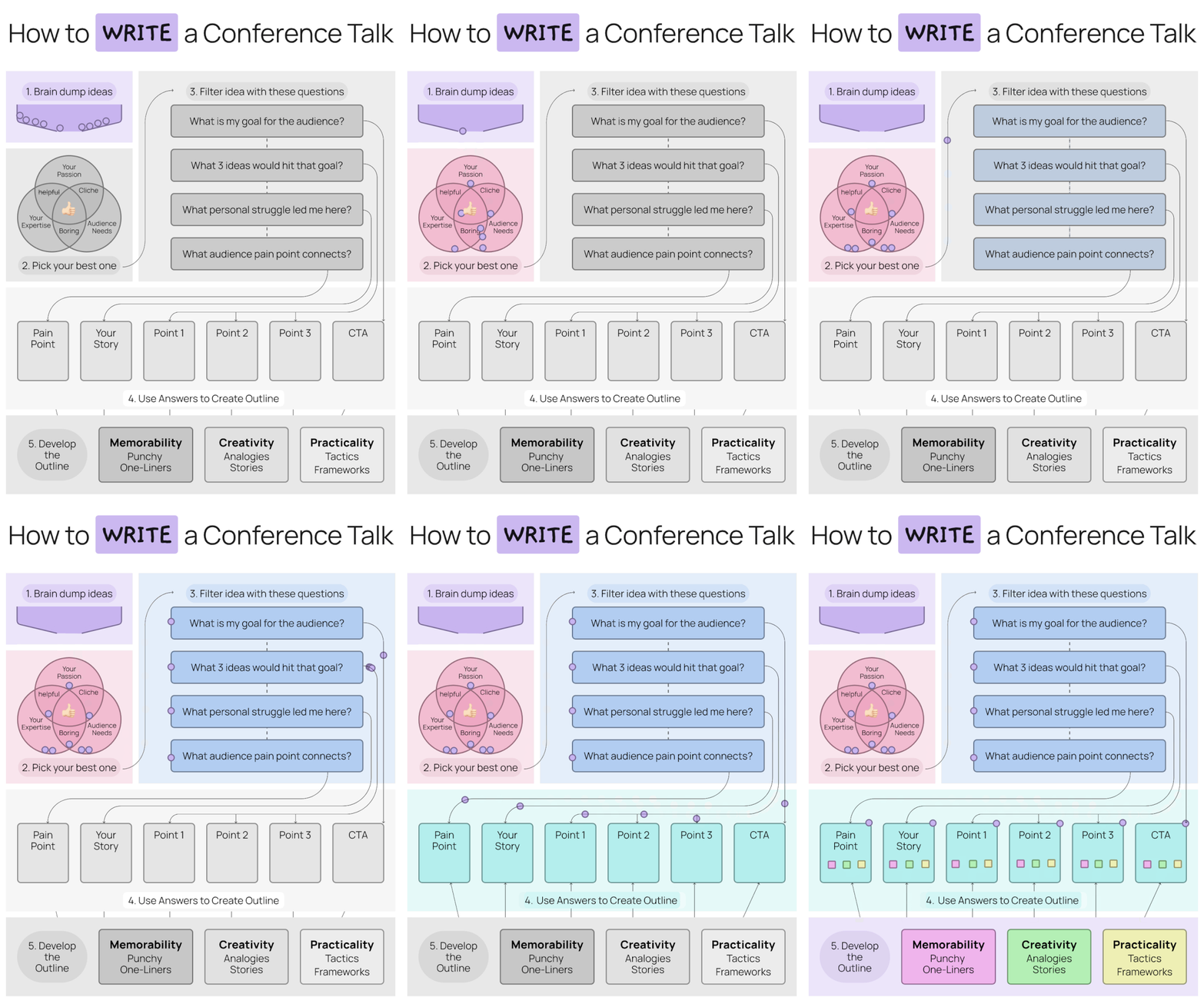
I mean specifically the craft of writing a killer talk:
→ Analogies & stories people never forget
→ An outline that is easy to follow and deliver
→ Hooks that work without leaning on charisma
→ Pain points woven into every section of the talk
→ One-liners your audience will quote back to you
Focus on content. Everything else falls into place.
Check the infographic for your roadmap.
You’ve got this!
The Iceberg of Toxic Culture
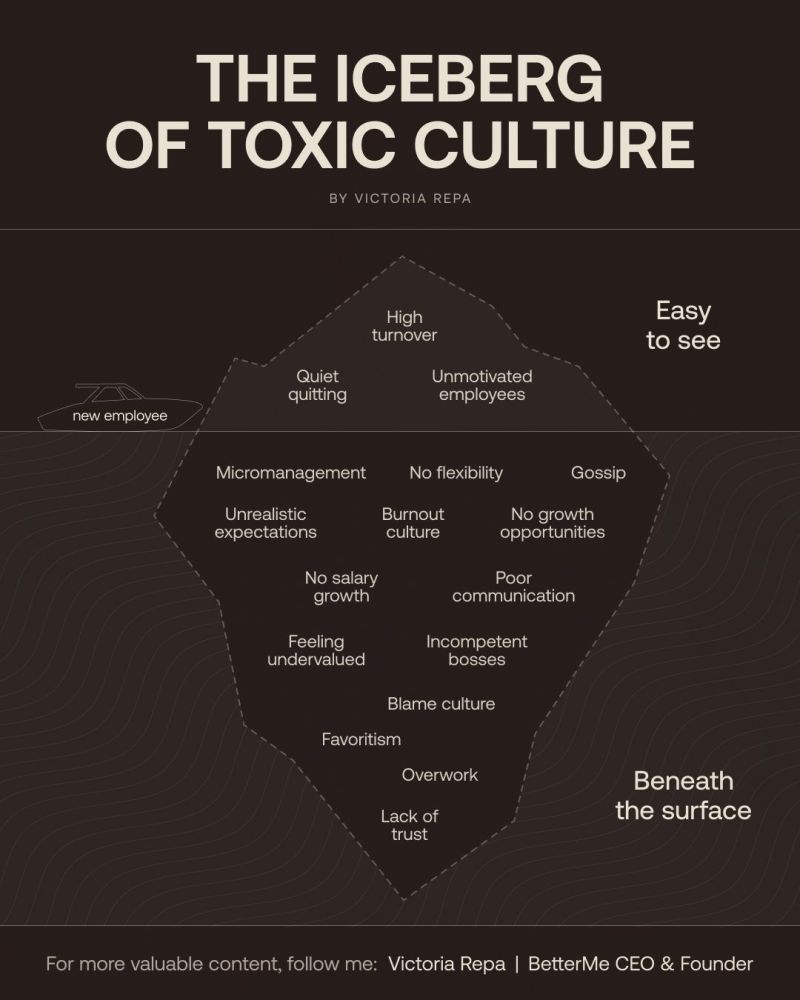
Toxic Work Culture.
Most candidates focus on:
↳ Salary.
↳ Job responsibilities.
↳ Benefits and team activities.
I used to do the same.
And yes, these things matter.
But none of it will matter if you step into a toxic environment.
What’s easy to spot in the first few weeks:
➟ High turnover
➟ Unmotivated employees
➟ Quiet quitting
What’s beneath the surface:
➟ Micromanagement
➟ Favoritism
➟ Incompetent leadership
➟ Blame culture
➟ Lack of trust
➟ No growth opportunities
➟ Overwork and burnout
➟ Unrealistic expectations
➟ No flexibility
➟ Feeling undervalued
➟ Gossip and office politics
➟ Poor communication
➟ Stagnant salaries
Culture isn’t just what’s visible — it’s what’s felt.
A thriving team isn’t built on surface-level perks.
It’s built on trust, respect, and an environment where people want to stay.
The real question:
What’s beneath the surface of YOUR workplace?
Have you ever taken a job only to realize the culture was toxic?
What were the warning signs?
How to Handle Disrespect
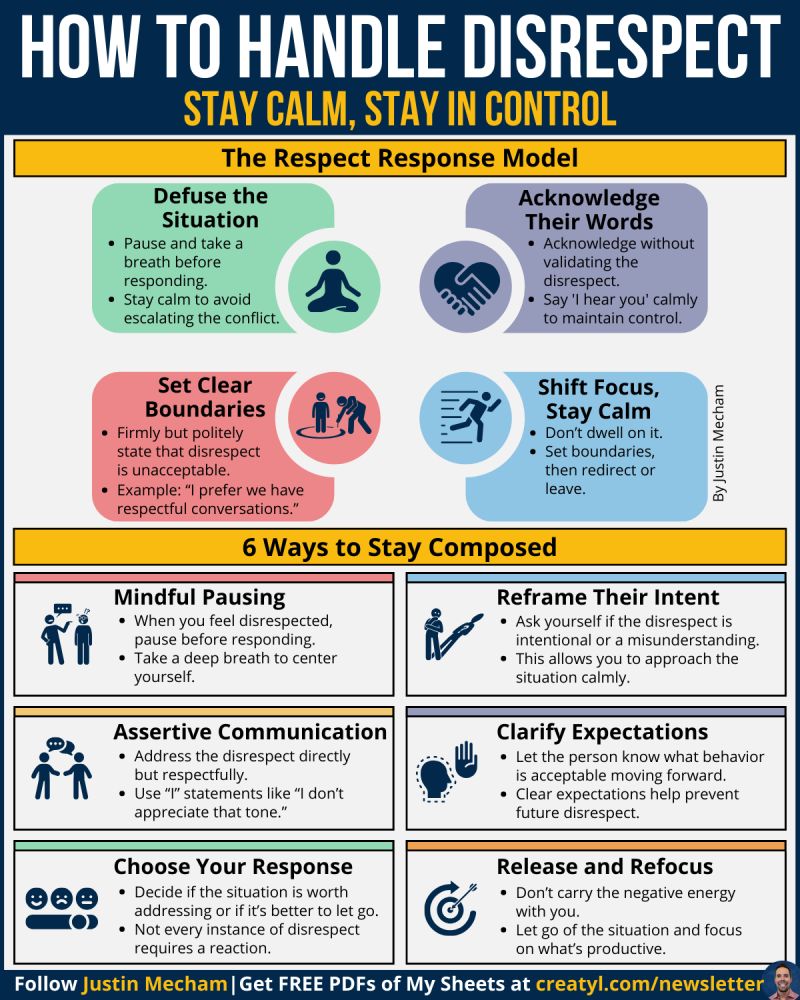
They crossed the line—
Now it’s your move:
Most people think disrespect
is about what was said.
It’s not.
It’s about what happens next.
That’s where your real power shows up.
You can’t control someone else’s tone, ego,
or behavior—but you can decide what
you will do in the moment.
And that choice is what keeps you in control.
Use my Respect Response Model to respond
without raising your voice, lowering your
standards, or losing your peace:
🟢 Defuse first
Take a breath. Pause before you respond.
🟣 Acknowledge calmly
Say “I hear you” without validating the disrespect.
🔴 Set boundaries
Be clear on what’s not okay—firm but respectful.
🔵 Shift the focus
Stay calm. Redirect, step away, or change the subject.
And if you want to stay grounded
when people cross the line:
🔹 Reframe their intent
Was it disrespect—or a misunderstanding?
🔹 Use “I” statements
Explain what crossed the line
without making it personal.
🔹 Choose your response
Not every comment deserves your energy.
You don’t win by outshouting anyone.
You win by staying clear on who you are—
while under pressure.
Because anyone can react.
Few know how to respond.
The Quiet Kind of Magic

We spend a lot of time chasing the loud version of magic. The kind that sparkles from a distance. The kind that photographs well. Lights strung just right. Gifts wrapped with precision. Homes that look like they belong on a holiday card. It’s easy to believe that magic lives there—on display, waiting for approval.
But real magic is quieter than that.
It doesn’t announce itself when you walk into a room. It settles in gently, almost unnoticed, until you pause long enough to feel it.
It shows up the moment you feel welcome. Not impressed. Not evaluated. Just welcome. The kind of welcome that doesn’t care how big the house is or how carefully curated the space looks. The kind that says, you’re safe here, without using words. Sometimes that welcome comes from others. Sometimes, and this matters more than we admit, it comes from ourselves.
There’s a special warmth in being seen. Not the spotlight kind, but the human kind. Being noticed without being measured. Being understood without needing to explain. In a crowded room, it can feel rare. In a quiet moment, it can feel profound. And when it happens, even briefly, it changes the way the day feels.
We often confuse noise with meaning. More people, more plans, more effort must mean more magic—right? But some of the most meaningful moments happen when nothing extraordinary is going on. No agenda. No performance. Just presence.
A cup of coffee enjoyed slowly. Music playing softly in the background. Light falling across a room in a way that feels kind. These moments don’t ask for attention, but they reward it. They remind us that beauty doesn’t need an audience to be real.
There’s also a quiet courage in choosing to create something beautiful for yourself. No applause. No validation. Just the simple decision that you are worth the effort. That your space, your time, your peace matter—even on an ordinary day, even when no one else is watching.
That kind of love is subtle but powerful. It doesn’t rely on seasons or celebrations. It doesn’t expire when the lights come down or the decorations are packed away. It stays. It grounds you. It becomes a steady source of calm in a world that constantly asks for more.
And maybe that’s what magic really is. Not something we manufacture with things, but something we allow through care. Care for others. Care for moments. Care for ourselves.
It’s the feeling of being at home, wherever you are. It’s knowing you don’t have to earn belonging. It’s recognizing that even a quiet day spent alone can be full, meaningful, and beautiful.
That kind of magic doesn’t shout.
It doesn’t sparkle on demand.
But once you notice it, you realize it’s been there all along—waiting for you to slow down and let it in.
Negotiate Like a Donkey (Not a Peacock)
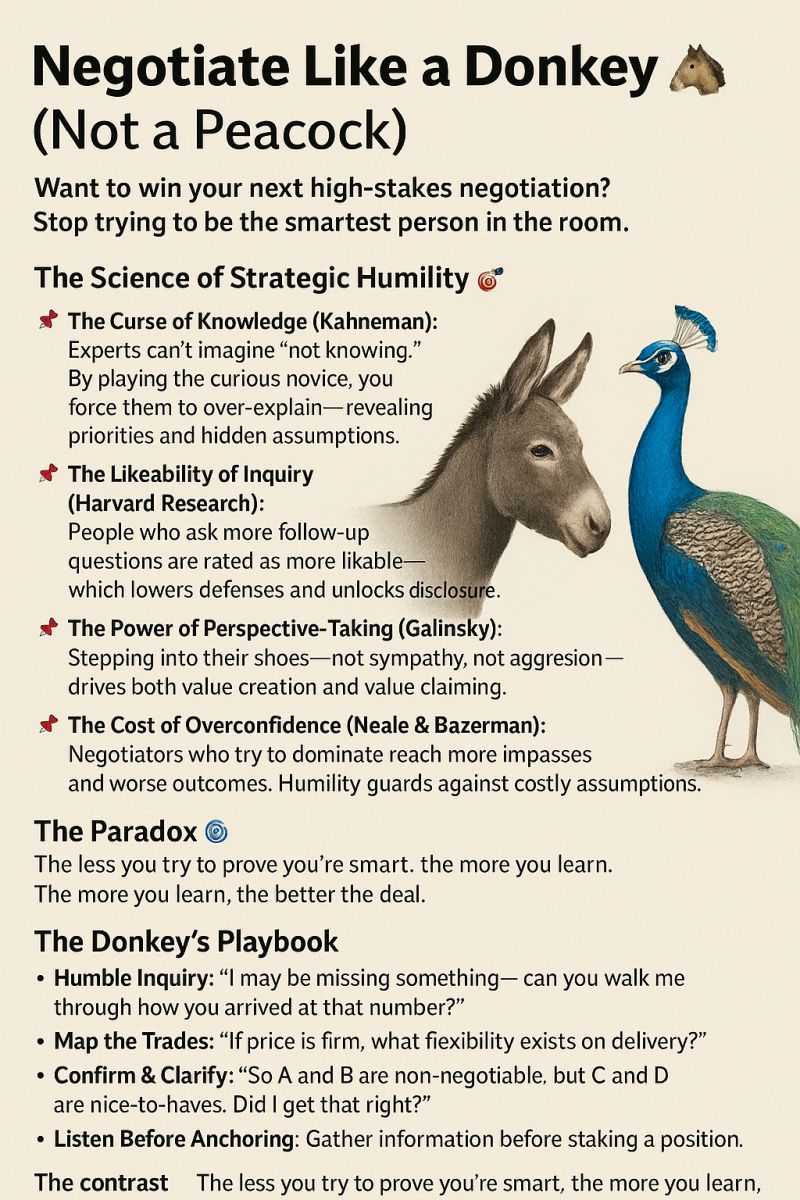
Want to win your next high-stakes negotiation?
Stop trying to be the smartest person in the room.
The flashy Peacock negotiator leads with expertise, confidence, and fast anchors.
The humble Donkey negotiator? Patient. Steady. Inquisitive. Deceptively simple.
And paradoxically—the donkey wins more.
The Science of Strategic Humility 🎯
📌 The Curse of Knowledge (Kahneman):
Experts can’t imagine “not knowing.” By playing the curious novice, you force them to over-explain—revealing priorities and hidden assumptions.
📌 The Likeability of Inquiry (Harvard Research):
People who ask more follow-up questions are rated as more likable—which lowers defenses and unlocks disclosure.
📌 The Power of Perspective-Taking (Galinsky):
Stepping into their shoes—not sympathy, not aggression—drives both value creation and value claiming.
📌 The Cost of Overconfidence (Neale & Bazerman):
Negotiators who try to dominate reach more impasses and worse outcomes. Humility guards against costly assumptions.
The Paradox 🌀
The less you try to prove you’re smart, the more you learn.
The more you learn, the better the deal.
The Donkey’s Playbook
· Humble Inquiry: “I may be missing something—can you walk me through how you arrived at that number?”
· Map the Trades: “If price is firm, what flexibility exists on delivery?”
· Confirm & Clarify: “So A and B are non-negotiable, but C and D are nice-to-haves. Did I get that right?”
· Listen Before Anchoring: Gather information before staking a position.
The Contrast
🦚 Peacock: Asserts, performs, anchors fast → Thin trust, fixed-pie deals.
🐴 Donkey: Probes, re-asks, clarifies → Rich disclosure, creative trades, durable agreements.
Sometimes the smartest negotiator is the one who looks like the slowest learner.
The donkey outsmarts the peacock. Every time.
👉 In your next negotiation, what’s the one “dumb” follow-up question you’re willing to ask that might make it the smartest deal of the year?
Navy Seal Mantras
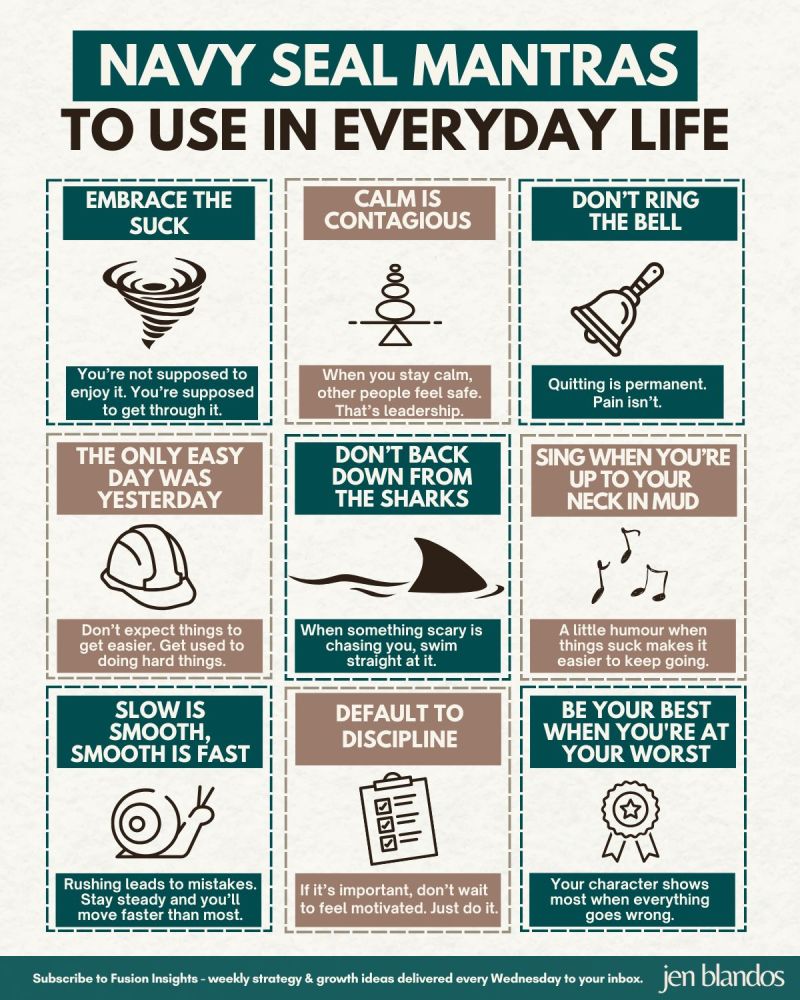
What can the military teach us about resilience?
A lot, it turns out.
These 9 mantras used by Navy SEALs can help navigate everyday stress, tough decisions and personal growth.
1/ Embrace the suck
↳ You’re not supposed to enjoy hard things. You’re supposed to finish them.
2/ Calm is contagious
↳ Your presence matters. Composure is leadership.
3/ Don’t ring the bell
↳ Quitting feels easy now. But regret lasts longer.
4/ The only easy day was yesterday
↳ Get comfortable doing what’s uncomfortable.
5/ Don’t back down from the sharks
↳ Face your fear head-on. Don’t flinch.
6/ Sing when you’re up to your neck in mud
↳ A sense of humour can carry you further than strength.
7/ Slow is smooth, smooth is fast
↳ Rushing causes mistakes. Move steady and win.
8/ Default to discipline
↳ Motivation fades. Discipline carries you when it does.
9/ Be your best when you’re at your worst
↳ Your character shows when everything falls apart.
 Kenrick Vaz