
After dozens of keynotes, team meetings, and investor calls,
I realized it’s not about being loud or “natural.”
It’s about being intentional.
Here are 8 rules that instantly upgrade how you speak:
(whether you’re on stage, in a pitch, or leading your team)
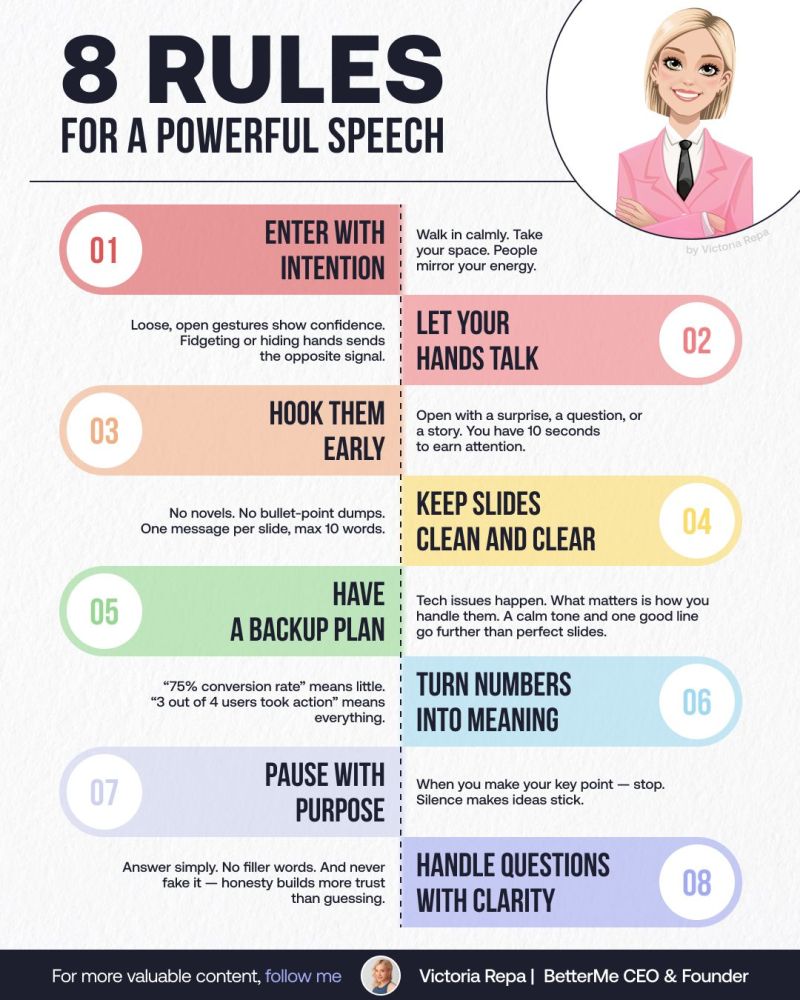
1/ Enter with intention
Walk in calmly. Take your space.
People mirror your energy.
2/ Let your hands talk
Loose, open gestures show confidence.
Fidgeting or hiding hands sends the opposite signal.
3/ Hook them early
Open with a surprise, a question, or a story.
You have 10 seconds to earn attention.
4/ Keep slides clean and clear
No novels. No bullet-point dumps.
One message per slide, max 10 words.
5/ Have a backup plan
Tech issues happen. What matters is how you handle them.
A calm tone and one good line go further than perfect slides.
6/ Turn numbers into meaning
“75% conversion rate” means little.
“3 out of 4 users took action” means everything.
7/ Pause with purpose
When you make your key point — stop.
Silence makes ideas stick.
8/ Handle questions with clarity
Answer simply. No filler words.
And never fake it. Honesty builds more trust than guessing.
The best speakers don’t try to impress.
They aim to connect.
And the more you simplify,
the more people will listen.
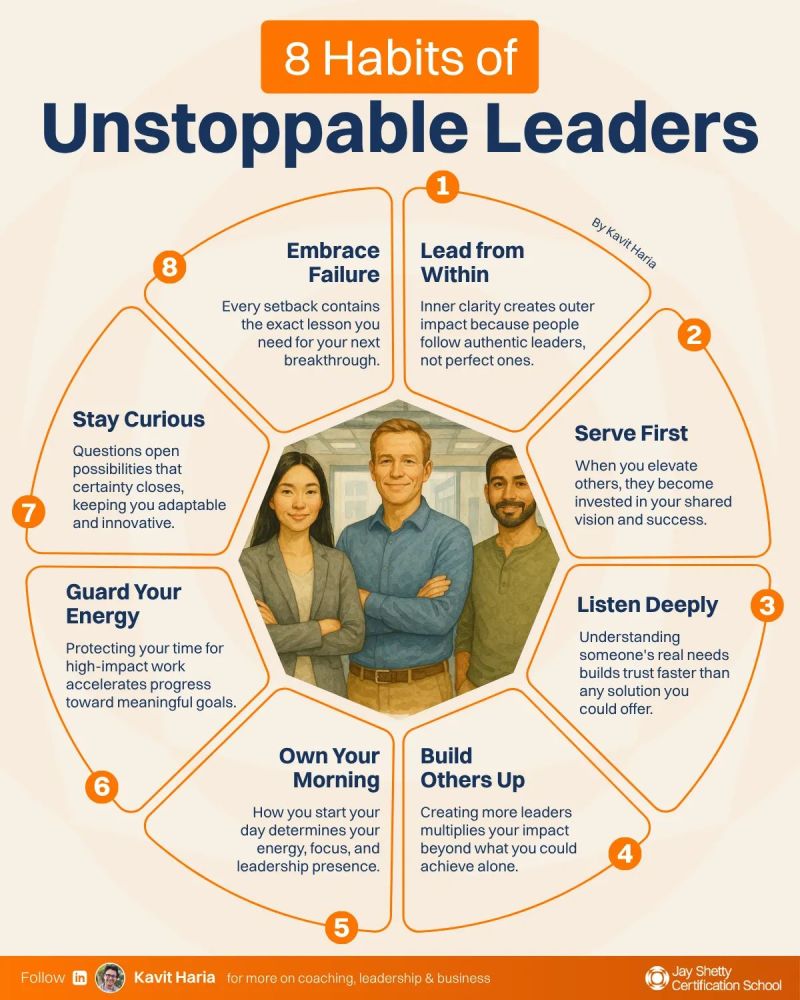
8 Habits of Unstoppable Leaders
I used to believe this too.
Until I started paying closer attention.
The leaders who seem effortless?
They’re actually the most intentional about their
daily practices.
Here’s what great leaders do differently:
💡Lead from Within
→ Inner clarity creates outer impact
→ People follow authentic leaders, not perfect ones
👐Serve First
→ Ask “How can I help?” before “What can you do?”
→ When you elevate others, they become invested
in your vision
👂Listen Deeply
→ Before offering help, offer your attention
→ Understanding someone’s needs builds trust faster
📣Build Others Up
→ Creating more leaders multiplies your impact
→ Your job isn’t to be the smartest person in the room.
It’s to make everyone smarter
⏰Own Your Morning
→ How you start your day determines your energy
→ Win the morning, win the day
🛡️Guard Your Energy
→ Protecting your time accelerates progress
→ Say no to good so you can say yes to great
🧠 Stay Curious
→ Questions open possibilities that certainty closes
→ When you think you know it all, you stop growing
🔥Embrace Failure
→ Every setback carries the lesson needed most
→ Let that fuel your next breakthrough
Leadership isn’t about perfection or natural gifts.
It’s about progression.
Each of these habits is a step forward.
Not toward becoming someone else,
but toward becoming more of who you already are.
The world needs leaders who show up
consistently, not perfectly.
So which step will you take first?
12 Morning Habits To AVOID

12 morning habits to avoid to regain control:
1) Snooze Button Trap 😴
↳ Set just one alarm and place it across the room.
↳ Getting up right away will make everything easier.
2) Morning Dehydration 💧
↳ Keep a water bottle by your bed.
↳ Empty it before coffee to kickstart your system.
3) Instant Scrolling 📱
↳ Resist checking social media first thing.
↳ Read something uplifting instead.
4) Sugar for Breakfast 🍩
↳ Skip the blood sugar crash.
↳ Choose protein-rich and whole-food options.
5) No Preparation 🎒
↳ Lay out clothes and prep your bag the night before.
↳ 10 minutes of prep saves an hour of chaos.
6) Skipping a Gratitude Practice 🙏
↳ Name 3 things you’re grateful for.
↳ It rewires your brain for optimism.
7) Calendar Review 📅
↳ Check it after your first coffee.
↳ Prioritize what really matters.
8) Not Making Your Bed 🛏️
↳ Make it part of your wake-up ritual.
↳ A small win builds early momentum.
9) Not Getting Morning Sunlight ☀️
↳ Get outside for at least 10 minutes.
↳ Pair it with a walk to boost mood and focus.
10) Multitasking Madness ⚡
↳ Prep one thing at a time.
↳ Less stress, more speed.
11) Not Setting Daily Goals 🧭
↳ Write down your top 3 for the day.
↳ Define what success looks like.
12) Checking Emails First Thing 📩
↳ Set a specific time for email later.
↳ Start your day proactively, not reactively.
Build Your Dream Leadership Team

Most CEOs are babysitting their leadership teams.
(And they don’t even realize it.)
You’re solving problems your execs should handle.
Making decisions they should own.
Pushing for results they should drive.
Meanwhile, your competition has leaders who think like owners and deliver without oversight.
The difference? They stopped managing and started building.
After coaching 400+ CEOs, I’ve seen the pattern.
Average leaders hire smart people then do all the heavy lifting.
Great leaders build systems that create self-managing teams.
7 steps that actually work:
1. Stop imposing your vision. Co-create it.
When leaders build the future together, they defend it.
One CEO spent 2 days with his team crafting their vision.
Result? They hit targets he never even set.
2. Put the right people in the right seats.
Rate every leader:
Do they live your values?
Excel in their role?
Below 7/10 on either?
Make the move. Fast.
3. Create your operating system together.
How will you debate? Decide? Disagree?
Document it. Live it. Reference it daily.
Dysfunction disappears when everyone follows agreed rules.
4. Build trust through conflict.
Teams that never disagree never excel.
Your new response to pushback: “Thank you, tell me more.”
Watch what happens when disagreement becomes safe.
5. Give autonomy with clarity.
Define the sandbox. Then get out.
What decisions can they make alone?
What’s their budget authority?
Answer these or keep babysitting forever.
6. Make accountability transparent.
It’s not about catching failures.
It’s about creating visibility.
When everyone sees everyone’s commitments, standards rise naturally.
Public scoreboards beat private conversations.
7. Invest in growth conversations.
Your highest-leverage hours aren’t in strategy sessions.
They’re asking: “How can I help you grow?”
Then actually investing in their answer.
Most CEOs think building great teams takes years.
It doesn’t.
It takes deciding you’re done being the bottleneck.
Here’s what no one tells you:
Your team could be extraordinary right now.
They’re just waiting for you to stop managing.
And start building the system that lets them soar.
Your next quarter doesn’t depend on you doing more.
It depends on you letting them become more.
12 Brutal Truths

Too many leaders say they want honesty.
But what they really want is validation.
So when someone shares a hard truth, they:
→ Get defensive
→ Shift the blame
→ Shut the conversation down
That’s not leadership.
That’s ego-protection.
Real leaders do the opposite:
✅ Listen without interrupting
→ Feedback isn’t an attack; it’s a gift.
✅ Pause before reacting
→ Defensiveness kills trust faster than mistakes.
✅ Ask questions, not excuses
→ “Help me understand” opens doors, “That’s not true” slams them shut.
✅ Act on what you hear
→ If nothing changes, the honesty stops coming.
✅ Thank people for the courage
→ Speaking truth to power is never easy.
If you only accept feedback when it feels good, you’re not leading.
You’re avoiding growth.
12 brutal truths every employer needs to hear:
1️⃣ When top people leave, it’s on you.
2️⃣ Remote work isn’t the issue. Trust is.
3️⃣ Can’t take feedback? You won’t last.
4️⃣ Say values. Act different. Lose trust.
5️⃣ All leaders look the same? Diversity’s fake.
6️⃣ Underpay = short-sighted, not smart.
7️⃣ Toxic culture kills brands. Always.
8️⃣ Employees first. Customers second.
9️⃣ Micromanaging = weak leadership.
🔟 No growth? No top talent.
1️⃣1️⃣ Fear-driven teams fail.
1️⃣2️⃣ Don’t pay them? Someone else will.
Leading with Empathy

The quietest leaders often make the biggest impact.
Not through bold declarations or power moves.
But through something deeper: empathy.
It’s more than just listening to words.
It’s hearing the unspoken.
Understanding the unsaid.
Real empathy in leadership means:
➟ Noticing when your star performer seems off
➟ Reading between the lines in conversations
➟ Sensing team tension before it erupts
When you lead with empathy:
✅ Trust deepens naturally
✅ Problems surface early
✅ Solutions emerge more easily
But here’s what many miss:
Empathy isn’t soft. It’s strategic.
It’s the difference between:
➟ A team that hides problems
➟ And one that solves them together
Between:
➟ People who do the minimum
➟ And those who give their best
Between:
➟ A group that works side by side
➟ And a team that moves as one
Want to strengthen your empathy?
Start with silence.
Listen more than you speak.
Watch for what isn’t being said.
Because in leadership, the greatest power
isn’t in being heard, but in truly hearing others.
That’s how you build teams that last.
That’s how you create impact that matters.
That’s how you leave a legacy worth leaving.
Your next level of leadership
starts with two simple words:
“I’m listening.”
Mean them.
6 Life Automations

6 life automations that will save you hundreds of hours:
1. Automate Your Finances
2. Automate Your Passive Income
3. Automate Your Wardrobe
4. Automate Your Meals
5. Automate Your Calendar
6. Automate Your Mornings
Remember:
Time is your most valuable resource.
You deserve to win back as much of it as possible.
Use these automations to get started today.
P.S. One of my favorite life automations?
Turning knowledge into passive income.
If you’re sitting on expertise that could help others,
platforms like Kajabi make it simple to monetize what you already know.
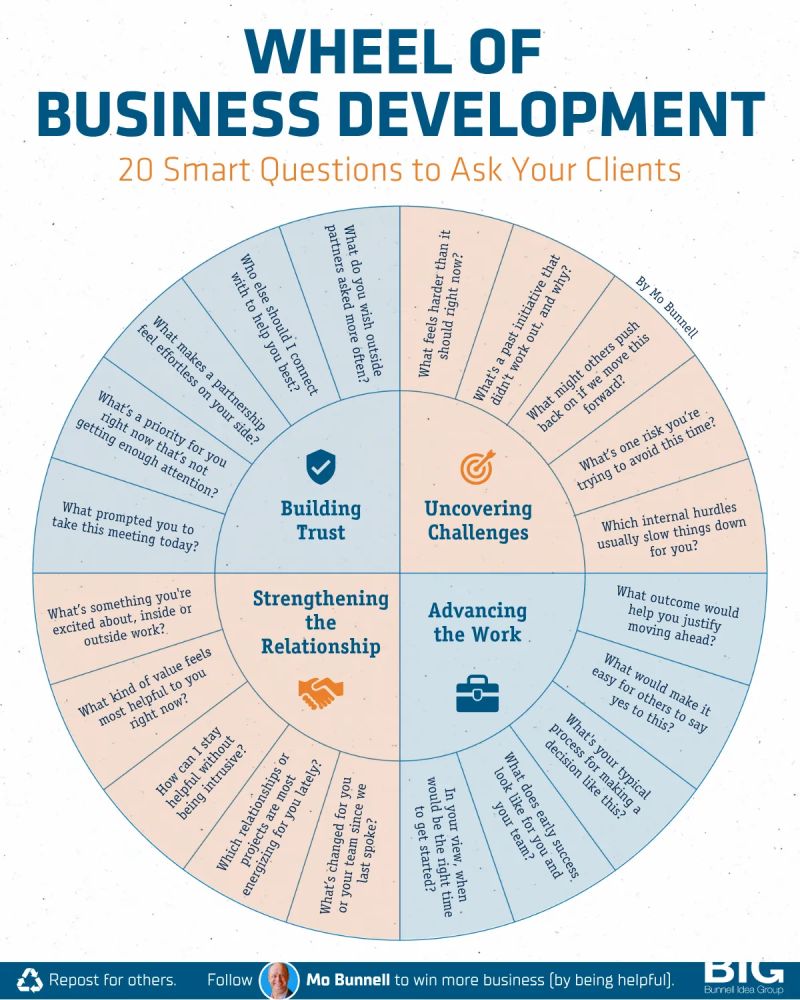
Wheel of Business Development
Stalled deals often have a common cause.
(And it’s easier to fix than you think.)
You didn’t ask the one thing they needed to hear.
Most client-facing professionals mean well.
But in conversations, good intent isn’t enough.
What matters is asking the right questions.
The kind that uncover what actually moves the work forward.
Having coached 50,000+ professionals through this exact challenge, I’ve learned something crucial.
Questions are a business developer’s greatest tool.
They move relationships forward when everything else stalls.
They uncover challenges no deck could reveal.
They open doors that presentations can’t.
They build trust faster than any credential.
Here are 20 smart questions to ask your clients, organized into 4 categories:
Building Trust
✅ What prompted you to take this meeting today?
✅ Who else should I connect with to help you best?
✅ What do you wish outside partners asked more often?
✅ What makes a partnership feel effortless on your side?
✅ What’s a priority for you right now that’s not getting enough attention?
Uncovering Challenges
✅ What feels harder than it should right now?
✅ What’s one risk you’re trying to avoid this time?
✅ What’s a past initiative that didn’t work out, and why?
✅ Which internal hurdles usually slow things down for you?
✅ What might others push back on if we move this forward?
Advancing the Work
✅ What outcome would help you justify moving ahead?
✅ What would make it easy for others to say yes to this?
✅ In your view, when would be the right time to get started?
✅ What does early success look like for you and your team?
✅ What’s your typical process for making a decision like this?
Strengthening the Relationship
✅ How can I stay helpful without being intrusive?
✅ What kind of value feels most helpful to you right now?
✅ What’s changed for you or your team since we last spoke?
✅ What’s something you’re excited about, inside or outside work?
✅ Which relationships or projects are most energizing for you lately?
I always tell my coaching clients:
Don’t rush the pitch.
Slow down.
Ask better questions.
And listen.
I mean, really listen to what they are telling you.
Because real relationships and real results start with a question that makes someone feel seen.
Try one of these in your next client conversation.
Listen for what surprises you.
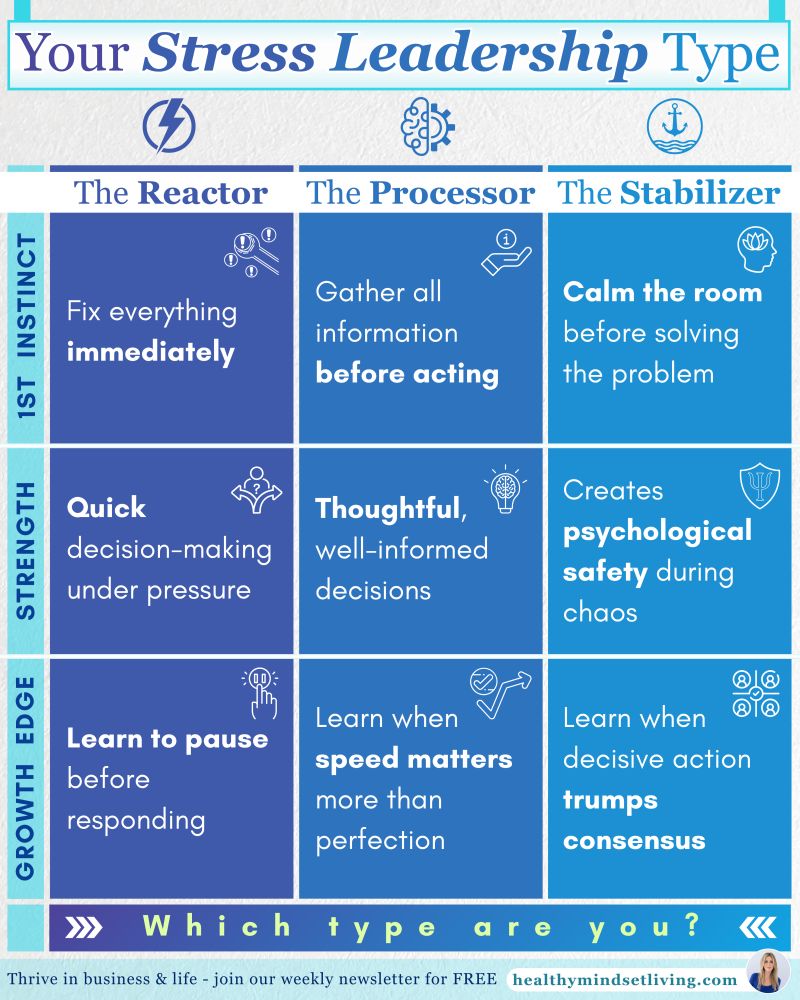
Stress Leadership Types
Your stress response reveals your leadership type.
Here’s how to decode yours👇🏼
Most people think stress kills leadership potential.
Wrong.
It reveals it.
3 stress leadership types:
1) ⚡ The Reactor
↳ First instinct: Fix everything immediately
↳ Strength: Quick decision-making under pressure
↳ Growth edge: Learn to pause before responding
↳ In action: “I’ll handle this” becomes your default response
2) 🧠 The Processor
↳ First instinct: Gather all information before acting
↳ Strength: Thoughtful, well-informed decisions
↳ Growth edge: Learn when speed matters more than perfection
↳ In action: “Let me think about this” is your go-to phrase
3) 🎯 The Stabilizer
↳ First instinct: Calm the room before solving the problem
↳ Strength: Creates psychological safety during chaos
↳ Growth edge: Learn when decisive action trumps consensus
↳ In action: “Everyone take a breath” starts most of your responses
Your stress response isn’t broken.
It’s your leadership signature.
Master it.
Don’t hide from it.
Which type resonates most with you right now?
The Rarest Thing We Carry
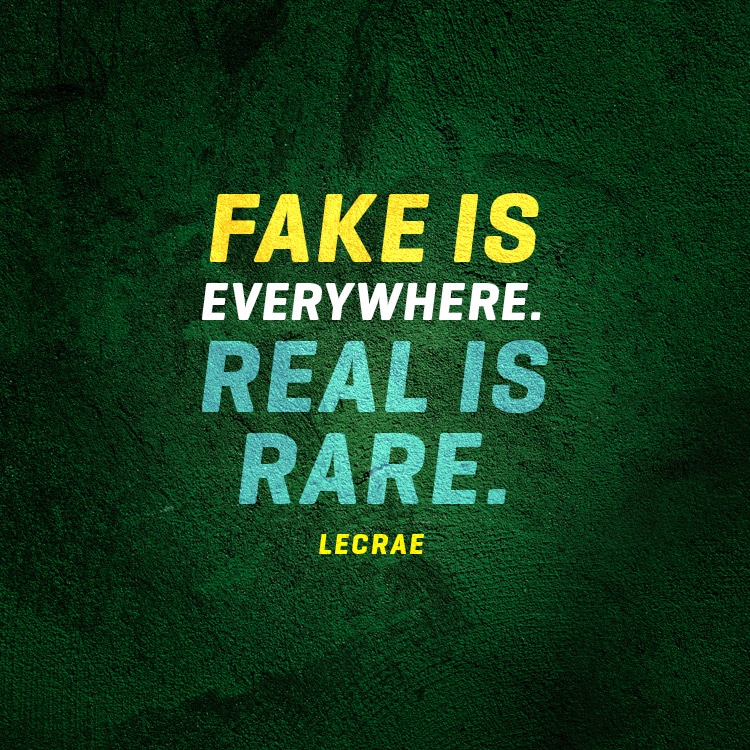
We live in a world where everything looks polished, filtered, edited, and staged. It’s almost funny how often I come across perfectly curated moments online—sunsets that look like they were painted by AI, “candid” smiles that were obviously rehearsed, quotes that sound deep but mean nothing when you really sit with them. You don’t even have to look far. Fake is everywhere. Real is rare. It’s the kind of line you read somewhere, nod to, and then suddenly start noticing in your everyday interactions.
Today, that thought found its way into a conversation with a colleague. We were talking about work when they suddenly said, “You know what I appreciate? When I can be myself with my manager and team. No extra layers, no politics, no filters, no performance.” It caught me off guard because it echoed exactly what I’d been thinking while looking at this illustration earlier. That simple line—Fake is everywhere. Real is rare.—felt like it had climbed out of the picture and sat right there between us.
And it stayed with me.
There’s a kind of relief that comes with realness. We spend so much of our time trying to manage impressions, maintain images, and present the most acceptable version of ourselves. When someone shows up without their armor, just as themselves, it hits different. It reminds you of how exhausting pretending can be. It makes you want to exhale.
Realness isn’t about oversharing or being brutally honest to the point of hurting people. It’s not about being raw 24/7 or saying whatever crosses your mind. It’s something softer, more grounded. It’s when your words match your intentions. When your actions match your promises. When the energy you give people is consistent whether someone’s watching or not.
Maybe that’s why authenticity feels so rare—because it requires courage. It requires slowing down long enough to know who you actually are beneath the expectations, the personas, and the habits you’ve collected over the years. It requires resisting the temptation to fit neatly into someone else’s idea of you.
The irony is, everyone claims to want authenticity, yet so many people retreat into masks because they fear judgment. And fair enough—being real comes with risk. You can be misunderstood. You can be rejected. You can be told you’re “too much” or “too honest” or “too sensitive.” But the rewards of being real? They’re worth every bit of that risk.
The relationships you build become deeper. Conversations become more meaningful. Trust becomes effortless. And life, oddly enough, becomes much simpler because you’re no longer juggling multiple versions of yourself.
Maybe that’s why I appreciated that conversation today. It wasn’t long or philosophical, but it was honest enough to remind me that authenticity still exists. People still crave it. And sometimes, the universe just nudges you with the right words at the right moment—whether on a piece of art or in a casual chat at work—to say, “Stay true. Stay real.”
Because in a world full of filters and illusions, being genuine might just be the rarest, most valuable thing you can offer.
 Kenrick Vaz