
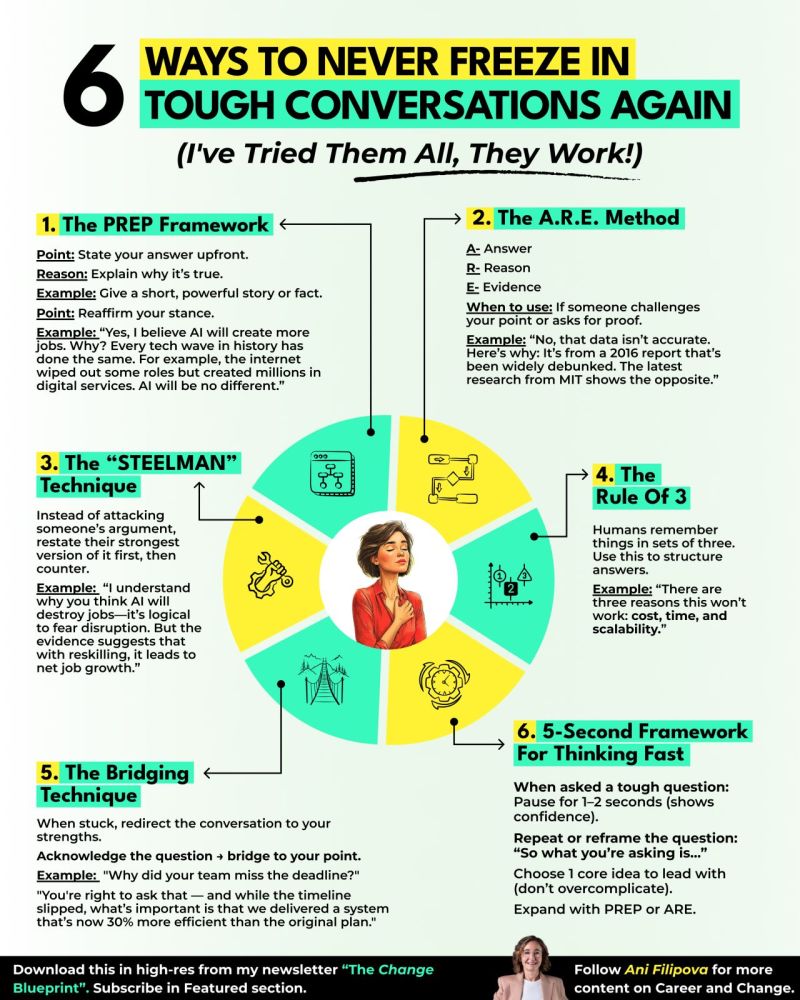
3am. Still awake. Still replaying that meeting.
The perfect response hits you now. 6 hours too late.
I used to have sleepless nights rewriting conversations in my head.
Angry at myself for freezing when it mattered.
The worst part?
Knowing exactly what to say.
Just… afterwards.
Then I cracked the code:
Quick thinking isn’t a talent. It’s a system.
Here are 6 frameworks that turn tongue-tied into articulate:
1. The PREP Power Move
Point → Reason → Example → Point
Make your stance unshakeable in under 30 seconds.
2. The A.R.E. Shield
Answer → Reason → Evidence
When they challenge you, hit back with facts, not feelings.
3. The “Steelman” Surprise
Restate their argument better than they did.
Then dismantle it with grace.
4. The Rule of 3
“Three reasons this won’t work…”
Humans remember things in sets of three.
Use it
5. The Bridge Escape
Acknowledge their point.
Redirect to your strength.
Control the narrative.
6. The 5-Second Reset
Pause. Reframe. Choose ONE idea. Expand.
Confidence beats speed every time.
(Full breakdown with examples in the visual – save it before your next big meeting)
Last week, one of my coaching clients texted me:
“Used the Steelman technique with my CEO. He actually said ‘great point’ for the first time ever.”
That’s what happens when you stop trying to be naturally quick.
And start being systematically prepared.
Your 3am revenge fantasies?
Time to make them tomorrow’s victories.
What conversation are you still replaying?
12 Secrets to Double Your Free Time

You don’t need more time.
You need smarter systems.
Here are 12 that will change everything.
1. “Swallow the frog”
2. 2-Minute Rule
3. 4 Quarter Method
4. Chunk bigger tasks
5. 5-Second Rule
6. Airplane Mode
7. 5-Year Filter
8. 3:3:3 Plan
9. Ask powerful questions
10. Grayscale Mode
11. Take imperfect action
12. Make ‘No’ your default
If you had more time, you could:
Build Your Wealth:
• Learn a high-income skill (AI, coding, sales)
• Start that side business you’ve been dreaming about
• Network with industry leaders over coffee
Optimize Your Health:
• Get in the best shape of your life
• Cook nutritious meals instead of fast food
• Sleep 8+ hours nightly (your body will thank you)
Deepen Your Relationships:
• Spend quality evenings with family
• Plan regular date nights with your partner
• Reconnect with old friends you’ve lost touch with
Set up these systems,
And start reclaiming time today.
How to be an Outstanding Coach

Great coaches don’t give answers.
They guide others to find their own ⬇️
Outstanding coaches know it’s not about control.
It’s about clarity, questions, and confidence.
Coaching isn’t fixing. It’s not leading with ego.
And it’s definitely not about having all the answers.
It’s about creating space…
For reflection, ownership, and growth.
Here’s the extended GROWTH model:
Goal – What do they truly want to achieve?
Reality – Where are they now in relation to that?
Options – What’s possible from here?
Will – Why does this matter to them?
Tactics – What’s the action plan?
Habits – How will they sustain momentum?
That’s the structure.
But these are the skills that make it work:
↳ Active listening
↳ Asking powerful questions
↳ Empathy without judgment
↳ Clarifying key insights
↳ Encouraging ownership
↳ Supporting emotional growth
These skills can’t be scripted.
They take practice.
But when done right, they unlock breakthrough moments.
Want to avoid derailing the session?
❌ Don’t wing it.
❌ Don’t make it about you.
❌ Don’t rush to give advice.
❌ Don’t skip clear goal setting.
Because when coaching becomes advice-giving,
you strip away their ability to grow on their own.
Instead, use questions that spark self-discovery:
↳ What goals are you looking to achieve?
↳ How would you like me to support you?
↳ What’s the first action you’d like to take?
↳ What might be getting in your way right now?
↳ What does success look like to you?
✅ Great coaching builds confidence.
✅ It strengthens decision-making.
✅ And it creates real accountability.
🧠 Remember; coaching isn’t about steering the ship.
It’s about helping others find their own compass.
What’s the one coaching habit that’s helped you the most?
Master Goal Setting

83% of New Year’s resolutions fail by February.
After years of setting ambitious goals only to
abandon them, I discovered something interesting:
The most successful people don’t count on motivation.
Instead, they use proven frameworks that make
success automatic.
4 goal-setting frameworks that actually work:
1. CLEAR Framework (h/t Adam Kreek)
↳ Get your team rowing in the same direction
↳ Stop chasing everything. Focus on fewer, better goals
↳ Connect goals to what truly motivates you
and your team
↳ Break big dreams into bite-sized steps
↳ Be willing to adjust when reality hits
2. Backward Goal-Setting (h/t Stephen Covey)
↳ Start with the end clearly in mind
↳ Map out every milestone needed to get there
↳ Break each milestone into specific actions
↳ Set clear deadlines for everything
↳ Begin with the very first step TODAY
3. The 5-3-1 Model
↳ Set ONE bold 5-year vision that excites you
↳ Define THREE annual targets that move you closer
↳ Check alignment QUARTERLY and course-correct
↳ Share your vision often to build team enthusiasm
↳ Stay agile. Pivot fast when something’s not working
4. Three Wins Method (h/t Peter Drucker)
↳ Identify 3 meaningful “wins” to achieve each day
↳ Write them down to stay laser-focused
↳ Prioritize your best energy for these wins
↳ Reflect on progress every evening
↳ Make it a daily habit
One final thought:
Goals not written down are just wishes.
And frameworks without action are just theory.
But goals written down + frameworks + action?
That’s how you make 2025 your breakthrough year.
Which method will you try first? Share below 👇
P.S. Want a PDF of my Goal Setting Cheat Sheet?
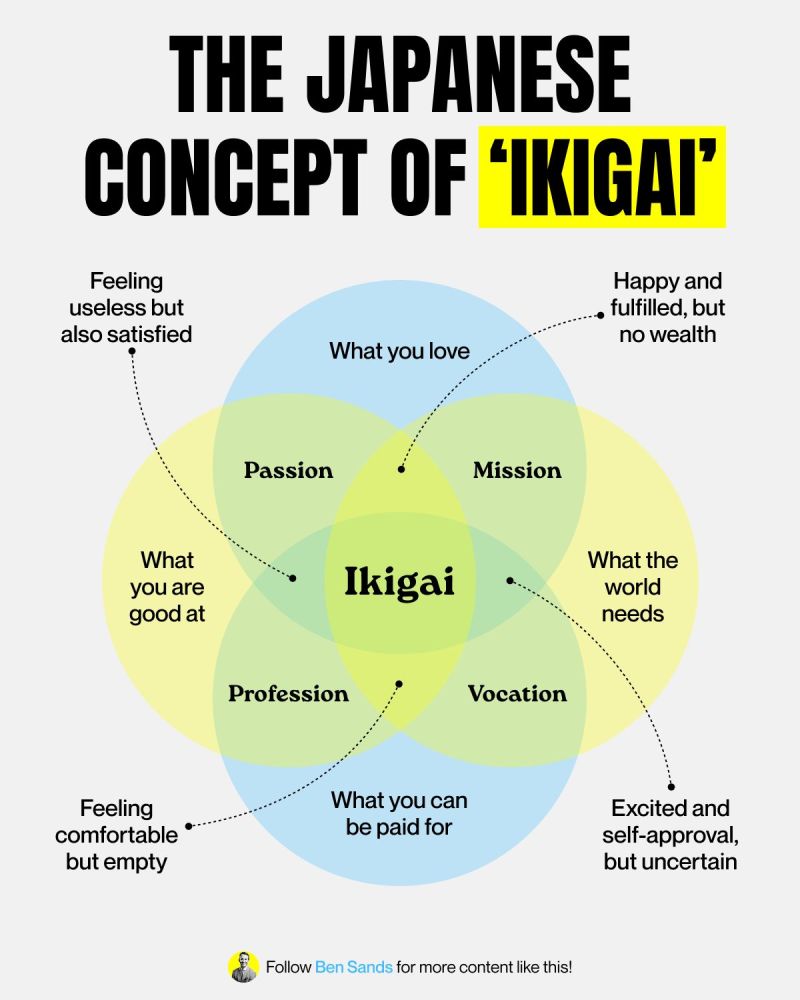
Ikigai
Success isn’t the same as alignment.
Most leaders learn this too late.
I’ve coached many who’ve felt off.
They’re at the top of their game at work,
but still, something was missing for them.
They’re checking the boxes but are disconnected.
Goals are hit, but they don’t feel like wins.
The life they thought they wanted doesn’t fit.
I’ve been there.
In my early career, I travelled the world
consulting for global companies.
On paper, it looked like success.
But something felt misaligned.
I was great at the work, but it wasn’t what I was meant to do.
Knowing about Ikigai would have been really helpful for me back then.
It’s a Japanese concept that reflects your reason for being.
At the center point between:
→ What you love
→ What you’re good at
→ What the world needs
→ And what you can get paid for
Is what you’re meant to do.
And when your life starts aligning around it,
things begin to shift.
→ You move with purpose, not pressure.
→ Work feels energizing, not draining.
→ You start leading with what you value.
Your values become your direction.
And everything else falls into place.
What does alignment look like to you day-to-day?
78 Habits of Top Leaders

Leadership isn’t about titles—
It’s about habits:
Not the habits you perform when it’s easy.
The ones you reach for when it’s not.
How you handle stress.
How you listen when you’re rushed.
How you give feedback when things fall apart.
That’s what people remember.
Not what you meant to say.
Not what you intended to do.
What you repeated.
Here are a few habits worth building:
🟢 Build trust with consistent actions
🟡 Listen actively so others feel heard
🔵 Keep learning, even when you lead
🟠 Stay resilient when things get tough
🟣 Give feedback that helps people grow
🔴 Set clear goals to give people direction
You don’t need 78 new habits.
You need the right one for
where you are right now.
That one small shift?
It can change your team,
your culture, your future.
Print the full list.
Pick your one.
Start today.
Because in the end, your habits
won’t just define how you lead—
They’ll define how you’re remembered.
Last day to register:
🔥I’m teaching a free live 30 day challenge to
build & launch any offer you can dream of.
➡️ Save your seat: https://lnkd.in/gVeRnVSt
When a Drop Becomes a World
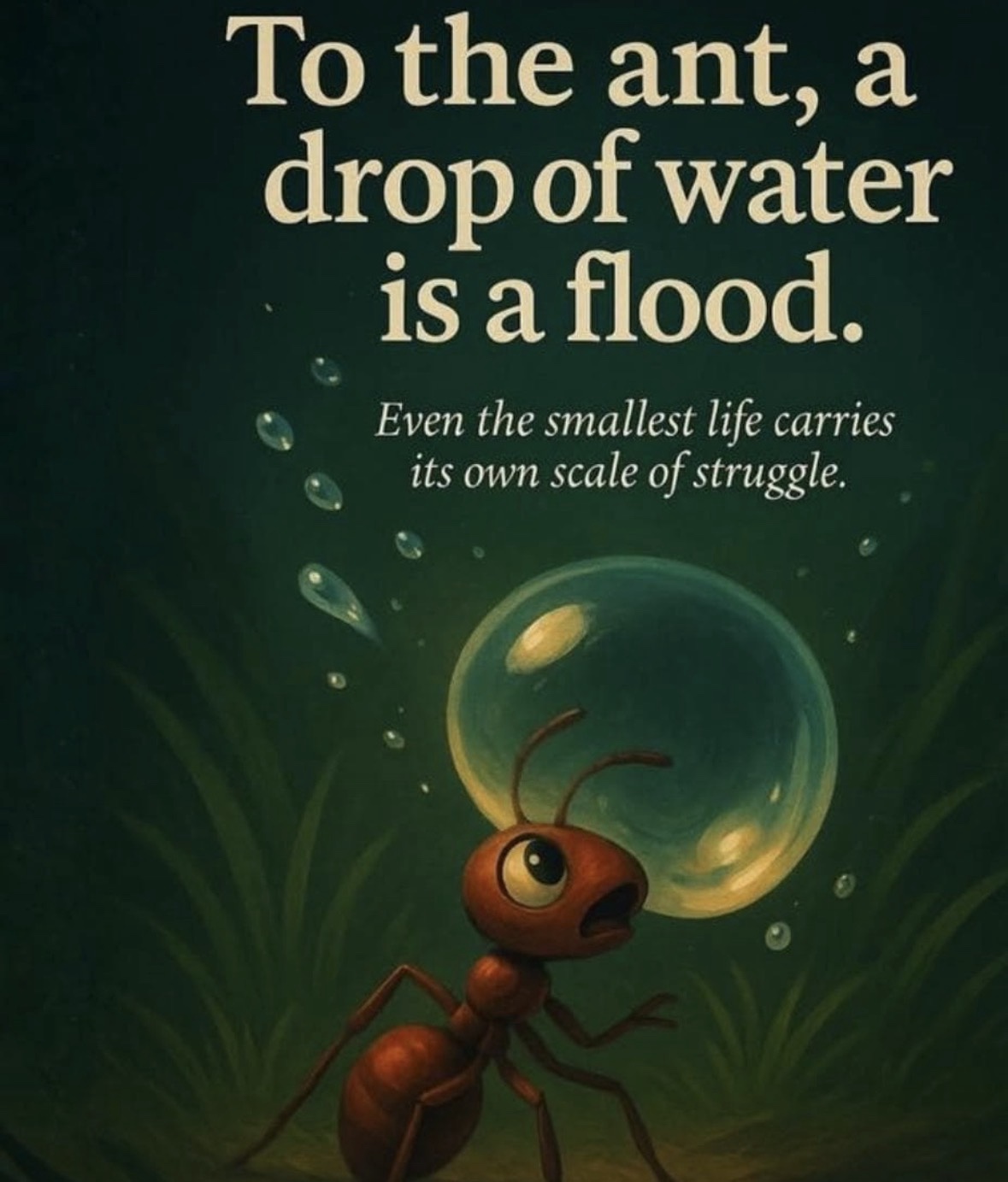
It’s funny how perspective works. To us, a drop of water is nothing—a blink, a bead on a window, a moment that dries before we even notice it. But to the ant, that same drop is a force of nature. A whole flood. A moment that changes everything. And the more you sit with that, the more it sinks in: every life carries a scale of struggle we can’t always see.
We’re quick to compare hardships, aren’t we? We weigh our days against someone else’s and judge our pain based on how “big” or “small” it looks from the outside. But the ant never apologizes for the size of its flood. It simply deals with what’s in front of it, because that’s its world. That’s its reality.
And people are the same. The quiet colleague who seems fine might be carrying weights you’d never expect. Your strongest friend might be wrestling something you’ll never hear about. Even the person who appears to have life “figured out” might be one drop away from feeling overwhelmed. Struggle isn’t universal, but the experience of struggling is.
There’s something strangely comforting in accepting that. It reminds us to soften a little. To stop dismissing our own challenges just because they don’t look dramatic from the outside. And to stop brushing off someone else’s because they don’t match our idea of what “hard” should look like. A drop can be a flood depending on who you are, where you are, and what you’re already carrying.
Maybe the real invitation here is to approach the world with a little more gentleness. To look up from our own path and notice the tiny battles happening around us. To offer patience instead of judgment. Understanding instead of assumptions. And maybe, on the days when everything feels heavier than it should, to give ourselves the same grace.
We’re all just trying to move through our world, step by step, doing our best with whatever falls into our path. Some days it’s sunshine. Some days it’s a storm. And some days it’s just a single drop that somehow feels like more than enough.
What matters isn’t the size of the struggle—it’s acknowledging that it matters at all.
The Art of Negotiation
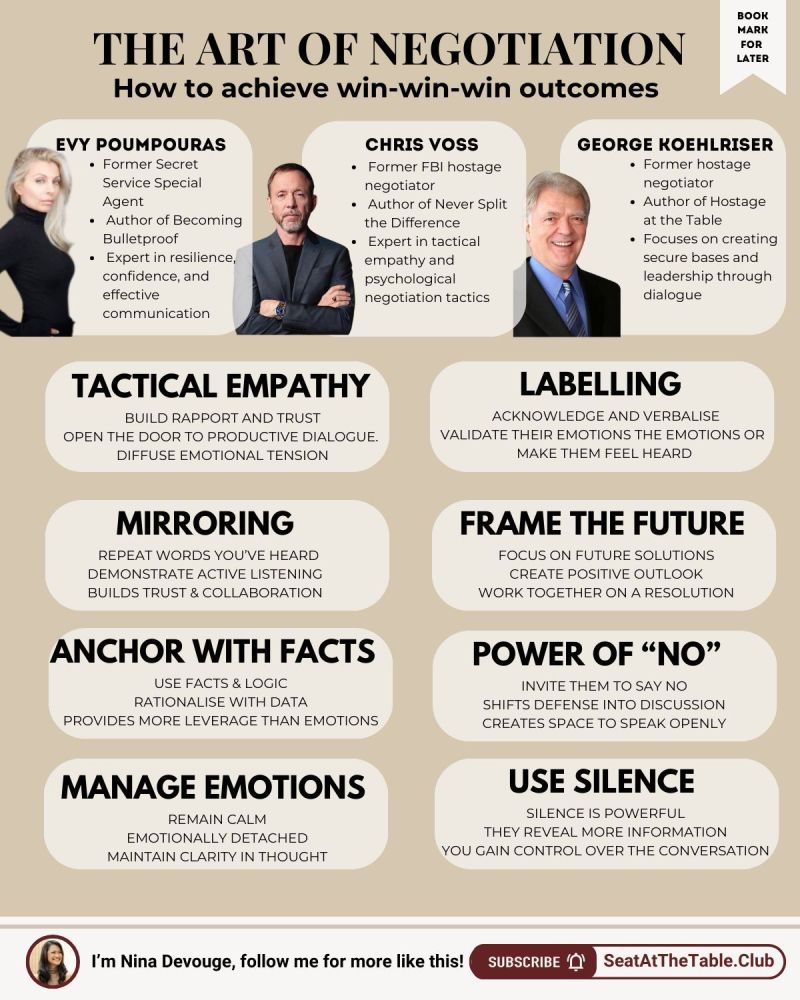
Negotiation isn’t about winning…
It’s about co-creation.
Too often, we enter negotiations thinking it’s a battle.
But the best negotiators?
They create partnerships.
✔️ They listen deeply, not just to respond, but to uncover hidden interests.
✔️ They reframe rejection—a “no” is often just a request for more clarity.
✔️ They trade value, not ultimatums.
Concessions should feel like a step forward, not a loss.
The goal?
A deal where both parties feel they’ve gained something meaningful.
Because real power in negotiation comes not from forcing agreement, but from building trust.
What’s the best negotiation tactic you’ve learned?
How to Write a Persuasive Talk
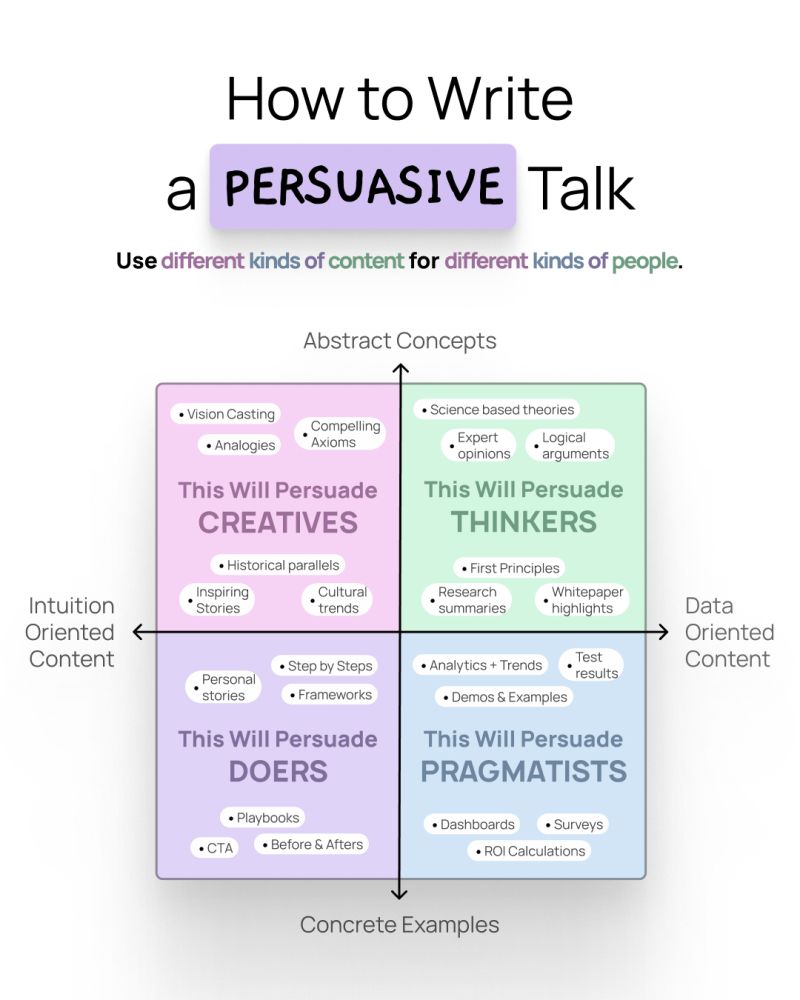
There are 4 kinds of people in every audience.
Most speakers only talk to 1. That’s why they fall flat.
Those 4 types are:
• CREATIVES
• THINKERS
• DOERS
• PRAGMATISTS
[Definitions coming below.]
The problem with most speakers?
They are one of those types themselves.
So they write a talk biased toward their own type.
(We all assume everyone is just like us, don’t we?)
But the most persuasive speakers learn to aim at all 4.
→ They get inside each type’s headspace & bias
→ They consider their values and temperaments
→ They intentionally use different kinds of content
Let me show you how it works:
1. CREATIVES
They’re moved by vision, beauty, and big ideas.
To persuade them, use:
→ Analogies
→ Vision Casting
→ Cultural Trends
→ Inspiring Stories
→ Historical Parallels
→ Compelling Axioms
2. THINKERS
They’re drawn to logic and intellectual clarity.
To persuade them, use:
→ First Principles
→ Expert Insights
→ Logical Arguments
→ Research Summaries
→ Whitepaper Highlights
→ Science-Based Theories
3. DOERS
They buy in through clarity, utility, and step-by-steps.
To persuade them, use:
→ CTAs
→ Playbooks
→ Frameworks
→ Step-by-Steps
→ Before & Afters
→ Example Stories
4. PRAGMATISTS
They care about what works, scales, and proves ROI.
To persuade them, use:
→ Surveys
→ Test Results
→ Dashboards
→ ROI Calculations
→ Analytics & Trends
→ Demos & Examples
If you want to give a persuasive talk, remember this:
→ It’s not how well you understand your idea.
→ It’s how well you understand the people hearing it.
Go get ’em.
Stress
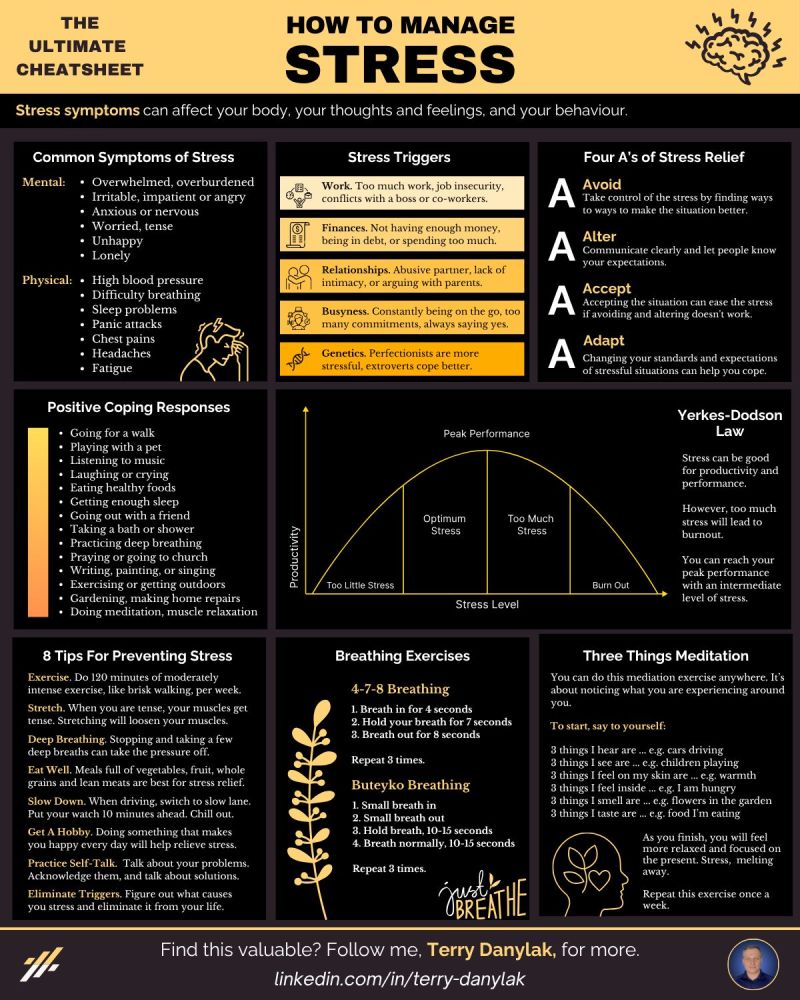
Stress can destroy your health and your career
(if you don’t manage it well).
But you can not only manage it.
You can conquer it.
Here are 8 tips for preventing stress:
1️⃣ Exercise.
Do 120 minutes of moderately intense exercise, like brisk walking, per week.
2️⃣ Stretch.
When you are tense, your muscles get tense. Stretching will loosen your muscles.
3️⃣ Deep Breathing.
Stopping and taking a few deep breaths can take the pressure off.
4️⃣ Eat Well.
Meals full of vegetables, fruit, whole grains and lean meats are best for stress relief.
5️⃣ Slow Down.
When driving, switch to the slow lane. Put your watch 10 minutes ahead. Chill out.
6️⃣ Get A Hobby.
Doing something that makes you happy every day will help relieve stress.
7️⃣ Practice Self-Talk.
Talk about your problems. Acknowledge them, and talk about solutions.
8️⃣ Eliminate Triggers.
Figure out what causes you stress and eliminate it from your life.
And here’s the best exercise to calm your mind:
🔥 The 4-7-8 Breathing
1. Breath in for 4 seconds
2. Hold your breath for 7 seconds
3. Breath out for 8 seconds
Repeat 3 times.
Don’t let stress take over your life.
Eliminate the triggers and live a happy life.

