
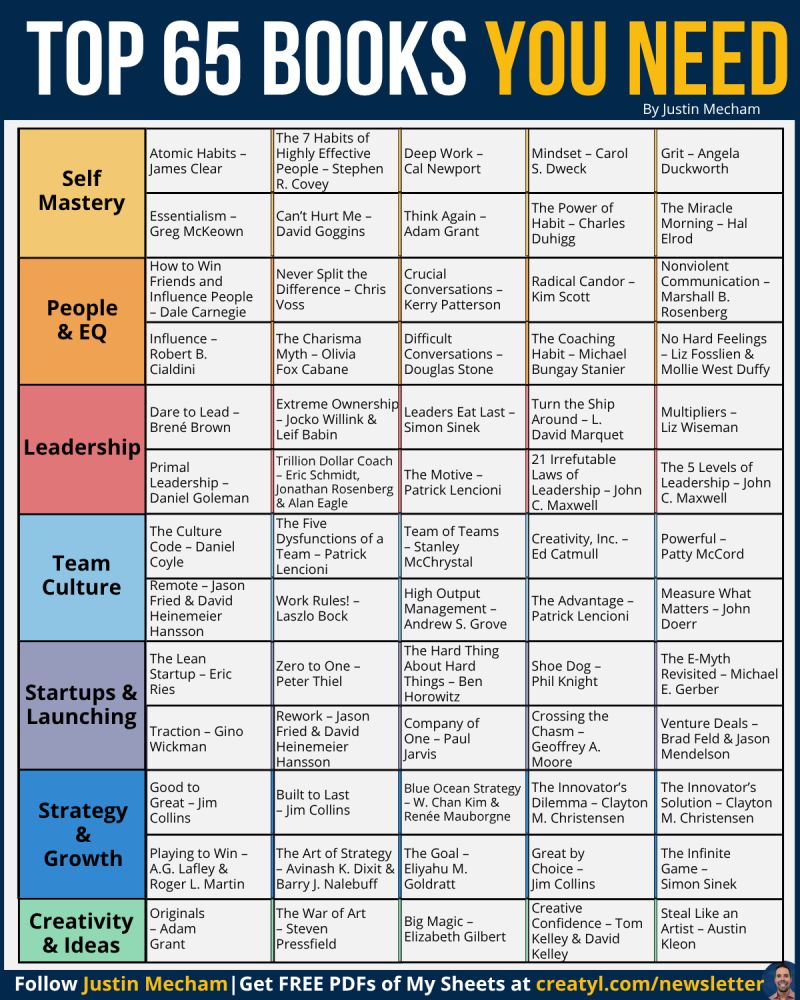
65 of the best books on planet earth—
Condensed into one list:
If you’re building anything—
a career, a company, or a better life,
These are the books that show up
again and again in the libraries
of leaders, builders, creators,
and decision-makers.
They don’t just share good ideas.
They change how you think, lead, and operate.
Because real breakthroughs don’t come
from more scrolling.
They come from deeper thinking.
And these books will take you there.
Inside you’ll find:
🟢 Creativity tools
🟠 People & EQ titles
🔵 Team culture guides
🟣 Startup and launch books
🟡 Self-mastery books
🔴 Leadership reads
🟤 Strategy plays
One book can shift your values.
One idea can change your decisions.
One page can stop bad habits from repeating.
One insight can build the life you actually want.
It only looks small—until it’s not.
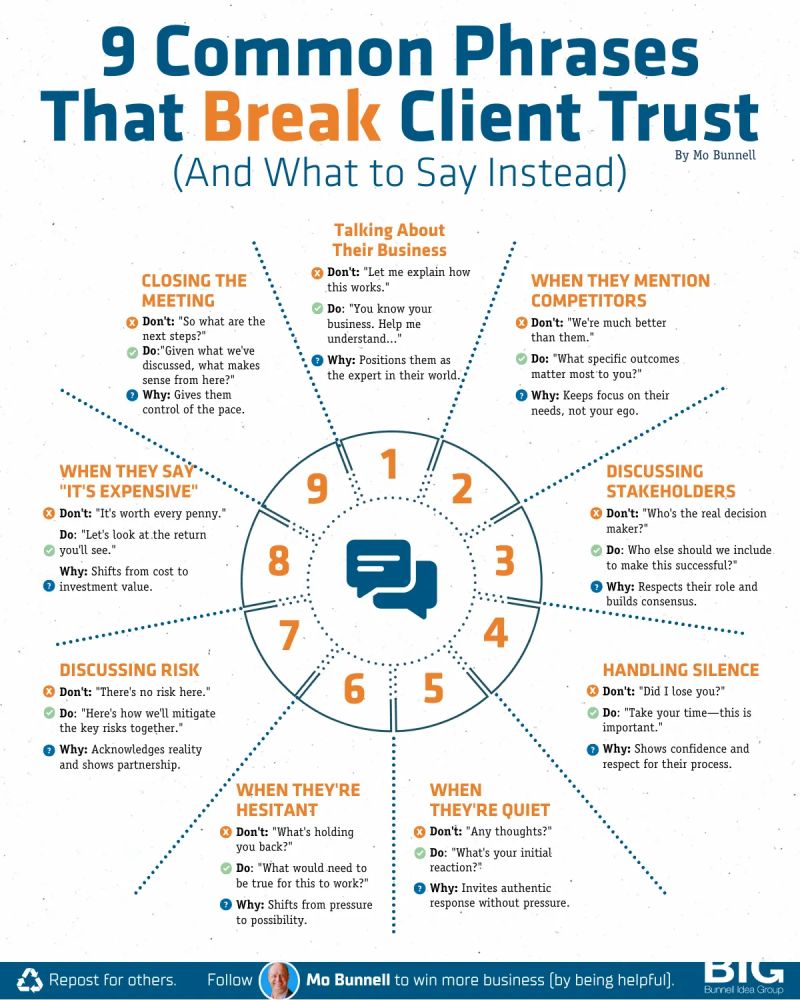
Phrases That Break Client Trust
In every client conversation, your words are doing one of two things:
Building trust or breaking it.
And it doesn’t take much to tip the scale the wrong way.
A recycled line.
A rushed phrase.
A question that makes them pull back.
We’ve all said something with good intent…
That landed the wrong way.
But here’s the upside:
Better language earns better outcomes.
Not perfect.
Not polished.
Just better.
Your language matters.
Here’s what often breaks trust:
❌ “Who’s the real decision maker?”
❌ “Let me explain how this works.”
❌ “So what are the next steps?”
❌ “What’s holding you back?”
❌ “We’re better than them.”
❌ “It’s worth every penny.”
❌ “There’s no risk here.”
❌ “Did I lose you?”
❌ “Any thoughts?”
And what builds it instead:
✅ “What’s your initial reaction?”
✅ “Who else should we include?”
✅ “Take your time, this is important.”
✅ “Let’s look at the return you’ll see.”
✅ “What outcomes matter most to you?”
✅ “What would need to be true for this to work?”
✅ “After our discussion, what makes sense next?”
✅ “Here’s how we’ll mitigate the key risks together.”
✅ “You know your business, help me understand…”
The beauty in it all?
Even small shifts in language can lead to big leaps in trust.
Because when your words reflect empathy, not ego, your clients lean in.
And that’s exactly how long-lasting partnerships are formed.
Which of these feels most natural to you?
And what’s one phrase you’ve retired lately?
12 Habits That Kill Growth
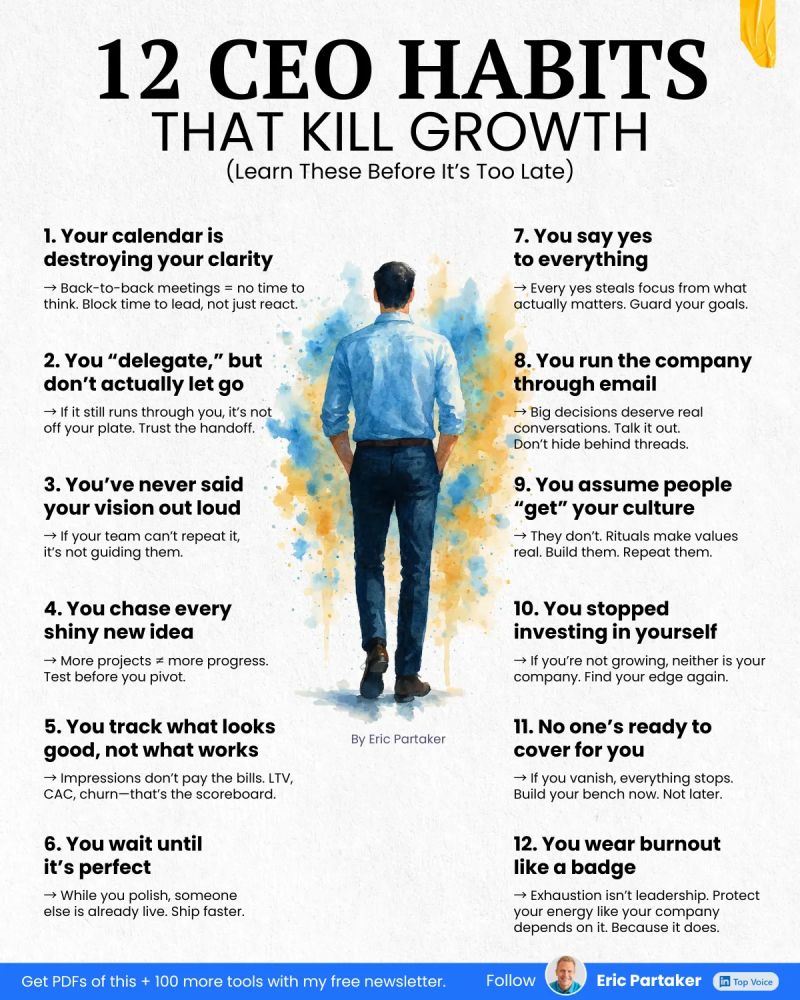
12 Brutal CEO Habits That Kill Growth
(This applies to you in your role too!)
1. Your Calendar Is Destroying Your Clarity
→ Back-to-back meetings leave no space to lead.
You’re reacting, not thinking.
2. You “Delegate,” But Don’t Let Go
→ If it still runs through you, it’s not really off your plate.
Don’t micromanage. Empower, then step back.
3. You’ve Never Said the Vision Out Loud
→ If your team can’t repeat it, it’s not guiding them.
4. You Chase Every Shiny New Idea
→ Constant pivoting kills momentum.
Test it before you toss the roadmap.
5. You Track What Looks Good, Not What Works
→ Likes and impressions don’t equal traction.
LTV, CAC, churn. That’s the truth.
6. You Wait for Perfect
→ While you polish, someone else ships.
Launch faster. Iterate later.
7. You Say Yes to Everything
→ Every yes steals focus from
what actually moves the needle.
8. You Run the Company Through Email
→ Long threads kill alignment.
One real conversation moves faster.
9. You Assume Everyone “Gets” the Culture
→ They don’t. Rituals make values stick.
Repeat them often.
10. You Stopped Investing in Yourself
→ If you’re not growing, neither is the business.
Find your edge again.
11. No One’s Ready If You Step Away
→ If you vanish, everything stops.
Build your bench now.
12. You Wear Burnout Like a Badge
→ Exhaustion isn’t leadership. Protect your energy
like your business depends on it. Because it does.
The truth is…
Most CEOs don’t fail because of one big mistake.
They get dragged down by small habits that
they thought were harmless.
💬 Which of these hits you hardest right now?
Quiet Places, Quiet People
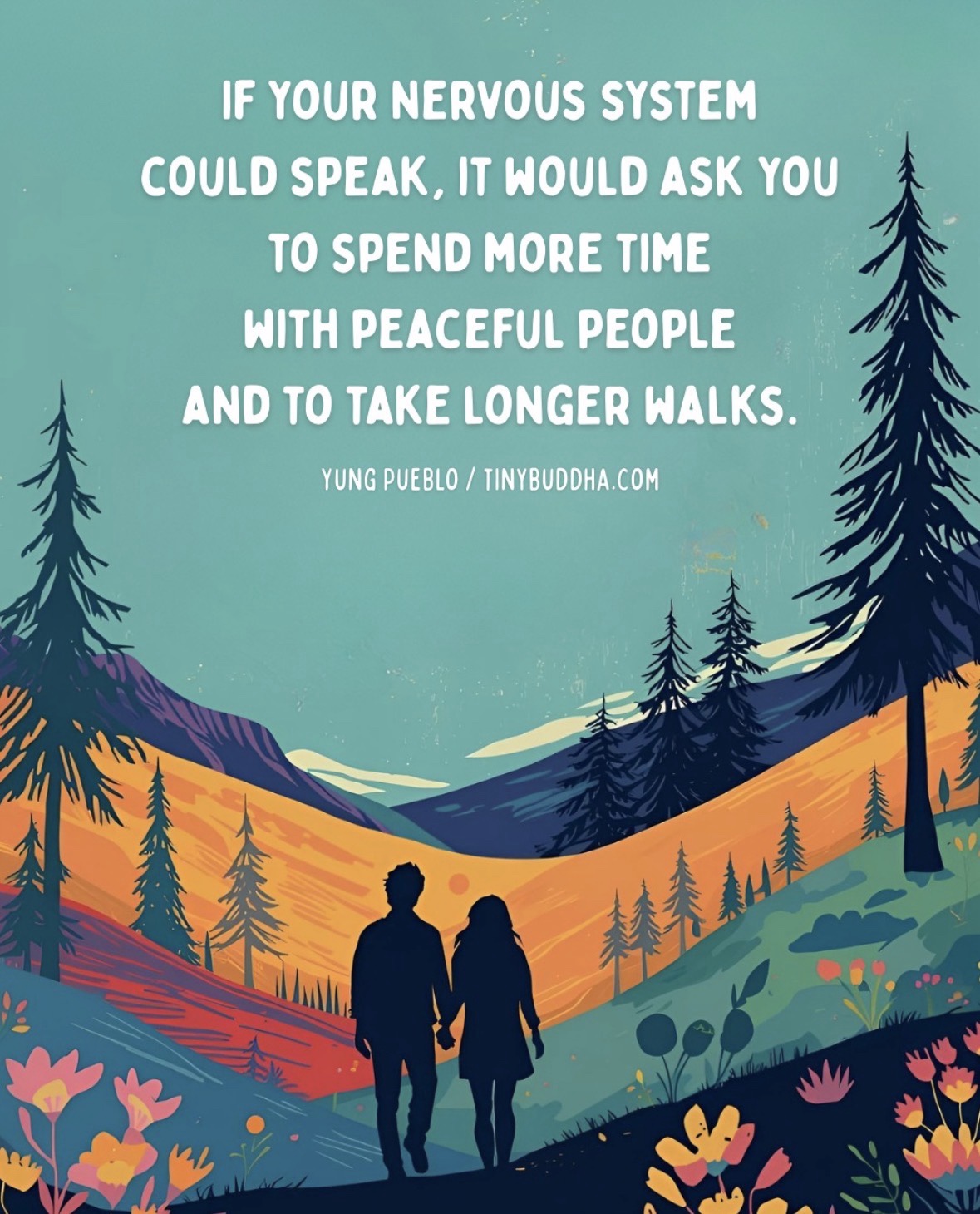
If my mind could speak without all the noise of the day, I think it would sound a lot like that line. Something soft. Something honest. Something I probably already know but ignore more often than I should.
It’s funny how we pretend we’re machines that can run forever on deadlines, pressure, and back-to-back obligations. We keep pushing, thinking a break is optional, rest is a reward, and calm is something we’ll “get to eventually.” But the body remembers what we force it to forget. It nudges us quietly at first—tired mornings, shorter patience, the sense that everything feels heavier than it should. And when we still don’t listen, it whispers a little louder: slow down, soften, reset.
I’ve learned that the people we spend our time with shape our inner weather more than we admit. There are people who bring storms—maybe unintentionally, maybe because they’ve never learned to sit with their own. And then there are the peaceful ones, the ones who don’t raise their voice to be heard, who make rooms feel safer just by being in them, who remind you—not by lecturing, but simply by living—that life doesn’t always have to be a rush.
Being around people like that feels like stepping into shade on a brutal summer day. Nothing dramatic. Just relief. Just quiet. Just the kind of company your nervous system would choose if it had the final say.
And then there are the walks… the simplest medicine we keep forgetting exists. There is something about putting one foot in front of the other without a destination, without a timer, without a purpose bigger than “let me breathe for a bit.” The world slows down when you walk. Your thoughts spread out instead of piling on top of each other. You start noticing small things—light on leaves, birds you’ve never seen before, the way the wind shifts around corners. It’s gentle, grounding, and strangely reassuring, as if life is reminding you it’s not as complicated as your mind makes it.
Maybe that’s the secret no one teaches us: peace isn’t a luxury, it’s a form of alignment. The more time you spend around peaceful people, the more you remember what it feels like to be calm inside. The more often you take unhurried walks, the more you learn to trust your own rhythm again.
And when your mind is calmer, everything else gets clearer. Decisions don’t feel like battles. Conversations don’t feel like performances. Even the problems that looked overwhelming start looking manageable, simply because you’re no longer approaching them from a place of exhaustion.
What I love most about this idea—your nervous system asking for peaceful company and longer walks—is that it doesn’t require a big life change. No dramatic escape. No perfect routine. Just small choices that tell your body: I’m listening now.
So maybe today, or this week, or whenever you finally feel the nudge, choose the gentler people. Choose the slower path home. Choose the walk with no goal except to breathe.
Your mind might not speak out loud, but trust me… it’s been trying to tell you this for a long time.
Master the Art of Saying No
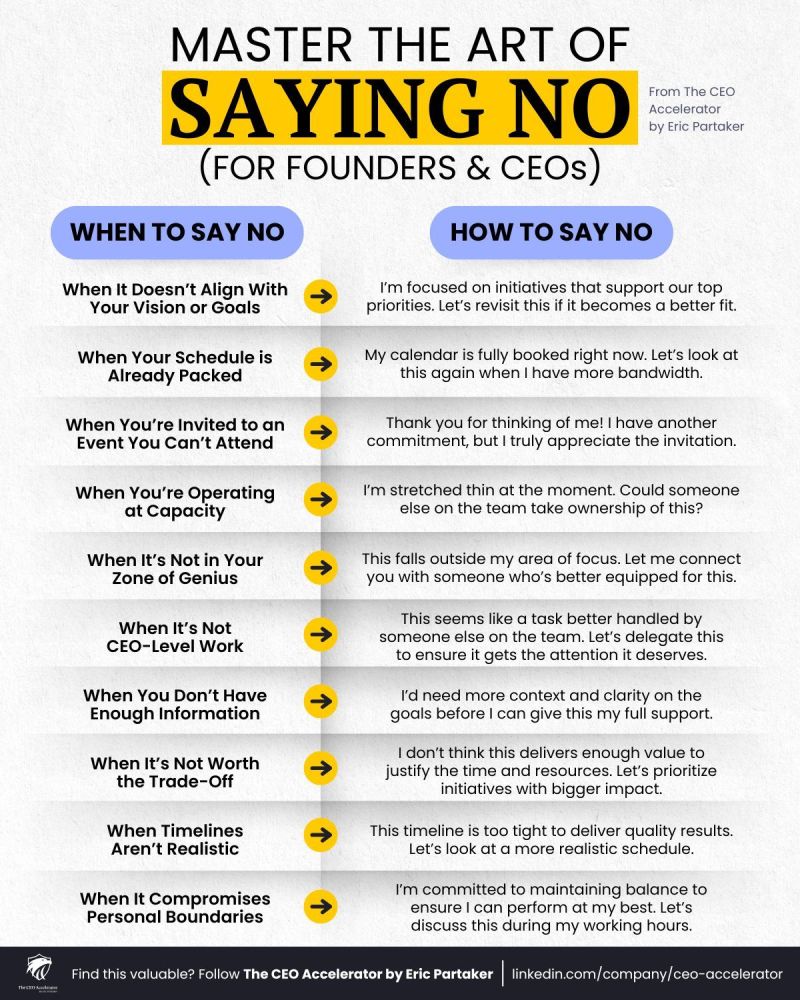
That word? “No.”
Most of us struggle to say it.
We worry about letting people down.
About missing opportunities.
About not being a “team player.”
But after decades in leadership I’ve learned this brutal fact:
Your ability to say “no” determines your success as a CEO.
Let me share the exact phrases that will help you
say “no” gracefully:
When your calendar is packed:
“My calendar is fully booked right now.
Let’s look at this again when I have more bandwidth.”
When it doesn’t match your vision:
“I’m focused on initiatives that support our top priorities.
Let’s revisit this if it becomes a better fit.”
When you’re at capacity:
“I’m stretched thin at the moment.
Could someone else on the team take ownership of this?”
When it’s not your expertise:
“This falls outside my area of focus. Let me connect you
with someone who’s better equipped for this.”
When you need more information:
“I’d need more context and clarity on the goals
before I can give this my full support.”
When the timeline isn’t realistic:
“This timeline is too tight to deliver quality results.
Let’s look at a more realistic schedule.”
When it affects your boundaries:
“I’m committed to maintaining balance so I can perform
at my best. Let’s discuss this during my working hours.”
Here’s what most leaders miss:
Every “yes” you give is actually saying “no” to
something else.
Every time you agree to a meeting that could have been
an email, you’re saying “no” to deep work.
Every time you take on a task someone else could handle,
you’re saying “no” to strategic thinking.
Every time you accept an unrealistic deadline,
you’re saying “no” to quality.
Master the art of saying “no,” and you’ll find yourself
saying “yes” to what truly matters.
Your legacy as a leader depends on it.
Protect Your Peace
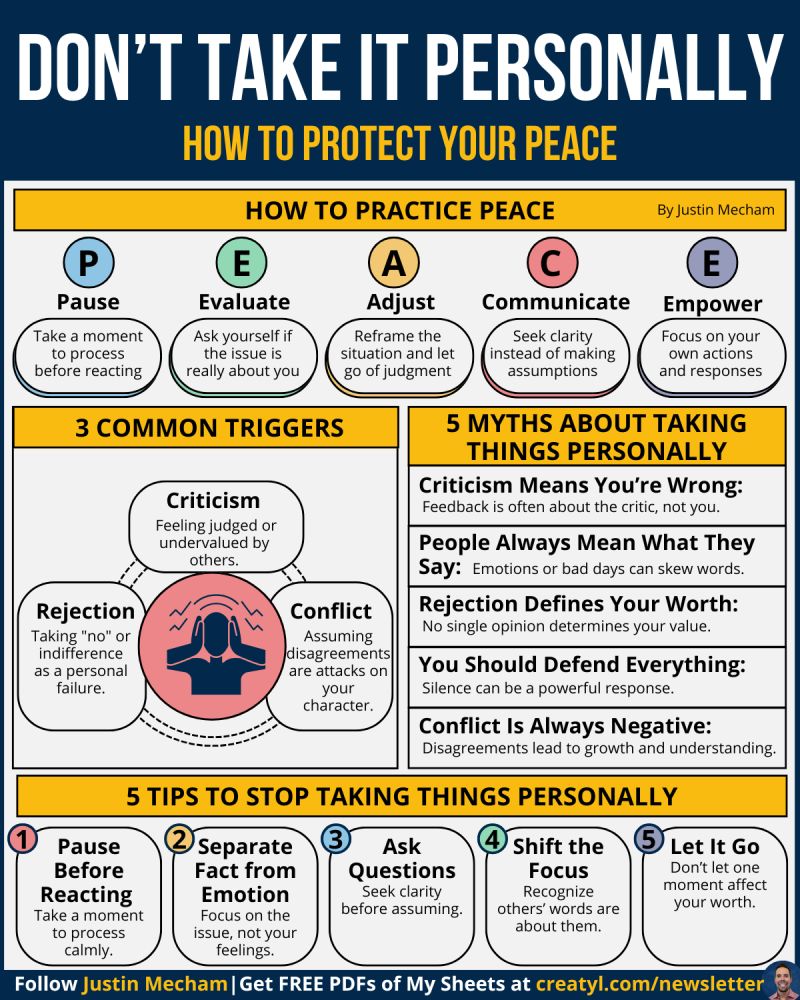
Most people aren’t attacking you—
Here’s how to keep your peace:
Someone criticizes.
Someone rejects you.
Someone disagrees.
Your brain says:
“This is about me.”
But it’s usually not.
It’s about their pressure, their story, their fears.
Not your worth.
So what do you do instead?
Here’s how to protect your peace
when everything feels personal:
🔴 3 triggers that spark overthinking:
• Conflict
• Criticism
• Rejection
🟠 5 myths that turn pain into identity:
• Every word = truth
• Criticism = you’re wrong
• You must explain yourself
• Conflict = something’s broken
• Rejection = you’re not enough
🟡 The P.E.A.C.E. method to reset fast:
• Pause
• Evaluate
• Adjust
• Communicate
• Empower
🟢 5 quick habits to stay calm in chaos:
• Pause before reacting
• Separate fact from emotion
• Ask before assuming
• Shift the focus
• Let it go
Most of what hurts you
isn’t even aimed at you.
You’re not soft for feeling it—
You’re strong when you stop carrying it.
Protect your peace like it’s your job.
Because it is.
How to Introduce Yourself
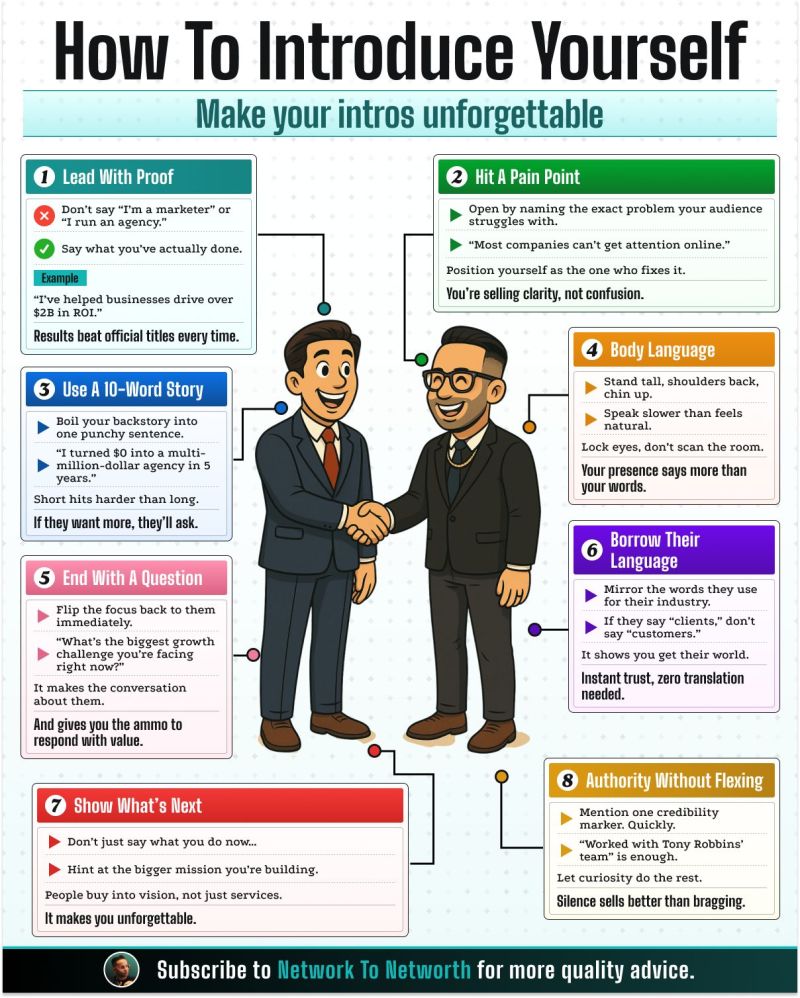
If you blow that intro, the whole room moves on.
In business and networking, most people fumble this one shot.
🚫 They ramble.
🚫 They oversell.
🚫 They sound like a broken record.
Don’t be like most people.
If you can master your intro, you’ll unlock doors most people wouldn’t dream of.
Here’s how to do it right:
1️⃣ Lead With Proof
→ Skip the title. Share a result.
→ “I’ve helped drive $2B in ROI” hits way harder than “I’m in marketing.”
2️⃣ Hit a Pain Point
→ Call out their biggest challenge.
→ “Most companies can’t get attention online” sets you up as the solution.
3️⃣ Use a 10-Word Story
→ Boil down your backstory.
→ “Built a 7-figure agency in 5 years” is clear and punchy.
4️⃣ Own the Room With Body Language
→ Shoulders back. Chin up. Eye contact locked.
→ Speak slower than usual. Presence > pitch.
5️⃣ End With a Question
→ Flip the script. Make it about them.
→ “What’s your biggest growth challenge right now?” = instant connection.
6️⃣ Mirror Their Language
→ If they say “clients,” don’t say “customers.”
→ Speak their language. Build trust faster.
7️⃣ Show What’s Next
→ Talk about the vision, not just the job.
→ People follow momentum, not maintenance.
8️⃣ Flex Without Flexing
→ Drop one credibility marker, then pause.
→ “Worked with Tony Robbins’ team” is all you need.
You won’t get a second shot at a first impression.
So when the moment comes, make it count.
Want more tactical networking advice that helps you stand out,
And connect with the right people?
When Everything Finally Stops Making Sense

It took me a long time to understand this, and honestly, I learned it the hard way. Before Covid, I used to treat every task like it was life-or-death. Every project felt urgent. Every meeting felt critical. Every message felt like it needed an immediate response. I thought being busy meant being valuable, and being constantly available meant being indispensable.
Then Covid hit, and everything I believed about “importance” flipped. One day I was in the middle of juggling deadlines, and the next I was sick—scared, exhausted, and completely unable to function. And in that forced stillness, something I’d never allowed myself to see became painfully clear: the world kept moving without me.
The emails were answered. The meetings continued. Decisions were made. Work went on. Not because I wasn’t good at what I did, but because no one—not me, not anyone—is truly irreplaceable at work. Life doesn’t pause to wait for you to feel better. Companies don’t collapse because one person steps away. And that realization, strangely enough, was liberating.
It stripped away the illusion that every little thing I stressed over was essential. When you’re lying in bed, fighting to breathe comfortably or just trying to get through the day, the things we normally obsess about shrink to their real size. You stop caring about the noise. You stop trying to be a superhero. All that matters is getting better. All that matters is your health.
And it hits you with a clarity that feels almost embarrassing: you weren’t carrying the world. You were carrying expectations—mostly your own. The real foundation of your life wasn’t your productivity, your title, or the number of hours you put in. It was your body, quietly holding you up every single day.
COVID taught me what no manager, no mentor, no motivational quote ever could: everything is “super important” until your health isn’t there to support it. And when your body decides to shut down, every meeting, deadline, and task you thought was critical suddenly becomes irrelevant. The only thing that truly matters is getting your strength back.
But here’s the tricky part—we tend to forget this once we recover. We slide back into the rush, the pressure, the constant urgency. We forget we were once lying in bed wishing for nothing more than the ability to breathe normally and enjoy a meal. We forget how fragile we felt. Until the next reminder comes.
The real challenge isn’t realizing what matters when you’re sick. It’s remembering it when you’re well.
So maybe it’s time to start treating health the way we treat our most important commitments. Listen to your body when it whispers, not when it screams. Rest before you’re forced to. Protect your peace like your life depends on it—because, in a way, it does.
Everything else—the work, the busyness, the pressure—will always find a way to sort itself out. You, on the other hand, get only one body and one life. And when everything else stops making sense, your health is the one thing that still will.
8 Thinking Roles
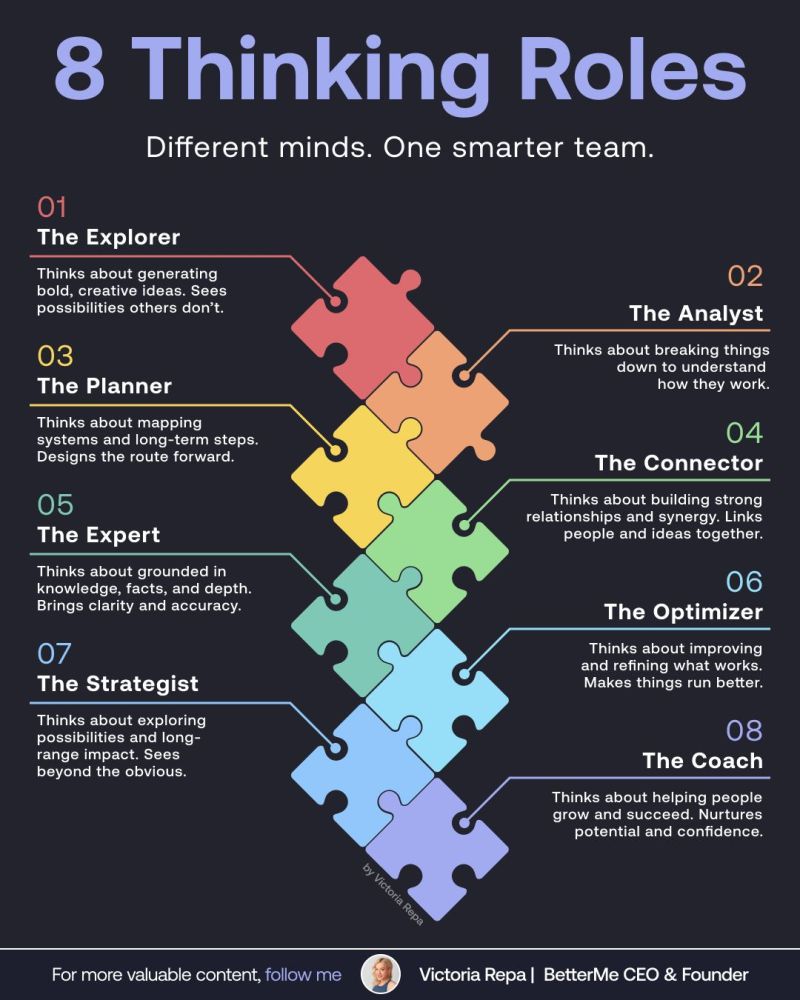
They’re shaped by diverse minds,
each contributing something essential.
– Some spark ideas.
– Some build structure.
– Some turn vision into action.
– And others make sure no one gets left behind.
True collaboration isn’t just about talking.
It’s about how we think together.
📌 These 8 thinking roles reflect the core ways people contribute with their minds:
(whether you’re solving problems, building products, or leading change)
1/ The Explorer
↳ Thinks about generating bold, creative ideas. Sees possibilities others don’t.
2/ The Analyst
↳ Thinks about breaking things down to understand how they work. Makes sense of complexity.
3/ The Planner
↳ Thinks about mapping systems and long-term steps. Designs the route forward.
4/ The Connector
↳ Thinks about building strong relationships and synergy. Links people and ideas together.
5/ The Expert
↳ Thinks about grounded in knowledge, facts, and depth. Brings clarity and accuracy.
6/ The Optimizer
↳ Thinks about improving and refining what works. Makes things run better.
7/ The Strategist
↳ Thinks about exploring possibilities and long-range impact. Sees beyond the obvious.
8/ The Coach
↳ Thinks about helping people grow and succeed. Nurtures potential and confidence.
No one thinks in all 8 ways.
But together?
That’s where the magic happens.
Leadership User Manual
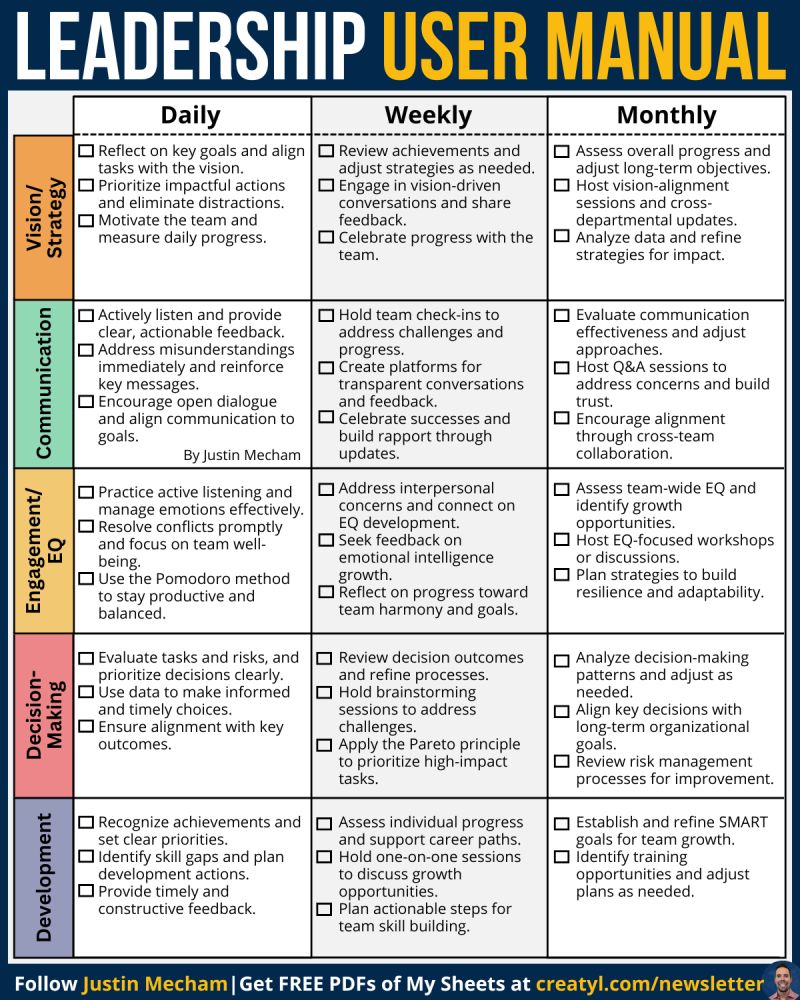
Most leaders don’t lack effort—
They lack structure, try this:
Great leadership isn’t reactive—
It runs on rhythm.
The best leaders don’t just respond.
They set a repeatable pace.
Here’s how to lead with
clarity instead of chaos:
Daily ➝ Control the chaos
🟨 Give feedback before confusion starts
🟨 Stay calm, even when it’s messy
🟨 Fix issues before they spread
🟨 Clear distractions early
Weekly ➝ Align the humans
🟧 Talk goals, not just tasks
🟧 Adjust what’s not working
🟧 Grow your people on purpose
🟧 Coach through decisions
Monthly ➝ Lead with altitude
🟥 Zoom out, spot the patterns
🟥 Reset direction with clear goals
🟥 Create connection across teams
🟥 Build emotional clarity (not just KPIs)
You don’t need to do everything.
You just need to do the right things.
Because leadership isn’t about doing more,
It’s about doing what matters on purpose.
 Kenrick Vaz