
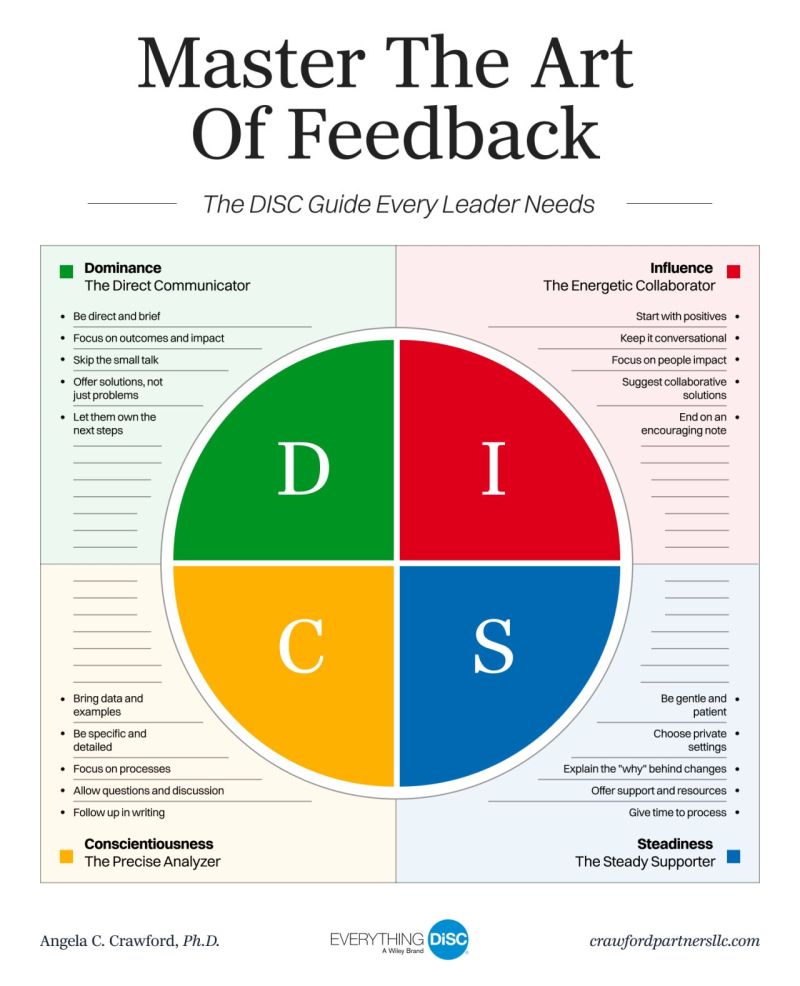
I’ve learned that personality type determines feedback success.
The DISC framework transforms how your message lands.
Here’s how to give feedback that drives real change:
For D (Dominance) personalities:
→ Cut to the chase – they hate fluff
→ Focus on business impact
→ Let them propose solutions
Result: They’ll take immediate action
For I (Influence) personalities:
→ Start with what’s working well
→ Keep the energy positive
→ Connect feedback to team success
Result: They’ll enthusiastically improve
For S (Steadiness) personalities:
→ Create a safe, private space
→ Explain how changes help the team
→ Offer ongoing support
Result: They’ll make lasting changes
For C (Conscientiousness) personalities:
→ Bring specific examples and data
→ Focus on process improvements
→ Give them time to analyze
Result: They’ll perfect the solution
The secret? Match your delivery to their style.
When leaders master this, team performance soars.
What’s your biggest challenge when giving feedback?
The GPS Theory – Recalculating Without Shame

It’s funny how the little things we use every day end up teaching us the biggest lessons. Take a GPS. You miss a turn, and what does it do? It doesn’t sigh dramatically, flash a warning, or play a disappointed “I told you so.” It just pauses for a second, thinks, and quietly offers you another route. No accusation, no drama — just the next best step from where you are right now.
If only we treated ourselves the same way.
Most of us carry this invisible scoreboard around, where every wrong turn feels like a failure stamped in permanent ink. Miss a deadline? Off track. Change a plan? Messed up. Slow down? Falling behind. It’s wild, because when you think about it, missing a turn has never stopped anyone from reaching the destination. All it does is change the journey a bit — maybe you end up taking a road you didn’t expect, maybe it adds a few minutes, maybe you even discover something along the way that you would’ve otherwise missed.
But the destination? It’s still there. Waiting.
The truth is, life rarely moves in a straight line. You’ll take detours you didn’t plan for and some you didn’t want. You’ll have moments where you’re sure you’ve gone too far off course to fix anything. You’ll rerun decisions in your head and wonder why you didn’t see the signs sooner. And yet, every single time, life hands you a quiet little prompt: “Recalculating.”
There’s something comforting about that. No matter how many wrong turns you take, there’s always another way forward. It may not be the shortest route, it may not be the smoothest, and it may not look anything like what you once imagined — but it will still move you closer to who you want to be.
We forget that progress isn’t measured by how perfectly we follow the original plan. It’s measured by how we keep going even when the path changes on us. Sometimes the real growth happens in the messy middle — the detours, the backtracking, the moments you have to stop to catch your breath and rethink your direction. Those aren’t signs of failure. They’re proof that you’re trying, that you care enough to pick a new route instead of giving up.
So the next time you miss a turn in your life — a plan that falls apart, a goal you didn’t hit, a version of yourself you’re struggling to live up to — remember your GPS. No judgment. No panic. Just an update: here’s where you are, and here’s the next step you can take.
Keep moving, keep choosing, keep adjusting. Your path may twist and change, but your destination hasn’t gone anywhere. And the beautiful part is, neither have you.
The Art of Influence
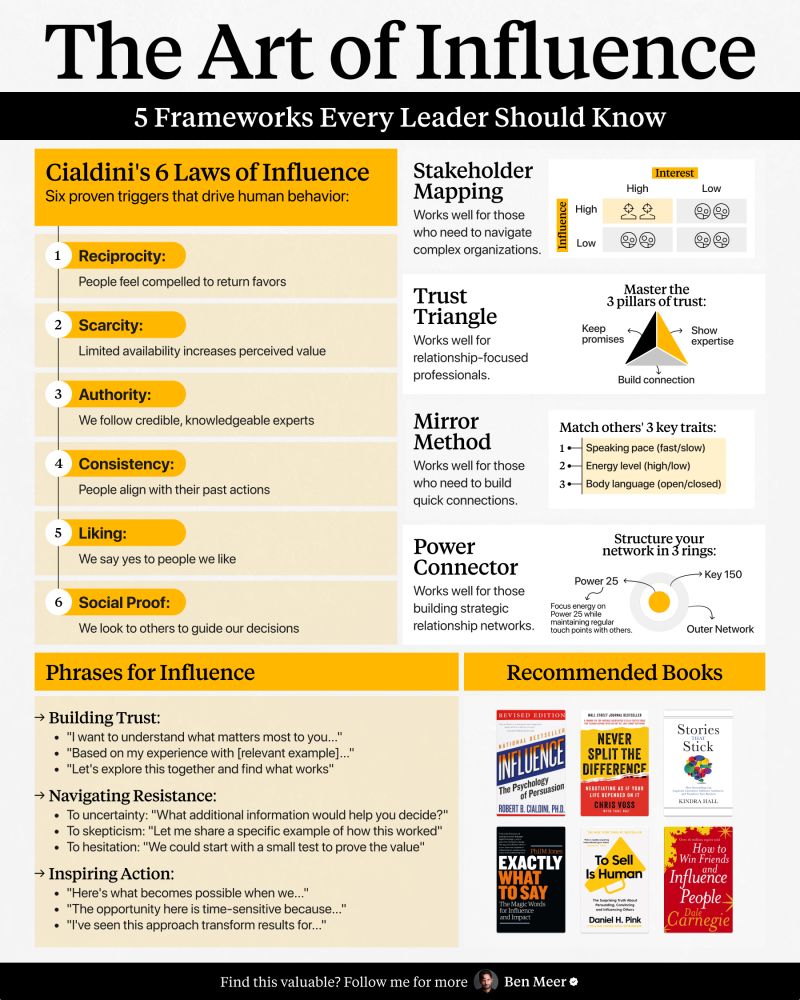
Real influence isn’t about pulling rank or demanding compliance.
It’s about:
• Understanding human psychology
• Building genuine connections that inspire action.
Here are 5 frameworks that separate truly influential leaders from the rest:
1. Cialdini’s 6 Laws of Influence: The foundation of ethical persuasion. Master reciprocity, scarcity, and authority to guide decisions without manipulation.
2. Stakeholder Mapping: Know your audience. High-interest, high-influence stakeholders get different treatment than low-interest ones.
3. Trust Triangle: The secret sauce of leadership. Keep promises, show expertise, and build genuine connections.
4. Power Connector Framework: “Your network is your net worth.” Structure relationships in strategic rings for maximum impact.
5. Mirror Method: Instant rapport builder. Match speaking pace, energy levels, and body language to create connection.
The best part? These aren’t manipulation tactics.
They’re systems for creating genuine value and building relationships that benefit everyone involved.
True influence comes from serving others, not controlling them.
Which technique resonates most with your leadership style?
8 Costly Leadership Mistakes

The good news? Your company is growing.
The challenge? Your team is growing.
Here are 8 common growth challenges
and how great leaders handle them:
1. Scaling your team without solid systems
↳ As teams get bigger, the old ways of working
often don’t work anymore
✅ Solution:
Review your systems, remove what’s no longer working,
and create new, simple guidelines for the team
2. Hiring people without culture alignment
↳ Skills can be taught. Values can’t.
↳ One toxic hire can poison your entire team
✅ Solution: Hire for values first, skills second
3. Lacking clear roles in the team
↳ Confusion leads to frustration and more mistakes
✅ Solution:
Define responsibilities early and update them often
4. Micromanaging your team
↳ You hired them for a reason. Trust them to do their job
✅ Solution: Set expectations, then step back
5. Burning out your top performers
↳ Even your best people have limits.
Protect them from burnout.
✅ Solution: Distribute the workload across the team
6. Lacking clear communication channels
↳ Information gaps lead to assumptions, and mistakes
✅ Solution: Establish open feedback channels
7. Avoiding hard conversations
↳ Small issues grow into bigger problems over time
✅ Solution: Address issues early. Be kind but clear
8. Neglecting your team’s development
↳ Growth isn’t just about hitting targets,
it’s about learning together.
✅ Solution: Invest in your people. They’re your future
Look at your team right now:
Which of these mistakes feels familiar?
Which one needs your attention first?
The sooner you spot them, the sooner you can fix them.
Remember:
Your company’s growth isn’t just about getting bigger.
It’s about getting better.
Cycle of Critical Thinking

Most people believe they’re great thinkers.
(But studies show only 1 in 10 actually are.
Critical thinking isn’t about being smart.
It’s about using a smarter process.
So what is critical thinking?
It’s how you:
➟ Examine information from all angles
➟ Question what you read and hear
➟ Find the truth (not just any answer)
Why does it matter?
Because poor thinking leads to poor decisions.
And poor decisions lead to poor results.
Use this 5-stage cycle to build stronger thinking:
1. GATHER EVIDENCE
Verify before you trust.
Check dates and sources.
Ask: Where did this come from?
2. CHALLENGE ASSUMPTIONS
Question what seems obvious.
Spot your hidden beliefs.
Ask: What if I’m wrong?
3. EXPLORE PERSPECTIVES
Get out of your bubble.
See different sides.
Ask: Who disagrees with this?
4. GENERATE ALTERNATIVES
Think beyond your default.
Mix ideas together.
Ask: What else could work?
5. MAP IMPLICATIONS
Think ahead.
Trace ripple effects.
Ask: What happens next?
The key? Don’t stop at step 1.
Strong thinkers cycle through all 5.
Sometimes you loop back.
That’s not indecision.
That’s wisdom.
In a world full of hot takes and quick opinions,
this is how you stay clear-headed.
Save it.
Share it.
Use it.
Because the quality of your thinking shapes
the quality of your life.
The Distance You Don’t See
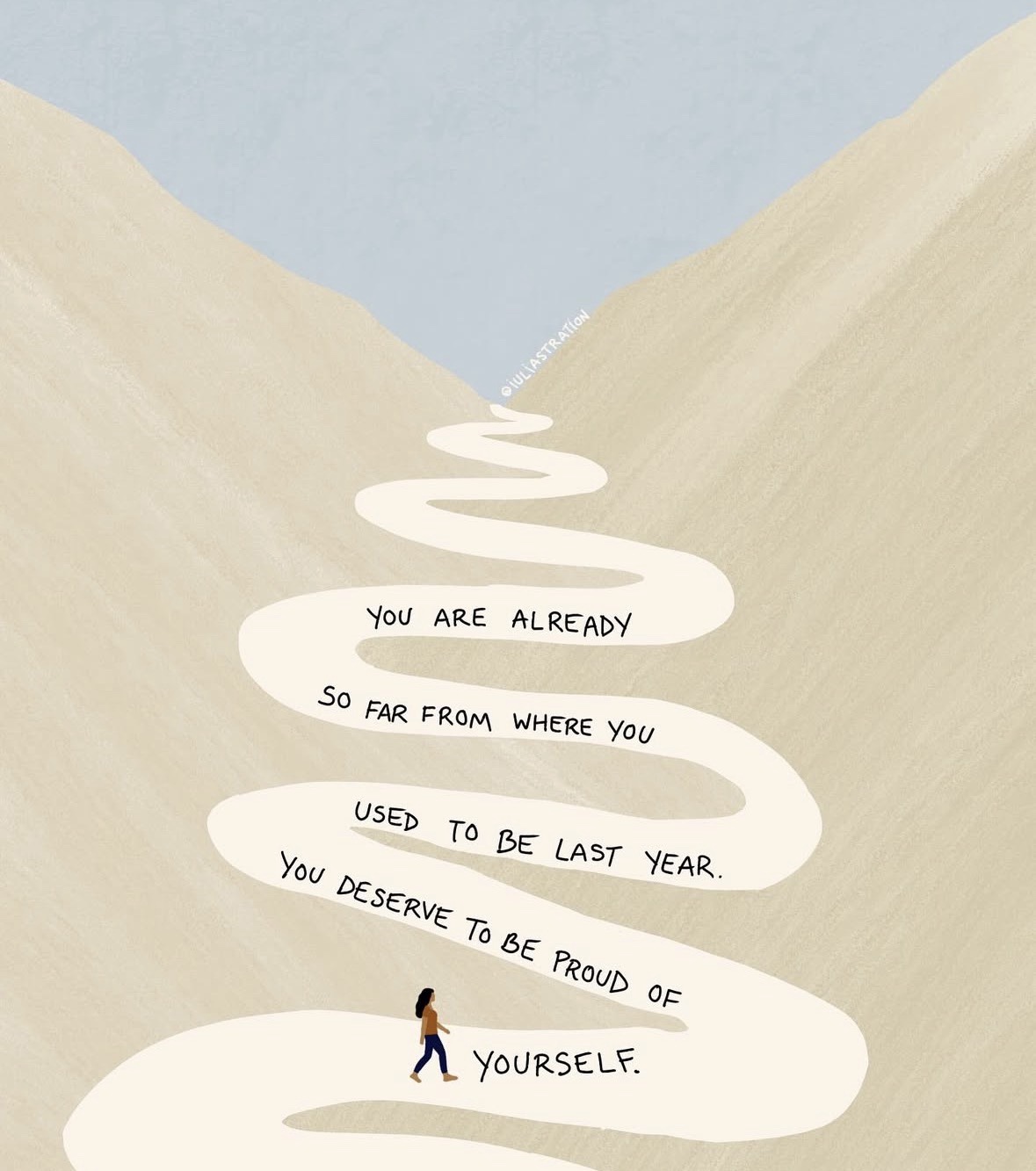
We don’t always notice how far we’ve come because progress rarely makes noise. It doesn’t announce itself with confetti or trumpets. It shows up quietly — in the way you handle things that once broke you, in the calm that’s replaced chaos, in the peace you’ve earned one hard day at a time.
A year ago, you might have doubted what you’re now doing with ease. You might have felt stuck in a place that today feels like a lifetime away. Growth is funny that way — it doesn’t happen in one big leap but in countless little steps that don’t look like much until you glance back and realize you’ve climbed an entire mountain.
So take a breath. You’ve done more than survive — you’ve adapted, learned, and evolved. You’ve turned uncertainty into strength, pain into perspective, and hesitation into motion. Maybe you don’t give yourself enough credit for that.
You don’t need to have everything figured out to be proud of yourself. Pride isn’t only for the finish line — it belongs in the middle of the race too. It’s okay to pause and say, “I’ve come a long way,” even if you’re still on the road.
Because you have. You’re already so far from where you used to be. And that, in itself, is worth celebrating.
Energy vs Time

You don’t need more hours in your day.
You need fewer energy leaks in your life.
The burnout epidemic?
It’s not caused by lack of time —
👉 It’s caused by mismanaged energy.
And the smartest leaders in 2025 are no longer asking:
“How do I manage my time better?”
They’re asking:
“How do I protect my energy at all costs?”
What time management gets you:
↳ Fills the calendar
↳ Prioritizes tasks
↳ Measures hours worked
↳ Can lead to burnout
↳ Looks busy
What energy management creates:
↳ Protects your focus
↳ Prioritizes recovery + clarity
↳ Measures impact and presence
↳ Enables sustainability
↳ Feels effective
⚠️ Because looking productive ≠ being effective.
Here’s the real problem:
“You’re not burned out because of too little time…
You’re burned out because of too many energy leaks.”
Leaky boundaries.
Too many Zooms.
Saying “yes” when you meant “not today.”
This isn’t a calendar problem —
It’s a capacity problem.
Want to be a more impactful leader?
Manage the fuel, not just the clock.
Here’s what that looks like:
✔️ Fewer meetings, more thinking time
✔️ Saying NO with clarity, not guilt
✔️ Deep work over shallow tasks
✔️ Rest as a strategy, not a reward
✔️ Protecting your zone of genius
This isn’t slacking.
It’s sustainable leadership.
And it’s what keeps the best performing at their best.
The ROI? Game-changing.
Leaders who manage energy—not just time—report:
✅ Better decision-making
✅ More creative thinking
✅ Higher-quality execution
✅ And… they don’t crash every quarter
Time hits a limit.
But energy? Energy multiplies.
What’s one way you’re protecting your energy this week?
The Turtle Theory

There’s something quietly powerful about turtles. They don’t rush, they don’t compete, they don’t overthink the waves. They move with this calm certainty that’s almost poetic—one steady stroke at a time. While everything around them shifts—the tides, the currents, the noise—they just keep going.
We live in a world obsessed with speed. Everyone’s sprinting somewhere, chasing something, counting milestones and measuring moments in metrics. But turtles? They remind us that pace isn’t progress. Progress is about direction, not velocity. It’s about showing up again tomorrow, even if today felt slow.
Some days you’ll glide. Some days you’ll crawl. There’ll be waves that push you back and days that make you question if you’re even moving at all. But the turtle teaches us the quiet art of patience—the kind that doesn’t demand instant results, the kind that trusts the process even when the shore isn’t yet in sight.
Because that’s how real growth happens. Not in leaps, but in inches. Not through panic, but through presence.
You don’t have to sprint. You just have to keep going. Slow progress is still progress—and peace, the kind that comes from patience, will always outlast pressure.
Words That Work

One phrase can shut someone down—
Another can open the door:
Small shifts in what we say can
change the tone of any conversation.
At work, even simple phrases can make you
more collaborative, thoughtful, and clear.
What happens when we use
the wrong words at work?
🚫 Work feels harder than it should
🚫 Small issues become big ones
🚫 Silence replaces honesty
🚫 Stress spreads quietly
🚫 Problems get ignored
🚫 People shut down
🚫 Ideas go unsaid
🚫 Clarity gets lost
🚫 Morale takes a hit
🚫 Trust breaks down
🚫 Decisions get delayed
🚫 Good employees leave
🚫 Feedback turns into blame
🚫 Collaboration turns into conflict
🚫 Teams stop talking—and start guessing
Use my sheet for success.
Your words shape the way people see you.
Every phrase is a chance to build real trust.
Your next move?
Start with one better phrase today.
The Johari Window

Think you know yourself well?
This will tell you otherwise ⬇️
Most people don’t realise they’re sitting on untapped strengths.
The Johari Window helps you and your team, see what’s hidden, what’s shared, and what’s missing.
It divides insight into 4 areas:
Open:
What you know about yourself and others see too.
Hidden:
What you know, but keep private.
Blind Spot:
What others see but you don’t.
Unknown:
What no one sees yet not even you.
Why does this matter?
The Johari Window helps people understand themselves and each other better.
It encourages open conversations, which builds trust across teams and makes communication a lot smoother.
When feedback becomes a normal part of how you work, it’s easier to grow, improve, and support each other.
It’s not just about fixing problems, it’s about unlocking potential and creating stronger, more connected teams.
Ask yourself:
What do I keep hidden from others?
What feedback surprised me the most?
What strengths do others consistently notice?
What could I achieve if I explored my unknown areas?
Want to use it with your team?
Here’s how:
1. Seek feedback to uncover blind spots.
2. Share insights to reduce your hidden area.
3. Encourage open dialogue within your team.
4. Take on new challenges to explore your unknown area.
5. Build trust through openness and transparency.
I’ve used the Johari Window in coaching sessions, team development workshops, and leadership programmes for years and it never fails to reveal something powerful.
Whether it’s a strength someone didn’t know they had, or a blind spot that’s been quietly derailing progress, this model helps surface what’s been hidden in plain sight.
When teams use this tool together, it transforms how they communicate.
Defensiveness gives way to curiosity.
Assumptions are replaced with clarity.
And people start to understand not just how they show up but how they’re experienced by others.
That shift alone builds deeper trust, stronger collaboration, and a culture where feedback becomes fuel, not fear.
🧠 Remember; Self-awareness is the foundation of emotional intelligence, trust, and leadership.
What quadrant do you need to work on most?
 Kenrick Vaz