
Every word you say—
Is either building or breaking:
Most feedback doesn’t help.
It hurts.
It’s vague.
It’s rushed.
It’s forgotten.
And teams are left with:
🔴 Confusion
🔴 Stagnation
🔴 Resentment
We think we gave them clarity—
But they walk away unsure.
We think we sparked progress—
But we just shut them down.
The truth?
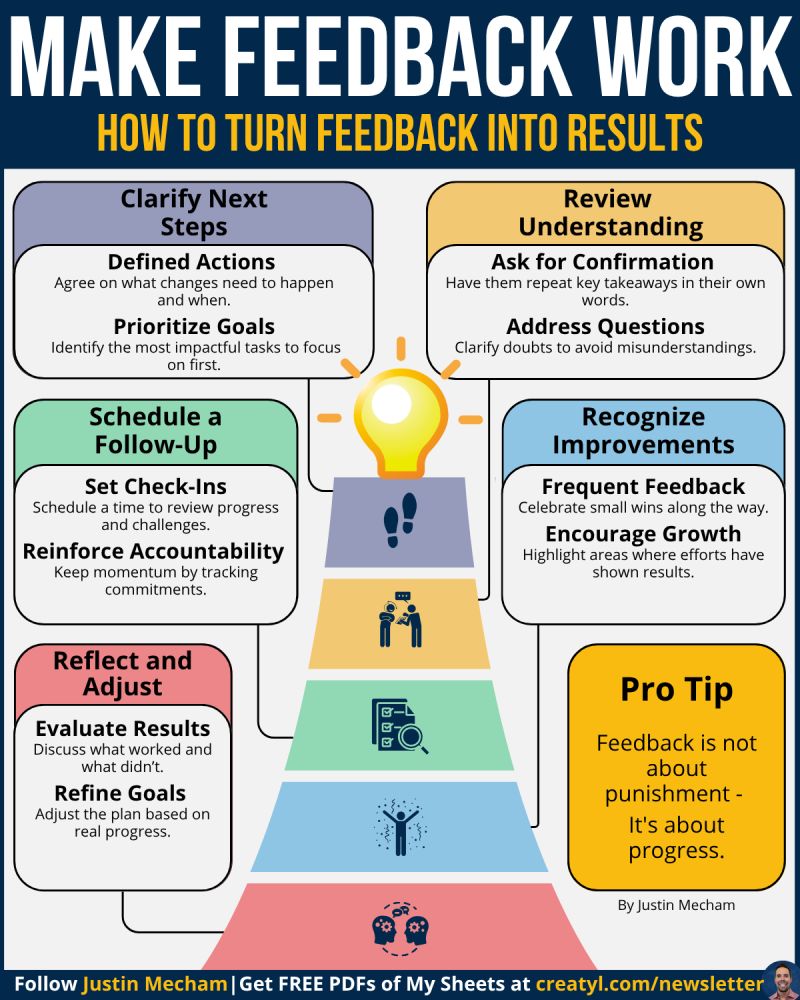
Feedback only works when it’s built right.
That means:
⭕ Naming the wins
⭕ Noticing the effort
⭕ Adjusting what didn’t
⭕ Tracking what worked
⭕ Clarifying what matters
⭕ Following up with purpose
⭕ Agreeing on what comes next
⭕ Asking what they heard—not what you meant
This isn’t soft.
This is structure.
Use this to reset how your team
gives and gets feedback.
Make it stick.
Make it clear.
Make it count.
Because every conversation—
Is a chance to move someone forward.
When You Stop Wrestling the Weather
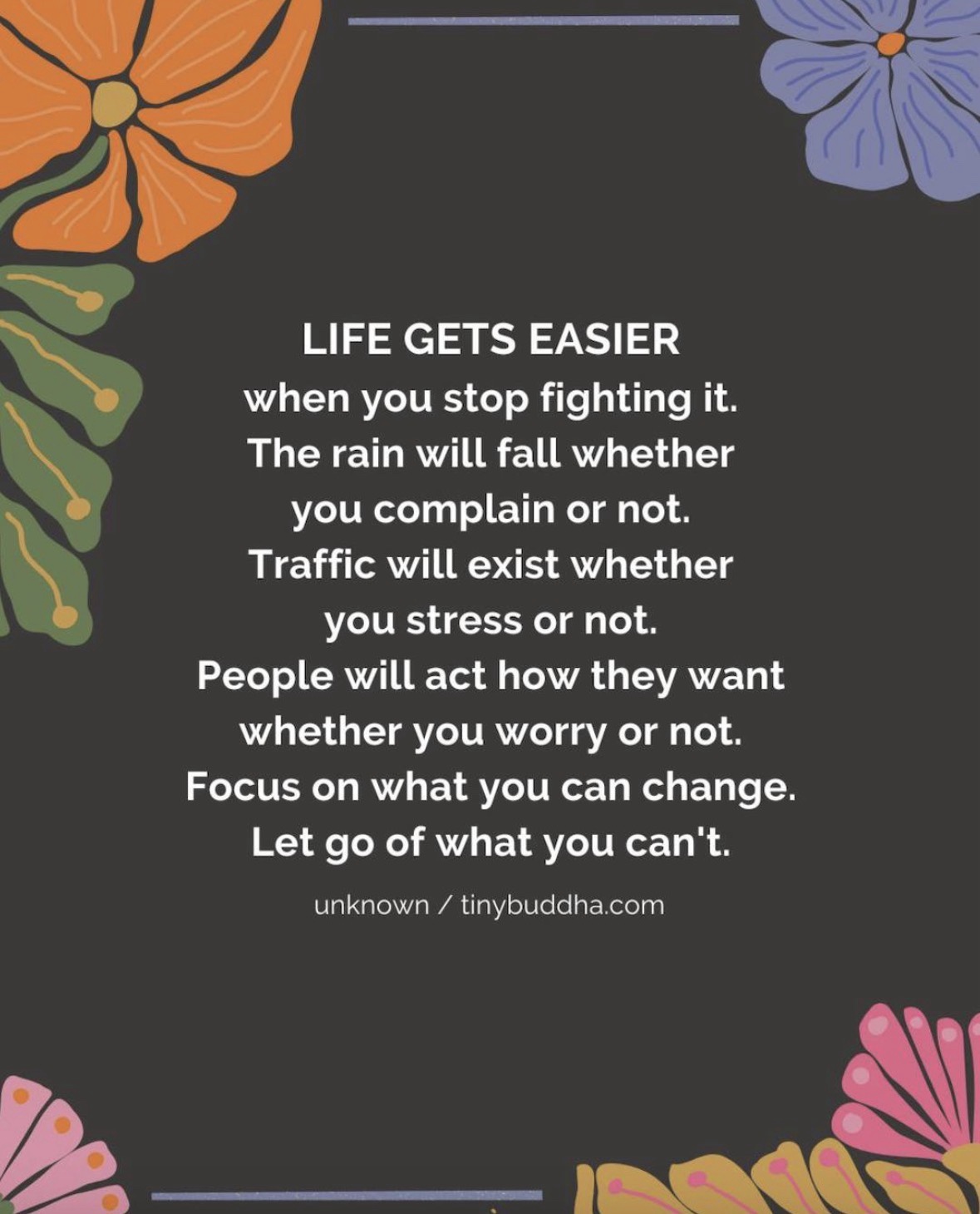
Life has a funny way of reminding us that we’re not in charge of as much as we think. We like to believe we can out-muscle circumstances, out-plan uncertainty, or out-worry the things that bother us. But the truth is simpler and far less dramatic: some things won’t move no matter how hard we push. And ironically, the moment we stop fighting what won’t change is the moment everything starts to feel lighter.
It’s like the rain. You can yell at the sky, bargain with the clouds, or lecture the thunder about your schedule, but the weather doesn’t negotiate. It just is. And standing there soaked and frustrated doesn’t stop the storm—it only drains you. The same goes for traffic. You can clench the steering wheel, roll your eyes at the brake lights stacked in front of you, and convince yourself you’re the only one who deserves to get somewhere on time. But every car around you is filled with someone who thinks the same, and stressing about it won’t magically clear the road.
And then there are people—unpredictable, beautiful, maddening humans who will behave exactly how they choose. You can tie yourself in knots trying to decode their intentions, predict their moods, or control their responses. But their choices will still be theirs. Worrying doesn’t grant you superpowers; it only steals your peace.
What you can do is shift your attention from the storms you can’t stop to the umbrella you can choose to carry. You can decide how you show up in moments that aren’t ideal. You can choose patience in traffic, curiosity instead of judgment, resilience instead of spiraling. You can save your energy for the things that are actually moveable—your habits, your reactions, your voice, your attitude, your boundaries.
Letting go isn’t surrender. It isn’t giving up. It’s choosing not to waste strength on battles that don’t have a win condition. It’s understanding that acceptance is not passivity—it’s wisdom. It’s learning to walk with the weather instead of pretending you command the sky.
And something beautiful happens when you do: life softens. The noise quiets. The weight shifts. You start noticing the small joys you used to miss because you were too busy wrestling the things you couldn’t fix. You realize how much easier it all feels when you release what was never yours to control in the first place.
Focus on what you can change. Let go of what you can’t. The rain will come and go, but your peace doesn’t have to.
How To Set Priorities
Every CEO I know struggles with the same paradox.
The more successful you become, the more everything feels urgent.
Hiring and training.
Board meetings.
Customer fires.
Team crises.
Investor updates.
Product launches.
Strategic initiatives.
All screaming for attention. All “top priority.”
The best don’t rely on gut instinct when the pressure hits.
They use frameworks.
Not because frameworks are magic.
But because under stress, your brain defaults to whatever is loudest.
Not what’s most important.
A framework forces you to think, not just react.
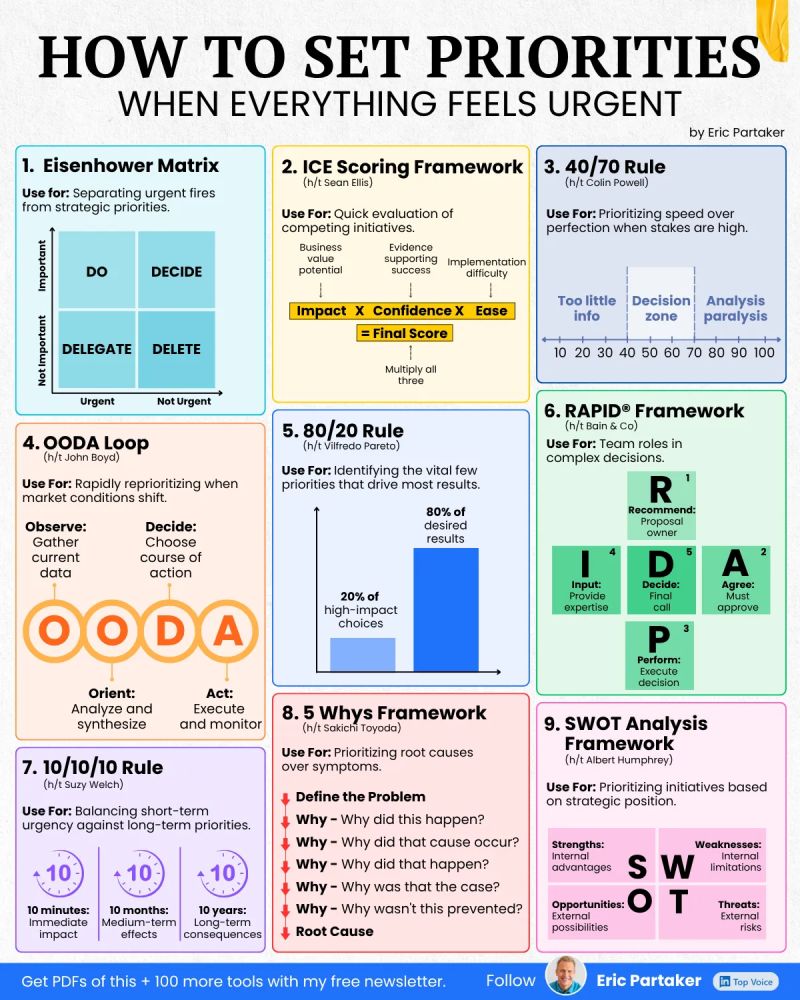
Take the Eisenhower Matrix. Simple 2×2 grid.
But it exposes a painful truth:
Most “urgent” tasks aren’t actually important.
They’re just noise dressed up as necessity.
Or the 80/20 rule. Brutal in its clarity.
Most of what fills your calendar contributes almost nothing to your goals.
The 40/70 rule?
It gives you permission to move when you have enough information, not perfect information.
Because waiting for certainty is a luxury leaders can’t afford.
Each framework serves a different moment:
– When choosing between good opportunities
– When speed matters more than perfection
– When the team can’t agree who decides
– When you’re drowning in daily tasks
The frameworks themselves aren’t the insight.
The insight is this:
In the heat of battle, you need pre-made decisions about how you’ll decide.
Because when everything feels urgent, nothing is.
And the leaders who understand that don’t just survive the chaos.
They cut through it.
The Pyramid of Self-Care
How to make self-care a part of your life
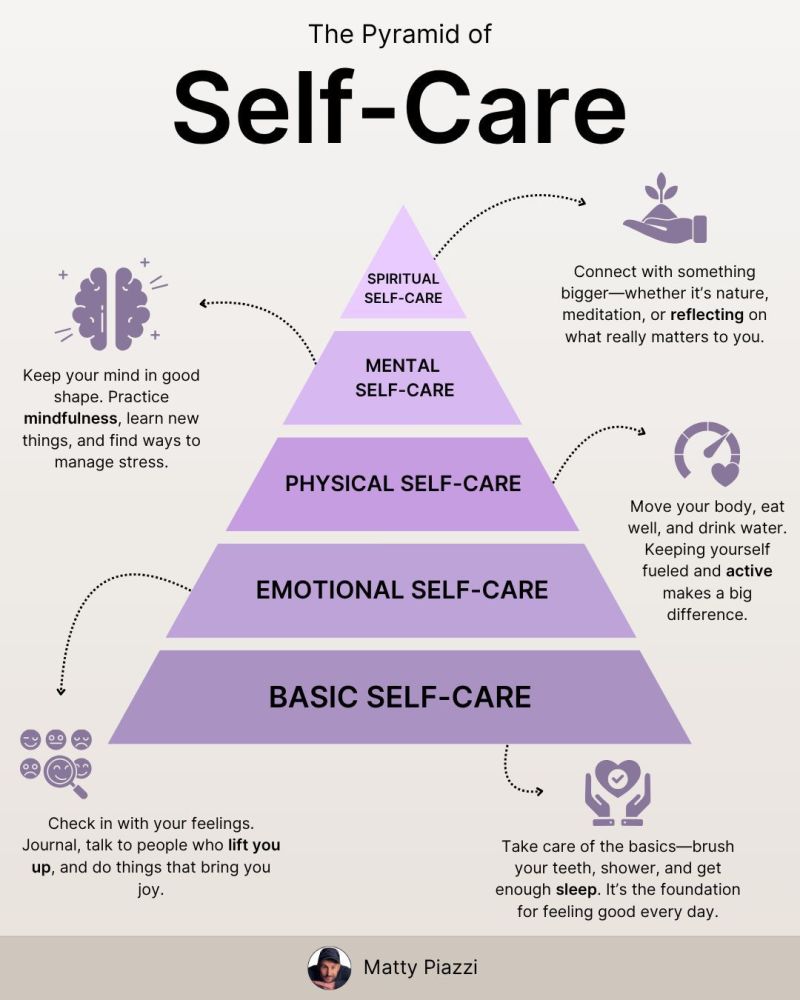
Here’s how to use the Pyramid of Self-Care:
1. Basic Self-Care
This is about taking care of your essential needs.
It’s the foundation for feeling good and staying healthy.
For example:
→ Brushing your teeth
→ Getting enough sleep
→ Taking a shower (or a hot-cold shower, like me)
Basically, it’s just the basic stuff that keeps you going every day.
2. Emotional Self-Care
This layer is all about taking care of your feelings.
It helps you stay emotionally balanced and happy.
For example:
→ Keeping a journal
→ Talking with friends or family about your feelings
→ Doing activities you enjoy, like painting or playing music
I’m not a huge fan of painting or music.
But I know they’re therapeutic for many.
So, this layer is about making sure your emotional needs are met.
3. Physical Self-Care
This is about taking care of your real home—your body.
It’s about making sure you feel strong, energized, and healthy.
For example:
→ Eating well
→ Going for a walk in nature
→ Hitting the gym (my second home!)
→ Drinking enough water (underrated!)
4. Mental Self-Care
This layer is all about keeping your mind sharp.
It’s about doing things that help you think clearly and handle stress.
For example:
→ Doing puzzles
→ Learning new skills
→ Practicing meditation (try Zen Meditation! Love it!)
It’s like exercise for your brain.
5. Spiritual Self-Care
This is about finding meaning and purpose.
It’s about practices that help you connect with your inner self.
It helps you feel fulfilled at the end of the day.
For example:
→ Reflecting on your values
→ Spending time in nature (it’s therapeutic!)
→ Engaging in activities that give you a sense of purpose
It’s the stuff that keeps you grounded.
It helps you stay connected to something bigger.
That’s it.
Now, we just gotta fit each layer into our crazy schedules.
How?
By scheduling them. Period.
And let’s remember: self-care isn’t selfish.
We can’t truly care for others if we don’t take care of ourselves.
So, what’s your favorite layer?
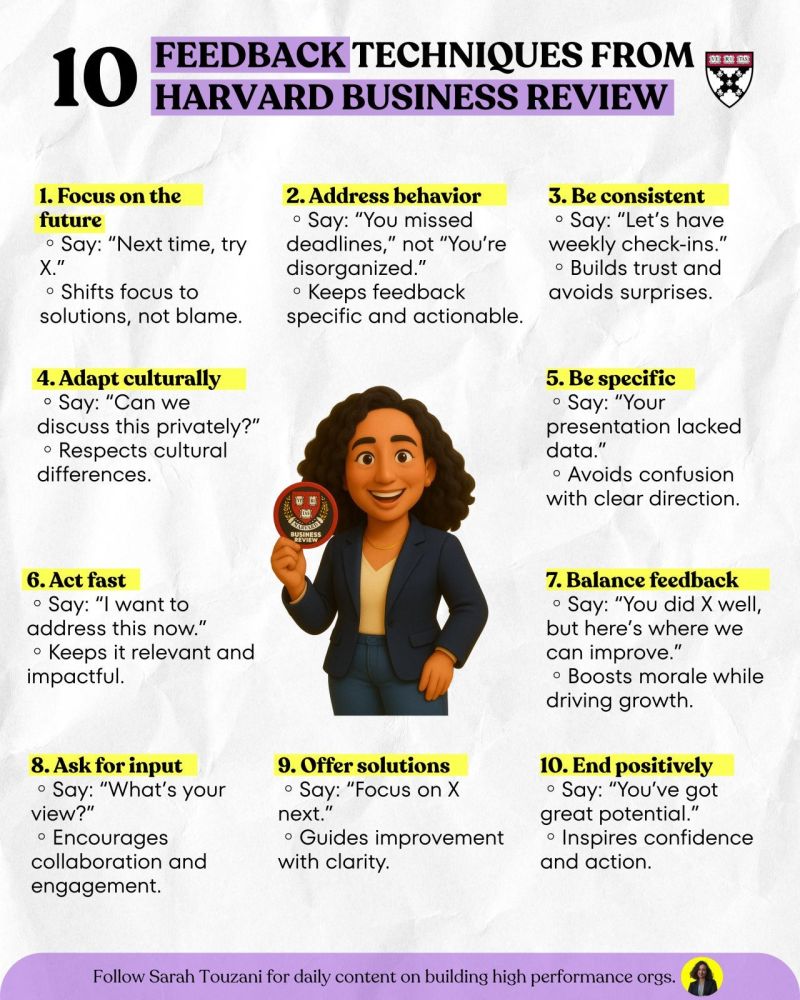
10 Feedback Techniques From Harvard
69% of employees want more feedback.
But only 23% of leaders provide it consistently.
Here’s what Harvard discovered:
Your “feedback sandwich” is hurting growth.
Why?
• It dilutes positive recognition.
• It weakens constructive feedback.
• It creates anxiety (everyone knows it’s coming).
The research is clear:
Employees receiving direct feedback are 3x more engaged.
So, how do you give feedback effectively?
Here are 10 science-backed techniques to drive performance:
1. Focus on the future
◦ Say: “Next time, try X.”
◦ Shifts focus to solutions, not blame.
2. Address behavior
◦ Say: “You missed deadlines,” not “You’re disorganized.”
◦ Keeps feedback specific and actionable.
3. Be consistent
◦ Say: “Let’s have weekly check-ins.”
◦ Builds trust and avoids surprises.
4. Adapt culturally
◦ Say: “Can we discuss this privately?”
◦ Respects cultural differences.
5. Be specific
◦ Say: “Your presentation lacked data.”
◦ Avoids confusion with clear direction.
6. Act fast
◦ Say: “I want to address this now.”
◦ Keeps it relevant and impactful.
7. Balance feedback
◦ Say: “You did X well, but here’s where we can improve.”
◦ Boosts morale while driving growth.
8. Ask for input
◦ Say: “What’s your view?”
◦ Encourages collaboration and engagement.
9. Offer solutions
◦ Say: “Focus on X next.”
◦ Guides improvement with clarity.
10. End positively
◦ Say: “You’ve got great potential.”
◦ Inspires confidence and action.
Microsoft proved it under Satya Nadella.
A feedback-rich culture drives exceptional results.
Under Nadella’s leadership,
Microsoft prioritized continuous feedback, open communication, and a growth mindset, transforming their culture.
This feedback-rich environment helped them:
• Increase employee engagement and retention
• Drive innovation and adaptability
• Achieve superior financial and market results
The simple framework I use:
What? → So What? → Now What?
Which of these techniques will you try first?
The Strongest People

We grow up thinking strength is about holding everything together with steady hands and a stiff spine. We’re taught that the toughest people are the ones who never crack, never cry, never let their knees hit the ground. But life has a way of rewiring that definition. It breaks through the armor in the places we swore were unshakeable, and suddenly strength starts looking a lot more like surrender than control.
There are moments when the weight gets so heavy you have no choice but to fall. And maybe that’s the point. Falling isn’t failure; it’s the door that finally opens when stubbornness exhausts itself. There’s something sacred about the moment you let your knees touch the floor—not in defeat, but in release. It’s the space where pride steps aside and Heaven steps in, quietly catching the tears you couldn’t hold back anymore.
People don’t rise because they’ve mastered the art of being unbroken. They rise because mercy meets them where everything fell apart. They rise because grace knows how to gather ashes and turn them into something that can stand again. And every time they get back up, it’s not because they’ve toughened up—it’s because they’ve learned who truly carries them.
Real strength has never been about pretending you’re okay. It’s about knowing exactly where to run when you’re not. It’s about trusting that the One who shaped your heart knows how to mend it. It’s about understanding that resilience isn’t built in silence and self-reliance, but in the courage to collapse into divine hands that don’t condemn weakness—they dignify it.
So if you’re kneeling today, don’t mistake it for a setback. Sometimes the ground is exactly where renewal begins. Sometimes the bravest thing you can do is fall, cry, breathe, and let Heaven lift you again. Strength is not the absence of breaking. It’s the miracle that happens after.
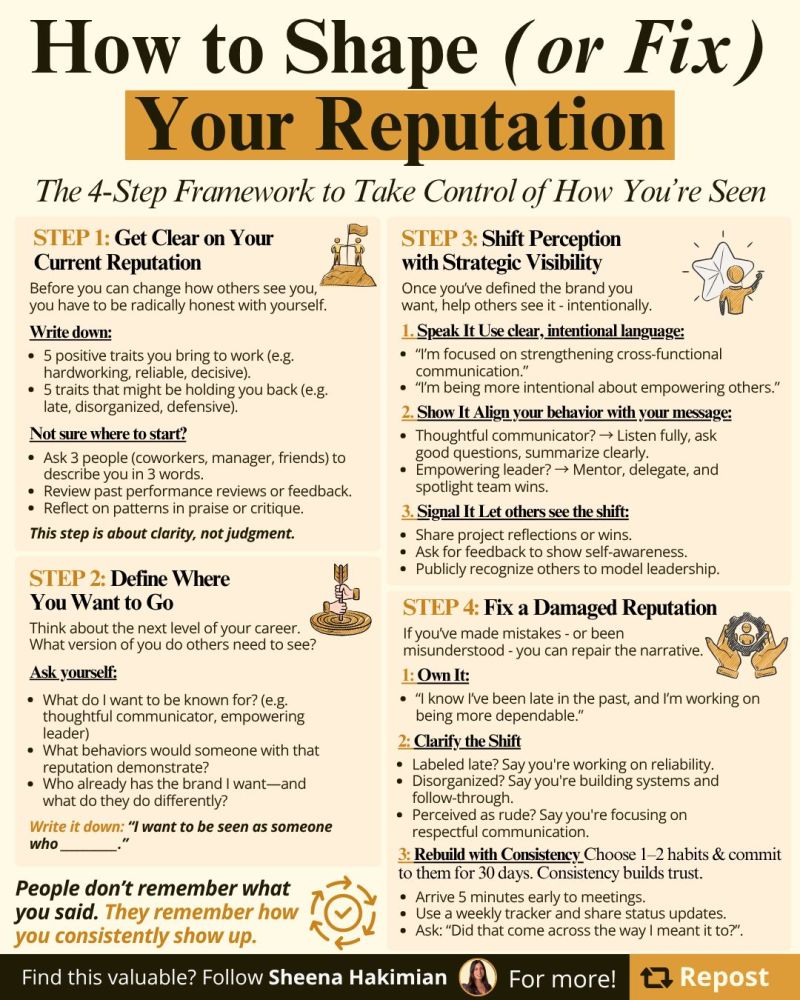
How to Fix your Reputation
The #1 reason people get overlooked at work?
Their reputation doesn’t match their potential.
Early in my career, I was shy.
I had ideas, but I rarely spoke up.
I assumed my work would speak for itself.
It didn’t.
I wasn’t seen as strategic or leadership-ready.
Not because I wasn’t capable, but because I wasn’t visible.
That’s when I realized: Your reputation is your personal brand.
And if you don’t shape it, someone else will.
Here’s the exact 4-step process I used to shape my reputation:
1️⃣ Get clear on your current reputation
↳ Write down 5 of your positive and negative traits. Be radically honest.
↳ Ask 3 people to describe you in 3 words.
2️⃣ Define where you want to go
↳ What do you want to be known for? (Thoughtful communicator? Empowering leader?)
↳ And what does that version of you do differently?
3️⃣ Shift others’ perceptions strategically
↳ Say it → “I’m being more intentional about cross-functional leadership.”
↳ Show it → Coach, actively listen, do what you say you are going to do.
4️⃣ Fix what needs to be repaired
↳ Always late? Unreliable? Defensive?
↳ Own it. Say what you’re working on. Be consistent.
Reputations aren’t set in stone.
They’re shaped by how you consistently show up.
What’s one trait you want to be known for this year? Let me know in the comments! (I want to be known as a great storyteller!).
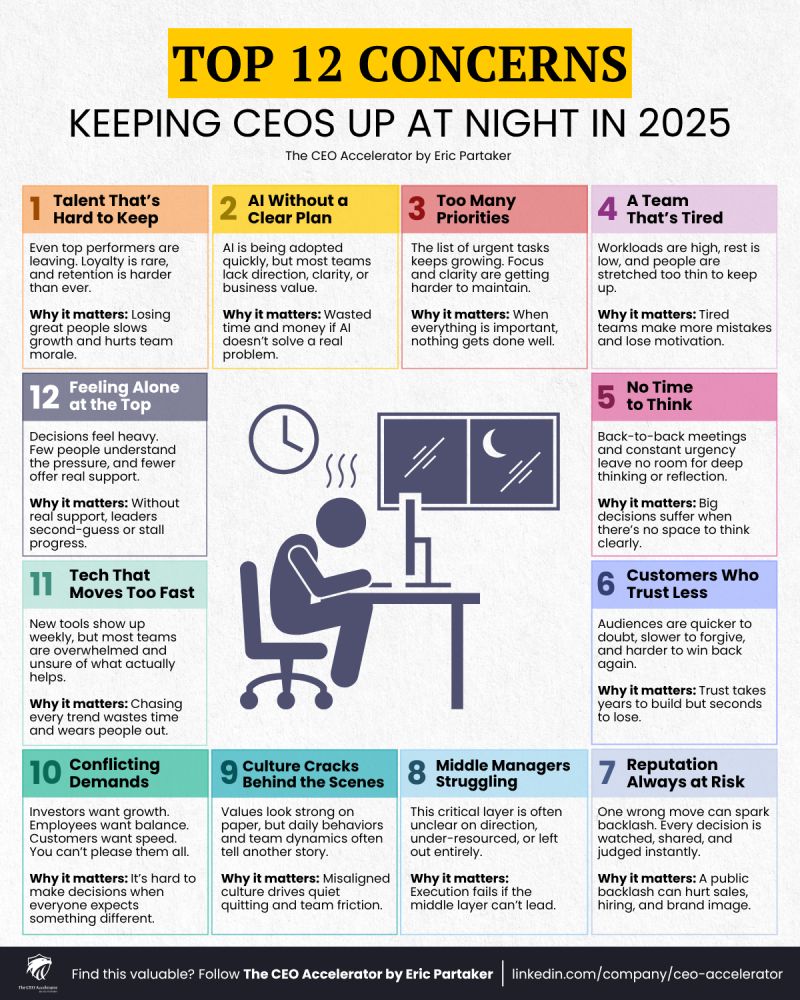
12 challenges every CEO faces in 2025
(And how to turn them into opportunities)
1. Talent That’s Hard to Keep
↳ Top performers have more options than ever
↳ Build a culture worth staying for
2. AI Without a Clear Plan
↳ Teams need clarity on AI’s role and value
↳ Start small, measure impact, scale smart
3. Too Many Priorities
↳ Focus diluted across competing initiatives
↳ Master the art of strategic saying “no”
4. A Team That’s Tired
↳ High workloads affecting performance
↳ Rest isn’t weakness—it’s strategic fuel
5. No Time to Think
↳ Reactive mode replacing strategic planning
↳ Block thinking time like you block meetings
6. Customers Who Trust Less
↳ Higher expectations, lower patience
↳ Transparency and consistency rebuild trust
7. Reputation Always at Risk
↳ Every decision under public scrutiny
↳ Lead with values, communicate with clarity
8. Middle Managers Struggling
↳ Caught between strategy and execution
↳ Invest in their growth—they’re your multipliers
9. Culture Cracks Behind the Scenes
↳ Misalignment between values and behaviors
↳ Address issues early, model what matters
10. Conflicting Demands
↳ Stakeholders pulling in different directions
↳ Find the win-wins, communicate trade-offs
11. Tech That Moves Too Fast
↳ Pressure to adopt every new solution
↳ Choose tools that solve real problems
12. Feeling Alone at the Top
↳ The weight of leadership can isolate
↳ Build your support network—peers get it
Great companies aren’t built by avoiding challenges.
They’re built by facing them head-on.
Where does your company stand?
🟢 0-3: Strong foundation, keep building
🟡 4-6: Time to strengthen weak spots
🟠 7-9: Major adjustments needed now
🔴 10-12: Full transformation required
The truth?
Every successful CEO has faced most of these.
The difference is what you do next.
Which challenges resonate most with you?
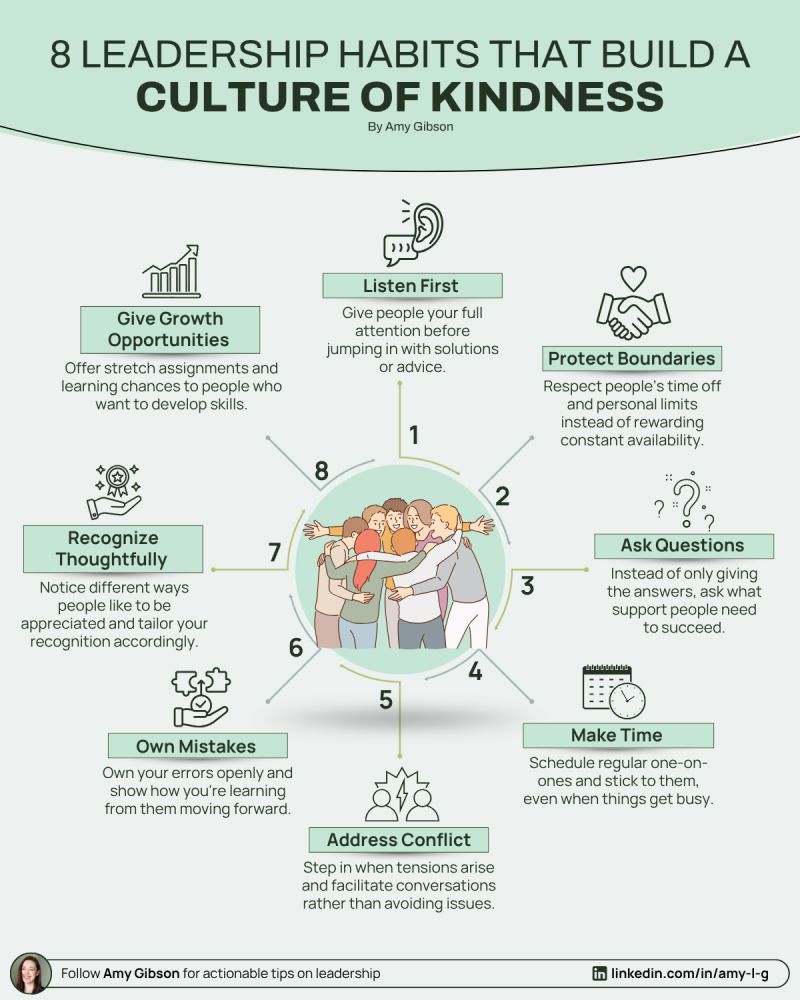
8 Leadership Habits That Build A Culture Of Kindness
The best leaders I know share one thing in common:
They’ve recognized that kindness isn’t “soft”.
It’s the strongest kind of leadership.
Because culture isn’t built in meetings.
It’s built in moments.
Those small interactions that happen between
the big decisions.
The way you respond when someone
makes a mistake.
How you handle conflict when tensions rise.
Whether you really listen or just wait for your turn to talk.
Here are 8 habits that build a culture of kindness
at work:
✦ Listen first, solve second
✦ Protect boundaries instead of rewarding burnout
✦ Ask questions rather than giving all the answers
✦ Make time for people, even when you’re busy
✦ Address conflict instead of hoping it goes away
✦ Own your mistakes openly and learn from them
✦ Recognize people in ways that matter to them
✦ Give growth opportunities to those who want them
None of these require budget approval or a new policy.
They just require intention.
Because people may forget the decisions you made.
But they’ll never forget how you made them feel.
And that’s the real power of leading with kindness.
When the Mind Gets Loud

There’s a moment we all hit—a point where the noise in our own head gets so intense that we start believing it’s who we are. Every doubtful whisper, every replayed mistake, every imagined disaster becomes this giant monologue dictating how we feel, how we act, how we show up. And somewhere along the way, we start thinking the only way to be okay is to “fix” every thought that passes through. But that’s not how the mind works. And honestly, that’s not how peace works either.
You don’t have to control your thoughts. You just have to stop letting them run the entire show.
Thoughts are like weather: constantly shifting, rarely predictable, often dramatic, and completely incapable of staying still. Some days your head is a clear sky. Other days it’s a tornado. And neither state says anything about your worth or your direction. It just means you’re human. Your brain is doing what brains do—throwing ideas, fears, jokes, memories, and anxieties at you like one of those T-shirt cannons at a basketball game.
The trick is realizing you don’t need to catch everything it fires.
Most of our mental stress isn’t from the thought itself—it’s from the meaning we attach to it. A worry pops up, and instead of letting it float by, we wrestle with it. We analyze it. We catastrophize it. We give it power simply because it appeared. But a thought is just a thought until you give it a throne. And when you stop handing it the crown, something shifts. You start remembering that you’re not the storm—you’re the sky holding it.
You can let a thought pass without arguing with it.
You can feel anxious without assuming danger.
You can hear the old “you’re not enough” tape and not treat it like truth.
This isn’t suppression. It’s awareness. It’s the quiet confidence of knowing that not every internal voice deserves a microphone. Some can stay in the back row where they belong.
And once you stop trying to control every thought, something unexpected happens: the mind softens. The volume lowers. The grip loosens. You create just enough space between you and the noise to breathe again. You start walking through your day with a little more steadiness. You begin to trust that a passing thought doesn’t have the power to ruin the moment unless you hand it that authority.
Maybe that’s the real win—not forcing yourself to think “better,” but giving yourself permission to stop being bullied by whatever pops into your head.
You don’t need to be the perfect thinker. You just need to be the one in charge of the remote.
 Kenrick Vaz