
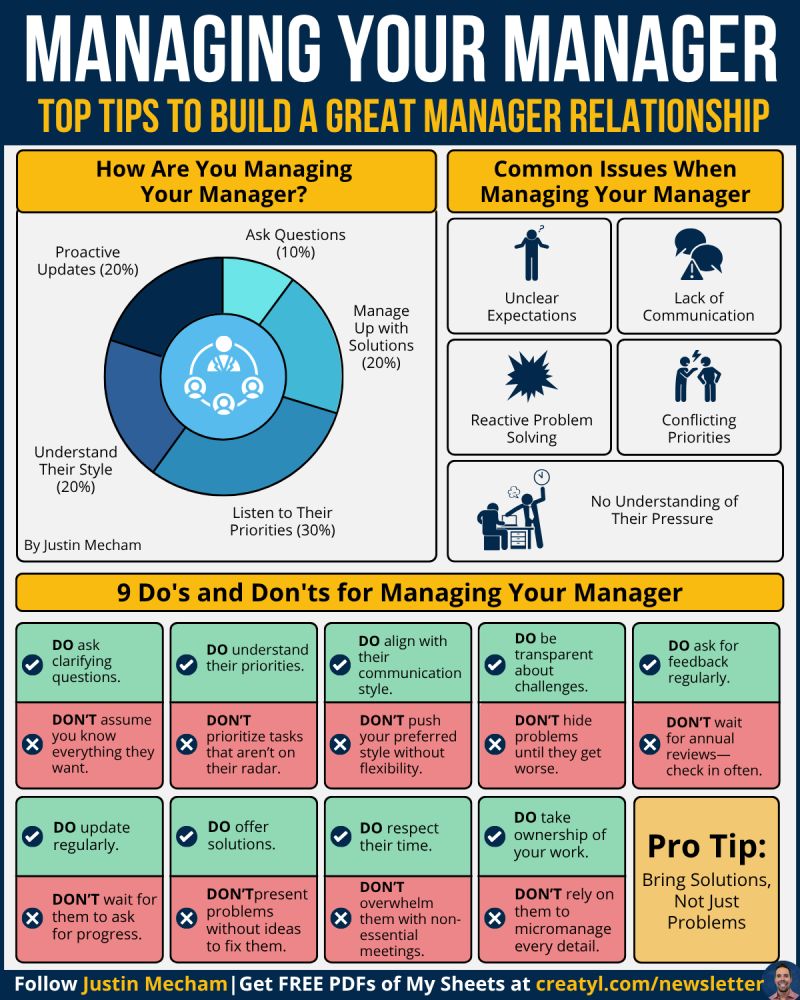
Most managers won’t tell you this—
But they wish you’d do it:
They want fewer surprises.
Fewer loose ends.
Less guessing what you need.
And more help carrying the weight.
The truth?
Managing your manager is a skill—
And most people never learn it.
They wait.
They assume.
They hope things just work out.
But the ones who rise?
They know how to lead up, not just down.
Here’s how to make that shift—
And start earning real trust:
💡How You Support Your Manager
→ Share updates before they ask
→ Ask clear, simple questions
→ Match their goals and style
⚠️What Holds You Back
→ Letting fear stop you
→ Avoiding honest talks
→ Focusing on the wrong things
→ Waiting too long to get direction
✅❌Do’s vs. Don’ts
→ Do: Speak up, take action,
offer solutions, respect their time.
→ Don’t: Assume they know what you need,
hide problems hoping they disappear.
Behind every manager is
someone under pressure.
They don’t always know what you need.
They don’t always say what they feel.
But they always notice who shows up ready.
Make sure that person is you.
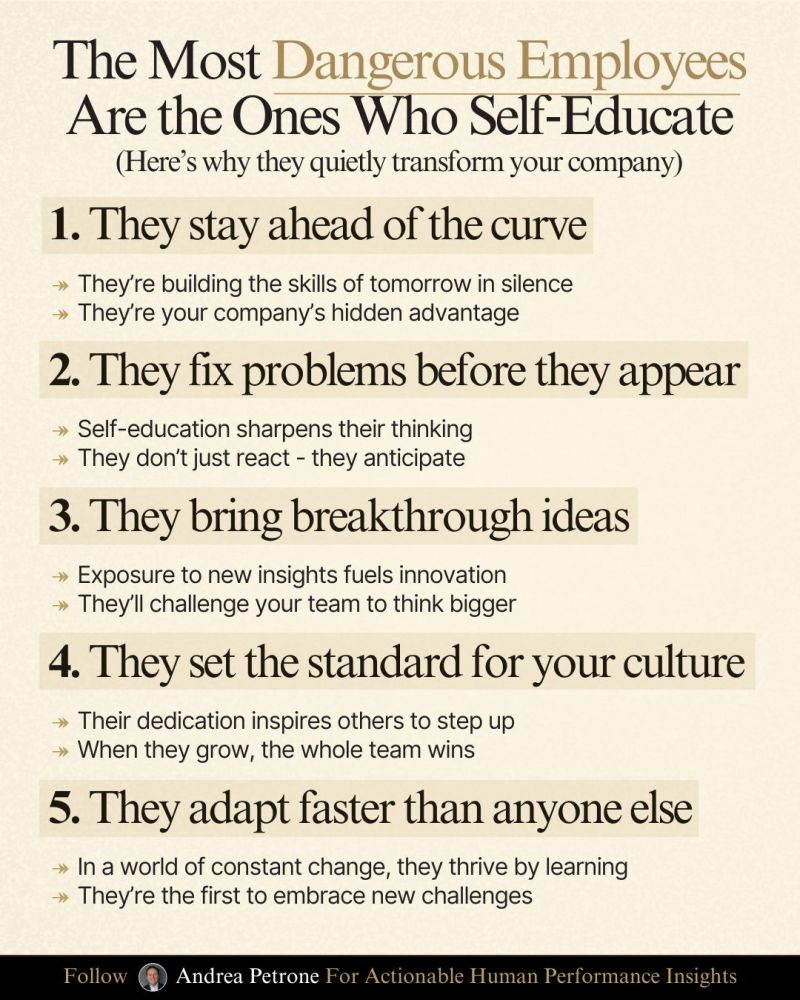
Dangerous Employees
The most valuable employees aren’t waiting for training.
They’re creating their own edge.
And they’re already two steps ahead.
They’re the ones quietly:
→ Upskilling in AI after hours
→ Learning leadership through podcasts
→ Preparing for what’s next while others stand still
Here’s why they’ll transform your company (and why you need to watch them closely):
1. They stay ahead of the curve
→ They’re building the skills of tomorrow in silence
→ They’re your company’s hidden advantage
2. They fix problems before they appear
→ Self-education sharpens their thinking
→ They don’t just react—they anticipate
3. They bring breakthrough ideas
→ Exposure to new insights fuels innovation
→ They’ll challenge your team to think bigger
4. They set the standard for your culture
→ Their dedication inspires others to step up
→ When they grow, the whole team wins
5. They adapt faster than anyone else
→ In a world of constant change, they thrive by learning
→ They’re the first to embrace new challenges
Here’s your wake-up call:
If you don’t recognize their value,
someone else will.
Your goal:
Spot them.
Support them.
Or watch them grow for someone else.
Do you know who these employees are on your team?
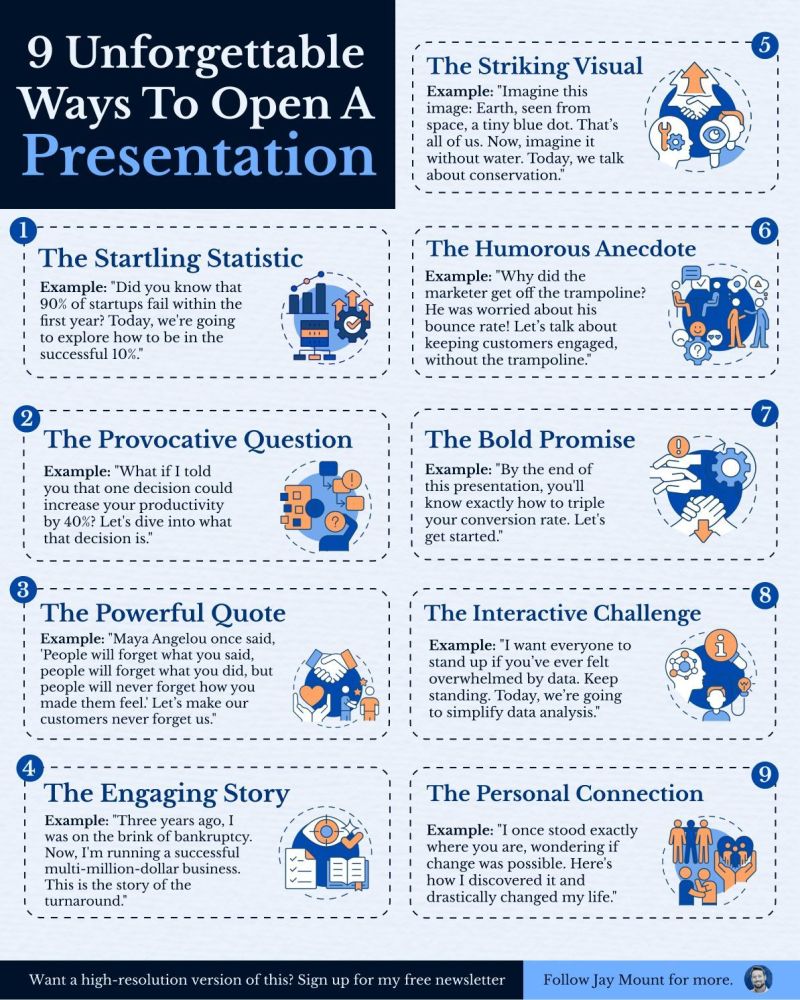
9 Powerful Ways to Open a Presentation
The First 10 Seconds Can Make or Break Your Presentation
If you don’t hook your audience immediately, you risk losing them.
The best speakers don’t just start talking—they command attention from the first sentence.
Here are 9 powerful ways to open a presentation and captivate your audience:
—
1. Lead with a Shocking Statistic
➝ “Did you know 80% of presentations fail to keep the audience engaged?”
✅ Why it works: It grabs attention and sparks curiosity.
2. Ask a Thought-Provoking Question
➝ “What if one small habit could double your productivity?”
✅ Why it works: It invites the audience to think and engage.
3. Share a Compelling Quote
➝ “Steve Jobs once said, ‘The most powerful person in the room is the storyteller.’”
✅ Why it works: Adds credibility and sets the tone.
4. Tell a Personal Story
➝ “Five years ago, I bombed my first public speech… and here’s what I learned.”
✅ Why it works: Stories create emotional connections.
5. Paint a Vivid Scenario
➝ “Picture this: You’re on stage. The room is silent. Every eye is on you…”
✅ Why it works: It activates imagination and draws people in.
6. Use Humor
➝ “Public speaking is like coffee—some love it, some need it, and some just pretend to enjoy it.”
✅ Why it works: It relaxes the audience and builds rapport.
7. Make a Bold Promise
➝ “By the end of this talk, you’ll have a strategy to turn any speech into a standing ovation.”
✅ Why it works: It keeps people interested in what’s coming next.
8. Engage with a Challenge
➝ “Raise your hand if you’ve ever struggled with stage fright.”
✅ Why it works: It creates instant interaction and energy.
9. Relate to the Audience’s Experience
➝ “I know exactly how nerve-wracking this moment can feel—I’ve been there too.”
✅ Why it works: It builds connection and trust.
—
### The Best Openers Do One Thing:
They grab attention and set the stage for impact.
💡 Choose an opener that fits your message, and watch your audience stay engaged from the very first word.
The Importance of Being in the Right Place

Sometimes life tricks you into thinking your effort is the problem. You push harder, stay longer, stretch yourself thinner than you should, and yet the results never look like what you hoped for. You start wondering if you’re the weak link, if you’re not talented enough, not smart enough, not disciplined enough. But what if the issue isn’t you at all? What if you’re just standing in the wrong place?
There are environments that ask you to shrink before you even begin. Places where your ideas feel “too much,” where your kindness is mistaken for weakness, where your strengths go unnoticed because no one is looking in your direction. In those spaces, even your best effort feels like a drop in a bottomless bucket. You could give everything you have, and somehow it still feels like you’re failing. It’s not because you’re lacking. It’s because the soil was never meant for you to bloom in.
And then, there are the other kinds of places—the right ones—where something shifts the moment you walk in. You don’t have to prove your worth; it’s already recognized. Your energy is welcomed. Your strengths aren’t just tolerated; they’re valued. Here, even your smallest contributions feel meaningful. You can breathe deeper. You can think clearer. You feel seen without having to perform.
What’s wild is how subtle this difference can be. Two people can do the exact same thing—same talent, same effort, same heart—and in one environment they are ignored, while in another they’re celebrated. That’s not luck. That’s alignment.
Finding your place isn’t always about geography; sometimes it’s a room, a team, a relationship, a community, a calling. And often, you don’t realize you were in the wrong place until you finally experience the right one. The right place doesn’t demand perfection. It doesn’t keep score. It doesn’t dim your light. It does the opposite—it reminds you that your presence alone has value.
So if you’ve been fighting to be enough lately, maybe it’s time to pause and ask a harder question: Am I giving my best in the wrong place? Because effort shouldn’t feel like drowning. Growth shouldn’t feel like punishment. And being appreciated shouldn’t feel like a miracle.
You deserve to be somewhere that recognizes you without making you beg for it. Somewhere your gifts are obvious, your voice matters, and your existence is met with, “We’re glad you’re here.”
Right place. Right people. Right soil.
And suddenly, without changing a single thing about yourself, you begin to bloom.
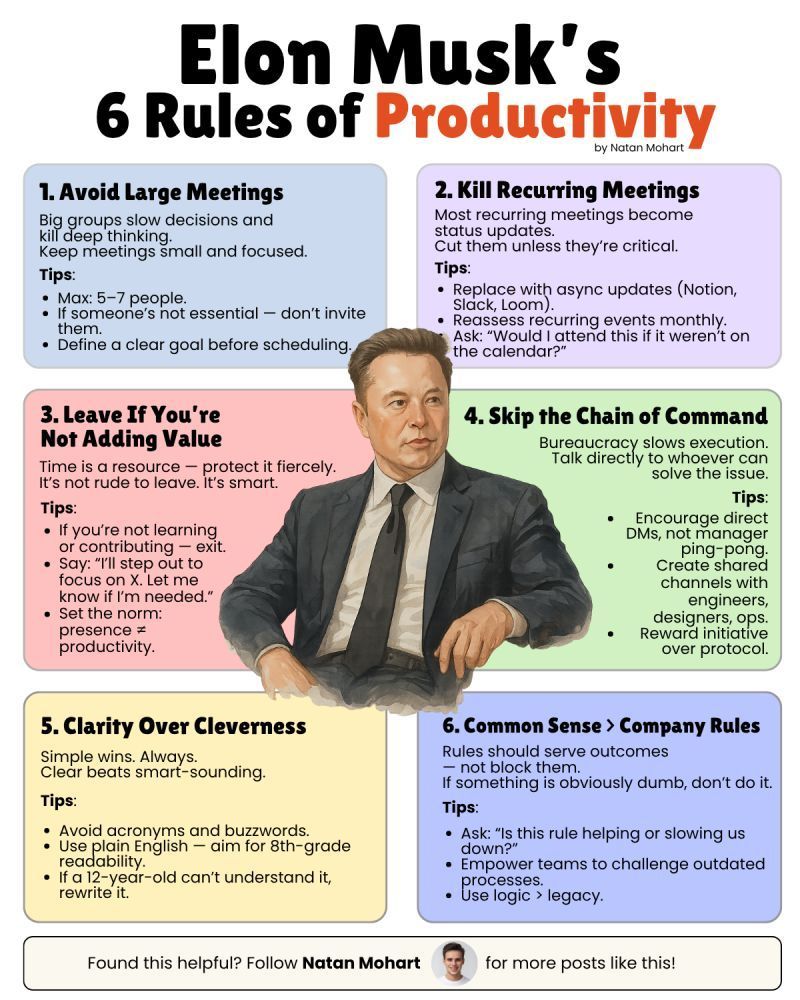
Elon Musk’s 6 Rules of Productivity
Most people waste time pretending to be productive.
Elon Musk doesn’t have that luxury.
He runs 6 companies.
Most can’t handle one.
So how does he do it?
A leaked internal email revealed the 6 ruthless rules he lives by to maximize productivity.
Save this. Live by it.
Your calendar will thank you.
1/ Avoid Large Meetings
↳ Big meetings = collective procrastination.
↳ Only include people who are actually contributing.
2/ Kill Recurring Meetings
↳ Regular meetings are often performative.
↳ Build things, don’t just talk about building them.
3/ Leave If You’re Not Adding Value
↳ Walking out of a pointless meeting isn’t rude.
↳ Wasting people’s time is.
4/ Skip the Chain of Command
↳ Talk directly to the person who can get it done.
↳ Middle managers slow down momentum.
5/ Clarity Over Cleverness
↳ If you can’t explain your idea simply, you don’t understand it well enough.
↳ Jargon ≠ intelligence.
6/ Common Sense > Company Rules
↳ If a rule makes no sense in context — change it.
↳ You’re here to get results, not follow bureaucracy.
Circle of Control
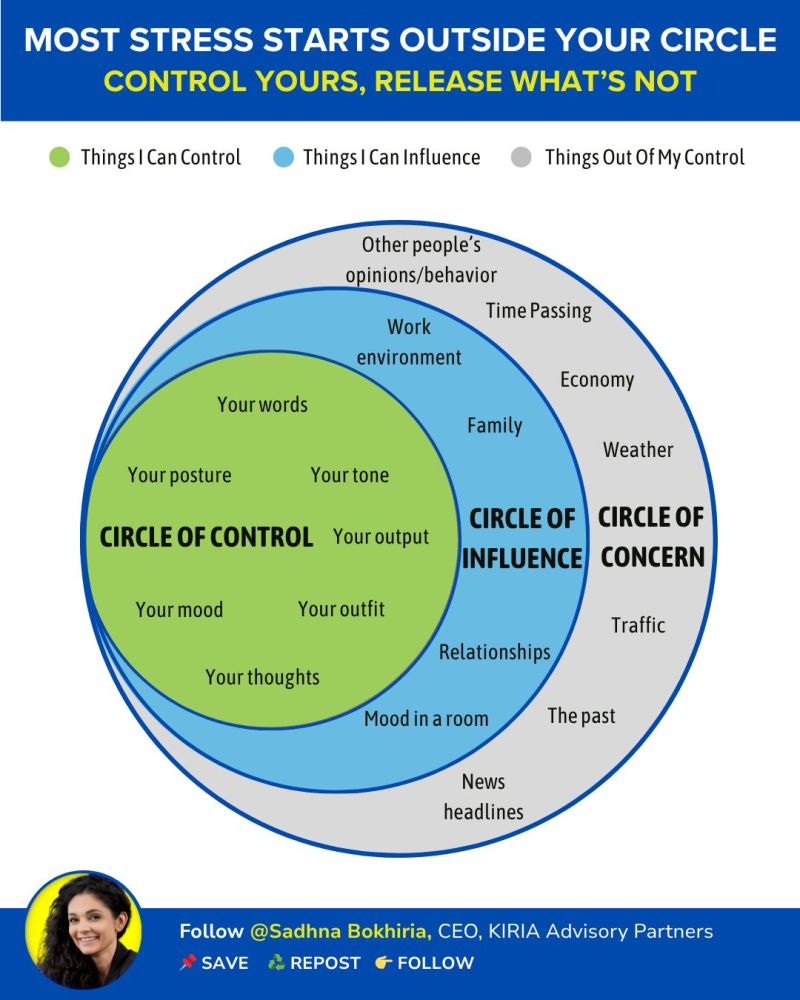
‼️ Nearly 47% of Americans are constantly stressed – often about things they can’t even control.
So check your circles👇
🔵 CIRCLE OF CONTROL
⤷ You act and something changes. This is your zone of power.
🔵 CIRCLE OF INFLUENCE
⤷ You can shape outcomes, but can’t force them. Nudge. Suggest. Model.
🔵 CIRCLE OF CONCERN
⤷ No amount of effort moves the needle. Stress thrives here.
10 Ways to be Kind to Yourself
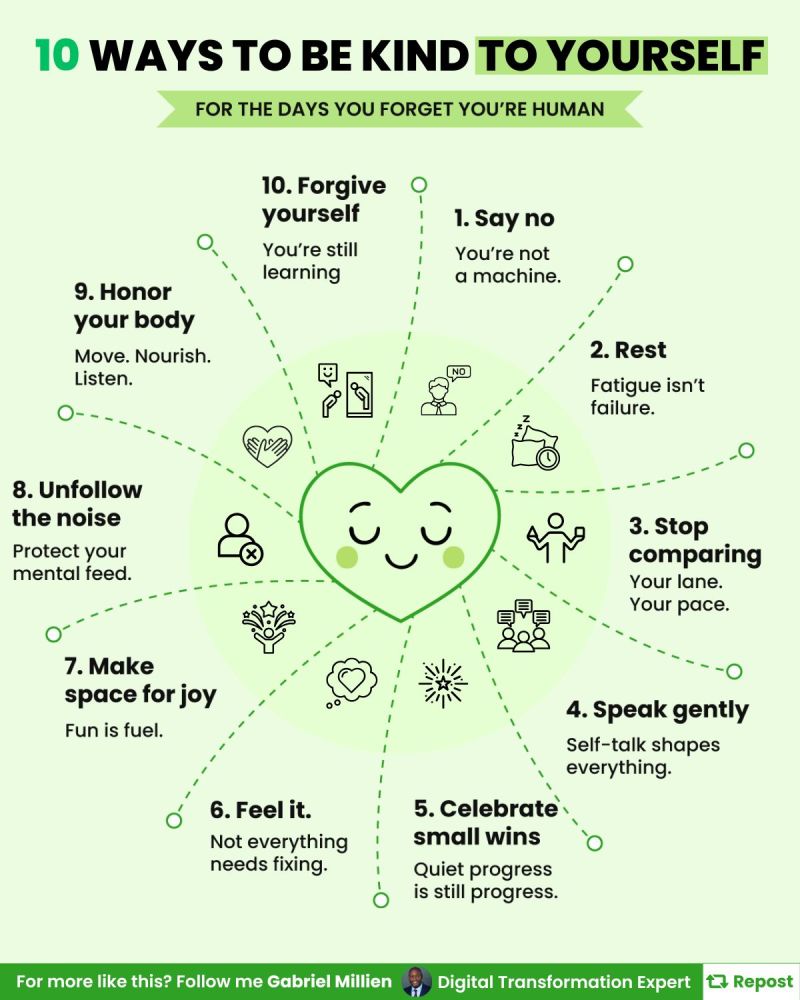
We’re praised for pushing through.
But rarely taught how to be gentle with ourselves.
That’s not strength. That’s survival mode.
And it comes at a cost.
When you:
→ are tired but keep going
→ are hurting but show up smiling
→ give to everyone but forget yourself
Self-kindness isn’t soft.
It’s how you stay whole. 🌱
10 Ways to Be Kind to Yourself:
1. Say no 🛡️
↳ Your worth isn’t in your yes. You don’t need a reason.
2. Take a break 🌅
↳ Rest isn’t earned, it’s essential.
3. Do alone 🪴
↳ Solitude can be sacred.
4. Forgive yourself 🕊️
↳ You’re not who you were.
5. Set boundaries 🛑
↳ “No” is a complete sentence.
6. Let yourself rest 🌙
↳ Burnout doesn’t build legacy.
7. Do something just for you 💫
↳ Fun counts too.
8. Go slow 🌊
↳ Unfollow what drains your peace.
9. Ditch perfect 🦋
↳ Growth is messy—and worth it.
10. Keep showing up 💝
↳ But this time, for you.
Remember: The way you treat yourself sets the tone for everything else.
Which one did you need to hear today?
THE MIRACLE YOU’RE STANDING ON

Look around for a second. Not with the tired, half-awake glance you give the world on a Monday morning, but with the eyes you had as a kid—the ones that thought everything was magic because, honestly, it kind of is.
We live on a planet that shouldn’t make sense. There’s fire boiling at its core, powerful enough to melt rock like butter. There are peaks that scrape the sky and stay frozen even when the sun shines on them all day. There are oceans so deep they could hide mountains, whole ranges swallowed by darkness where strange creatures glow like stars. And somehow, all of this is happening beneath our feet, around our homes, outside our windows while we rush through emails and complain about traffic.
And then there’s us—walking, thinking, loving, breaking, rebuilding. Hearts that hurt and heal. Minds that dream impossible things. Bodies made of the same elements as stardust, doing ordinary tasks that are actually extraordinary when you zoom out far enough.
Yet we say miracles don’t exist.
Maybe miracles aren’t rare events. Maybe they’re the default setting. Maybe we’ve just gotten used to them, like you get used to the hum of a refrigerator until someone turns it off and the silence feels strange.
Think about it. Every morning you open your eyes on a floating rock that’s spinning through space at 1,000 miles an hour, warmed by a star that’s just the right distance away so you don’t freeze or burn. You breathe air you didn’t create, drink water that’s been cycling through clouds and rivers for billions of years, and trust gravity to keep you grounded. You call that normal. But if it stopped for one second, you’d call it a miracle to get it back.
Maybe the problem is we expect miracles to be loud—burning bushes and parted seas, neon signs from the sky. But most miracles are quiet. They look like your child laughing at something only they understand. Like someone remembering your favorite song. Like healing from a hurt that once felt impossible to survive. Like waking up on a day you once thought you wouldn’t make it through.
Miracles don’t always change the world. Sometimes they just change you.
So the next time you feel small or unlucky or forgotten, step outside for a moment. Feel the ground under you. Look at the sky. Listen. This place is wild. It’s ridiculous. It’s breathtaking. And despite every reason it shouldn’t work, it does.
You’re not just alive in the middle of all this—you’re part of it.
And that’s a miracle in itself.
9 Old Rules About Change
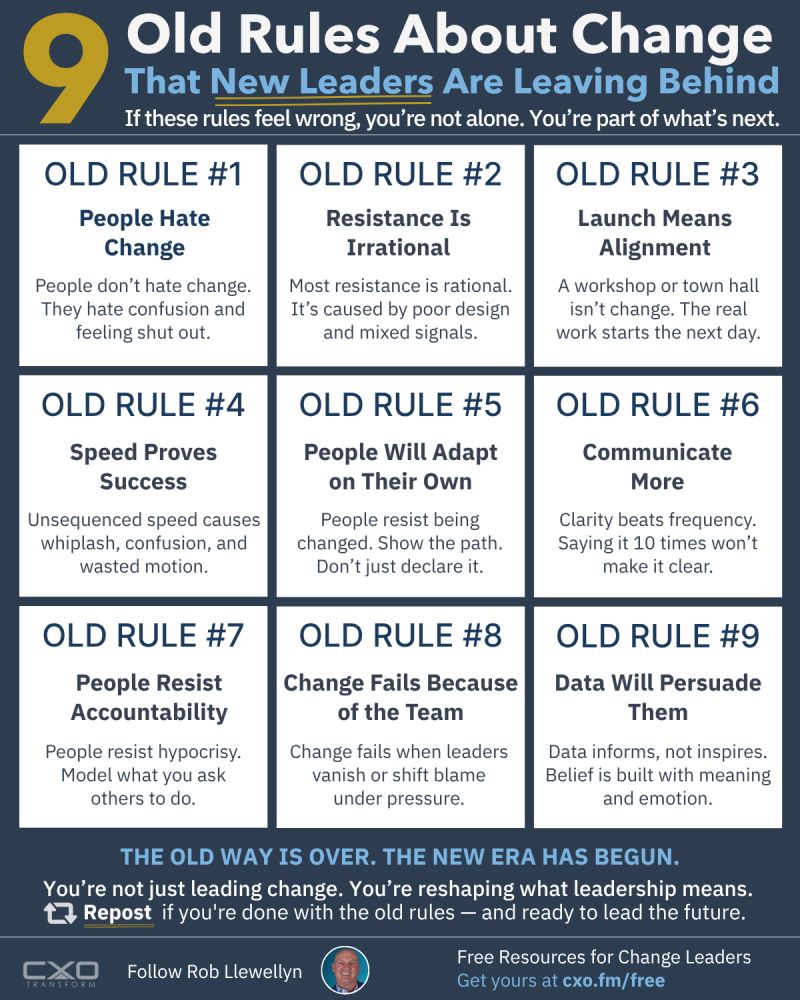
People hate change.
You’ve heard it. You’ve said it. It’s wrong.
The truth?
People hate confusion.
They hate feeling shut out.
They hate being told they’ve changed.
But change itself?
People want it.
They just want it to make sense.
The best transformation leaders already know this:
The old rules of change are broken.
The ones in training decks.
The ones recycled in offsites.
The ones that let leaders vanish when things get hard.
They don’t work anymore.
Because the world you’re leading in has changed.
Here’s what’s really happening:
• People don’t resist change.
They resist mixed signals.
• Launch isn’t alignment.
It’s day one of the real work.
• Speed doesn’t prove success.
It creates whiplash when mis-timed.
• Repeating it doesn’t make it clear.
Clarity beats noise.
• People don’t resist accountability.
They resist hypocrisy.
One vague email can undo six weeks of trust.
One skipped stand-up, and the story collapses.
Change doesn’t fail because of the team.
It fails when leaders disappear.
I’ve sat in rooms where the plan looked perfect.
But the leader had already checked out.
Leadership isn’t strategy.
It’s presence.
Seventy percent of change fails after launch.
Not from bad plans. From vanishing leadership.
If you want people to believe in the change:
Don’t bury them in data.
Tell them what it means.
Show them why it matters.
Real leaders get this.
They don’t treat change as an event.
They treat it as a craft.
Old question:
“How do I make them change?”
Better question:
“How do I lead them through it?”
If you’ve ever looked at a change plan and thought:
“This doesn’t feel right.” You’re not wrong.
You’re not the problem.
You’re part of what’s next.
You see the gap. And you’re willing to lead through it.
Are you ready to be the one who stays visible?
Most leaders talk change.
Few stay visible when it gets messy.
Prioritizing Your Tasks
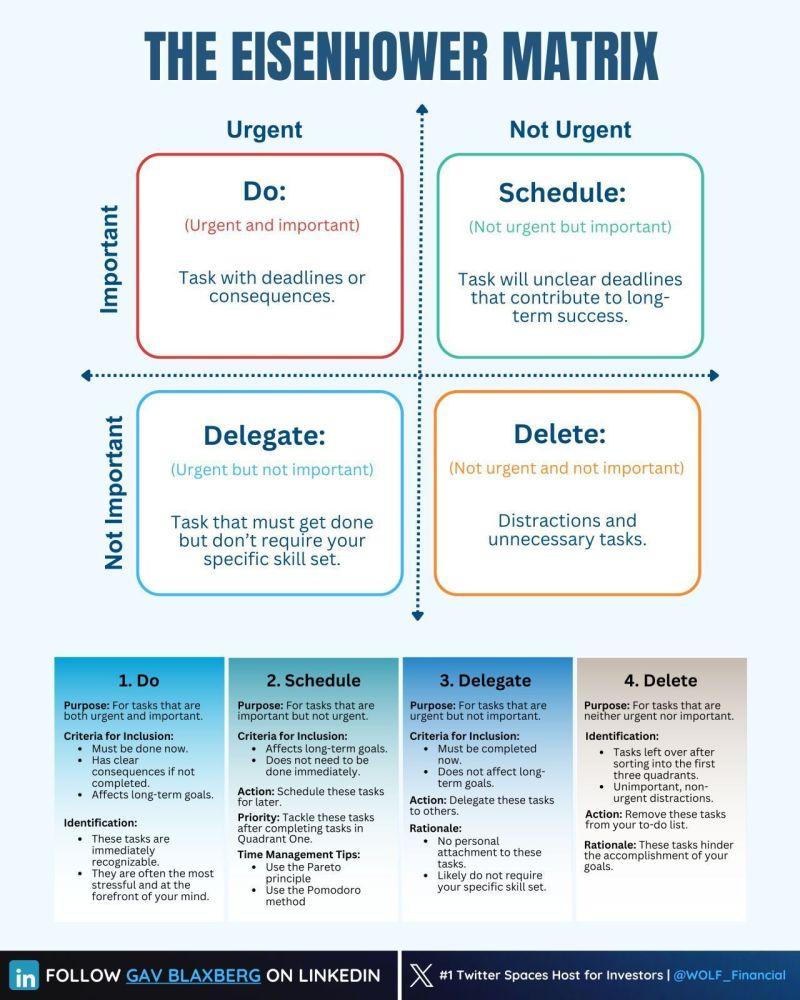
Effective prioritization boosts productivity and ensures urgent tasks get immediate attention.
Boost your productivity by organizing tasks with the Eisenhower Matrix.
The four quadrants of the Eisenhower Matrix:
1. Do:
➟ Purpose: For tasks that are both urgent and important.
➟ Criteria for Inclusion:
– Must be done now.
– Has clear consequences if not completed.
– Affects long-term goals.
➟ Identification:
– These tasks are immediately recognizable.
– They are often the most stressful and at the forefront of your mind.
2. Schedule:
➟ Purpose: For tasks that are important but not urgent.
➟ Criteria for Inclusion:
– Affects long-term goals.
– Does not need to be done immediately.
➟ Action: Schedule these tasks for later.
➟ Priority: Tackle these tasks after completing tasks in Quadrant One.
➟ Time Management Tips:
– Use the Pareto principle (focus on the 20% of tasks that yield 80% of the results).
– Use the Pomodoro method (work in focused intervals with breaks).
3. Delegate
➟ Purpose: For tasks that are urgent but not important.
➟ Criteria for Inclusion:
– Must be completed now.
– Does not affect long-term goals.
➟ Action: Delegate these tasks to others.
➟ Rationale:
– No personal attachment to these tasks.
– Likely do not require your specific skill set.
➟ Benefits of Delegation:
– Efficient workload management.
– Opportunity for team members to expand their skill set.
4. Delete
➟ Purpose: For tasks that are neither urgent nor important.
➟ Identification:
– Tasks left over after sorting into the first three quadrants.
– Unimportant, non-urgent distractions.
➟ Action: Remove these tasks from your to-do list.
➟ Rationale: These tasks hinder the accomplishment of your goals.
4 tips for prioritizing your tasks
1. Color-code your tasks
2. Limit tasks to 10 per quadrant
3. Make personal and professional to-do lists
4. Eliminate, then prioritize
 Kenrick Vaz