

It’s not always about working too many hours…
Burnout doesn’t always come from late nights or heavy workloads.
Sometimes, it comes from how people feel while doing the work.
Harsh truth:
You can have the best intentions as a leader and still be creating an environment that quietly drains your team.
Here are 9 signs you might be burning them out without realizing it:
1️⃣ Everything Feels Urgent
When everything’s ASAP, nothing is strategic. Constant pressure erodes focus and trust.
2️⃣ You’re Always “Pushing for More”
Growth is good…until it becomes nonstop. High performers need rest to stay high performing.
3️⃣ Wins Go Unnoticed
If you only give feedback when something’s wrong, motivation fades fast.
4️⃣ There’s No Room for Autonomy
Micromanagement signals distrust. It also drains creativity and morale.
5️⃣ You Change Priorities Constantly
Your team spends more time shifting gears than making progress.
6️⃣ You Don’t Model Healthy Boundaries
If you send 11 PM emails or never take time off, you’re silently setting expectations they’ll follow.
7️⃣ You Avoid Difficult Conversations
Unaddressed tension doesn’t disappear—it spreads. Psychological safety matters.
8️⃣ You Rely Heavily on the Same Few People
Your “go-to” employees may seem fine… until they burn out and check out.
9️⃣ There’s No Clear Path Forward
When people don’t see growth, purpose, or direction, burnout turns into disengagement.
Never forget:
Burnout isn’t just about workload—it’s about culture.
If you want sustainable performance, lead with empathy, clarity, and awareness.
Chaos

If your team is always busy—
Why does everything feel stuck?
🚫 Slow approvals.
🚫 Endless back-and-forth.
🚫 Everyone’s working… but no one’s aligned.
Sound familiar?
It’s not that people don’t care.
It’s that no one’s clear on how
work should actually move.
So what do most leaders do?
💻 Buy new tools.
📋 Add more meetings.
⚠️ Still feel stuck.
More tech doesn’t fix messy decision-making.
And a fancy dashboard won’t solve
unclear roles or bad handoffs.
I’m hosting a free webinar sponsored by BILL
to show you what actually works.
Leading Like an Operator:
Driving Culture, Speed, and
Efficiency in Modern Finance
🗓️ Date: July 23, 2025
⏰ Time: 1pm ET / 10am PT
👥 Save your seat here: https://lnkd.in/gDvYfTVJ
You’ll learn the operator approach that
works—without adding more noise.
Chaos isn’t strategy.
Busy doesn’t mean better.
Clear leadership wins.
Let’s get your team unstuck—fast.
I hope to see you there.
Handling Toxic Co-Workers
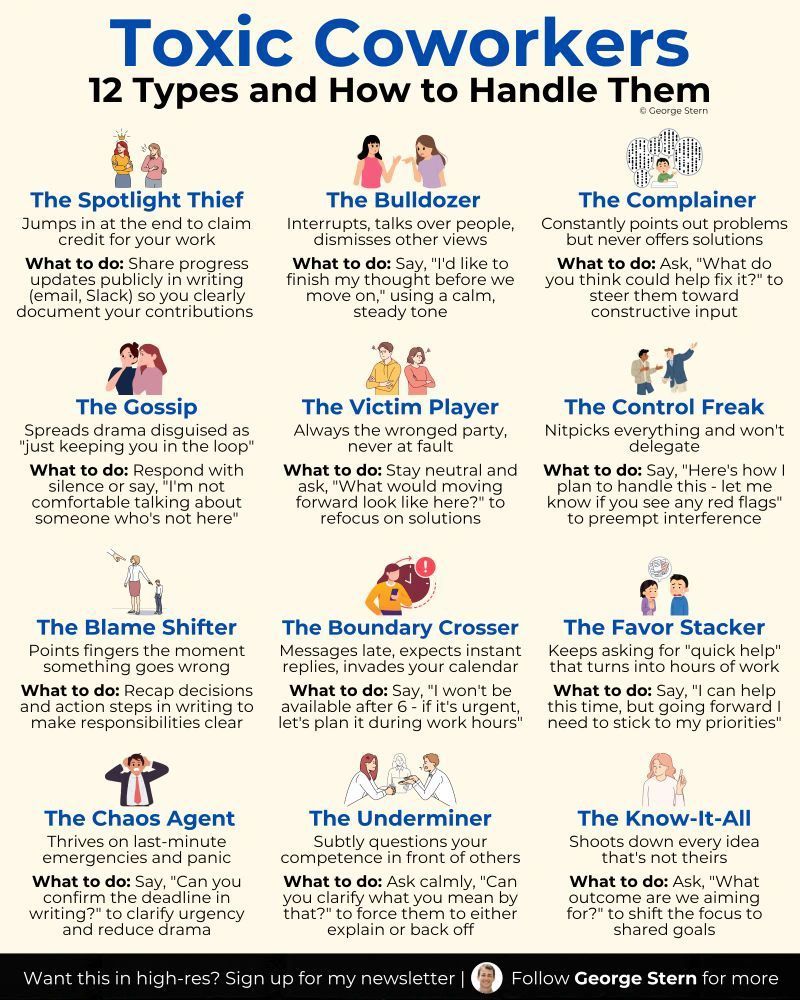
We all know these 12 toxic coworkers.
Handle them like a pro:
Colleagues like this destroy morale and slow down teams.
They:
↳Interrupt
↳Hog credit
↳Spread Drama
↳And make every day harder than it has to be.
You can’t always avoid them.
But you CAN learn to deal with them –
Calmly and confidently:
1. The Spotlight Thief
↳Jumps in at the end to claim credit for your work
↳What to do: Share progress updates publicly in writing (email, Slack) so your contributions are clearly documented
2. The Bulldozer
↳Interrupts, talks over people, dismisses other views
↳What to do: Say, “I’d like to finish my thought before we move on,” using a calm, steady tone
3. The Complainer-in-Chief
↳Constantly points out problems, never offers solutions
↳What to do: Ask, “What do you think could help fix it?” to steer them toward constructive input
4. The Gossip
↳Spreads drama disguised as “just keeping you in the loop”
↳What to do: Respond with silence or say, “I’m not comfortable talking about someone who’s not here”
5. The Blame Shifter
↳Points fingers the moment something goes wrong
↳What to do: Recap decisions and action steps in writing to make responsibilities clear
6. The Control Freak
↳Nitpicks everything and won’t delegate
↳What to do: Say, “Here’s how I plan to handle this – let me know if you see any red flags” to preempt interference
7. The Victim Player
↳Always the wronged party, never at fault
↳What to do: Stay neutral and ask, “What would moving forward look like here?” to refocus on solutions
8. The Boundary Crosser
↳Messages late, expects instant replies, invades your calendar
↳What to do: Say, “I won’t be available after 6 – if it’s urgent, let’s plan ahead during work hours”
9. The Know-It-All
↳Shoots down every idea that’s not theirs
↳What to do: Ask, “What outcome are we aiming for?” to shift the focus to shared goals
10. The Chaos Agent
↳Thrives on last-minute emergencies and panic
↳What to do: Say, “Can you confirm the deadline in writing?” to clarify urgency and reduce drama
11. The Underminer
↳Subtly questions your competence in front of others
↳What to do: Ask calmly, “Can you clarify what you mean by that?” to force them to either explain or back off
If any of these are all too familiar,
Don’t try to match their energy.
Instead, use this sheet to:
↳Set clear boundaries
↳Stay calm under pressure
↳And protect your peace
20 Benefits of Understanding Personality Types

For Your Team:
• Enhanced brainstorming sessions
• Better team problem-solving
• Easier resolution of conflicts
• Fewer misunderstandings
• Stronger team cohesion
• Efficient task allocation
• Better communication
• Tailored development
• Higher engagement
• Lower stress levels
For You:
• Sharper intuition
• Stronger influence
• Improved empathy
• Increased resilience
• Greater adaptability
• Deeper connections
• Increased confidence
• Better self-awareness
• Clearer communication
• Improved decision-making
All great leaders know:
Understanding your team is key to success.
And why is so important?
It shows how each team member:
➟ Thinks & processes information
➟ Interacts & communicates
➟ Handles conflict & stress
With these insights, you can:
➟ Improve team synergy
➟ Tailor your leadership style
➟ Increase overall productivity
Find this valuable?
How to Talk to Toxic People

I’ve been there.
A toxic manager once pushed me to walk away from a job I truly loved.
But here’s what I’ve learned:
You can’t control someone else’s behavior.
But you can control how you respond
and how you protect your peace.
Here are 8 practical phrases that helped me set boundaries and reclaim my confidence:
1️⃣ When they try to guilt you:
“I understand how you feel, but I’m confident in my decision.”
2️⃣ When they dismiss your feelings:
“My feelings are valid, and I’d appreciate it if you respected them.”
3️⃣ When they constantly criticize you:
“I welcome constructive feedback, but this doesn’t feel helpful.”
4️⃣ When they play the victim:
“I hear what you’re going through, but I can’t take responsibility for this.”
5️⃣ When they spread negativity:
“Let’s focus on what we can control and improve.”
6️⃣ When they gaslight you:
“I know my experience, and this is how I see it.”
7️⃣ When they try to control the situation:
“I understand your perspective, but I need to make my own decisions.”
8️⃣ When they interrupt you:
“I’d appreciate it if I could finish speaking before you share your thoughts.”
You’re not responsible for fixing toxic people.
But you are responsible for protecting
your energy, your values, and your peace.
Speak up.
Stand firm.
Every boundary you set teaches others how to treat you.
Lead with Heart

We obsess over numbers.
Revenue. Margins. Forecasts.
But the truth?
Business is 100% about people.
Yet most leaders still focus on:
🎯 KPIs
📊 Metrics
📈 Dashboards
📋 Quarterly results
And they lose sight of the very thing
making the metrics possible:
People.
➟ The ones solving the problems
➟ Delivering those numbers
➟ Building the systems
➟ Closing the deals
Want your business to thrive?
Start with your people.
Show them you care about:
➟ Their growth
➟ Their dreams
➟ Their wellbeing
➟ Their challenges
Because when people feel valued as humans
(not just employees):
➟ They bring their best work
➟ They go the extra mile
➟ They stay longer
➟ They care more
If you want people to care about your business, show them first that you care about them as people.
Business is personal.
It always was.
It always will be.
Lead with heart.
The results will follow.
10 tiny habits to destress your life

Feeling stretched too thin lately?
10 tiny habits to destress your life:
1) Declutter your space 🧹
↳ Ask yourself: “Does this spark joy?” (Marie Kondo).
↳ Let go of anything unused for 2+ years.
2) Prioritize your tasks 🎯
↳ Write down your top 3 priorities each morning.
↳ Timebox tasks to treat them like appointments.
3) Limit digital distractions 📵
↳ Mute all non-essential notifications.
↳ Turn off your phone 1 hr before and 1 hr after bed.
4) Simplify your schedule 🗓️
↳ Say no to low-priority meetings and invites.
↳ Use the “Hell Yeah or No” rule to guard your time.
5) Streamline your wardrobe 👕
↳ Build a capsule wardrobe with versatile pieces.
↳ Wear what you love and stick to go-to combinations.
6) Focus on quality over quantity 🛠️
↳ Invest in durable, high-quality items.
↳ Avoid cheap things you’ll have to replace often.
7) Embrace mindful consumption 🧠
↳ Buy only what you truly need or deeply value.
↳ Prefer meaningful experiences over material stuff.
8) Simplify your communication 💬
↳ Lead with the main point, then give support.
↳ Use the Pyramid Principle: clear, concise, essential.
9) Create a daily routine 🔁
↳ End the day with a shutdown ritual.
↳ You’ll start the next morning with intention and clarity.
10) Practice mindfulness 🧘
↳ Set aside time for meditation or deep rest.
↳ Try NSDR to reset your energy and calm your mind.
– – – –
Ready to make your life simpler and less stressful?
Choose one habit that resonates with you.
Start today.
Progress loves simplicity.
When you focus on what matters, results will follow.
What would you add?
Where the Table Gets Longer
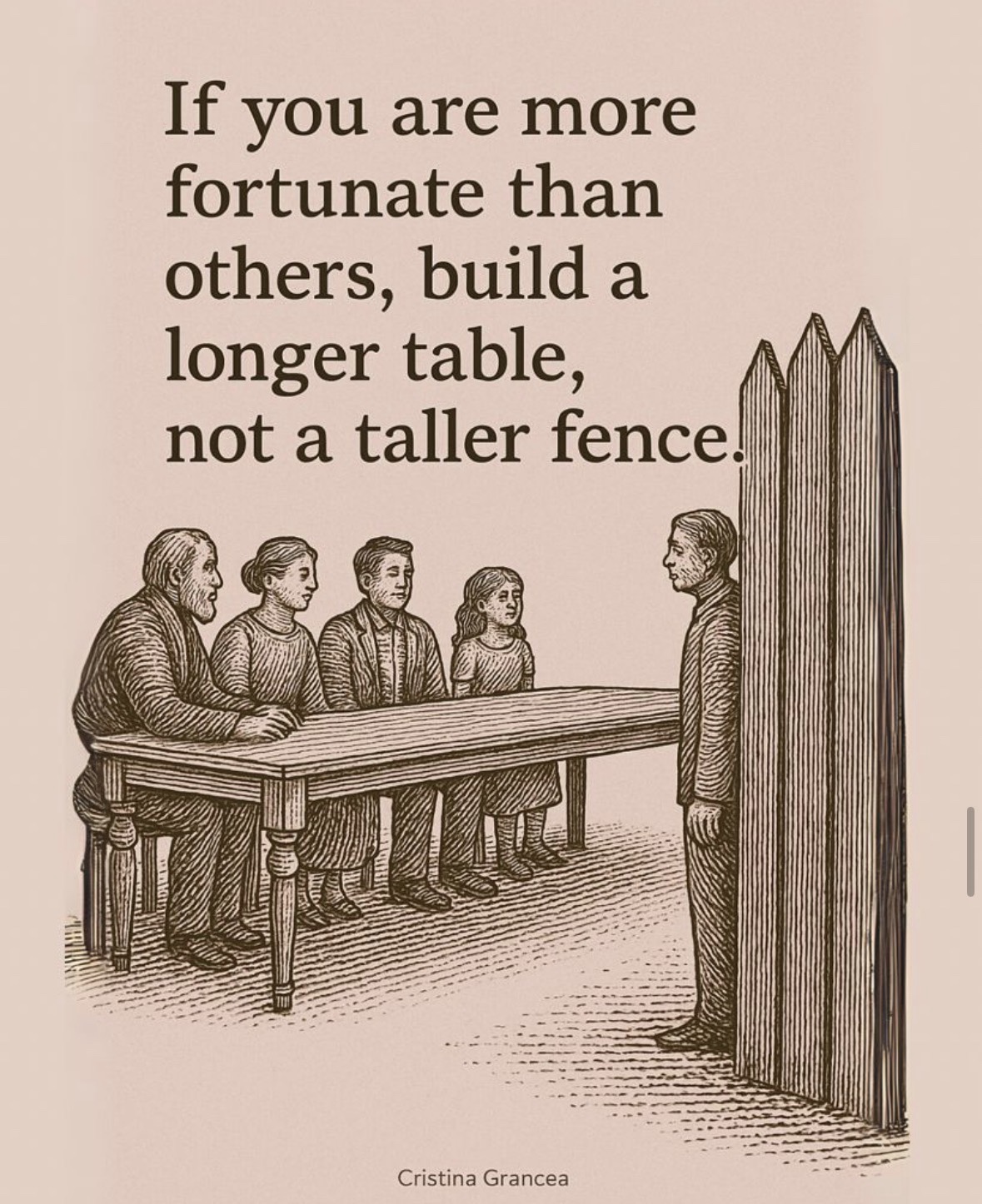
There’s a moment we all run into at some point—usually when life is going well—when we quietly wonder what we’re supposed to do with the things we’ve been given. Not the stuff we show off, not the pictures we post, but the quieter wins. The steady job. The calm season. The little pockets of abundance that arrive without fanfare.
And the truth is, those moments are where our character speaks the loudest.
It’s tempting to protect whatever we’ve earned. To pull it close. To tell ourselves we worked for it, fought for it, sacrificed for it. And maybe we did. But the world doesn’t reward us for stacking our blessings higher; it rewards us when we let those blessings spill over into other lives. Not in grand gestures or dramatic generosity—just in small openings where someone else gets a seat at something good.
A longer table doesn’t require wealth. It requires willingness. Willingness to notice the friend who’s been quiet lately. The coworker who pretends everything’s fine. The neighbor who keeps to themselves because they aren’t sure they belong. Willingness to pause our busy, curated, hyper-optimized lives and ask, “Hey… you alright? Want to join?”
We underestimate how much courage it takes for someone to accept help, and how much humility it takes to offer it. A table is an invitation, not an obligation. And it’s built slowly—one open door, one shared laugh, one unexpected kindness at a time.
The funny thing about giving is that it rarely leaves you with less. In fact, the more you stretch your table, the more you discover it was never meant to have fixed edges. You make room for people and somehow your heart expands to match it. You offer warmth and somehow your world grows warmer. You let someone else lean on you for a moment and somehow you walk away steadier.
We don’t need higher fences. We’re surrounded by enough of those already—boundaries built from fear, pride, insecurity, or just the exhaustion of trying to keep up. Fences keep things out, but they also trap us in. They shrink our sightlines until we forget what connection even looks like.
A longer table, though—now that’s a different story. It’s messy. It’s unpredictable. It requires grace. But it also fills the room with the kind of sound fences never make: conversation, laughter, understanding, belonging.
And when you look back, years from now, you won’t remember the times you stood guard over what you had. You’ll remember the nights when the chairs didn’t match, the plates were mismatched, the food was simple, but the company made the whole space feel richer.
Good fortune is temporary. Good impact lasts.
So if you find yourself in a season with a little more than you need—more time, more clarity, more patience, more peace—don’t build higher walls around it.
Just add another seat.
You’ll be surprised who shows up—and how much of yourself you discover in the process.
15 Company Culture Killers
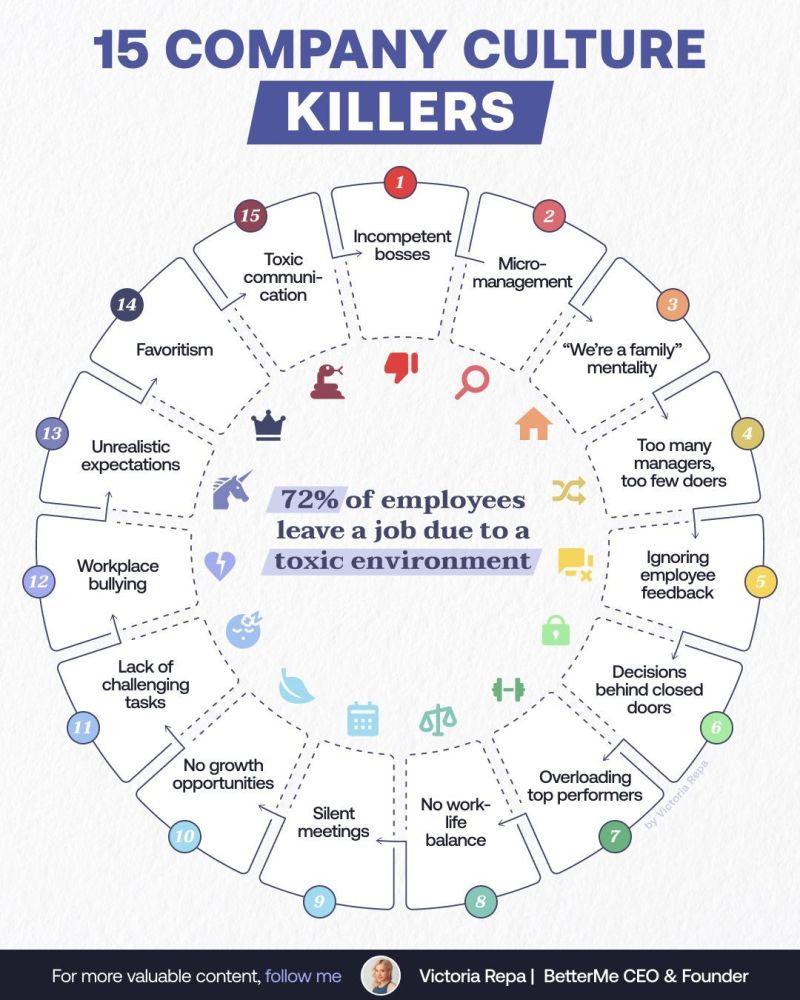
88% of people believe a strong company culture drives business success.
But one wrong move can destroy it.
Here are 15 silent culture killers that push your best people away:
1) Poor leadership.
2) Micromanagement.
3) “We’re a family” (used to avoid boundaries).
4) Too many bosses, not enough builders.
5) Ignoring employee feedback.
6) Decisions made in secret.
7) Overloading your top performers.
8) No respect for work-life balance.
9) Meetings where no one speaks.
10) No path for growth.
11) No challenges — just busywork.
12) Bullying, masked as “jokes”.
13) Unrealistic expectations.
14) Favoritism.
15) Toxic or unclear communication.
But spotting the problem is only Step 1.
If you want to build a high-performing team —
you need to protect your culture daily.
When you invest in people,
they invest back in the business.
Because when your culture is strong:
– Talent stays.
– People feel seen.
– Innovation grows.
– Performance increases.
Strong culture = strong results.
4 Meetings Every Leader Needs
But most leaders overlook the easiest place to start:
Their meetings.
We’ve all sat through the ones that feel:
❌ Too long
❌ Off-track
❌ Totally pointless
But when they’re done right?
Meetings become your fastest path to:
✅ Momentum
✅ Alignment
✅ Clarity
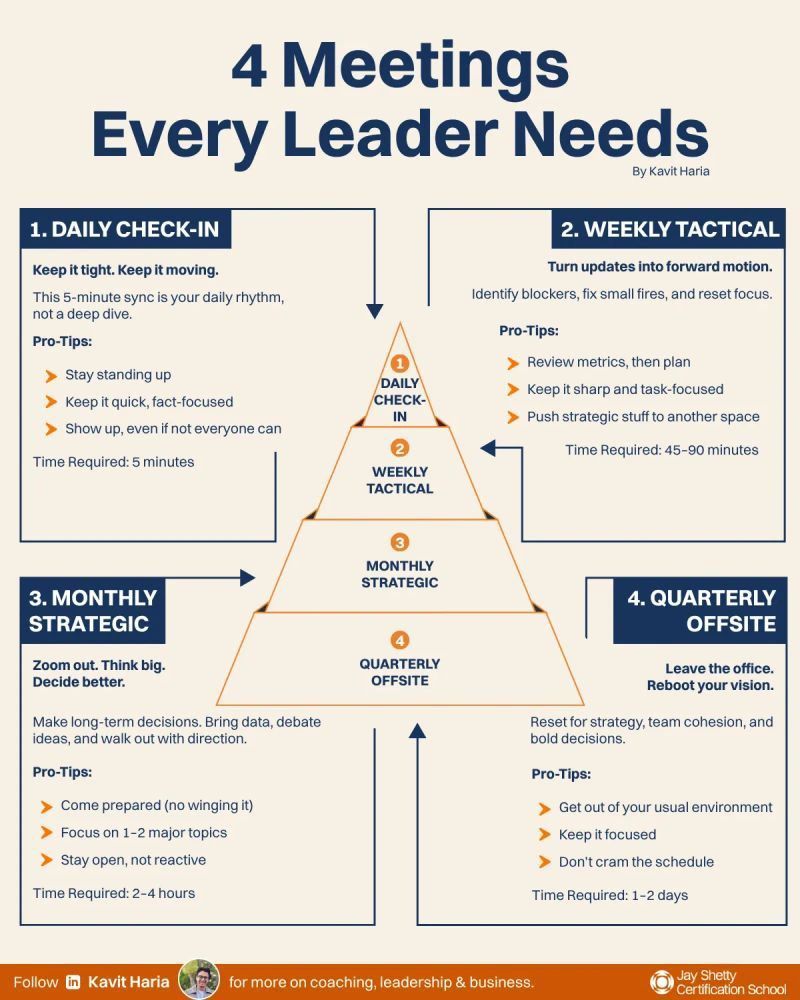
Here are 4 meetings that high-impact leaders
run on repeat:
1. Daily Check-In (5 minutes)
↳ Quick sync. Stand up. Share priorities.
↳ Skip the small talk, this is your rhythm reset.
↳ Run it even if a few folks miss it.
2. Weekly Tactical (45–90 minutes)
↳ Turn updates into traction.
↳ Name what’s stuck. Celebrate what moved.
↳ Start with metrics. Then solve, don’t spiral.
3. Monthly Strategic (2–4 hours)
↳ Zoom out. Think long-term.
↳ Ask better questions. Make smarter bets.
↳ Pick 1–2 topics. Reflect. Decide with clarity.
4. Quarterly Offsite (1–2 days)
↳ New space. Bigger vision.
↳ Get off Zoom. Clear the whiteboard.
↳ Focus on team health and bold direction.
Meetings aren’t a distraction from leadership.
They are leadership.
The truth?
You don’t need more meetings.
You need better ones.
Start with these 4.
Use them to coach, not just coordinate.
That’s how real leaders build momentum.

