

Most bosses focus only on results.
Great leaders focus on people first, and the results follow.
Use the six-step L.E.A.D.E.R. plan in the picture and you’ll do both.
Listen
→ When someone feels heard, the “alarm” in their brain quiets down.
Empower
→ Let people make real choices. their brain’s “reward light” turns on.
Align
→ Connect their personal goals to the team goal. Now they want to work hard.
Develop
→ Teach and coach them. their “learning center” stays active.
Engage
→ Ask everyone to share ideas. the brain loves feeling included.
Recognize
→ Give clear praise. People remember and repeat good actions.
Think of it like this:
safety → freedom → purpose → growth → belonging → praise.
Each step boosts the next one, so you can use the loop in any setting.
→ create one small habit to fix it
→ choose one step your group needs most—maybe listen or recognize.
→ every month, check the loop and level up another step.
Leaders who do this don’t just reach goals,
they build teams that reach goals again and again.
Which step will you improve this week,
and what tiny habit will help?
You Don’t Even See How Amazing You Are

Funny how we never see ourselves the way others do. You’re there, tangled up in your own thoughts, picking apart every move you’ve made. You’re replaying conversations, doubting your choices, wondering if you’ve done enough, if you are enough. Meanwhile, someone out there is watching you and thinking—how does this person manage it all so effortlessly?
They see the parts you forget to notice. The calm you keep when everything feels chaotic inside. The way you show up, even when you’d rather disappear. The way you somehow make things work, even when you’re not sure you can. To them, you look put-together, focused, strong. To you, it’s just another day of trying to hold it together.
We underestimate how inspiring our ordinary can be. Because from the inside, everything looks messy—half-finished plans, quiet fears, and the constant loop of “what ifs.” But from the outside? It looks like grace. It looks like strength. It looks like someone who’s figured it out.
You’ve probably done that too—looked at someone and thought, I wish I had their confidence, their energy, their clarity. And yet, that same person might be envying your calm, your persistence, your ability to keep going. We’re all busy comparing our behind-the-scenes to someone else’s highlight reel, forgetting that everyone’s just trying to make it through the same maze.
Maybe the trick is to pause the overthinking long enough to see what others already see in you. You don’t have to “do it all.” You just have to do you—the way only you can. The self-doubt won’t vanish overnight, but maybe it can coexist with self-recognition.
So the next time you catch yourself wondering if you’re doing enough, remember: someone out there is already inspired by what you’ve done. They’re looking at your story and finding courage for their own. You may not feel like you’re shining, but to someone else—you’re the light that’s keeping them going.
Emotional Intelligence
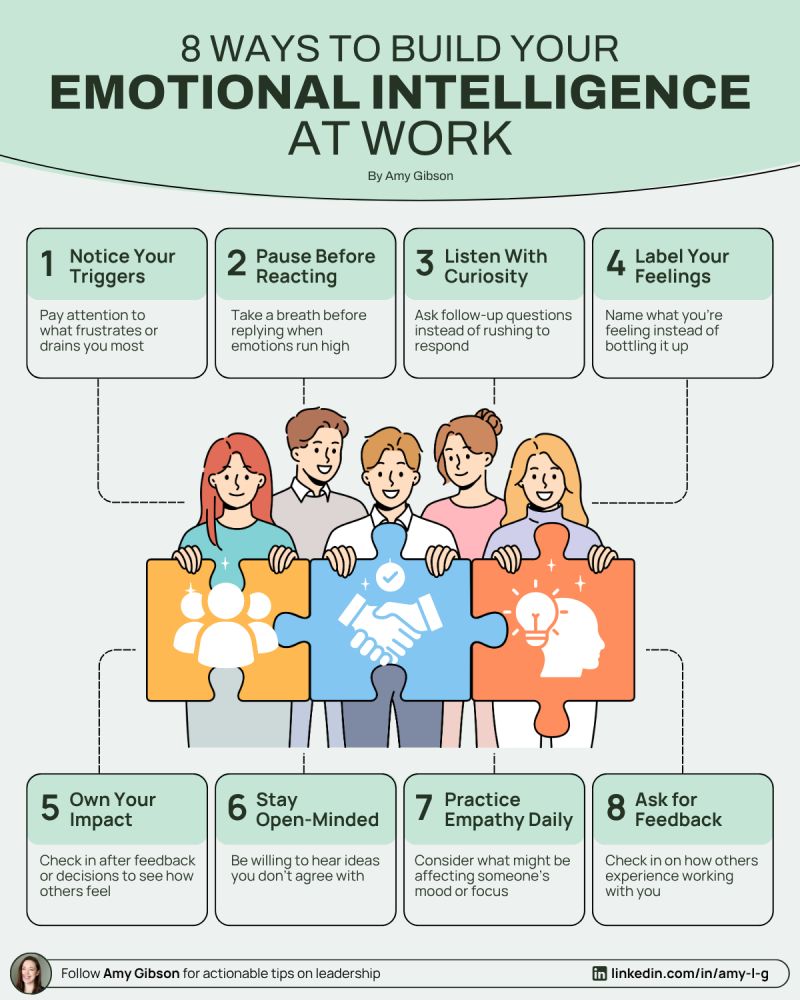
We talk a lot about vision, strategy, and execution.
But there’s a set of skills that often gets overlooked:
Emotional intelligence.
And yet, it’s been a common thread in every great
leader that I’ve had the privilege of working with.
Because in the middle of tight deadlines,
rising tension, and fast-moving decisions…
What tends to set trusted leaders apart is how they handle people.
(Yes, including themselves).
Here are 8 small habits that can help build
emotional intelligence at work:
1. Notice your triggers
↳ What consistently frustrates or drains you?
That’s where your self-awareness begins.
2. Pause before reacting
↳ Even a brief pause can shift you from
reactive to intentional.
3. Listen with curiosity
↳ Instead of planning your reply, ask one
more question.
4. Label what you feel
↳ Naming emotions helps you manage them
(and teaches your team to do the same).
5. Own your impact
↳ Decisions affect people. Check in.
Ask how they’re doing.
6. Stay open-minded
↳ Especially when you don’t agree.
That’s where growth happens.
7. Practice empathy daily
↳ Assume there’s more going on beneath
the surface and lead accordingly.
8. Ask for feedback
↳ Not just on results but on how you show up.
Take your time:
Emotional intelligence is a muscle.
And like any muscle, you build it through reps.
By listening. Reflecting. Pausing.
Every interaction is a chance to stretch it.
Every moment is a rep.
So keep showing up.
Growth

Let’s kill the myth:
Growth isn’t a lucky break.
It’s not viral.
It’s not magic.
And it’s definitely not just “hustle harder.”
The real reason most businesses stall?
👉 They try to scale chaos instead of building clarity.
👉 They chase volume before validating value.
👉 They skip the strategy—and then wonder why nothing sticks.
Here’s what sustainable, intentional growth actually looks like:
G.R.O.W.T.H. – The Strategy Behind Sustainable Scale
G → Get Clear on Value
▸If your team can’t explain your value in 10 words, your customers won’t either.
▸Clarity isn’t optional—it’s the engine of momentum.
R → Refine the Model
▸You don’t scale what’s broken.
▸You evolve your business model until it naturally fits the way people buy.
O → Optimize for Learnings
▸Growth isn’t about winning every test.
▸It’s about learning faster than your competition.
W → Win Small First
▸Don’t chase mass appeal.
▸Nail one use case. One market. One customer pain. Then scale that.
T → Test and Tweak
▸Real strategy lives in iteration.
▸The best teams treat every outcome—win or fail—as feedback.
H → Hold the Vision
▸Scaling is hard.
▸But the mission doesn’t change. Stay anchored.
▸Your vision is the one thing that should outlast every pivot.
You don’t need to chase every trend.
You need a repeatable system that turns signals into strategy.
What part of G.R.O.W.T.H. hits home for you right now?
Problem Solving Frameworks
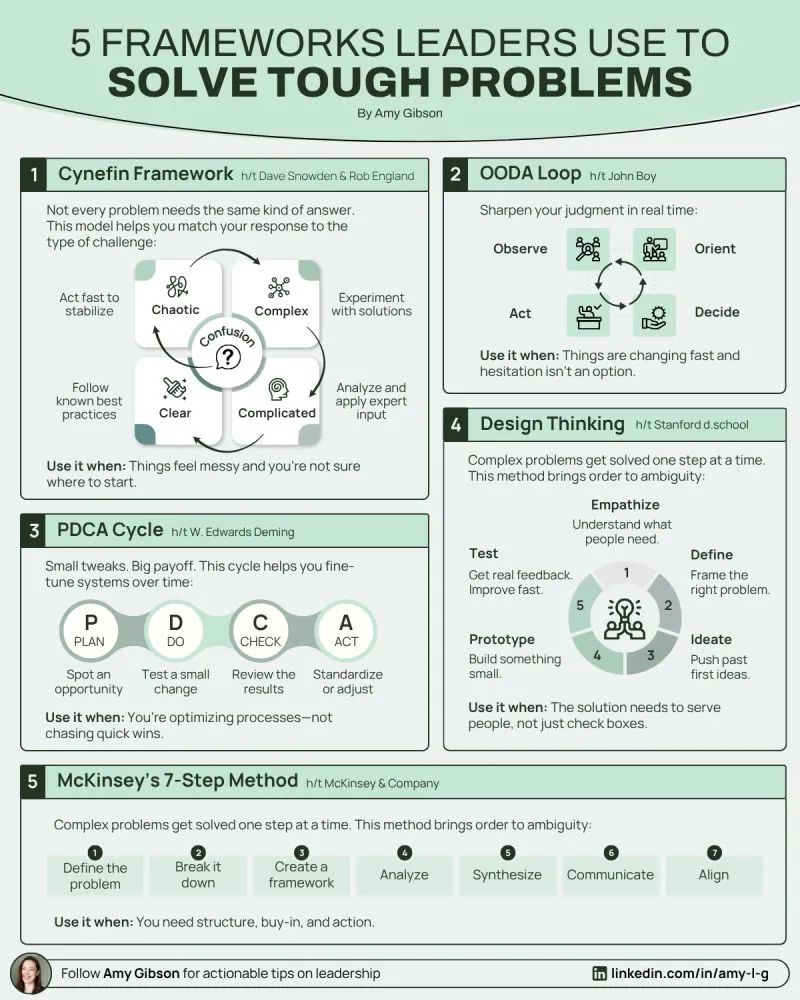
Structured problem-solving can boost performance
by 40%. (And cuts costs by up to 25%.)
But that’s not the only reason it matters.
It also helps you breathe when everything feels messy.
And gives your team confidence when pressure is high.
It turns
❌ “Where do we even begin?”
Into:
✅ “Here’s our next step.”
These 5 frameworks aren’t just tools, they’re anchors.
Use them to reframe, refocus, and respond with clarity:
1. Cynefin
↳ Not all problems are created equal.
↳ This model helps you name what kind you’re facing.
So, you can respond with clarity, not guesswork.
2. OODA Loop
↳ Fast-changing situation?
↳ This loop helps you take thoughtful action without
freezing or rushing in blindly.
3. PDCA
↳ Simple, steady improvement.
↳ Best for fixing what’s working okay, but could
work better.
4. Design Thinking
↳ Lead with empathy.
↳ This one starts with people, not processes.
And it shows in the solutions.
5. McKinsey 7-Step
↳ Feeling overwhelmed by complexity?
↳ This gives you a grounded way to move through it,
one clear step at a time.
These frameworks don’t promise perfection.
But they do bring something better:
✅ Direction.
✅ Progress.
✅ Confidence.
Which one has helped you most recently?
Or which one do you want to learn next?
When the World Can Wait
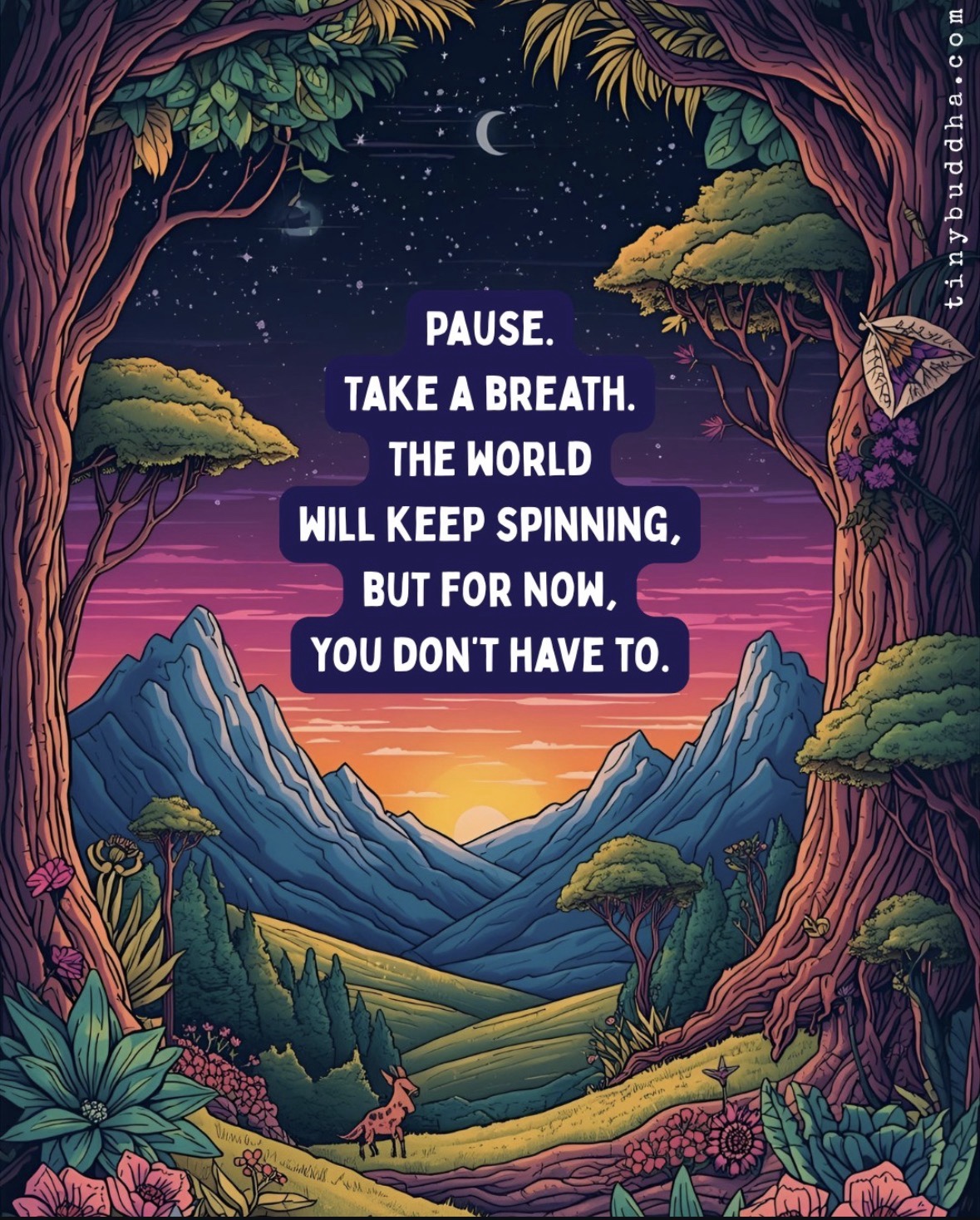
Some days, it feels like the world’s on fast-forward. Emails, meetings, notifications, messages—everything demands a response now. You wake up already behind, spend the day catching up, and go to bed thinking about tomorrow’s to-do list. It’s a loop that never seems to end. And in that chaos, one simple truth gets buried: it’s okay to stop.
You don’t have to keep spinning just because everything else does. The world won’t fall apart if you take a breath. Your worth isn’t measured by how much you produce or how quickly you respond. Sometimes the bravest thing you can do is pause—no agenda, no guilt, no pretending you’re fine when you’re running on fumes.
There’s a strange kind of power in stillness. When you slow down long enough, you start hearing things that constant motion drowns out—your own thoughts, your needs, maybe even the quiet reminders of what really matters. Rest isn’t weakness; it’s a reset. It’s how you find your balance again before the next storm hits.
You don’t have to earn a break. You don’t have to justify needing one. You’re allowed to stop mid-spin, close your eyes, and just breathe. Because the truth is, the world will keep turning whether you’re rushing or resting—but you? You deserve moments that are yours alone, where nothing and no one needs anything from you.
So pause. Take a breath. Let the noise fade.
The world can wait a minute. You’ve earned this one.
Authentic Leadership
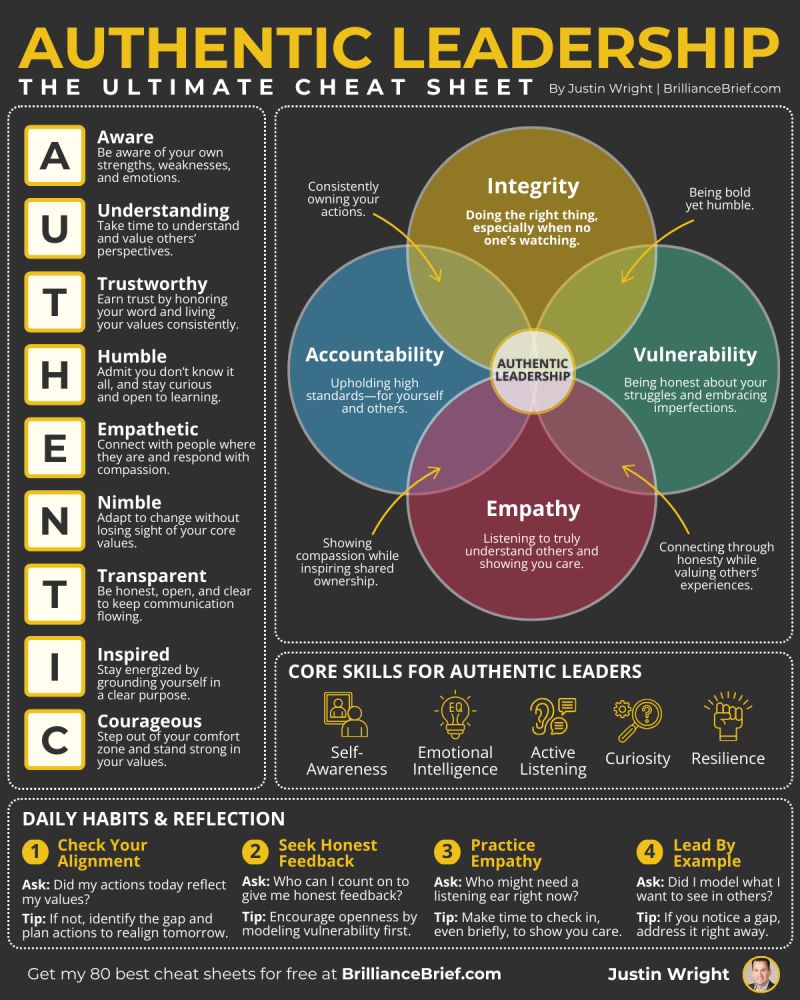
Less than 25% of leaders show authenticity consistently.
A leader’s style can be the difference between:
An employee quitting their dream job,
or growing into their true potential.
Most leaders obsess over what they accomplish.
Few pay attention to how they show up.
In my 24 years in business, I’ve learned:
True leadership isn’t about perfection.
It’s all about connection.
Own your vulnerability.
Admit when you’re wrong.
Ask for help when you need it.
It’s okay to be human.
Think about the best leader you ever had.
I bet they made you feel:
➟ Heard
➟ Valued
➟ Capable
That’s the power of authentic leadership.
It’s not about having all the answers.
It’s about being real. Building trust. Inspiring growth.
Maya Angelou was right:
“People will forget what you said,
they’ll forget what you did,
but they’ll never forget
how you made them feel.”
Be the leader who brings out the best in others.
Not by demanding perfection,
but by showing what’s possible through authenticity.
The best part?
You already have everything you need.
Just be you.
What Not to Say in High-Pressure Moments

Stress exposes real leadership.
It’s not about how you act when things are easy,
But how you show up when the pressure hits.
This guide will help you get it right:
1) Don’t say: “Calm down, it’s not that serious”
↳Because: It downplays emotions and blocks real connection
↳Instead try: “This seems intense. Want to walk through it together?”
2) Don’t say: “This isn’t acceptable behavior”
↳Because: It shames without offering support or solutions
↳Instead try: “Let’s talk about what happened and how we can improve it”
3) Don’t say: “Never mind, I’ll handle it myself”
↳Because: It takes away learning opportunities and builds resentment
↳Instead try: “Let’s go through it now so you can lead it next time”
4) Don’t say: “Why is this still incomplete?”
↳Because: It triggers defensiveness instead of encouraging progress
↳Instead try: “How’s it coming along? Is there anything getting in your way?”
5) Don’t say: “I don’t have time for this right now”
↳Because: It signals disinterest and makes others feel dismissed
↳Instead try: “Can we find time to revisit this when I can give it full focus?”
6) Don’t say: “You should know how to do this already”
↳Because: It discourages asking for help and creates shame
↳Instead try: “Let’s walk through this again to make sure it’s clear”
7) Don’t say: “I need this right away”
↳Because: It creates urgency without clarity or planning
↳Instead try: “Can you get this done by X? Let me know early if you run into any blockers”
8) Don’t say: “That’s just how we do it”
↳Because: It shuts down creative thinking and innovation
↳Instead try: “What ideas do you have for improving this?”
9) Don’t say: “Make sure this is perfect”
↳Because: It adds pressure and discourages momentum
↳Instead try: “Let’s aim for excellence, not perfection”
10) Don’t say: “You need to always be reachable”
↳Because: It creates burnout and blurred boundaries
↳Instead try: “Let’s align on when and how we’ll communicate during this stretch”
11) Don’t say: “Your feelings don’t matter right now”
↳Because: It dehumanizes the team and erodes morale
↳Instead try: “I know this is a big ask. What support would help you push through?”
What you say matters.
Don’t let stress make it be something you’ll regret.
Take a breath.
And respond like a leader.
It’s worth the effort.
Which of these do you think is most destructive?
Your title doesn’t make you a success
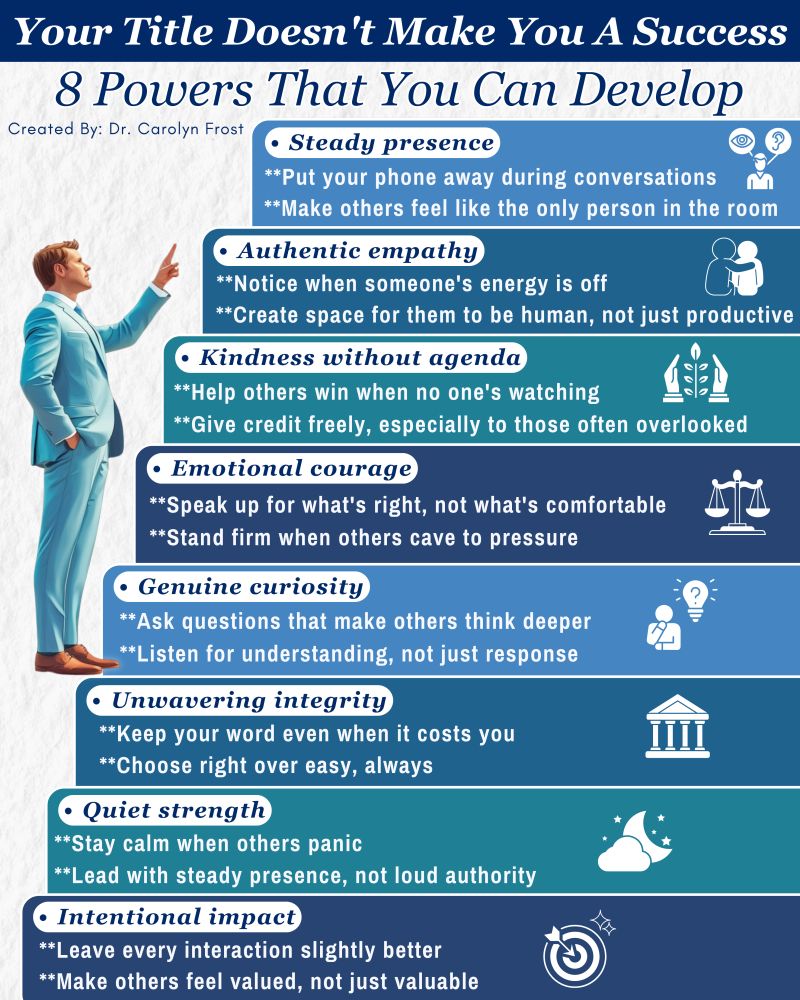
The way you choose to treat others does!
True success isn’t granted by position.
It’s earned through presence.
These 8 powers (that you can develop) transform ordinary careers into extraordinary legacies 👇🏼
1) Steady Presence
↳ Take three breaths before responding to tension
↳ Put phones away during all conversations
↳ Stay calm when others are reactive
2) Authentic Empathy
↳ Ask “What’s challenging about this?” without fixing
↳ Remember personal details shared in passing
↳ Validate feelings before offering solutions
3) Kindness Without Agenda
↳ Compliment work that can’t be repaid
↳ Recognize those who are often overlooked
↳ Welcome new people without being asked
4) Emotional Courage
↳ Name your feelings: “I’m concerned and curious”
↳ Be first to admit when you’re wrong
↳ Address tensions others avoid
5) Genuine Curiosity
↳ Ask “What am I missing?” before deciding
↳ Replace “won’t work” with “tell me more”
↳ Listen to understand, not to respond
6) Unwavering Integrity
↳ Speak of absent people as if they’re present
↳ Keep promises without reminders
↳ Acknowledge mistakes immediately
7) Quiet Strength
↳ Pause after others finish speaking
↳ Lower your voice for important points
↳ Say no without over-explaining
8) Intentional Impact
↳ Set clear intentions before each meeting
↳ Ask “How did that land?” after feedback
↳ Give public recognition where it’s due
Your power doesn’t come from your position.
It comes from your presence.
Which of these powers will you strengthen today?
Smarter People Are a Gift, Not a Competition

It takes a certain kind of maturity to be around brilliant people and not feel small. To listen without rushing to prove you belong. To learn without needing to show you already know. Somewhere along the way, many of us were taught that being the smartest in the room meant you’d “made it.” But that’s a lonely kind of success—because if you’re always the smartest person in the room, it probably means you’ve stopped growing.
Having access to people who think faster, see differently, or know more isn’t a threat—it’s one of the biggest blessings you can have. Their very presence challenges your limits. They sharpen your perspective, humble your ego, and open doors to things you didn’t even know existed. It’s like running next to someone who’s a little faster than you; you don’t resent them, you just find yourself running better.
The trick is to switch from comparison to curiosity. When you stop asking, “How do I measure up?” and start asking, “What can I learn from them?”—everything changes. Your conversations get richer. Your work improves. You start to operate with a quiet confidence that doesn’t need to compete. Because here’s the truth: confidence isn’t about believing you’re better than others—it’s knowing you don’t have to be.
The smartest people I’ve met don’t intimidate me anymore. They inspire me. They remind me that intelligence isn’t a trophy, it’s a tool—and tools get sharper when shared. So when you find yourself surrounded by people who are more experienced, more creative, or more insightful than you, don’t pull back. Lean in. Ask questions. Listen deeply.
You’ll realize that being in that circle doesn’t make you less capable—it means you’re exactly where you’re supposed to be. Growth doesn’t happen in comfort zones. It happens in the company of people who stretch you, who make you rethink, and who remind you that there’s always more to learn.
So next time you walk into a room full of brilliance, don’t let your ego whisper, “You don’t belong here.” Let your gratitude say, “What a blessing that I do.”

