
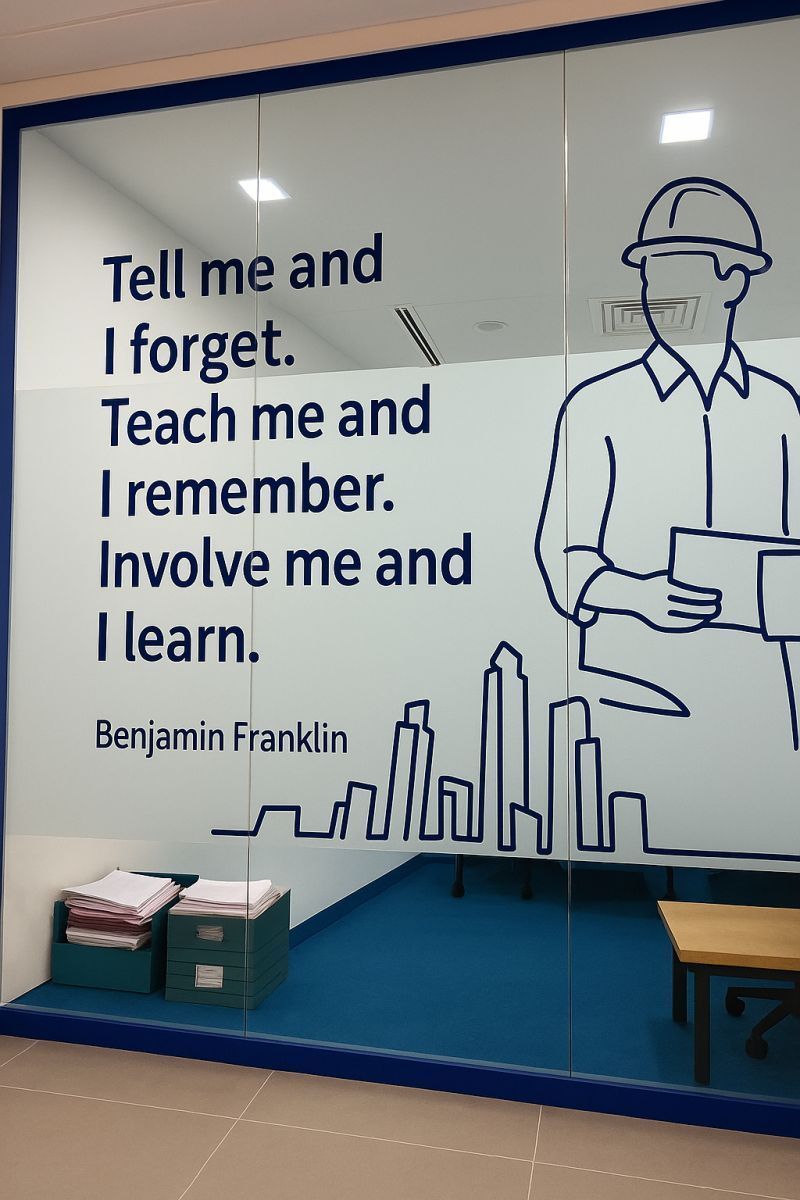
Advice hits the ears;
Practice hits the hippocampus.
Only active recall forges the synapses we call “long-term change.”
Telling a team what to do feels efficient,
until everyone forgets by Monday.
If you want ideas to stick, people must use them, not just hear them.
Here’s the neural rule:
Active Recall = Stronger Synapses.
Passive listening? The memory fades in hours.
So rather than lecture, weave in quick teach-back drills.
These exercises force the brain to light up the right circuits.
Sketch & Fill
• Hand the marker to the team.
• They draw the workflow from memory.
• You add missing steps.
Why it works
Drawing + recall = motor cortex + memory circuits firing together.
Role‑Swap Recap
• Pause halfway.
• Pick someone to explain the last step to the room in their own words.
• Correct gently, then move on.
Why it works
Speaking out loud forces retrieval and shows gaps instantly.
24‑Hour Demo Ping
• After the meeting, ask for a 2‑minute screen‑record by tomorrow.
• They run the new method on live data and narrate the choices they make.
Why it works
Spaced repetition within a day locks new pathways before they decay.
When people can teach you the playbook, you know they own it.
That’s when your leadership becomes lasting; neurons, habits, and culture all align
The One Who Survived

We talk a lot about growth, success, and becoming the best version of ourselves. But somewhere in that pursuit, we forget the version of us that barely made it through. The one who held it together when everything was falling apart. The one who got out of bed when it felt impossible. The one who smiled in public but cried alone. That version of you—yes, the one who barely survived—is just as worthy as the one who will thrive.
Because survival isn’t weakness. It’s proof. Proof that you showed up for your own life, even when it hurt. Proof that your heart didn’t give up, even when your mind wanted to. The world often celebrates thriving—new beginnings, success stories, transformation arcs—but thriving doesn’t happen in isolation. It grows out of survival. Every thriving version of you stands on the shoulders of the one who refused to quit.
Maybe you’re not thriving right now. Maybe you’re just holding on. That’s okay. You don’t have to constantly be evolving or glowing or achieving to be valuable. You are enough, even in the stillness. You are enough, even when all you can do is survive the day. The version of you that’s tired, uncertain, and messy deserves the same love and respect as the one that’s confident and accomplished.
And when you finally do thrive—and you will—don’t forget to thank the one who crawled so you could run. The one who stayed when everything screamed “leave.” The one who didn’t have it all figured out but kept going anyway. That version of you deserves a standing ovation.
Because thriving is beautiful. But surviving? That’s sacred.
Building Blocks of Leadership

We often speak about “skills” or “competencies” as if they’re interchangeable. But they’re not, and treating them as such leads to vague goals and shallow development plans.
This simple model breaks it down:
↳ Knowledge is what someone knows.
↳ Skills are what someone can do.
↳ Abilities are what someone is naturally equipped to do.
↳ Competencies combine all three — plus behaviors, attitudes, and context.
If you want to build true leadership capacity, focus on competencies.
Because great leadership is rarely about just knowledge or skill. It’s about applying them with judgment, in pressure-filled, people-rich environments.
That’s why our new Big 5 of Strategy coaching certification program focuses not on generic strengths or traits, but on strategic competencies.
The ones leaders actually need to grasp, shape, move, deliver and adapt.
We’ve built a full self assessment and development process around them.
Now we’re training the first 100 Certified Big 5 of Strategy Coaches.
You Don’t Need to Win You Need to Grow

Mastering Your Ego Is the First Step to Mastering Life
7 Essential Reminders for Real, Rooted Growth
True success isn’t just about what you achieve.
It’s about who you become on the way there.
The journey.
The lessons.
The character you build.
That’s what truly lasts.
If you want peace in your relationships, clarity in your purpose, and momentum in your growth; you’ll have to face your ego before it runs the show.
Here’s how to keep your soul grounded while your life grows forward:
1️⃣ Stop Taking Everything Personally
Not everything is about you.
Let the small stuff pass.
Protect your peace over your pride.
2️⃣ Drop the Superiority Complex
You’re not here to outshine others.
You’re here to outgrow the outdated version of you.
3️⃣ Let Go of the Need to Control Everything
You can’t micromanage life.
Flow with the process.
Trust more. Stress less.
4️⃣ Know When Enough Is Enough
The ego says, “More.”
Wisdom says, “You’re good.”
Pause. Breathe. Rest.
5️⃣ Winning Isn’t the Goal Growing Is
Losing doesn’t mean failure.
It means you’re learning.
And teachability is power.
6️⃣ You’re Not Your Resume
Your job title isn’t your soul.
What truly counts?
Integrity.
Kindness.
How you made people feel.
7️⃣ You Don’t Always Have to Be Right
Some debates cost peace.
Choose connection over correction.
Being understood isn’t always worth being divided.
Bonus Practices That Ground You
✅ Lead with empathy; see hearts, not just words.
✅ Ask for feedback; not for approval, but for truth.
✅ Stay present; ego reacts; presence responds.
Mastering your ego doesn’t dim your confidence; it sharpens your self-awareness.
And that’s where real success begins.
What’s one ego-check you’re currently learning?
10 habits that quietly crush our teams

These 10 habits are quietly crushing our teams:
They can handle hard work.
They can’t handle:
🚩 Unnecessary work
🚩 Meaningless work
🚩 Inefficient work
The truth is, we mean well.
But, these virtues put our teams in a vice.
Do any of these sound familiar?
1/ Always Available Trap
↳ Your 11 PM replies create midnight anxiety
↳ When you never unplug, neither will they
2/ I’ll Just Handle It Reflex
↳ Quick fixes create permanent dependencies
↳ Build problem-solvers, not permission-seekers
3/ Hustle Harder Signal
↳ Your overtime becomes their default
↳ Excellence needs recovery
4/ Perfect Over Done Mindset
↳ One more iteration isn’t always the answer
↳ Done beats perfect every quarter
5/ Problem Solver Identity
↳ Being the hero makes your team helpless
↳ Guide discovery, don’t gift answers
6/ Crisis Mode Default
↳ Constant urgency kills clear thinking
↳ Always reacting means rarely building
7/ Positive Vibes Only Shield
↳ Forced smiles hide real struggles
↳ Growth lives in uncomfortable conversations
8/ Just One More Thing Habit
↳ Small requests stack into silent stress
↳ Respect boundaries to keep talent
9/ Meeting Marathon Culture
↳ Calendar chaos crushes creativity
↳ Make space to attack bottlenecks
10/ Instant Response Expectation
↳ Always-on kills deep work
↳ Give space for fresh thinking
Your leadership habits shape your culture.
Make them intentional, not accidental.
Your team isn’t tired from the work.
They’re tired of how you lead it.
The Only Thing Worth Keeping

Life has a strange way of humbling us. You arrive with nothing, a blank slate wrapped in warmth and wonder. Then the race begins — school, work, money, recognition, security, success. We run faster, climb higher, collect more. And yet, somewhere in the noise of chasing everything, we forget that we’ll still leave with nothing. Every possession, every title, every applause fades into dust. The only thing that lingers is what your heart learned along the way.
It’s easy to measure life by what fills your hands — the paycheck, the car, the house, the milestones. They feel solid, tangible, like proof that we’ve done something right. But if you look closely, those are just props on a temporary stage. What matters are the invisible things: the kindness you showed, the forgiveness you gave, the moments you sat still and felt grateful. Those can’t be taken away because they don’t live in your hands — they live in your heart.
At some point, everyone realizes that success without peace feels empty. You can have everything you ever wanted and still feel like something’s missing. That missing piece isn’t another achievement or purchase — it’s meaning. It’s connection. It’s the quiet comfort of knowing you loved well and were loved in return.
So as you chase the things the world tells you to, don’t lose sight of the things that matter when the chase ends. Let your hands work hard, but let your heart stay soft. Collect memories, not just medals. Choose moments over materials. Because when it’s time to leave, your hands will be empty again — but if you’ve lived right, your heart will be full.
Focus on the WHO

Most leaders focus on the what and the how.
What needs to be done. How to get there.
But the best leaders focus on the who first.
Who are the people on their team?
What do they need to succeed?
How do they feel and what drives them?
That’s where real leadership lives.
The most impactful leaders I know all share
8 emotional intelligence traits:
✅ Sensing emotions
↳ They notice what’s not being said
✅ Genuine empathy
↳ They truly understand their team’s perspective
✅ Leading by example
↳ They model the behavior they want to see
✅ Authentic connection
↳ They build relationships that matter
✅ Deep listening
↳ They make people feel heard and valued
✅ Demonstrated commitment
↳ They show up when it counts
✅ Investment in growth
↳ They help others reach their potential
✅ Active involvement
↳ They work with their team, not above them
When you lead this way:
People don’t just complete tasks.
They go above and beyond.
They don’t just show up.
They show up as their best selves.
The leaders people remember and follow
aren’t the ones with all the answers.
They’re the ones who cared enough to understand
the people asking the questions.
They saw the who, first.
And understood it.
The Skill-Will Matrix
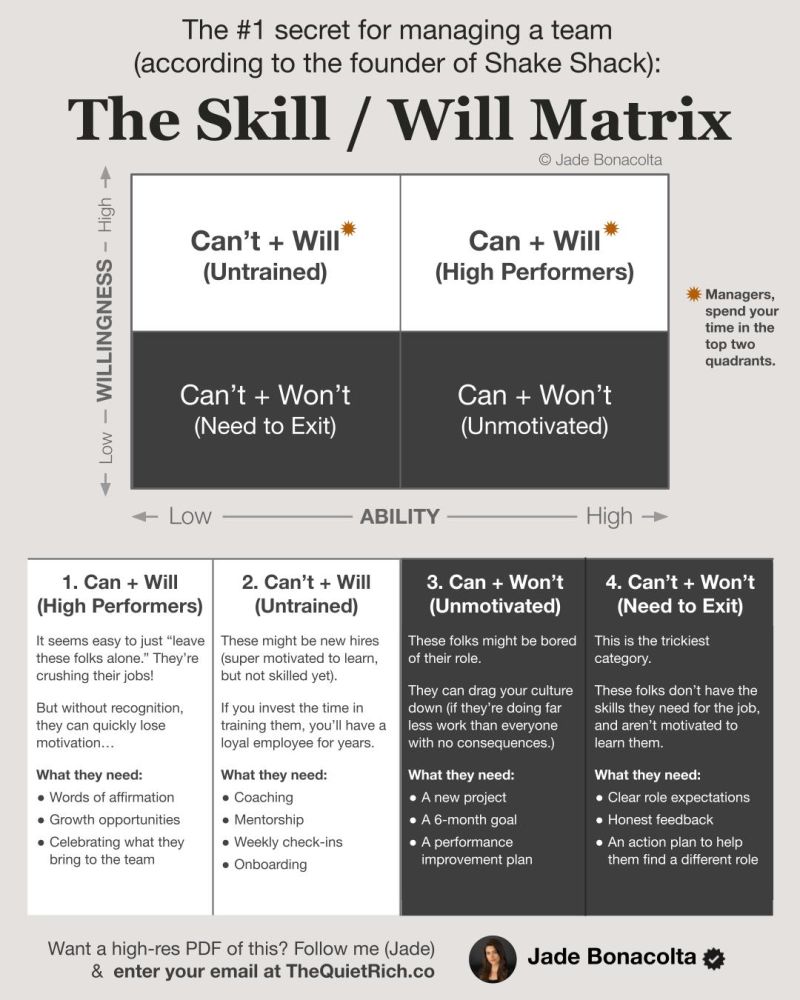
Heard of Danny Meyer?
He’s a legendary New York restauranteur known for
Shake Shack, Union Square Cafe, Gramercy Tavern, Manhatta, etc.
On the Tim Ferriss Show, he talked about this simple
(but brutally-effective) 2×2 matrix.
It’s the best framework for people managers to
decide which team members need most of their time.
He scores each team member on two things:
Willingness (motivation)
+ Ability (skill).
———
So, where on the chart does he spend the most time
as a leader?
Many people would say the bottom two quadrants
↳ the folks who need motivation or need to move on.
Danny disagrees.
He spends the MOST time with the top two quadrants
↳ the high performers and those who are new to the team.
Why? Because they are the key to long-term success.
It’s MUCH easier to teach a skill than to teach motivation.
———
And guess what…
Danny doesn’t just keep this matrix in his own head.
He put it on the mirror of his employees’ locker room.
He’s 100% transparent in how he manages his team.
So every time they get ready for work, they can decide
where they are now (and where they want to be). 🙌
How to handle stress at work
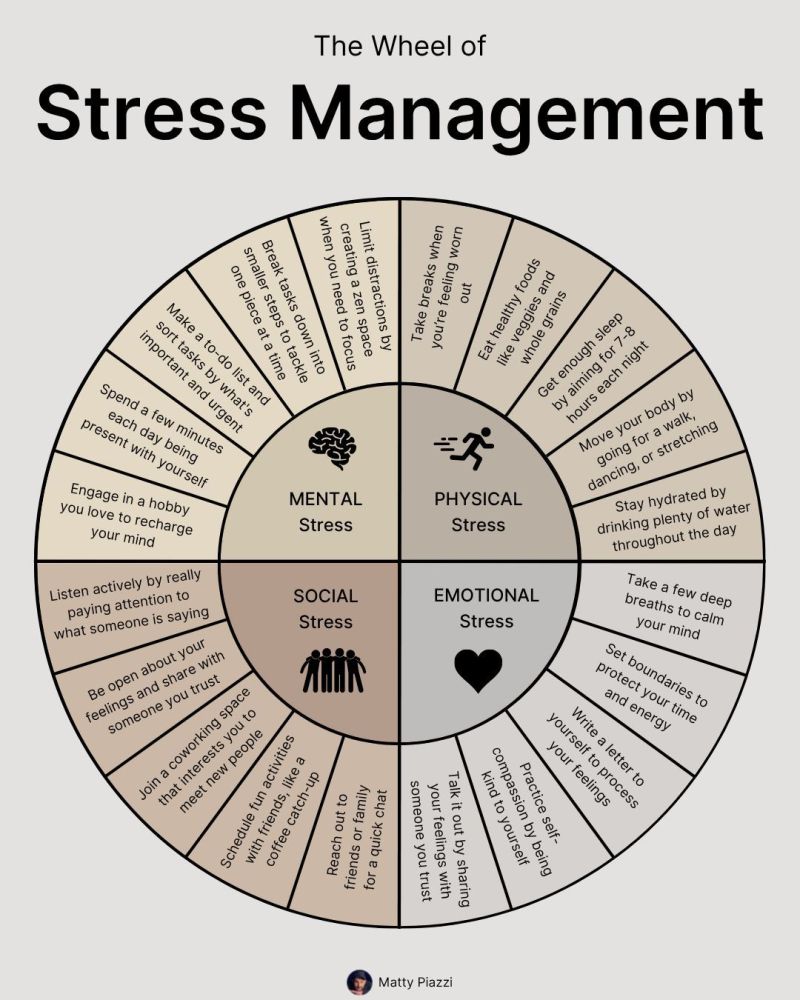
How to handle stress at work
Here’s a special tool that could help you:
→ Writing a letter to yourself (or to others)
I’m not joking :)
We’re gonna write a letter to Jasmine…
Let’s see how to give it a try!
1. First, grab a notebook and a pen.
Make sure to find a quiet spot without distractions.
2. Now, think about who you wanna write to.
This could be:
→ Yourself
→ Others — like a coworker, friend, or mentor
Let’s say you wanna write a letter to Jasmine, your mentor.
By the way, Jasmine is my favorite name.
Did you know that? :)
3. Alright, now it’s time to start writing.
Start your letter with a greeting, like:
“Dear Jasmine, I hope this letter finds you well.
I’m reaching out because…
I’ve been feeling overwhelmed with…”
4. Now, write about what’s bothering you.
And be honest!
Use these questions to help you write:
→ What specific situation is causing me stress?
→ How does it make me feel? (anxious, frustrated…)
→ Why do I think this situation is affecting me?
5. Okay, you’ve just expressed your feelings.
Now, think about how you can address the situation and write it down.
Keep writing like you’re talking to Jasmine.
So, write something like:
→ “You know what, Jasmine, I think I should…”
Get help from these 3 questions:
→ Are there any resources I can use?
→ What support do I need from others?
→ What steps can I take to feel better or manage the stress?
6. Alright, it’s time to say goodbye to Jasmine.
Wrap up your letter on a positive note.
Remind yourself that it’s okay to feel stressed.
For example, you can say:
“Yes Jasmine, I know it’s normal to feel this way.
And honestly, I’m proud of myself for recognizing my stress.
Here’s my promise:
I’ll take things one step at a time and seek help when I need it!”
7. Great job!
Now, take a moment to read your letter.
Reflect on what you’ve written to Jasmine.
This can help you gain perspective on your feelings.
Plus, you’ll have more clarity about your next steps.
Don’t Hang It in Your Gallery

You can’t stop people from painting their version of you. Some will sketch from memory, others from imagination, and a few will draw from rumor. Everyone, it seems, has a canvas with your name on it. They’ll paint you in colors that match their mood, not your truth — and when they’re done, they’ll hold it up proudly as if it’s the real you.
It’s human nature. People interpret, assume, and project. Sometimes they see your confidence and call it arrogance. Your silence becomes rudeness. Your kindness, weakness. Your boundaries, attitude. They paint what fits their frame, not yours.
But here’s the thing: you don’t have to hang their painting in your gallery. You don’t have to look at it, defend it, or fix it. You don’t even have to acknowledge it. Not every opinion deserves wall space in your mind.
Your gallery — the inner space where you store your peace, your self-worth, your story — should be curated carefully. Let it hold only the art that reflects truth, growth, and grace. Keep the walls clean of cheap interpretations. Protect that space fiercely.
Because when you stop worrying about how others see you, you start living how you see yourself. You begin to notice the quiet beauty of your own strokes — the resilience, the kindness, the lessons learned in shades of light and shadow.
So let them paint. Let them post. Let them whisper. That’s their art, not yours. You’re under no obligation to buy the portrait they made of you. Smile, move on, and keep working on your masterpiece.
After all, the only gallery that truly matters is the one where you decide what deserves to stay.

