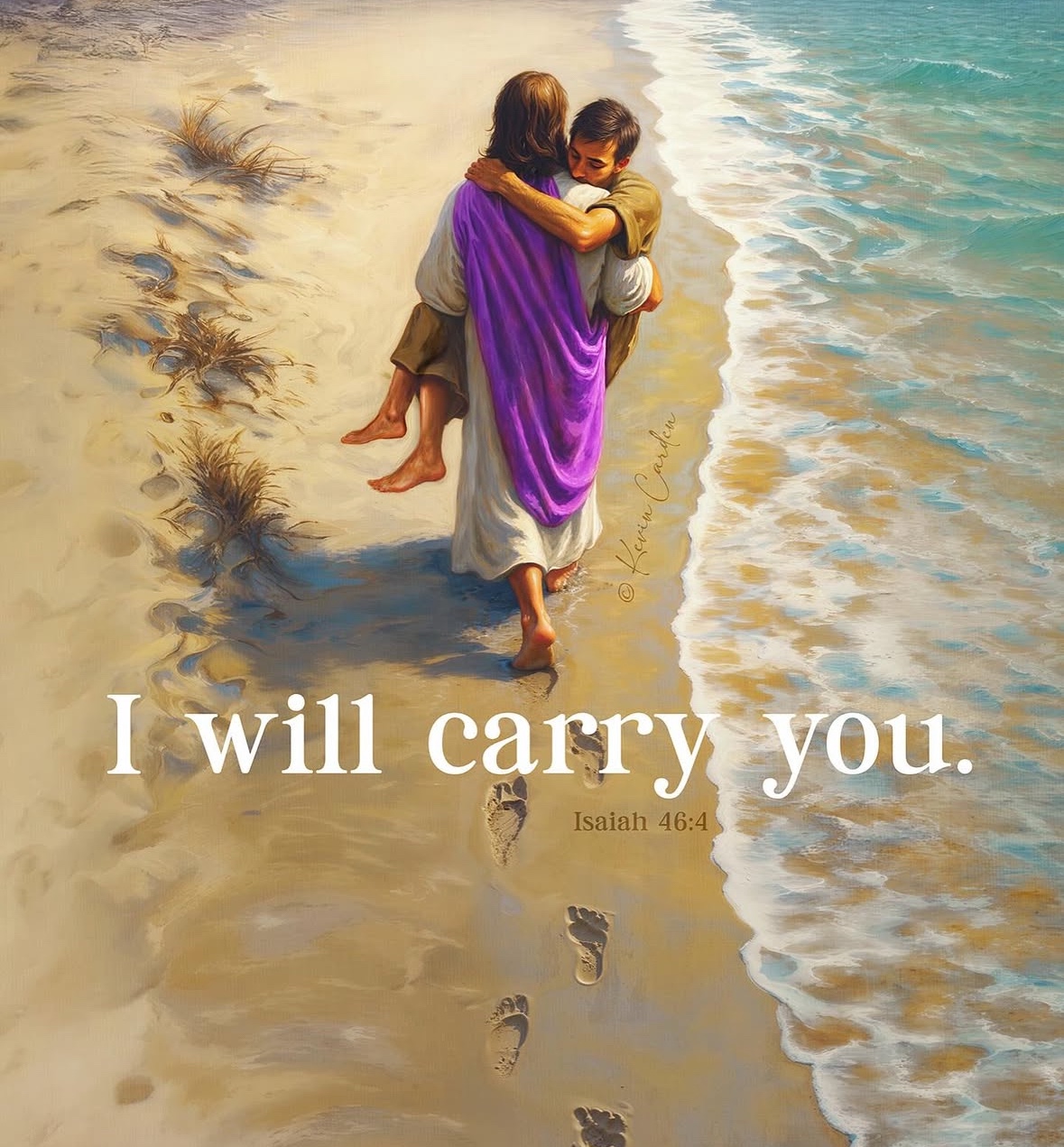
When Your Strength Runs Out, I Will Carry You

“Even to your old age and gray hairs I am he, I am he who will sustain you. I have made you and I will carry you; I will sustain you and I will rescue you.”

There’s a quiet kind of power in those four words: “I will carry you.”

Not “I might,” not “if you deserve it,” not “when it’s convenient.”

Just I will.

This verse from Isaiah isn’t just a poetic promise—it’s a deeply personal vow from a God who sees the full timeline of our lives, from the cries of our first breath to the sighs of our last.

We live in a world that praises independence, hustle, and strength. We’re told to carry our own weight, power through the pain, and never show weakness. But here in Isaiah, God offers us something wildly countercultural: the freedom to rest in Him. The permission to admit, “I can’t do this alone.”

And the best part? He’s already ahead of us, saying, “You don’t have to.”

Carried Through Chaos

Think about the moments when life felt heavier than usual—when loss, stress, uncertainty, or exhaustion made even the simplest tasks feel like climbing mountains. Maybe you’re in one of those seasons right now.

Isaiah 46:4 is for that exact moment.

This isn’t a promise that life will be easy. It’s a promise that you’ll never have to walk it alone. When you can’t stand, He’ll steady you. When you can’t move forward, He’ll lift you. When your heart is weary, He’ll cradle it.

God’s Track Record Is Perfect

He reminds us: “I have made you, and I will carry you.”

He’s not a stranger trying to help. He’s your Creator. He knows your fears, your habits, your heartaches. He knows what’s coming next, and still, He chooses to stay close.

His love doesn’t expire with age, time, or failure. Whether you’re navigating your teens, your 30s, or your final years—He is still carrying, still sustaining, still rescuing.

For Anyone Who Feels Like They’re About to Break:

Let these words anchor your heart today:

You are not a burden to God. You are the reason He promises to carry on.

So when you’re tired of trying to keep it all together,

Let go. Fall into grace. And remember—

You’re not walking alone. You’re being carried.

Because the One who made you is still holding you. And He always will.

First-Timer Fear: Why Your Nerves Don’t Mean You’re Not Ready

Let’s talk about fear—the kind that shows up just before you try something new. It whispers, “You’re not ready,” “You’re not good enough,” or worse, “What if you fail?” But here’s a truth bomb:

Fear comes from inexperience, not incapability.

You’re not afraid because you’re incapable. You’re afraid because you haven’t done it yet.

Think about the first time you drove a car, gave a presentation, or tried to ride a bike. The fear wasn’t a signal of your limits—it was a reaction to the unknown. And the only way to make the unknown less scary? Do it anyway.

Inexperience is not a weakness—it’s a starting point.

The world trains us to equate confidence with capability. But confidence is often a side effect of repetition. People who seem fearless aren’t magically braver than you—they’re just further down the path. They felt the same hesitation once. They just didn’t let it stop them.

Courage ≠ absence of fear.

Courage = action despite fear.

This distinction is everything. Courage is what bridges the gap between “I’ve never done this before” and “Now I can.” And every time you take that leap, the fear fades just a little more. Until one day, you’re the one others look at and say, “Wow, they make it look so easy.”

So here’s the challenge:

Next time fear shows up, ask yourself:

“Is this fear coming from actual danger… or just unfamiliarity?”

Most times, it’s the latter. And if that’s the case, the antidote isn’t retreat—it’s action.

You don’t have to be fearless.

You just have to start.

Remember: Fear is just your brain saying, “We haven’t done this before.”

Your job is to answer, “Yeah, but we’re about to.”

6 Cs of Confident People

Confidence isn’t something you’re born with.

It’s something you build.

And the people who stand out?

They’re not magically different from you.

They’ve just built these 6 traits.

One small habit at a time.

Here’s how you can develop them too.

→ The 6 C’s of Confident People


1. Courage

We get about 80 summers—if we’re lucky.

So why waste time overthinking?

Might as well go for it and try new things, right?

→ Exercise:

Use the “What’s the worst that can happen?” trick.

Ask yourself this before taking a risk.

Most of the time, the answer isn’t as bad as your brain makes it seem.


2. Commitment

The best things in life take effort.

Commit to the challenge—don’t let hard work scare you.

→ Exercise:

The “No Zero Days” rule.

Even if today is a mess, do one small thing.

Write one sentence.

Take one deep breath.

Move forward—just a little.

Because progress beats perfection. Always.


3. Consistency

Confidence isn’t built overnight.

It’s built in the small, quiet moments.

Even when no one’s watching.

Even when it’s hard.

(Especially when it’s hard.)

→ Exercise:

The “2-Minute Rule.”

If something feels overwhelming, tell yourself:

“I’ll just do this for 2 minutes.”

Nine times out of ten, you’ll keep going.

Starting is the hardest part.


4. Character

No character, no trust.

And if people can’t trust you, they won’t follow you.

Simple as that.

→ Exercise:

Use the “Mirror Test.”

Before making a decision, ask yourself:

“Would I be proud to explain this to someone I respect?”

If the answer is no…well, you already know what to do.

And hey, we’ve all made choices we’re not proud of.

The real key?

Learning from them and choosing better next time.


5. Concentration

Your energy is limited.

Focus on what matters, and you’ll solve problems faster and better.

→ Exercise:

Use the “3 Priorities Rule.”

Each morning, write down your top 3 tasks. Just 3.

Not 10. Not 20. Just three things that actually matter.

Everything else? Bonus points.


6. Creativity

Confidence isn’t just about doing.

It’s about thinking differently.

Because:

The better your ideas, the better your results.

→ Exercise:

The “Opposite Thinking.”

When you’re stuck, flip the problem.

Ask yourself:

“How would I solve this if I had to do the exact opposite?”

It’s weird. It works. Try it.


Do you know?

Confidence isn’t a personality trait.

It’s a choice! (made over and over again.)

You don’t need to feel ready.

You just need to start.

And if you’ve read this far?

You’re already on your way.

So take the next step.

Even if it’s small. Even if it’s messy.

Because the only way to build confidence…

is to live like someone who already has it.

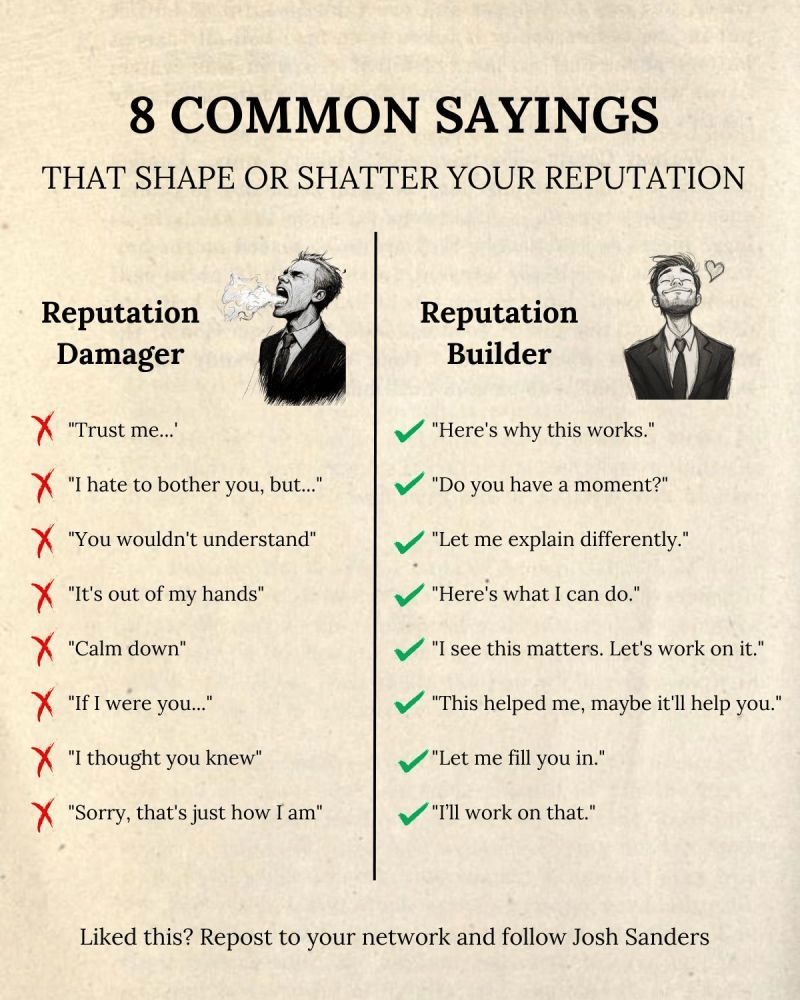
8 Common Sayings That Shape or Shatter Your Reputation

Words carry weight in the workplace. 

Something that can seem harmless…

Can negatively affect those around you. 

Check yourself on these phrases. 

And understand what to say instead: 

❌ “Trust me…’

✅ “Here’s why this works.”

❌ “I hate to bother you, but…”

✅ “Do you have a moment?” 

❌ “You wouldn’t understand”

✅ “Let me explain differently.”

❌ “It’s out of my hands”

✅ “Here’s what I can do.”

❌ “Calm down”

✅ “I see this matters. Let’s work on it.”

❌ “If I were you…”

✅ “This helped me, maybe it’ll help you.”

❌ “I thought you knew”

✅ “Let me fill you in.”

❌ “Sorry, that’s just how I am”

✅ “I’ll work on that.”

Remember: 

You don’t know what others are going through. 

Speak with empathy and care always.

What makes a client remember you?

❌ Not your fancy materials
❌ Not your credentials
❌ Not your pricing

It’s how you show up.

Every. Single. Time.

Here are 7 habits that make you unforgettable:

✅ You anticipate their needs
↳ Send the agenda before they even ask.
↳ Mention the one thing they forgot.

✅ You personalize everything
↳ Start your email with their latest win.
↳ Remember how they take their coffee.

✅ You reframe their challenges
↳ “What if this isn’t a cost issue—it’s a timing issue?”
↳ Turn challenges into next steps.

✅ You create calm in the chaos
↳ 3 options. Clear tradeoffs. 1 recommendation.
↳ Simplify the complex into next steps.

✅ You always follow through
↳ Tuesday promise = Tuesday delivery. Every time.
↳ Close loops before they notice they’re open.

✅ You think beyond them
↳ “How will this help you explain it to the board?”
↳ Draft the email they’ll forward up.

✅ You make it fun to work together
↳ Start with good news. End with energy.
↳ Be the meeting they don’t want to miss.

These aren’t talents you’re born with.

They’re simple, intentional choices.

Small moves that quietly show:

“I see you.”
“I get what matters to you.”
“I’m here to help.”

That’s how you stop being one of many…
and start being the one they call first.

Which of these habits will you practice this week?

7 Mindset Shifts That Will Change Your Career Forever

Careers aren’t built in a straight line.
They’re built through setbacks, detours, and comebacks.

Here are 8 mindset shifts that turn failure into fuel:

(+ 3 bonus shifts in the comments below)

1. 𝗘𝘃𝗲𝗿𝘆 𝗙𝗮𝗶𝗹𝘂𝗿𝗲 𝗜𝘀 𝗔 𝗗𝗮𝘁𝗮 𝗣𝗼𝗶𝗻𝘁
→ Treat failure as feedback, not as a flaw.
→ Each mistake gives you insights you can use to grow.
Shift: Ask: “What is this teaching me?”

2. 𝗚𝗿𝗼𝘄𝘁𝗵 𝗜𝘀𝗻’𝘁 𝗟𝗶𝗻𝗲𝗮𝗿
→ Progress often comes in bursts after plateaus.
→ Feeling stuck doesn’t mean you’re not moving forward.
Shift: Trust the process and stay consistent.

3. 𝗖𝗼𝘂𝗿𝗮𝗴𝗲 𝗕𝗲𝗮𝘁𝘀 𝗣𝗲𝗿𝗳𝗲𝗰𝘁𝗶𝗼𝗻
→ Waiting for perfect conditions delays progress.
→ Taking action—imperfectly—is where real growth starts.
Shift: Start before you feel ready.

4. 𝗥𝗲𝗷𝗲𝗰𝘁𝗶𝗼𝗻 𝗶𝘀 𝗥𝗲𝗱𝗶𝗿𝗲𝗰𝘁𝗶𝗼𝗻
→ Every “no” gets you closer to the right “yes.”
→ Sometimes closed doors are blessings in disguise.
Shift: See rejection as rerouting, not rejection of you.

5. 𝗦𝘁𝗮𝘁𝘂𝘀 𝗶𝘀𝗻’𝘁 𝗦𝘂𝗰𝗰𝗲𝘀𝘀
→ Titles and paychecks don’t always mean fulfillment.
→ True success is feeling aligned with your purpose.
Shift: Redefine success on your terms.

6. 𝗧𝗵𝗲 𝗣𝗮𝘀𝘁 𝗗𝗼𝗲𝘀𝗻’𝘁 𝗗𝗲𝗳𝗶𝗻𝗲 𝗬𝗼𝘂
→ You are not your past mistakes or labels.
→ Every day is a chance to rewrite your story.
Shift: Focus forward, not backward.

7. 𝗙𝗲𝗮𝗿 𝗶𝘀 𝗮 𝗖𝗼𝗺𝗽𝗮𝘀𝘀
→ The things you fear most may be pointing you to growth.
→ Push beyond what you feel you are capable of.
Shift: Step toward what scares you.

You don’t need a perfect record to have a powerful career.
You just need the courage to keep showing up.

How to Master Your Body Language

Your body language could undermine your reputation.

This is how to fix it:

The way you stand.

The way you move your hands.

And even the way you make eye contact.

It can make or break your message.

Here’s how you can master your body language:

→ On camera:

Make eye contact with the camera.

Keep your hands visible to emphasize.

Frame yourself at eye-level to convey confidence.

→ In person or on stage:

Keep your feet shoulder-width apart to project stability.

Move purposefully to keep your audience engaged.

Use expansive gestures to convey your authority.

→ Anywhere:

Smile naturally to build rapport and show warmth.

Use open body language to show approachability.

Vary your gestures to keep communication dynamic.

Remember, 

Your body speaks louder than your words.

Master body language to become unforgettable.

Why We Sleep

Nine ideas from the book “Why we sleep: unlocking the power of sleep and dreams” 😴

➡️ The shorter our sleep, the shorter our life.

➡️ The best bridge between despair and hope is a good night’s sleep.

➡️ When sleep is abundant, our mind flourishes. When it is deficient, it doesn’t.

➡️ Sleep is the single most effective thing we can do to reset our brain and body health each day.

➡️ Practice does not make perfect. It is practice, followed by a night of sleep, that leads to perfection.

➡️ Inadequate sleep disrupts blood sugar levels so profoundly that we would be classified as pre-diabetic.

➡️ The leading causes of disease and death in developed nations all have recognized causal links to a lack of sleep.

➡️ Routinely sleeping less than six or seven hours a night demolishes our immune system, more than doubling your risk of cancer.

➡️ We are not sleeping the way nature intended. The number of sleep bouts, the duration and when sleep occurs have all been distorted by modernity.

Invisible Battles, Visible Grace

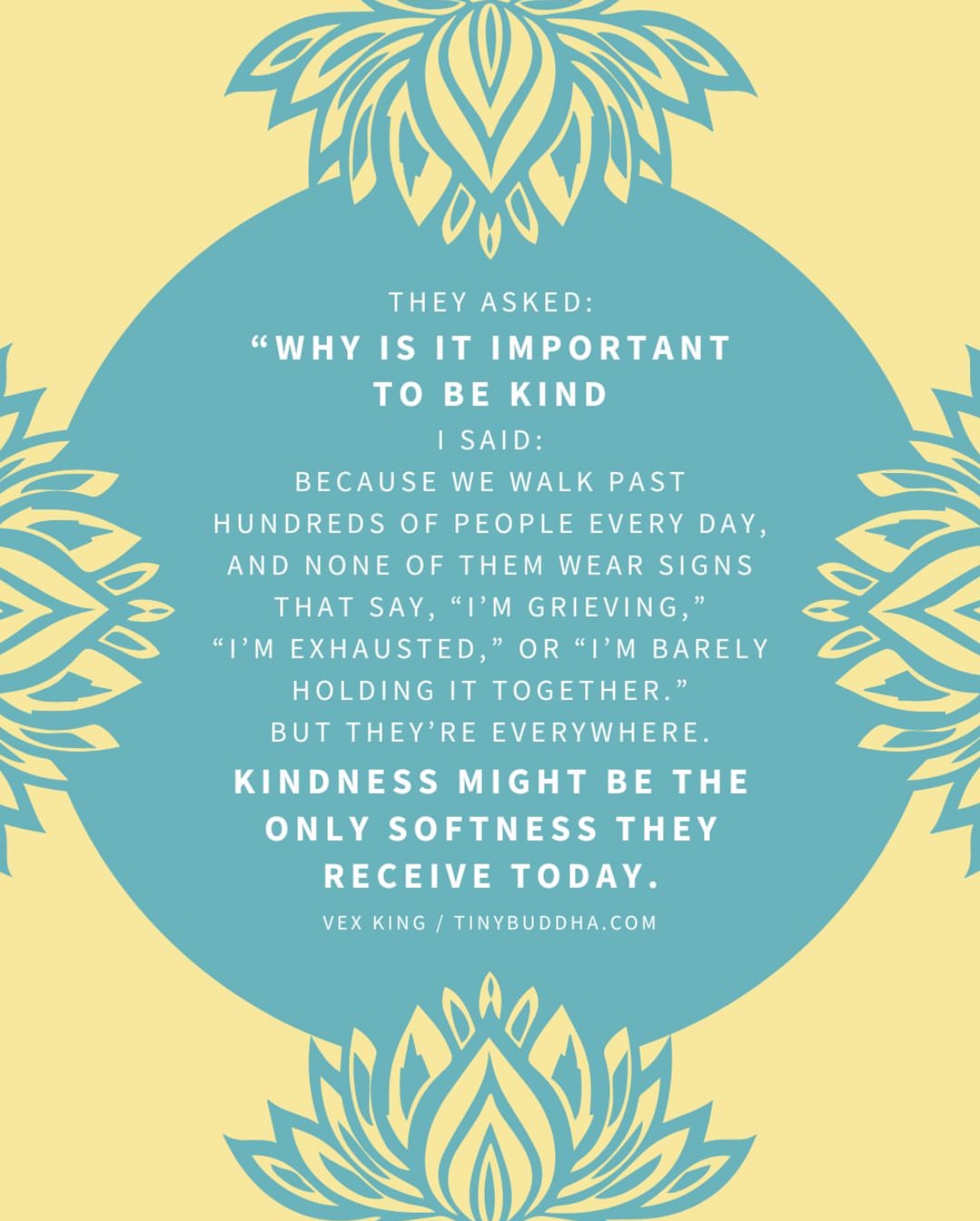
We pass by strangers every day — at the store, on the sidewalk, at work, in traffic. We nod, maybe smile politely, and move on. But what if we could see the weight each person carried? What if grief, exhaustion, heartbreak, or loneliness came with visible signs?

They don’t.

And that’s exactly why kindness matters.

Not everyone wears their wounds on the outside. Most people don’t. That person who snapped at you may have just lost someone they love. The quiet one at the coffee shop might be struggling with anxiety. The coworker who seems distracted might be caring for a sick parent or battling their own health issues.

Kindness isn’t about grand gestures. It’s in the little things — a smile, a gentle tone, a bit of patience. It costs us nothing but might mean everything to someone else. In a world moving fast and often harsh, our smallest kindness might be the only softness someone receives all day.

So when they ask, “Why is it important to be kind?” — here’s why:

Because you never know who’s barely holding it together.

And maybe, just maybe, your kindness is the thread that keeps them going!

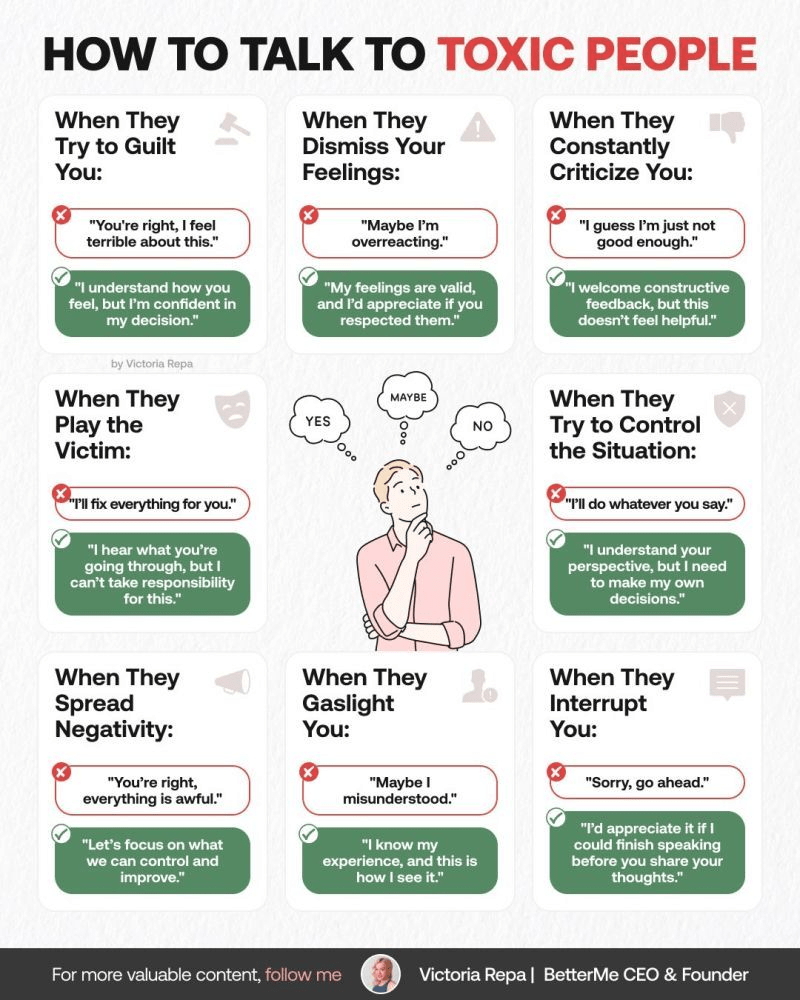
How to Deal with Toxic People

Here are 8 practical tips to protect your boundaries and reclaim your peace:

1/ When they try to guilt you: 

“I understand how you feel, but I’m confident in my decision.”

2/ When they dismiss your feelings: 

“My feelings are valid, and I’d appreciate if you respected them.”

3/ When they constantly criticize you: 

“I welcome constructive feedback, but this doesn’t feel helpful.”

4/ When they play the victim: 

“I hear what you’re going through, but I can’t take responsibility for this.”

5/ When they spread negativity: 

“Let’s focus on what we can control and improve.”

6/ When they gaslight you: 

“I know my experience, and this is how I see it.”

7/ When they try to control the situation: 

“I understand your perspective, but I need to make my own decisions.”

8/ When they interrupt you: 

“I’d appreciate it if I could finish speaking before you share your thoughts.”

It’s not your responsibility to fix toxic people.

Your priority is to protect your energy and maintain your boundaries.

By responding assertively, 

you set the standard for how you deserve to be treated