How to Deal with Toxic People

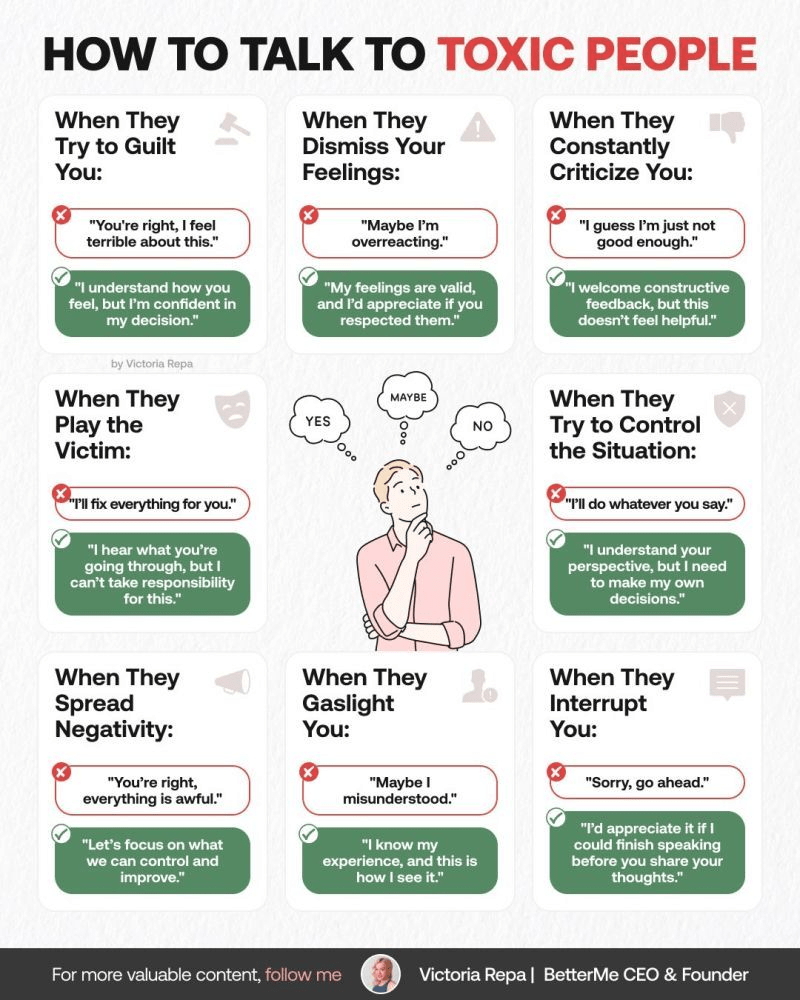
Here are 8 practical tips to protect your boundaries and reclaim your peace:

1/ When they try to guilt you: 

“I understand how you feel, but I’m confident in my decision.”

2/ When they dismiss your feelings: 

“My feelings are valid, and I’d appreciate if you respected them.”

3/ When they constantly criticize you: 

“I welcome constructive feedback, but this doesn’t feel helpful.”

4/ When they play the victim: 

“I hear what you’re going through, but I can’t take responsibility for this.”

5/ When they spread negativity: 

“Let’s focus on what we can control and improve.”

6/ When they gaslight you: 

“I know my experience, and this is how I see it.”

7/ When they try to control the situation: 

“I understand your perspective, but I need to make my own decisions.”

8/ When they interrupt you: 

“I’d appreciate it if I could finish speaking before you share your thoughts.”

It’s not your responsibility to fix toxic people.

Your priority is to protect your energy and maintain your boundaries.

By responding assertively, 

you set the standard for how you deserve to be treated
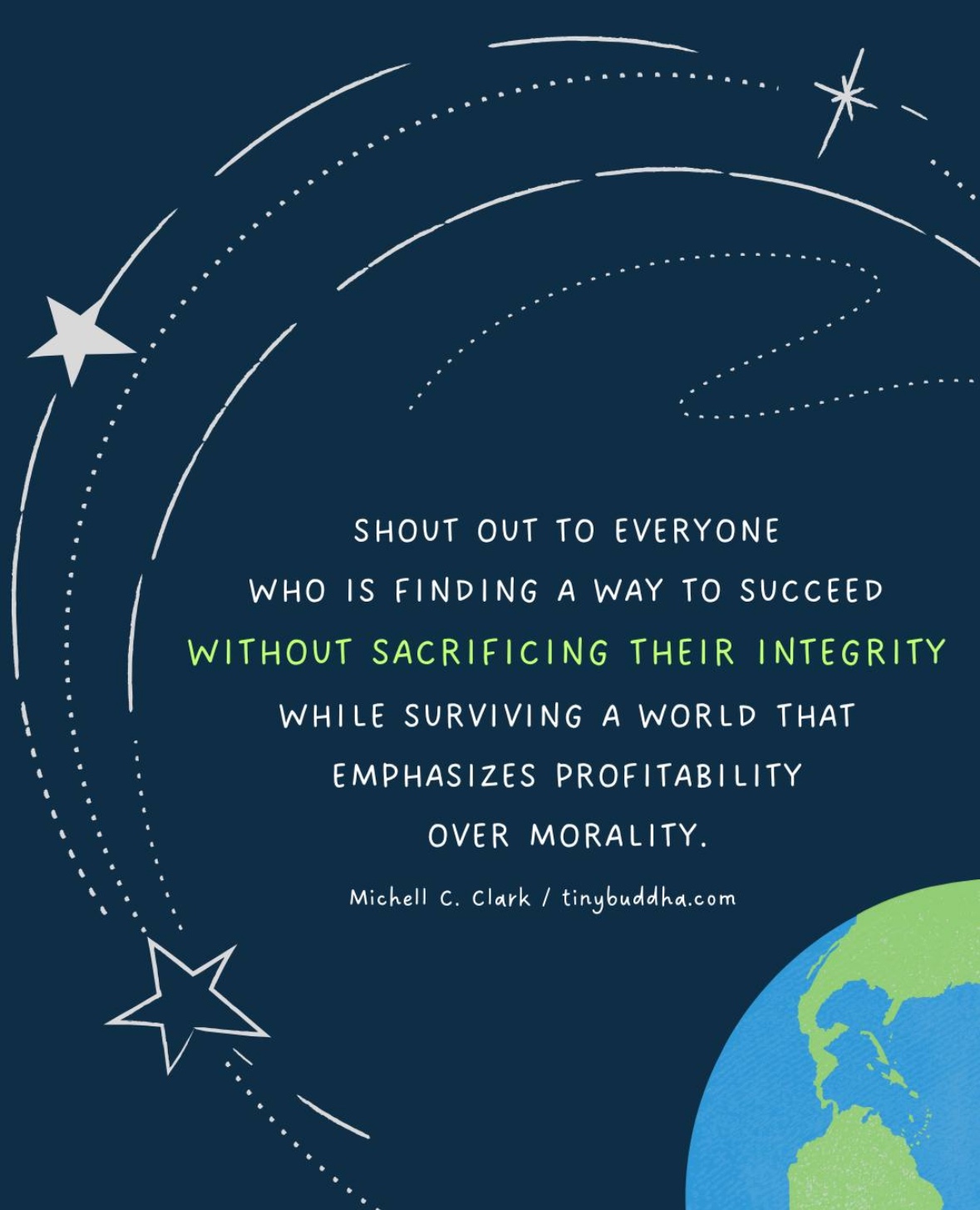
Winning Without Selling Your Soul

Just wanted to take a moment and shout out the real ones.

The people out here doing their thing—building, growing, showing up—without cutting corners or stepping on others. The ones choosing honesty over hype, kindness over clout, and values over shortcuts.

It’s not always flashy. It’s not always the fastest route. And yeah, sometimes it feels like you’re swimming against the current in a world that screams “profit first, figure out the ethics later.”

But you’re still doing it.

You’re proving that you can succeed without sacrificing your integrity. That you can chase your goals without losing yourself in the process. And honestly? That’s the kind of success that actually sticks.

So here’s to the quiet grinders, the value-driven dreamers, and everyone making tough choices with a clear conscience.

You’re not just surviving—you’re rewriting the playbook.

And that’s something worth celebrating.

Keep going. We see you!

Mastering 1-1s

Early in my career, 

I didn’t understand the power of a great 1-on-1.

As a founder, I make sure my 1-on-1s drive growth, trust, and retention.

As a Manager:

Here’s what I do differently.

▶️ I plan ahead. My team knows the agenda before we meet. 

No surprises, no wasted time.

▶️ I start with a human check-in. No one wants to jump straight into work talk.

 A few minutes of real conversation builds trust.

▶️ I always give structured feedback. 

I use “Start, Stop, Continue”:

Start: What new actions could help them grow?

Stop: What habits might be slowing them down?

Continue: What are they excelling at? Reinforce their strengths.

▶️ I set meaningful goals with them, not for them. Using “The 3Ps” framework:

Project: What’s the next big deliverable?

Progress: How are their skills evolving?

Path: Where do they want to go in their career?

▶️ I never cancel. If something comes up, I reschedule. 

It’s a signal that their time matters.

▶️ I listen more than I talk. 

My job is to unblock—not dominate the conversation.

▶️ I offer genuine support. Saying, “Let me know if you need anything” is lazy. 

Instead, I make specific offers to help.

As an Employee, 

Here’s what I did to make my 1-on-1s count:

✅ I came prepared. 

I treated these meetings as a chance to drive my own growth, not just report updates.

✅ I gave my managers feedback using “The H.O.W.” framework:

Highlight: What’s working? 

Start with the positives.

Observe: What challenges are holding me back? 

Be honest.

Wish: What support do I need? 

Be specific.

✅ I took ownership of my career.

I didn’t wait for my manager to ask about my goals—I brought them up myself.

✅ I defined my own growth using the “G.R.I.T.” framework:

Goal: What’s my long-term career objective?

Reality: Where am I right now? What gaps exist?

Initiative: What skills, projects, or mentorship will get me there?

Timeline: When do I want to reach each milestone?

Invest in these conversations.

You’ll see the ROI in trust, collaboration, and retention.

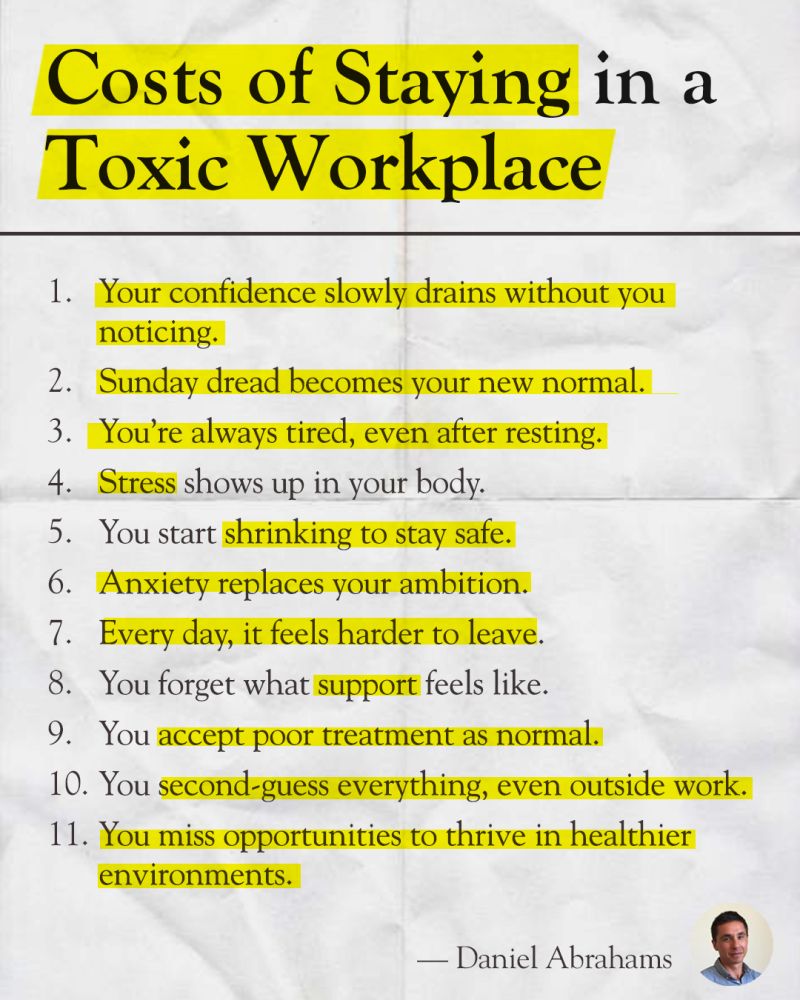
Costs of Staying in a Toxic Workplace

Toxic isn’t always loud.
Sometimes, it’s quiet, slow.
And soul-crushing.

You tell yourself it’s not that bad.
But your mind and body know better.

11 Costs of Staying in a Toxic Workplace
(And why it’s quietly stealing your best self):

1. Your confidence slowly drains
➟ You don’t even notice it slipping away.
➟ Doubt creeps into your skills and decisions.

2. Sunday dread becomes your new normal
➟ The weekend feels shorter and more stressful.
➟ You brace yourself for Monday morning again.

3. You’re always tired, even after resting
➟ Exhaustion lingers beyond sleep and downtime.
➟ Your energy disappears before the workday ends.

4. Stress shows up in your body
➟ Physical aches and tension become constant.
➟ Your mind and body feel out of sync.

5. You start shrinking to stay safe
➟ You hold back ideas and opinions.
➟ Playing small becomes a survival strategy.

6. Anxiety replaces your ambition
➟ Fear blocks your next career moves.
➟ Worry crowds out dreams and goals.

7. Every day, it feels harder to leave
➟ Toxicity builds an invisible trap around you.
➟ You imagine escape but stay frozen in place.

8. You forget what support feels like
➟ Genuine encouragement fades from your experience.
➟ Isolation becomes a quiet, daily companion.

9. You accept poor treatment as normal
➟ Bad behaviour becomes the workplace standard.
➟ You lower your boundaries and expectations.

10. You second-guess everything, even outside work
➟ Self-doubt spills over into your personal life.
➟ You stop trusting your instincts.

11. You miss opportunities to thrive elsewhere
➟ Healthier workplaces pass you by unnoticed.
➟ You settle when you could soar.

Toxic workplaces aren’t just uncomfortable.
They drain your confidence, energy and potential.

Your mental health is worth more than any job or salary.

Already Enough: The Peace in Letting Yourself Just Be

We live in a world that celebrates constant hustle. Every scroll, every notification, every quote on your feed tells you to grind harder, be better, push more, level up. And while growth is beautiful, it’s easy to forget something essential in the noise:

You don’t have to constantly push yourself to be better.

Read that again.

Not because growth is wrong, but because it’s okay to pause. It’s okay to breathe. It’s okay to not chase a next version of yourself every single moment.

Because here’s the truth that gets buried under performance reviews, self-help books, and comparison traps:

This version of you—right here, right now—is already enough.

You’ve come through challenges that no one sees. You’ve carried silent burdens with grace. You’ve shown up—imperfect, yes, but with heart. And that matters.

There is strength in striving, but there is also strength in stillness.

There is courage in climbing, but also courage in saying, “I’m proud of where I am.”

You don’t have to earn your worth. You don’t need to be more productive, more attractive, more successful to deserve rest or peace. You already do.

So today, take a moment to honor yourself—not the version you’re working toward, but the version that’s made it this far.

You’re not a project to be fixed.

You’re a person to be loved.

And that’s enough!

10 Principles of Kaizen

The Japanese secret that makes success feel effortless.

You don’t need big breakthroughs. You need Kaizen.

A Japanese concept that means “change for better.”

It started in the business world, but can help you

improve your life too.

It’s all about small steps that lead to

big changes over time.

Why it works:

✅ It’s simple and sustainable

✅ It builds momentum (fast)

✅ It turns mistakes into fuel

Here’s how to put Kaizen into action:

1. Choose One Thing

Start small. A tiny habit. A simple routine.

Improve it little by little. This makes change easier.

2. Learn From Mistakes

Messed up? No sweat.

Figure out what went wrong, learn, and move on.

3. Celebrate Small Wins

Found a quicker route to work?

Great! The small things add up.

4. Value Feedback

Listen to what others say.

Their insights can help you improve.

5. Stay Consistent

Make small improvements

part of your daily routine.

6. Get Others Involved

Share your journey.

Kaizen loves company. Grow together.

7. Reflect On Your Progress

Take time to look back at your improvements.

Then, set new goals.

8. Keep It Simple

The best changes are often the simplest.

Don’t overcomplicate things.

9. Be Patient

Good things take time.

Keep at it, and you’ll see results.

10. Never Stop

There’s always room for improvement.

Keep looking for ways to get better.

Kaizen is more than a concept. It’s a way of life.

Start small. Stay steady.

And one day, you’ll look back and realize…

you’ve come unbelievably far.

Leadership

Leadership isn’t a title.

You can be at the bottom of an org chart and still be a leader.

After 15+ years leading teams…
I’ve learned the uncomfortable truth:

Power moves aren’t what make great leaders

These 10 qualities do:

Listening
↳ It’s not about waiting for your turn to speak
↳ You’d be amazed at what people tell you when you truly listen

Empathy
↳ Stop trying to be right all the time
↳ Start trying to understand why others feel right
↳ The gap between perspectives is where solutions live

Adaptability
↳ Your perfect plan will face challenges. Guaranteed
↳ Success isn’t about having the right strategy – it’s about pivoting faster than everyone else

Dedication
↳ Show up consistently. Especially when it’s hard
↳ Your team doesn’t just need your inspiration – they need your presence

Ethics
↳ Shortcuts are tempting. They always are
↳ But trust takes years to build and seconds to break. Choose wisely

Respect
↳ Treat the intern with the same respect as the CEO
↳ Because titles don’t determine value, actions do

Support
↳ Your job isn’t to shine. It’s to help others shine brighter
↳ Effective leaders are the ones you barely notice

Humility
↳ You’re going to make mistakes. Often
↳ Admit it quickly, learn from it immediately, and move forward deliberately

Inclusion
↳ Different voices aren’t nice to have – they’re essential
↳ If everyone in your room thinks alike, you’re in the wrong room

Patience
↳ Meaningful change takes time and patience
↳ The best time to plant a tree was 20 years ago
↳ The second-best time? Today

How to Lead Change Without Stressing Everyone Out

As leaders, we often focus on overcoming resistance to change initiatives. But what if we’re overlooking a crucial factor?

Organizational psychologist Anna Kraft suggests that resistance often stems from employees feeling stressed and overwhelmed.

To lead change effectively, we need to understand and address employee needs at each phase of the change process.

Let’s break it down:

1️⃣ Exploration (Thinking About a Change)

Employees need reassurance:

❓ They may be confused and worried by rumors

❓ Uncertain future is a major concern

Leaders can:

✅ Actively address rumors and concerns

✅ Remain available and attentive to employees

2️⃣ Preparation (Planning for Change) 📝

Employees need context:

❓ They worry about personal impact: “How will this affect me?”

❓May swing between emotional extremes like hope and fear

Leaders can:

✅ Lead conversations about the potential impact of change

✅ Make room for employee emotions

3️⃣ Implementation (Making the Change) 🛠️

Employees need balance:

❓ May struggle with impatience and frustration

❓ Might focus only on negative consequences

Leaders can:

✅ Listen to ongoing questions and concerns

✅ Spread a balanced message about positives and negatives

4️⃣ Evaluation (Assessing the Change) 🔍

Employees need acknowledgment:

❓ Need to understand their role in successful change

❓ This builds confidence in their capacity for future change

Leaders can:

✅ Give feedback and convey confidence in employees

✅ Be honest about challenges – this builds trust for future initiatives

Reducing resistance to change starts with understanding and addressing employee needs at each phase. It’s about creating an environment where change doesn’t equal stress.

5 Ways To Find Clarity

It helps you slow down, reflect, and reset.

Try → Journaling for Clarity

Here’s how to do it:


1. Find a quiet moment.

Somewhere calm.

Just you, your thoughts, and a notebook (or your notes app—
whatever works).

This is your space.

You get to make the rules.


2. Write down what happened.

Not just how you felt—but what actually happened.

Ask yourself:

→ What exactly happened?


→ What part did I play?

Be honest, but don’t be hard on yourself.

You’re here to reflect, not to judge.


3. Talk about how it felt.

Go ahead—say it like it is.

→ I feel __ because…

→ This got to me because…

You’re not being dramatic. You’re being real.

And that’s what creates a growth mindset.

Being real enough to grow.


4. What can you control?

Not everything. But probably something.

Ask:


→ Could I have handled anything differently?

→ Is there a small step I can take now?

→ What’s outside my control?

Just asking these questions puts you back in your power.


5. Shift the self-talk.


If you notice your inner voice getting harsh—pause.

Breathe. Rewrite it.

Try:

→ “I made a mistake, but I’m learning.”

→ “I did the best I could with what I knew then.”


→ “I care enough to grow from this.”

That’s growth mindset in action. One kind word at a time.


6. Find the lesson.

There’s always something to learn.

Even if it’s small.

→ This taught me to speak up sooner.

→ I’m learning to stay calm in hard moments.

→ I’ll handle it differently next time—and that’s growth.

You don’t need a breakthrough.

You just need awareness.


7. End with kindness.

Always. Wrap it up with something soft and honest.

Say to yourself:

→ “It’s okay to feel this.”

→ “I’m learning, and I’m proud of that.”

→ “I’m building strength by slowing down.”

Feels better already, doesn’t it?

You’re not just writing.

You’re getting to know yourself.

You’re choosing a growth mindset.

And you’re doing it with care.

Silent Burnout

Burnout is more common than you think. 

Are you missing the signs?

76% of employees are experiencing burnout.

And a staggering 96% of senior leaders feel the same way.

You’re not alone.

Here are 10 signs you shouldn’t ignore.

If any of these resonate with you, it’s time to act:

1/ Prioritise Self-Care:

↳ Move your body, sleep well, eat mindfully

2/ Set Boundaries:

↳ Say ‘no’ more often, ban work emails after hours

3/ Take Breaks:

↳ Schedule mini-breaks daily, take mental health days

4/ Delegate & Streamline:

↳ Prioritise key tasks, delegate the rest, use productivity tools

5/ Get Support:

↳ Lighten your load, seek help from a mental health professional

6/ Reconnect with Purpose:

↳ Focus on meaningful projects, revisit your goals

7/ Balance Work & Life:

↳ Do what brings you joy, spend time with loved ones

8/ Boost Wellbeing:

↳ Keep a gratitude journal, practice mindfulness

9/ Grow Professionally:

↳ Learn new skills, seek constructive feedback

10/ Nurture Your Network:

↳ Connect with friends, join professional groups

Burnout isn’t just a buzzword – it’s a threat to your health and career.

Remember: It’s okay to ask for help.