

Paychecks come once a month
But the their culture is everyday
Finding a place that values you is just as important as salary
Here’s 8 signs your company won’t put you first
1. Values disconnect
↳ Leaders talk about company principles but consistently act against them.
↳ What’s celebrated in public meetings isn’t rewarded in practice.
2. Feedback vacuum
↳ Employee input disappears without acknowledgment or implementation.
↳ The same problems persist despite repeated suggestions for improvement.
3. Toxic tolerance
↳ Bad behavior from certain employees continues without consequences.
↳ Different standards apply based on position or relationship with leadership.
4. Resource scarcity
↳ You’re expected to deliver results without necessary tools or training.
↳ Requests for essential support are consistently deferred or denied.
5. Compensation gaps
↳ Your pay falls below market rate despite strong performance.
↳ Recognition comes as verbal praise rather than tangible rewards.
6. Boundary erosion
↳ After-hours communications and weekend work become expected norms.
↳ Time off requests face scrutiny or subtle pressure to cancel.
7. Growth ceiling
↳ Advancement discussions remain vague despite consistent performance.
↳ Training and development opportunities aren’t supported or encouraged.
8. Values as decoration
↳ Company mission statements appear on walls but not in decisions.
↳ Business priorities regularly override stated principles without explanation.
What’s a sign you’ve seen?
Bye Bye Bad Emails
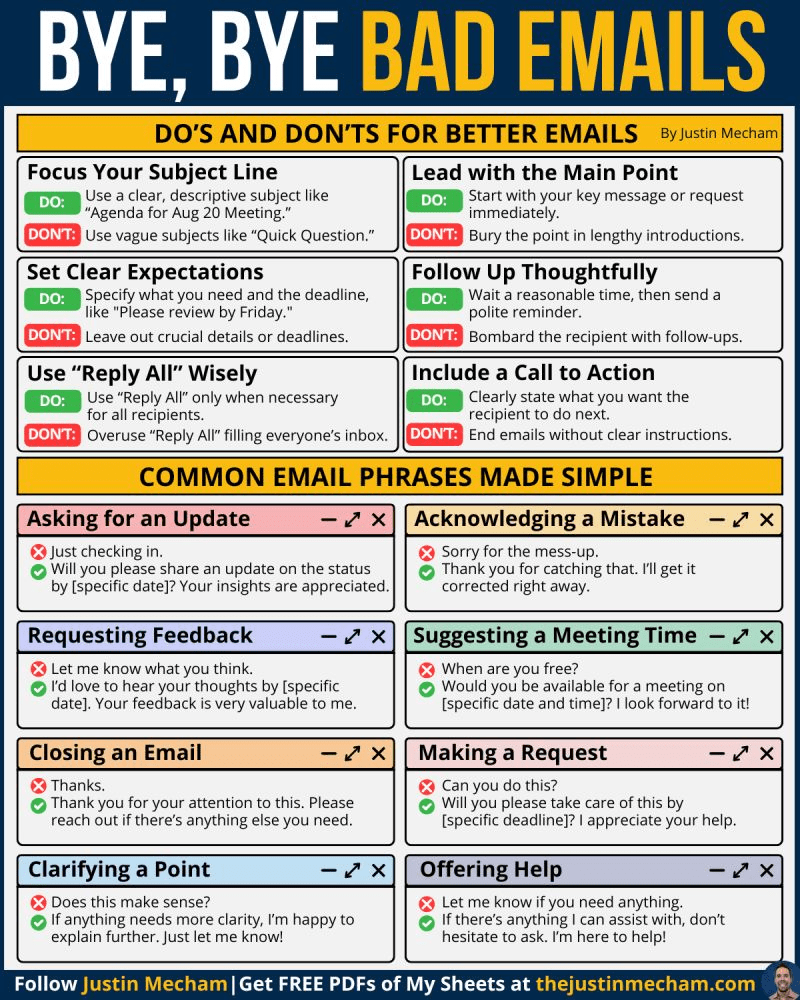
Bad emails don’t just waste time—
They waste trust. Here’s why:
Weak emails aren’t harmless.
They confuse, frustrate, and stall.
And the damage adds up:
🔺 Frustrated teams
🔺 Delayed decisions
🔻 Poor follow-through
🔻 Confused ownership
🔺 Damaged relationships
🔺 Wasted time rereading threads
🔻 Tasks slipping through the cracks
🔻 Work getting done—but not aligned
🔺 People replying without context
🔺 Feedback that comes too late
🔺 Unclear expectations
🔻 Overloaded inboxes
🔻 Lost accountability
🔺 Missed deadlines
🔻 Shifting blame
Use my sheet to say “Bye, bye” to bad emails.
Bad emails waste more than time.
They cost clarity, confidence, and connection.
Write like your words matter—because they do.
Build Confidence

13 science-backed actions to build your confidence:
1. Start the day with a quick win
↳You build confidence by proving you can create momentum early
↳Ex: Send the message you’ve been putting off
2. Wear something that energizes you
↳Grow confidence by dressing like someone who respects themselves
↳Ex: Choose your favorite jacket, even if it’s casual
3. Accept a compliment without disclaimers
↳Say “thank you” – then let it land, allowing yourself to feel seen
↳Ex: Say “Thanks, I worked hard on that” instead of “It was nothing”
4. Reframe one negative thought
↳Confidence comes from interrupting the voice that holds you back
↳Ex: Catch “I’m not good at this” and replace it with “This is new – I’ll improve”
5. Use confident body language
↳Your posture teaches your brain how to feel
↳Ex: Sit or stand tall with shoulders back in meetings
6. Prepare for something that matters
↳Confidence comes from readiness, not luck
↳Ex: Rehearse your intro before an event
7. Hold eye contact one second longer
↳Train your confidence by forcing yourself to stop shrinking
↳Ex: Look the cashier in the eye and smile
8. Speak with more intention
↳You build confidence by speaking like your words carry weight
↳Ex: Say “I think this is the right move” instead of “I could be wrong, but maybe…”
9. Reach out to someone positive
↳Surround yourself with people who see – and remind you of – your value
↳Ex: Call a friend who always lifts you up
10. Practice one skill for 10 minutes
↳Even short reps build long-term belief
↳Ex: Watch a tutorial and try it immediately
11. Try something you’ve never done
↳Show yourself you can handle the unknown
↳Ex: Join a virtual event you wouldn’t normally attend
12. Reflect on one personal win
↳Remind yourself what you’re capable of
↳Ex: “I spoke up today even though I was nervous”
13. End your day with action
↳Enter the next day with confidence, knowing you’re prepared for it
↳Ex: Write down tomorrow’s top 3 priorities
Confidence isn’t something people are born with.
It’s something you build – through consistent practice.
These habits may seem small,
But practiced daily, they change how you see yourself.
Do you do any of these already?
Unshakeable Boundaries

Stop justifying your boundaries.
These 12 phrases command instant respect 👇🏼
I used to say yes to everything:
– Last minute requests at 5pm
– Weekend emails “that couldn’t wait”
– “Quick” calls that stole my focus time
All because I didn’t know how to say no.
Everything changed when I switched to these 12 power phrases ✨
1) “That won’t work for me, but here’s what will”
↳ Redirects the conversation without justification
2) “I’m unavailable after 6pm, I can help tomorrow at 9”
↳ Sets time limits without room for negotiation
3) “I need to check my schedule before answering”
↳ Creates thinking space to avoid reactive yeses
4) “My calendar is blocked for deep work until 2pm”
↳ Establishes professional barriers few will challenge
5) “Which of these priorities should I set aside?”
↳ Shifts responsibility while showing your full plate
6) “I’ve set aside 30 minutes for this conversation”
↳ Time-boxes interactions that tend to expand endlessly
7) “I can help with part A and B, but not part C”
↳ Offers partial help instead of total rejection
8) “I don’t respond to messages on weekends”
↳ Sets expectations that prevent future disappointment
9) “This needs my full attention – can we schedule it?”
↳ Transforms demands into planned interactions
10) “I’ve learned I can’t take last-minute requests”
↳ Frames boundary as growth, not personal choice
11) “Let me think and get back to you by [time]”
↳ Creates space without tension or commitment
12) “That’s outside my zone of wisdom, here’s who can help”
↳ Turns rejection into helpful redirection
Strong boundaries don’t require explanation.
They require the right words at the right moment ✨
Leadership Strategies for Stress Reduction

Leadership comes with a lot of weight, but how you carry it makes all the difference.
From nonstop meetings to overflowing inboxes, the demands can feel nonstop.
But it’s not about removing the pressure—
It’s about building systems that help you stay steady.
Here are 5 practical ways to protect your clarity and lead with more ease:
—
1. Inbox out of control?
Try: Inbox Zero
Unsorted messages drain mental bandwidth.
➟ Clear what doesn’t matter
➟ Delegate when possible
➟ Respond to quick asks on the spot
Clear inbox = clear mind.
2. Tight timelines stacking up?
Try: Parkinson’s Law
Work expands to fill the time you give it.
➟ Set a short, focused deadline
➟ Race the clock (in a good way)
You’ll be surprised how efficient you can be when the timer’s ticking.
3. Brain constantly switching gears?
Try: Single-Tasking
Multitasking looks productive—but it’s not.
➟ Focus on one thing
➟ Finish it before you start the next
More flow. Less friction.
4. Team dynamics feeling off?
Try: The Thomas-Kilmann Model
Tension often hides beneath the surface.
➟ Understand your go-to response (avoid, compete, collaborate…)
➟ Shift toward open, shared solutions
Healthy dialogue creates high-performing teams.
5. Juggling too much at once?
Try: The Four Burners Theory
You have four burners: work, health, family, friends.
➟ You can’t run them all on high—choose intentionally
➟ Trade-offs aren’t failure—they’re strategy
Lead with your energy, not just your effort.
—
Final Thought:
You can’t eliminate every challenge—but you can redesign how you move through them.
Protect your clarity. Prioritize your energy. Lead from a centered place.
The Art of Negotiation
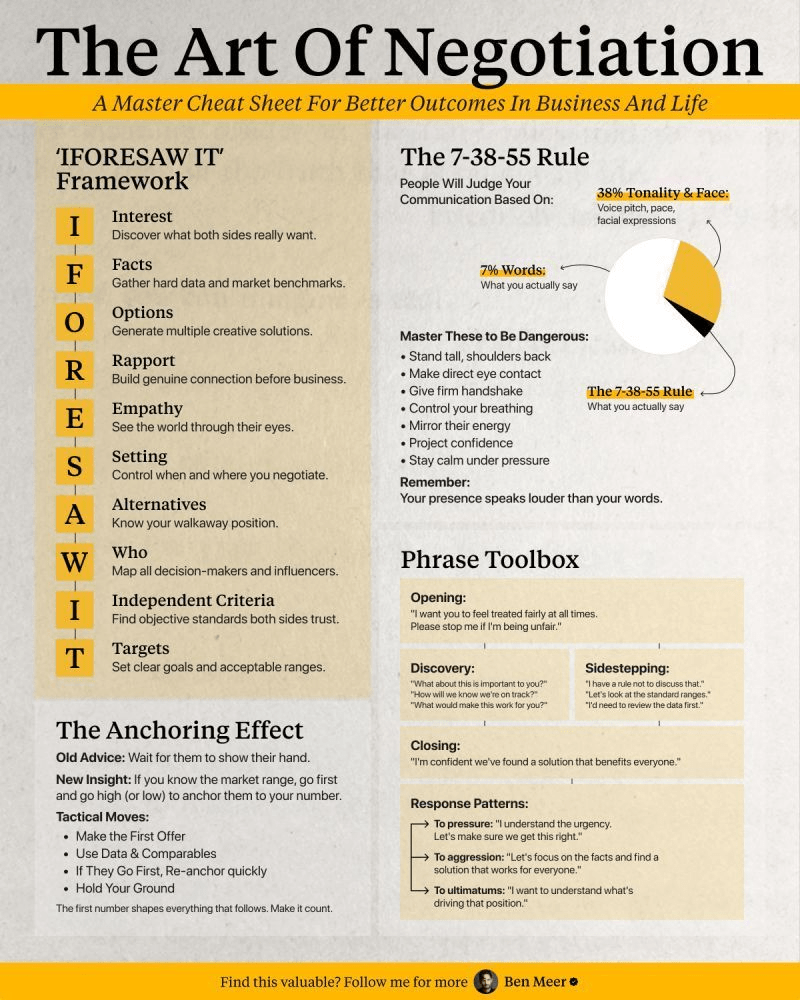
You don’t get what you deserve, but what you negotiate.
3 ways to master negotiation (in life and business):
1. The ‘I FORESAW IT’ Framework (H/T Seth Freeman)
↳ Creates a roadmap for every element before you walk in
↳ Uses preparation to transform anxiety into quiet confidence
2. The 7-38-55 Rule
↳ Words only have a 7% impact on communication
↳ Focus on mastering your body language, too
3. The Anchoring Effect
↳ The opening number shapes the rest of the negotiation
↳ Use market data to strengthen your anchor point
—
Here are some phrases to help when you’re negotiating:
When you start:
↳ “I want you to feel treated fairly at all times. Please stop me if I’m being unfair.” (H/T Chris Voss)
When you’re discovering motivation:
↳ “What about this is important to you?”
When you’re sidestepping:
↳ “I have a rule not to discuss that.”
When you close:
↳ “I’m confident we’ve found a solution that benefits everyone.”
Problem Solving in 60 Minutes?

80% of solving a problem is simply making a decision.
Most people stay stuck not because the problem is difficult —
but because they delay choosing what to do.
Here’s my 60-minute framework to break through any problem.
Fast. Focused. Clear.
⏰ Minutes 0–10: Define the real problem
What we think is the issue… usually isn’t.
Clarity here can save you weeks of wasted energy.
⏰ Minutes 10–20: Break it down
What’s in your control? Where does it actually get stuck?
Suddenly, it feels manageable.
⏰ Minutes 20–35: Brainstorm solutions
Dump every idea. Don’t filter. Don’t judge.
Look for patterns, combinations, and fresh angles.
⏰ Minutes 35–50: Choose your path
Ask yourself:
→ Can I realistically do this?
→ Can I do it fast?
→ Will it solve the root cause?
⏰ Minutes 50–60: Take action
Pick one small step. Do it today.
No overthinking. Just move.
I use this every time I feel stuck —
whether it’s a product decision, a team issue, or a strategic question.
A problem clearly stated is a problem half solved.
Give yourself 60 minutes,
and you’ll be surprised how much power you actually have.
10 Toxic Leadership Styles

Most people have no clue how to manage their toxic boss.
Let’s face it…Bad bosses don’t just drain your morale.
They drive your best people out the door.
According to a DDI study, over 57% of employees have left a job because of their toxic boss.
Not the role! Not the pay! Toxic leadership!
Toxic leadership is rarely just one behavior.
There’s pattern-repeats that anyone can spot.
Quitting immediately is often not wise. You must survive the storm while charting your next move.
Study my 10 common toxic leadership styles—and learn to manage your toxic boss without getting fired.
1/ The Micromanager:
Fix – Communicate regularly. Preempt control with detailed updates.
2/ The Credit Hog:
Fix – Document contributions. Share them openly before they do.
3/ The Blame Shifter:
Fix – Keep a clear record of your work and decisions. Facts protect.
4/ The Inconsistent Leader:
Fix – Confirm direction and priorities—frequently.
5/ The Bully Boss:
Fix – Set boundaries. Get HR or leadership involved when needed.
6/ The Favorites Player:
Fix – Strengthen peer relationships. Outgrow the favoritism.
7/ The Unethical Leader:
Fix – Keep receipts. Uphold integrity and report what matters.
8/ The Overly Critical:
Fix – Ask for constructive feedback. Spotlight your wins.
9/ The Disconnected Boss:
Fix – Communicate team efforts clearly. Don’t stay in the dark.
10/ The Ego-Centric Leader:
Fix – Align Your Work with their goals. Win by serving the mission.
The Beach Theory

We often think of edges as final. The last page. The end of the road. The final goodbye. But nature has a gentler way of redefining endings—just stand at the shore and you’ll feel it.
The beach is the perfect paradox. It’s where the land ends, yes—but it’s also where the ocean begins. The edge is not a wall. It’s a threshold. A wide-open door to something new, something deeper, something vast and alive.
That’s the Beach Theory:
Every edge is also an entrance.
When something ends—a relationship, a job, a season of life—it’s tempting to feel like that’s it. Over. But the beach whispers a different story: maybe this is just where something else begins. Maybe endings are not finish lines, but invitations. To explore. To let go. To wade into the unknown with bare feet and brave hope.
Because the wildness of the ocean doesn’t promise safety—but it does promise something. Movement. Mystery. Possibility.
So the next time you reach your edge, don’t panic. Pause. Breathe. Let the waves speak.
You’re not done.
You’re just stepping in!
The First Step: When Faith Meets the Floodwaters

There’s something sacred about a first step.
It’s the tremble in your chest before you speak up.
The pause before you apply for the job.
The shaky trust before you forgive.
The moment you choose to believe—before anything around you changes.
In Joshua 3, the Israelites stand at the edge of the Jordan River, bursting at its banks. They’ve been waiting for the promise, wandering in the wilderness, and now the final barrier stands between them and the land God swore to give them.
But here’s the twist:
God doesn’t part the waters before they step in.
He asks the priests to carry the Ark and place their feet in the flood.
And then—only then—does the miracle unfold.
The waters halt. The riverbed dries. The impossible becomes the path.
This image is a powerful reminder:
God often waits for us to move first—so He can move next.
Faith isn’t passive.
It’s not just believing He can do something.
It’s trusting Him enough to start walking, even when the river’s still raging.
So whatever your Jordan looks like today—
a big decision, a tough season, a lingering fear—
maybe the breakthrough you’re waiting for…
starts with that first courageous step.
Step in.
Even if the waters don’t move yet.
Even if your foot sinks a little.
Even if your heart isn’t fully sure.
Because sometimes, the real miracle isn’t just that the river parts—
it’s that you dared to believe it would.
Walk by faith. The river will make way.
 Kenrick Vaz