
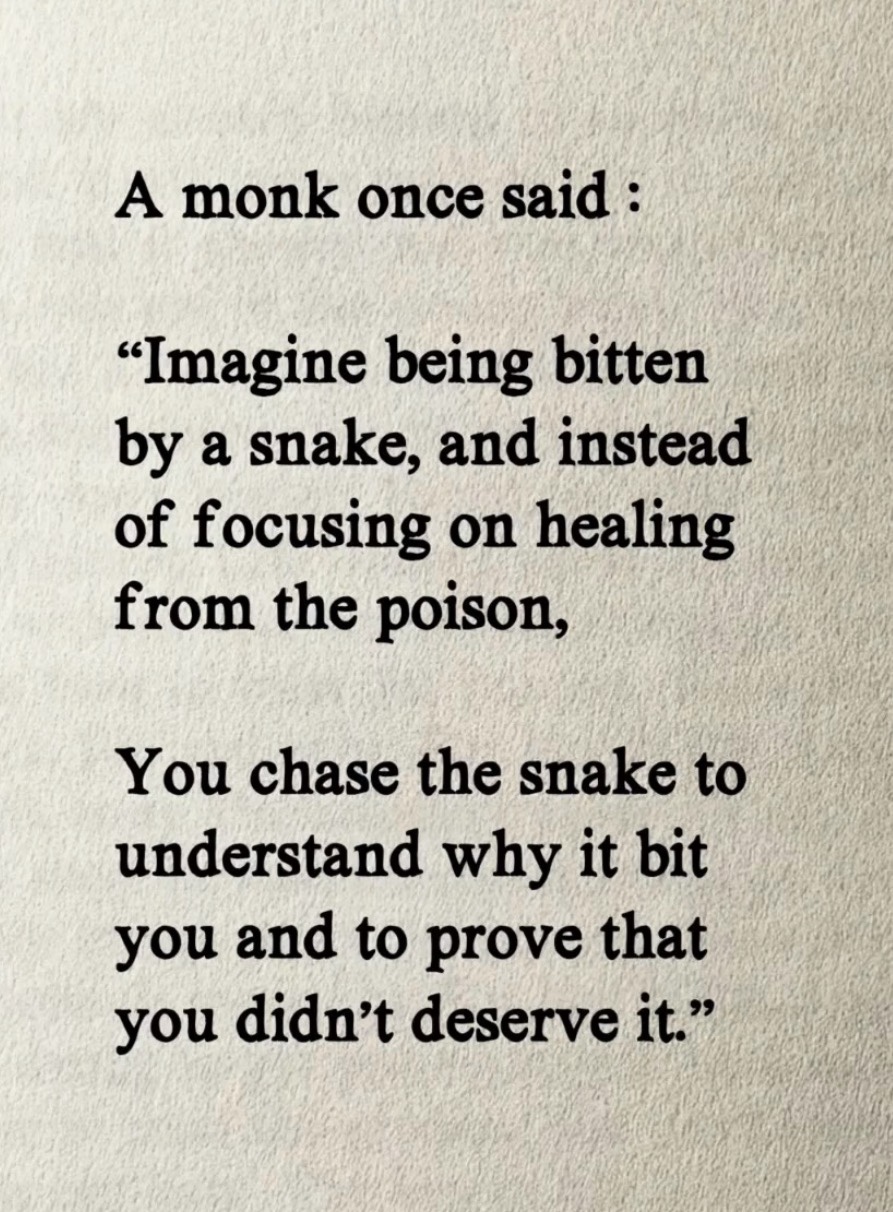
Came across this quote sometime back and it has stayed with me long after I first heard it. Imagine being bitten by a snake, and instead of focusing on healing from the poison, you chase the snake. You want to know why it bit you. You want to prove that you didn’t deserve it. You want answers, explanations, justice. Meanwhile, the poison is still in your body, quietly doing its damage.
Most of us live like this more often than we’d like to admit.
We replay conversations in our heads. We dissect texts, tones, silences. We revisit moments where someone hurt us and ask the same questions again and again. Why did they do that? What did I do wrong? Why wasn’t I enough? We tell ourselves we’re just trying to understand, but deep down, we’re chasing validation. We’re hoping that if we can make sense of the bite, it will hurt less.
It rarely does.
The truth is, pain has a way of hijacking our attention. When we’re hurt, our instinct is to look outward, to find a cause we can point to. A person. A decision. A betrayal. It feels productive to analyze it, to build a case, to assign blame. It gives us the illusion of control. But while we’re busy chasing the snake, the poison keeps spreading. The resentment hardens. The sadness settles in. The bitterness becomes part of how we see the world.
Healing doesn’t begin with answers. It begins with care.
There’s something deeply uncomfortable about that idea because it feels incomplete. We want closure. We want explanations. We want the other person to admit they were wrong or at least acknowledge our pain. But life doesn’t always offer that. Sometimes the person who hurt you doesn’t understand it themselves. Sometimes they’re not capable of giving you the clarity you’re seeking. Sometimes they’re not even aware they left a wound behind.
Waiting for them to fix it is like waiting for the snake to apologize.
Focusing on healing doesn’t mean what happened didn’t matter. It doesn’t mean you’re minimizing your pain or letting anyone off the hook. It simply means you’re choosing yourself first. You’re saying, “I may never fully understand why this happened, but I refuse to let it keep poisoning my life.”
That shift is subtle, but it’s powerful.
Healing looks quieter than chasing. It’s less dramatic. It’s choosing rest over rumination. It’s setting boundaries instead of crafting arguments you’ll never get to deliver. It’s talking kindly to yourself on days when the memory resurfaces. It’s acknowledging that something hurt you and allowing that to be enough, without turning it into a lifelong investigation.
There’s also humility in healing. It requires accepting that not everything will make sense, and not every wound will come with a neat explanation. We like to believe that understanding equals peace, but often peace comes first. Understanding, if it arrives at all, comes later.
Or not at all.
And that’s okay.
Chasing the snake keeps you tethered to the moment you were hurt. Healing loosens that grip. It doesn’t erase the past, but it stops letting the past dictate your present. You begin to notice that your energy returns. Your thoughts become less heavy. The world feels a little wider again.
The monk’s wisdom isn’t telling us to ignore pain. It’s reminding us where our attention belongs. Not on the one who caused the wound, but on the wound itself. Not on proving you didn’t deserve it, but on helping yourself recover from it.
Because whether or not you deserved the bite is irrelevant now. You’re already hurt. The only question that matters is what you do next.
You can spend your days chasing the snake, reliving the moment, hoping for answers that may never come. Or you can tend to the wound, draw out the poison, and slowly, patiently, heal.
One of those paths keeps you stuck.
The other gives you your life back.
 Kenrick Vaz